
Chef Juliette
John Dory (St. Pierre)
John Dory has the delicacy of sole and the firmness of turbot. A light flouring, a quick butter sauté, and nut-brown beurre noisette show exactly why looks never mattered.
A cooking platform built around craft, culture, and the stories behind what we eat.
Created by Chef Juliette
Based on No. 1867, Perdreau à la Lautrec, from Le Guide Culinaire (1907) by Auguste Escoffier
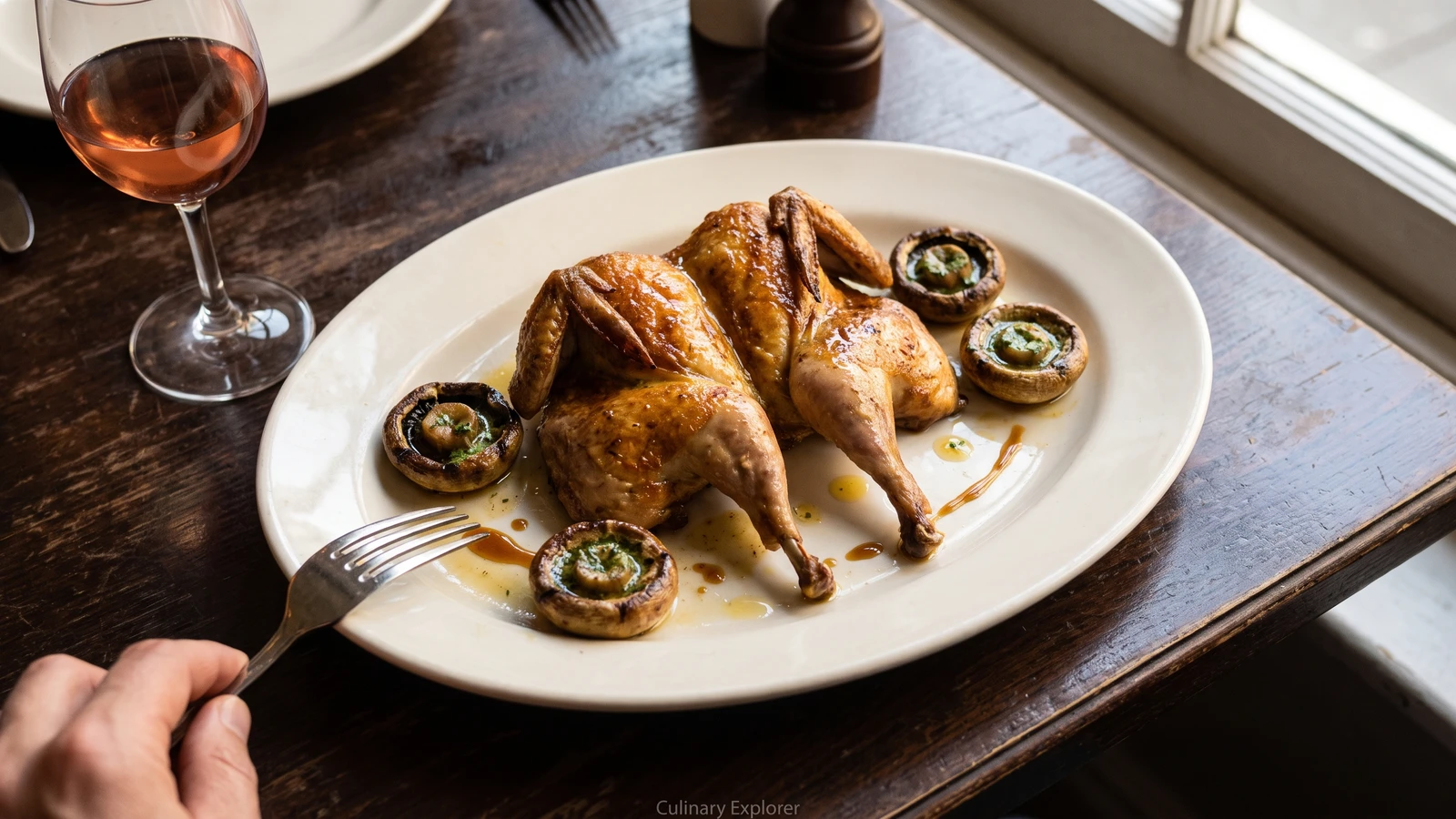
A butter-brushed young partridge, opened down the back and grilled flat until evenly bronzed, with mushroom caps carrying maître d’hôtel butter, lemon, and a fine gleam of meat glaze.
Perdreau à la Lautrec (young partridge grilled flat with mushrooms and maître d’hôtel butter) teaches the discipline of evenness. The one true thing to know before you touch a pan is this: a small game bird cooks beautifully only when its joints and breast meet the heat on the same plane. Open it down the back and flatten it gently; without that, the breast dries while the hip stays raw.
The original entry assumed a grillardin tending charcoal, a saucier beside a stockpot never off the fire, and a salamander ready if the colour lagged. At home, a broiler set well below its element supplies measured overhead heat, while a small quantity of good unseasoned meat glaze replaces the brigade’s daily reduction. The standing stockpot and the handoffs are scaffolding, so they go. The open-backed bird, gentle grilling, six mushroom caps, maître d’hôtel butter, lemon, and the fine line of glaze stay because they are the dish. One cook, one stove, one evening.
At the table, the skin is bronze and glossy, the mushrooms are tender rather than collapsed, and the compound butter begins melting into their hollows. Don’t pound the bird thin. Press only until the breastbone and hips lie level; that even plane is the step that decides the dish.
Perdreau à la Lautrec belongs to the classical Parisian dining-room repertoire, where young game birds were grilled to order and sent out with named garnitures. Despite the title, it is not a regional formula rooted in the town of Lautrec in the Tarn: its grammar is the national canon, and its identifying arrangement is six grilled mushroom caps carrying maître d’hôtel butter, edged with meat glaze and sharpened by lemon. The preparation traveled easily to private tables because its luxury lies in exact handling rather than elaborate abundance.
Quantity
4 (12 to 16 oz / 340 to 450 g each)
plucked and oven-ready
Quantity
2 teaspoons (10 ml / 12 g)
Quantity
1 teaspoon (5 ml / 2 g)
Quantity
4 tablespoons (60 ml / 57 g)
melted
Quantity
24 (about 10 oz / 285 g)
stems removed
Quantity
6 tablespoons plus 2 teaspoons (100 ml / 95 g)
softened but still cool
Quantity
1 tablespoon (15 ml / 4 g)
finely chopped
Quantity
2 teaspoons (10 ml / 10 g)
Quantity
1/4 teaspoon (1.25 ml / 1.5 g)
Quantity
1/8 teaspoon (0.6 ml / 0.25 g)
Quantity
1/4 cup (60 ml / 70 g)
warmed
Quantity
1 tablespoon (15 ml / 15 g)
only if needed to loosen the meat glaze
Quantity
1 teaspoon (5 ml / 5 g)
| Ingredient | Quantity |
|---|---|
| young partridgesplucked and oven-ready | 4 (12 to 16 oz / 340 to 450 g each) |
| fine sea salt for the partridges | 2 teaspoons (10 ml / 12 g) |
| freshly ground black pepper for the partridges | 1 teaspoon (5 ml / 2 g) |
| unsalted buttermelted | 4 tablespoons (60 ml / 57 g) |
| small button mushroom capsstems removed | 24 (about 10 oz / 285 g) |
| unsalted butter for the maître d’hôtel buttersoftened but still cool | 6 tablespoons plus 2 teaspoons (100 ml / 95 g) |
| flat-leaf parsleyfinely chopped | 1 tablespoon (15 ml / 4 g) |
| fresh lemon juice for the maître d’hôtel butter | 2 teaspoons (10 ml / 10 g) |
| fine sea salt for the maître d’hôtel butter | 1/4 teaspoon (1.25 ml / 1.5 g) |
| freshly ground black pepper for the maître d’hôtel butter | 1/8 teaspoon (0.6 ml / 0.25 g) |
| unseasoned meat glazewarmed | 1/4 cup (60 ml / 70 g) |
| water (optional)only if needed to loosen the meat glaze | 1 tablespoon (15 ml / 15 g) |
| fresh lemon juice for finishing | 1 teaspoon (5 ml / 5 g) |
Work the softened butter with the parsley, 2 teaspoons of lemon juice, 1/4 teaspoon of salt, and 1/8 teaspoon of pepper until evenly flecked but not whipped. Portion it into 24 level teaspoonfuls and chill them while you prepare the birds. The butter should be cool enough to sit on the mushrooms, yet soft enough to begin melting on contact; if it becomes oily while you mix, chill it for ten minutes and continue.
Pat each partridge completely dry. Set it breast-side down and use poultry shears to cut through the ribs along one side of the backbone from tail to neck, then open the bird like a book while keeping the breast intact. Turn it breast-side up, cover it with parchment, and give the breastbone and hip joints two or three measured blows with the smooth face of a mallet until the bird lies in one even plane. Flatten the frame, not the flesh.
Pass one long metal skewer crosswise through both thighs and the lower body of each partridge so it remains open under the heat, then tuck the wing tips underneath. Brush both sides generously with melted butter and season with the 2 teaspoons of salt and 1 teaspoon of pepper. If the skin has split, lay it back over the flesh and secure it beneath the skewer; it will protect the meat as it cooks.
Set an oven rack about 6 inches (15 cm) below the broiler and preheat it at medium-high for ten minutes. Arrange the partridges opened-side up on a large heavy baking sheet, leaving air between them, and place the mushroom caps rounded-side up around the birds. Broil for 6 to 7 minutes, until the exposed flesh has taken light colour and the mushroom crowns begin to bronze.
Turn the partridges skin-side toward the heat, turn the mushrooms hollow-side up, and brush the birds again with the butter collected on the tray. Continue broiling gently for 7 to 11 minutes, removing the mushrooms as soon as they are tender and bronzed. The partridges are ready when the skin is deep gold and an instant-read thermometer reaches 165°F (74°C) in the thickest part of the thigh without touching bone. If the skin browns before the meat is ready, cover it loosely with foil and lower the tray one level. Ça se rattrape. If the meat reaches temperature while the skin remains pale, move the tray closer for 30 seconds, watching without distraction.
Warm the meat glaze over low heat while the birds finish. It should fall from a spoon in a fine, continuous thread rather than sit like paste. If it is too tight, whisk in the water one teaspoon at a time; if it is too loose, simmer it briefly until the spoon leaves a clean wake across the saucepan. Keep it warm without boiling hard, which would make it harsh and overly salty.
Rest the partridges for 5 minutes, then place one bird on each warm plate. Set three mushroom caps on either side of every bird and crown each cap with one level teaspoon of maître d’hôtel butter. Draw a fine thread of warm meat glaze around the mushrooms, never a moat, and sprinkle a few drops of the remaining lemon juice over each partridge. Serve as the compound butter begins to soften. À table!
1 serving (about 285g)
Culinary guides, cultural storytelling, and the editorial depth that makes cooking meaningful.
Discover Culinary ExplorerChef Juliette
John Dory has the delicacy of sole and the firmness of turbot. A light flouring, a quick butter sauté, and nut-brown beurre noisette show exactly why looks never mattered.

Chef Juliette
Fresh haddock proves its delicacy in the meunière pan: a fine flour crust, moist pearly flakes, and beurre noisette sharpened with lemon and parsley, ready from one skillet in half an hour.

Chef Juliette
Éperlans à l’Anglaise turns small fish into a lesson in disciplined coating: boned smelts under a close, crisp crumb, pan-fried in clarified butter and finished with bright, half-melted maître d’hôtel butter.

Chef Juliette
Tiny smelts, shallot, mushrooms, white wine, gratin sauce, and fine bread raspings meet a fierce oven, where the fish must turn tender in the same breath the buttered crust bronzes.