
Chef Juliette
John Dory (St. Pierre)
John Dory has the delicacy of sole and the firmness of turbot. A light flouring, a quick butter sauté, and nut-brown beurre noisette show exactly why looks never mattered.
A cooking platform built around craft, culture, and the stories behind what we eat.
Created by Chef Juliette
Based on No. 1860, Pain de Faisan en Belle-vue, from Le Guide Culinaire (1907) by Auguste Escoffier
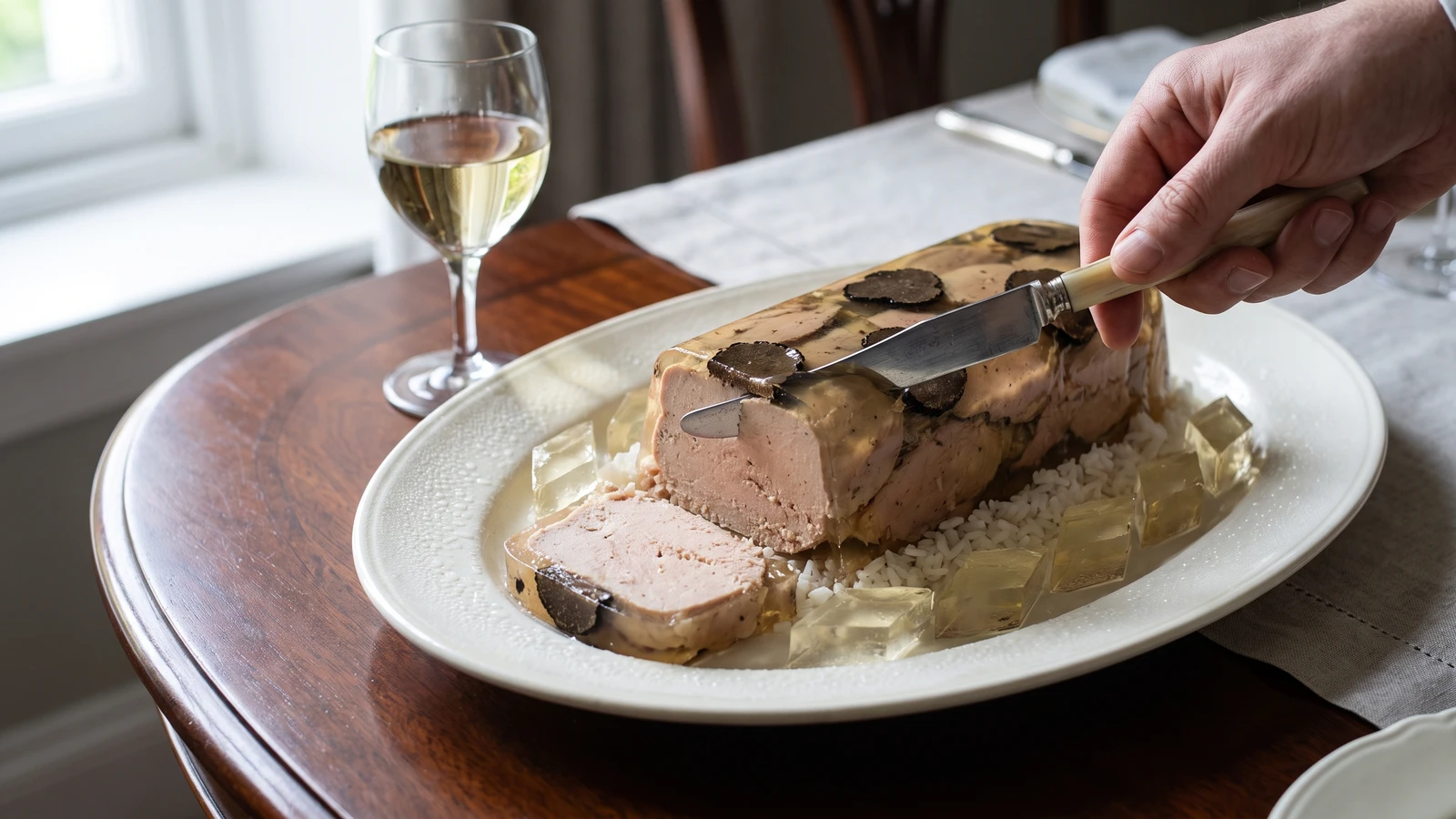
Pain de Faisan en Belle-vue sets tender pheasant and black truffle beneath clear aspic, with a butter-rich filling and a cold, clean slice that returns the classical buffet canon to the home table.
Pain de Faisan en Belle-vue (cold moulded pheasant displayed in clear jelly) teaches the discipline of cold cookery: what you hide while warm becomes visible once the jelly sets. The one true thing to know before touching a pan is that the aspic must be clear, cleanly defatted, and only firm enough to hold. Cloudy or rubbery jelly dulls the pheasant and truffle instead of displaying them.
The classical kitchen assumed a saucier on staff, strong veal stock never off the fire, a garde-manger with ice at hand, and a salamander waiting for dishes that wanted colour. This pale preparation never goes under it. At home, Pain de Volaille Froid (No. 1709) remains the whole parent preparation, while one young pheasant replaces the chicken, a food processor and fine sieve replace pounding and the tammy, and a refrigerator with an ice bowl replaces a block of ice. The hand-pounding and towering rice socle are brigade scaffolding; keeping the bird uncoloured, reducing the cooking liquor, building the butter-yolk emulsion, arranging the truffled collops, and setting them beneath transparent jelly are the dish and must stay.
The finished pain should cut cold and close, pale pheasant framed by dark truffle beneath a clear, trembling coat, with enough richness from real butter to keep the game from tasting austere. One cook, one stove, one evening of work, then the refrigerator completes the set. Before the mould is lined, hold a spoonful of jelly against the light. That clear spoonful decides the dish.
Pain en belle-vue belongs to the Parisian grand-kitchen tradition of cold buffets, where a clear aspic protected cooked meat while displaying the cook's arrangement beneath it. The word pain describes the moulded loaf form, not bread, while en belle-vue names the clear-jelly presentation that makes every collop and truffle slice visible. Pheasant entered the formula through the classical practice of applying a proven poultry preparation to game without disturbing its underlying proportions.
Quantity
1 batch Pain de Volaille Froid (No. 1709), scaled for 4 servings and made with 1 young pheasant (2 to 2½ lb / 900 g to 1.1 kg)
replace the chicken with pheasant while preserving every other proportion and the complete en belle-vue finish
| Ingredient | Quantity |
|---|---|
| Pain de Volaille Froidreplace the chicken with pheasant while preserving every other proportion and the complete en belle-vue finish | 1 batch Pain de Volaille Froid (No. 1709), scaled for 4 servings and made with 1 young pheasant (2 to 2½ lb / 900 g to 1.1 kg) |
Use a young, tender pheasant close in size to the chicken required by the parent preparation. A mature wild cock can remain stringy even after careful cooking, while a young farmed bird gives enough supple breast for the decorative collops and enough leg meat and skin for the purée. If the bird is wild, feel carefully for shot and remove every fragment before cooking.
Prepare Pain de Volaille Froid (No. 1709) as the complete parent preparation, replacing its tender chicken with the pheasant and changing nothing else. When the linked method tells you to poêler (covered-roast in butter), keep the bird pale and baste it carefully; colour would muddy both the purée and the jelly. Cook only until the thickest part reaches 165°F (74°C), then cool it promptly. Keep the prescribed strong veal stock, burned brandy, yolks, real butter, gelatin, truffled collops, rice cushion, and jelly croûtons in their proper sequence.
At the butter-and-yolk stage of the parent preparation, keep the reduced poêling liquor warm but never simmering. Whisk in the butter gradually, letting each addition disappear before the next; pheasant is lean, and this emulsion supplies the tenderness the cold meat needs. If the sauce turns oily, stop adding butter. Whisk a few drops of cold water in a clean bowl, then draw the broken sauce into it a spoonful at a time. Ça se rattrape. Once smooth, add the dissolved gelatin and pass the sauce through the fine sieve as directed.
Set a spoonful of the prepared jelly on a chilled saucer before lining the mould. After several minutes it should hold a clean edge while trembling under the spoon, and it should remain transparent enough to see the saucer beneath it. If fat clouds the jelly, chill it until the fat hardens, lift that film away, then warm the jelly only until liquid and strain it through damp fine cloth. If it sets too firmly, remelt it gently and loosen it with a little clear stock; if too softly, reinforce it with a small amount of bloomed gelatin. Never boil it.
Set the one-quart mould in a bowl of ice and coat it with successive thin films of jelly, chilling each before adding the next. One thick pour makes a rubbery shell. Dip each truffle slice in half-melted jelly, attach it to a pheasant collop, then arrange the collops against the bottom and sides so the truffle faces outward when unmoulded. If a piece slides, stop and return the mould to the ice until the surface becomes tacky, then lift the decoration back into place with a teaspoon.
Use a food processor in place of hand-pounding, but keep the fine sieving that follows; the processor is home-kitchen scaffolding, while the sieve is what makes the purée close and smooth. Combine the sieved pheasant meat and skin with the buttered sauce exactly as the parent preparation directs. Spoon it into the lined mould without disturbing the collops, pressing gently into the edges and tapping the mould against a folded towel to release hidden air. Seal with a final layer of jelly and chill for at least six hours, preferably overnight. Do not freeze it to hurry the set, because frozen aspic weeps when thawed.
Form the rice from the parent preparation into a low, chilled cushion on the serving platter. Dip the mould in warm water for about five seconds, dry it, place the platter over it, and invert both together. If the pain does not release, wrap the mould briefly in a warm towel; do not pull at the jelly. Surround it with the fine jelly croûtons and keep it cold until serving. Cut with a thin knife dipped in warm water and wiped dry between slices. À table!
1 serving (about 215g)
Culinary guides, cultural storytelling, and the editorial depth that makes cooking meaningful.
Discover Culinary ExplorerChef Juliette
John Dory has the delicacy of sole and the firmness of turbot. A light flouring, a quick butter sauté, and nut-brown beurre noisette show exactly why looks never mattered.

Chef Juliette
Fresh haddock proves its delicacy in the meunière pan: a fine flour crust, moist pearly flakes, and beurre noisette sharpened with lemon and parsley, ready from one skillet in half an hour.

Chef Juliette
Éperlans à l’Anglaise turns small fish into a lesson in disciplined coating: boned smelts under a close, crisp crumb, pan-fried in clarified butter and finished with bright, half-melted maître d’hôtel butter.

Chef Juliette
Tiny smelts, shallot, mushrooms, white wine, gratin sauce, and fine bread raspings meet a fierce oven, where the fish must turn tender in the same breath the buttered crust bronzes.