
Chef Juliette
Selle de Chevreuil et Cuissot
Selle de Chevreuil et Cuissot teaches the discipline of game: strip every tendon, skip marinade for a young, well-hung joint, roast in butter, and stop before leanness turns to dryness.
A cooking platform built around craft, culture, and the stories behind what we eat.
Created by Chef Juliette
Based on No. 1838, Faisan à la Georgienne, from Le Guide Culinaire (1907) by Auguste Escoffier
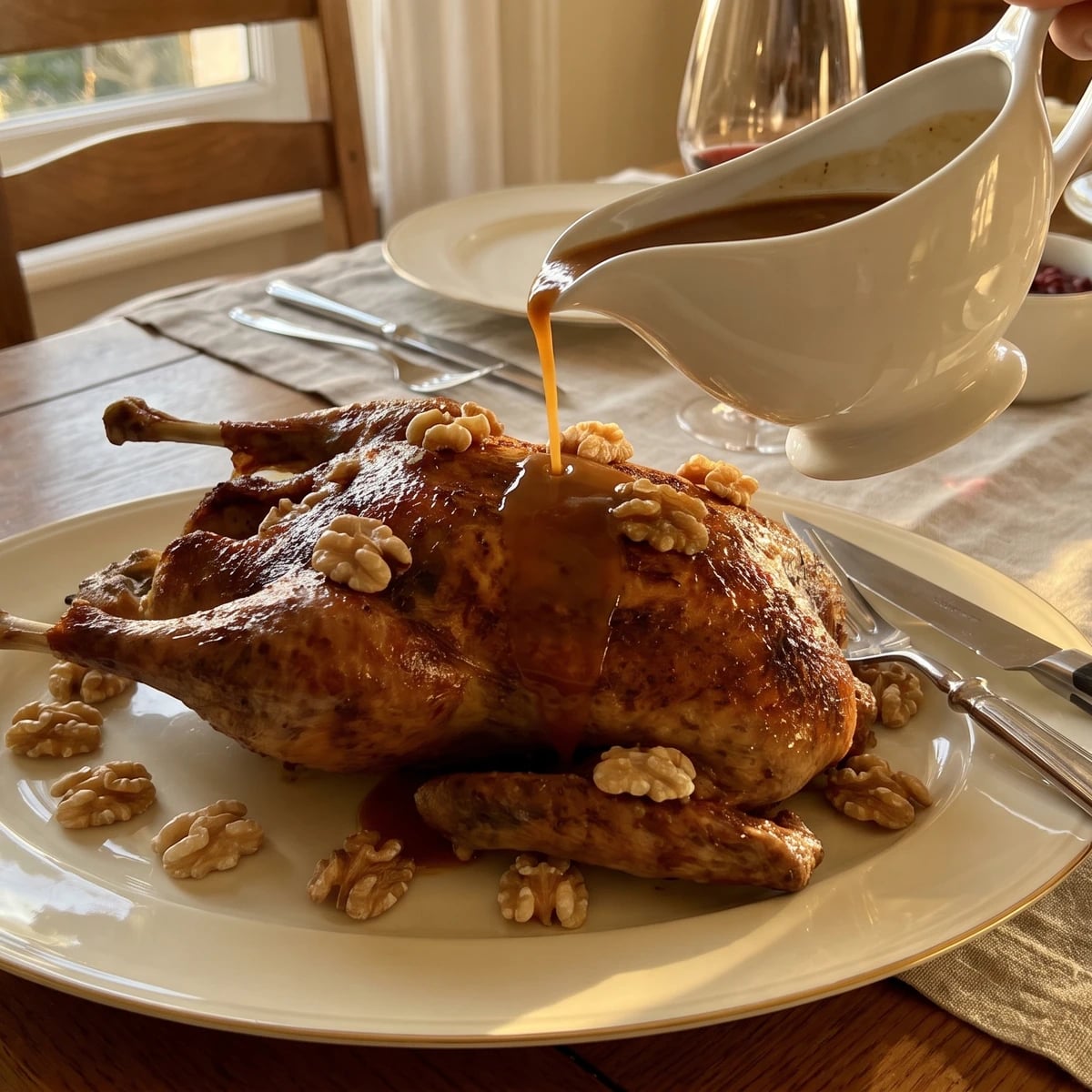
A whole pheasant poached in grape and orange juices with walnuts, Malmsey, and strong green tea, then bronzed fiercely and served under a glossy game sauce.
Faisan à la Georgienne (pheasant poached with walnuts, grape, orange, Malmsey, and green tea) teaches one true thing before you touch the pan: poaching cooks the bird, but it cannot colour it. The pheasant must leave the liquid just before it is done, be dried thoroughly, then meet fierce dry heat. Wait until it is fully cooked and the breast dries before the skin bronzes.
The original assumed a saucier maintaining game Espagnole, a stockpot never cold, a linen napkin for immaculate straining, and a salamander ready to colour the bird at service. At home, prepared game Espagnole remains a separate finished component, damp cheesecloth replaces the napkin, and the broiler replaces the salamander. The source already centres one pheasant, the right scale for four, so its natural home portion needs no shrinking. One cook, one stove, one evening.
The linen filtration is brigade scaffolding and can go. The thirty walnut halves, pressed fruit, Malmsey, green tea, game Espagnole, reduction by half, and final colouring are the dish itself, so every one stays. Dry the skin completely before it meets the broiler. That is the step that decides the dish.
Faisan à la Georgienne belongs to the Parisian grand-kitchen repertoire rather than to a French regional farmhouse table. Its name gestures toward Georgia, where walnuts and grapes form a deep culinary grammar, but the orange juice, Malmsey, green tea, and game Espagnole identify this as a composed French interpretation, not a Georgian household recipe. The written canon carried it from formal entrée service to private dining rooms, preserving its most surprising rule: poach the bird pale, then colour it at the finish.
Quantity
1 bird, about 2½ to 3 lb (1.1 to 1.4 kg)
giblets removed
Quantity
30 halves, about ¾ cup (180 ml / 60 g)
brown skins removed
Quantity
12 halves, about ⅓ cup (80 ml / 24 g)
brown skins removed
Quantity
6 cups (1.4 L / 2 lb / 907 g), yielding about 2½ cups (600 ml / 600 g) strained juice
crushed and pressed
Quantity
4 medium, yielding about 1⅓ cups (320 ml / 320 g) strained juice
juiced
Quantity
½ cup (120 ml / 120 g)
Quantity
¾ cup (180 ml / 180 g)
brewed from 2 tea bags and cooled
Quantity
3 tablespoons (45 ml / 43 g)
divided
Quantity
¾ cup plus 2 teaspoons (190 ml / 200 g)
Quantity
1½ teaspoons (7.5 ml / 9 g)
divided
Quantity
½ teaspoon (2.5 ml / 1 g)
divided
| Ingredient | Quantity |
|---|---|
| oven-ready pheasantgiblets removed | 1 bird, about 2½ to 3 lb (1.1 to 1.4 kg) |
| freshly shelled raw walnut halvesbrown skins removed | 30 halves, about ¾ cup (180 ml / 60 g) |
| freshly shelled raw walnut halves for the garnishbrown skins removed | 12 halves, about ⅓ cup (80 ml / 24 g) |
| seedless green grapescrushed and pressed | 6 cups (1.4 L / 2 lb / 907 g), yielding about 2½ cups (600 ml / 600 g) strained juice |
| orangesjuiced | 4 medium, yielding about 1⅓ cups (320 ml / 320 g) strained juice |
| Malmsey Madeira | ½ cup (120 ml / 120 g) |
| strong green teabrewed from 2 tea bags and cooled | ¾ cup (180 ml / 180 g) |
| unsalted butterdivided | 3 tablespoons (45 ml / 43 g) |
| prepared game Espagnole | ¾ cup plus 2 teaspoons (190 ml / 200 g) |
| fine sea saltdivided | 1½ teaspoons (7.5 ml / 9 g) |
| freshly ground black pepperdivided | ½ teaspoon (2.5 ml / 1 g) |
Blanch all 42 walnut halves in boiling water for 1 minute, drain them, and rub away the thin brown skins while they are still warm. Use a small knife for any stubborn patches, keeping 30 halves for the poach and 12 intact halves for the garnish. Pulse the grapes just until crushed, then press them through a fine sieve to obtain about 2½ cups (600 ml) juice. Juice the oranges and strain out the pulp. Brew the green tea strongly for 4 minutes, then remove the bags and cool it.
Tuck the wing tips beneath the pheasant and tie the legs together so the bird cooks compactly. Pat it dry, then season the cavity and skin with 1 teaspoon of the salt and half the pepper. Set it breast-side up in a snug 5 to 6-quart (4.7 to 5.7 L) oval pot. Add the 30 peeled walnut halves, grape juice, orange juice, Malmsey, green tea, and all but 1 teaspoon of the butter. The liquid should reach at least halfway up the bird; if it does not, use a smaller pot rather than diluting the carefully held proportions.
Bring the liquid slowly to the barest tremble, cover the pot, and lower the heat. Poach for about 30 minutes, turning the pheasant carefully after 15 minutes and basting the exposed side several times. Begin checking early: the bird is ready for colouring when the breast registers 150°F (66°C) and the inner thigh about 155°F (68°C). If the liquid begins to boil, pull the pot from the heat for a minute and resume over a lower flame. A hard boil tightens the meat and drives bitterness from the walnuts and tea, but ça se rattrape if you catch it promptly.
Heat the broiler fully with a rack about 6 inches (15 cm) below the element. Lift the pheasant onto a wire rack set over a roasting tray and blot every part of its skin completely dry. Melt the reserved teaspoon of butter and brush it over the bird. Broil for 5 to 8 minutes, turning the tray and rotating the bird as needed, until the skin is evenly bronzed and the thickest parts of both breast and thigh reach 165°F (74°C). If one patch darkens too quickly, shield it with a small piece of foil and continue colouring the rest. Rest the bird loosely tented for 15 minutes while you finish the sauce.
While the pheasant colours, pour its cooking liquor through a fine sieve lined with damp cheesecloth into a bowl. Do not press the cooked walnuts, which would cloud the sauce and force out their bitterness. Discard the solids and skim away any broad pools of fat, leaving the smaller beads of butter that give the sauce its sheen. Pour the clarified liquor into a wide sauté pan.
Add the prepared game Espagnole to the strained cooking liquor and note the liquid's starting depth in the pan. Bring it to a lively but controlled simmer and reduce it to precisely half its volume, about 15 to 25 minutes in a wide pan, until it lightly naps the back of a spoon. Stir more often as it concentrates because the fruit sugars can catch at the edges. Taste only after reducing, then add the remaining salt and pepper as needed. If the sauce goes syrupy or tastes too concentrated, whisk in hot water 1 tablespoon at a time until it returns to the half-volume mark. Ça se rattrape.
Set the rested pheasant on a warmed oval platter and arrange the 12 peeled fresh walnut halves around it. Spoon over just enough sauce to glaze the breast, legs, and walnuts while leaving the bronze skin visible. Pour the remaining sauce into a warmed sauceboat and carve the pheasant at the table, giving each guest some breast or leg, walnuts, and plenty of sauce. À table!
1 serving (about 315g)
Culinary guides, cultural storytelling, and the editorial depth that makes cooking meaningful.
Discover Culinary Explorer
Chef Juliette
Selle de Chevreuil et Cuissot teaches the discipline of game: strip every tendon, skip marinade for a young, well-hung joint, roast in butter, and stop before leanness turns to dryness.

Chef Juliette
A three-day marinade perfumes this lean saddle, but the roast lives or dies by its rosy center; the tray fond, cream, meat glaze, and one juniper berry make the sauce.

Chef Juliette
A butter-poêled venison saddle, carved rosy and flanked by unsweetened pears scented with cinnamon and lemon, with clear game jus and redcurrant jelly at the table.

Chef Juliette
Verjuice perfumes rather than pickles this saddle, while a thermometer protects its rosy centre. Poivrade and red-currant jelly meet in strict equality, with semi-candied cherries folded through for the generous game table.