
Chef Juliette
Selle de Chevreuil et Cuissot
Selle de Chevreuil et Cuissot teaches the discipline of game: strip every tendon, skip marinade for a young, well-hung joint, roast in butter, and stop before leanness turns to dryness.
A cooking platform built around craft, culture, and the stories behind what we eat.
Created by Chef Juliette
Based on No. 1831, Faisan à la Bohémienne, from Le Guide Culinaire (1907) by Auguste Escoffier
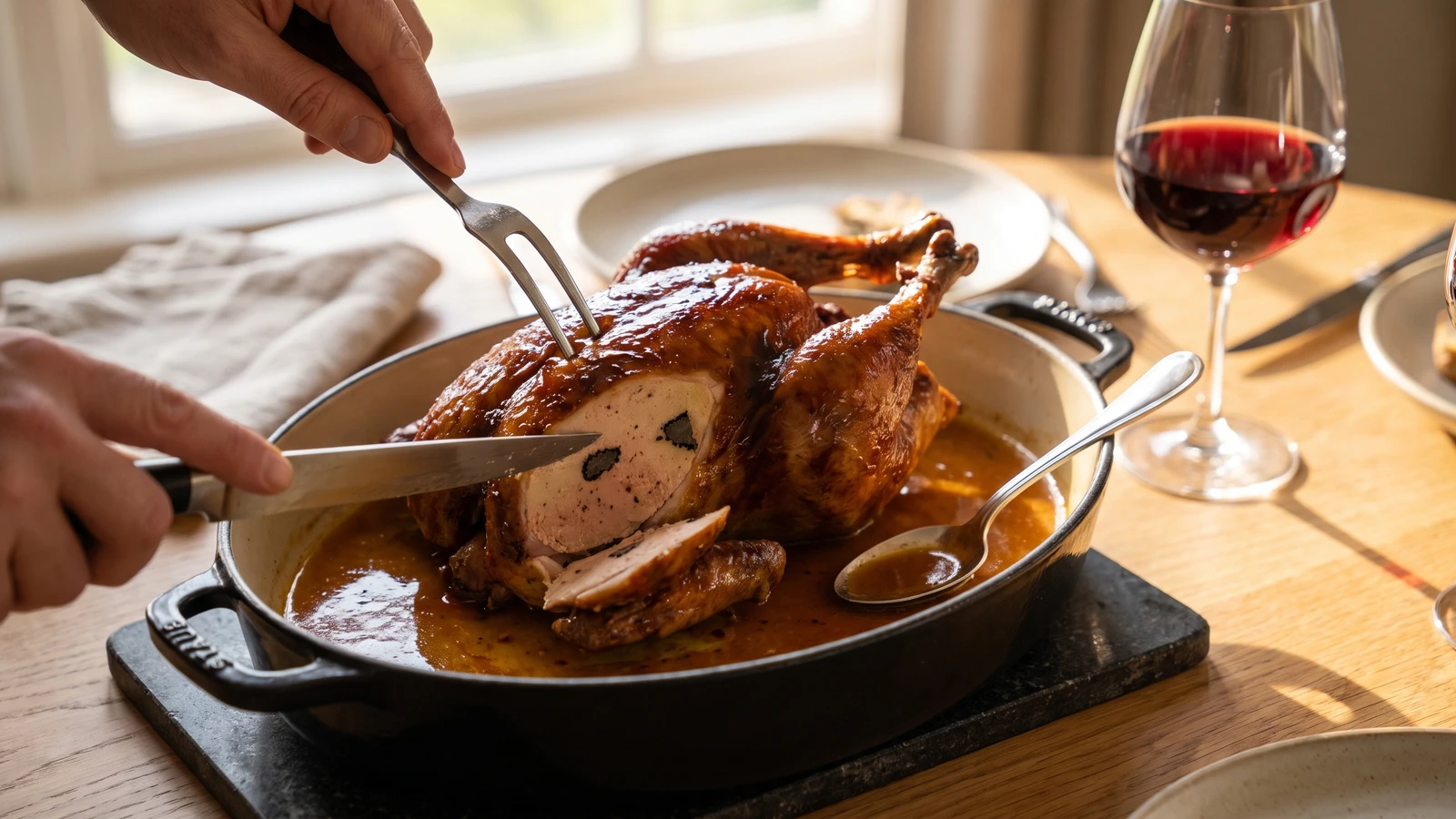
Faisan à la Bohémienne pairs butter-burnished pheasant with a cold heart of paprika-seasoned foie gras and truffle, then finishes the cocotte with flaming Cognac and glossy reduced game gravy.
Faisan à la Bohémienne (pheasant with foie gras and truffle) teaches one severe little truth: the stuffing must go into the bird completely cold. Warm foie gras leaks into the butter before the pheasant is cooked; cold foie holds its shape, bastes the bird from within, and gives each carving a piece of truffle-studded liver rather than an empty cavity.
The original entry assumed a properly hung, gamey pheasant, a hand free to poach and chill a small foie gras, and a saucier with reduced game gravy waiting beside the stove. A mature pheasant handled under controlled refrigeration by a reputable game dealer is the honest equivalent of the book's high bird. The perpetual stockpot becomes three concentrated spoonfuls of stock reduced around the pheasant neck. That reduction is brigade scaffolding made smaller; the cold stuffed liver, the Madeira poach, the butter cooking, and the final flambé are the dish and must stay. One cook, one stove, one evening.
Done properly, the pheasant reaches the table burnished with butter, the Cognac sharpened by flame, and the dark game liquor gleaming around a pale, paprika-scented center marked with black truffle. Protect the full chill after poaching the foie gras. That is the step that decides the dish before the bird ever meets the cocotte.
Faisan à la Bohémienne belongs to the grand Parisian game repertoire, where well-hung pheasant was paired with foie gras, truffle, Madeira, and Cognac for the formal table. Bohémienne is a fanciful classical title, not evidence of a Bohemian regional origin; the composition is French in method, from poaching the liver before stuffing to cooking and serving the bird in its cocotte. It passed readily into ambitious bourgeois kitchens because the final cooking utensil also served the dish, though the game-stock pot and several pairs of hands remained hidden behind its apparent simplicity.
Quantity
1, about 2½ to 3 lb (1.1 to 1.4 kg)
neck, heart, and gizzard reserved
Quantity
1 small lobe, about 8 oz (225 g)
large veins removed without breaking the lobe
Quantity
2 small, about 1½ oz (40 g total)
quartered
Quantity
2 teaspoons (10 ml / 12 g)
divided
Quantity
1 teaspoon (5 ml / 2 g)
Quantity
2 cups (475 ml / 475 g)
Quantity
1½ cups (355 ml / 355 g)
Quantity
½ cup (120 ml / 113 g)
divided
Quantity
¼ cup (60 ml / 57 g)
| Ingredient | Quantity |
|---|---|
| oven-ready pheasantneck, heart, and gizzard reserved | 1, about 2½ to 3 lb (1.1 to 1.4 kg) |
| fresh raw duck or goose foie graslarge veins removed without breaking the lobe | 1 small lobe, about 8 oz (225 g) |
| fresh black trufflesquartered | 2 small, about 1½ oz (40 g total) |
| fine sea saltdivided | 2 teaspoons (10 ml / 12 g) |
| sweet paprika | 1 teaspoon (5 ml / 2 g) |
| medium-dry Madeira | 2 cups (475 ml / 475 g) |
| unsalted game stock or rich unsalted chicken stock | 1½ cups (355 ml / 355 g) |
| unsalted butterdivided | ½ cup (120 ml / 113 g) |
| Cognac or good French brandy | ¼ cup (60 ml / 57 g) |
Keep the foie gras cold while you work. Season it all over with ½ teaspoon of the salt and the paprika. Make eight narrow pockets with the point of a paring knife, then push one raw truffle quarter into each, deep enough that the cut surface sits flush with the liver. Handle the lobe gently and preserve its compact shape; torn foie gras sheds fat much faster during poaching.
Pour the Madeira into a narrow saucepan and bring it to the barest tremble, with small bubbles gathering at the edge but no rolling boil. Lower in the studded foie gras and poach it gently for twenty minutes, turning it carefully after ten and spooning Madeira over any exposed surface. Lift it onto a small rack or plate, cool for twenty minutes, then cover and refrigerate for at least two hours, until firm and cold through. If the warm lobe slumps or loses a corner, don't discard it. Ça se rattrape: gather it on parchment, press it back into a compact lobe, wrap it snugly, and chill it in that shape.
While the foie gras chills, reserve 2 tablespoons of the stock. Melt 1 tablespoon of the butter in a small saucepan over medium heat and brown the pheasant neck, heart, and gizzard until deep gold on every side. Leave out the liver, which can make a hard reduction bitter. Add the remaining stock, scrape the browned fond from the pan, and simmer uncovered until only 3 tablespoons remain, about thirty minutes. Strain and keep warm. Watch closely near the end because the reduction moves quickly; if it becomes sticky or too salty, loosen it with a spoonful of the reserved stock.
Heat the oven to 350°F (180°C). Dry the pheasant thoroughly inside and out, then season it with the remaining salt. Slide the fully chilled foie gras into the cavity, keeping its truffle studs in place. Close the opening with a small metal skewer and truss the legs and wings firmly against the body with kitchen twine. A tight truss keeps the liver inside and gives the bird a compact shape that cooks evenly. Once stuffed, send the pheasant directly to the cocotte rather than letting it stand at room temperature.
Set a heavy oval cocotte over medium heat and add 6 tablespoons of the butter, keeping the final tablespoon in reserve. When the foam begins to subside, lay in the pheasant and brown it patiently on the breast, back, and both sides, turning without piercing the skin. Allow eight to ten minutes for this first coloring, then cover the cocotte and transfer it to the oven. Cook for forty-five minutes total from the moment the bird entered the butter, basting twice with the foaming cooking fat. The pheasant is ready when both the thickest part of the thigh and the center of the stuffing reach 165°F (74°C). If either falls short after forty-five minutes, continue in five-minute intervals. Let the cooked bird rest uncovered in its cocotte for eight minutes.
Tilt the cocotte and spoon away all but about 2 tablespoons of the cooking butter, leaving the browned fond untouched. Warm the measured Cognac briefly in a small pan until just warm, never boiling. Turn off the burner and extraction fan, keep the cocotte lid within reach, and pour the Cognac from the pan over the pheasant. Never pour from the bottle. Ignite it with a long match and let the flame die naturally. If it refuses to light, simmer the Cognac in the cocotte for one minute to cook off its raw edge. Set the cocotte over medium-low heat, add the 3 tablespoons of reduced game gravy, and swirl while scraping the fond into the liquor. The sauce should look glossy and concentrated; if it appears oily, spoon off a little more butter rather than clouding it with flour.
Bring the pheasant to the table in the cocotte, exactly as the preparation intends. Remove the twine and skewer, carve away the legs and breasts, then spoon the paprika-scented foie gras and its truffle quarters from the cavity so every serving receives some. Coat the meat lightly with the Cognac and game gravy from the bottom of the cocotte. The burnished bird, its rich center, and that small pool of sauce are the whole presentation. À table!
1 serving (about 320g)
Culinary guides, cultural storytelling, and the editorial depth that makes cooking meaningful.
Discover Culinary ExplorerChef Juliette
Selle de Chevreuil et Cuissot teaches the discipline of game: strip every tendon, skip marinade for a young, well-hung joint, roast in butter, and stop before leanness turns to dryness.

Chef Juliette
A three-day marinade perfumes this lean saddle, but the roast lives or dies by its rosy center; the tray fond, cream, meat glaze, and one juniper berry make the sauce.

Chef Juliette
A butter-poêled venison saddle, carved rosy and flanked by unsweetened pears scented with cinnamon and lemon, with clear game jus and redcurrant jelly at the table.

Chef Juliette
Verjuice perfumes rather than pickles this saddle, while a thermometer protects its rosy centre. Poivrade and red-currant jelly meet in strict equality, with semi-candied cherries folded through for the generous game table.