
Chef Juliette
John Dory (St. Pierre)
John Dory has the delicacy of sole and the firmness of turbot. A light flouring, a quick butter sauté, and nut-brown beurre noisette show exactly why looks never mattered.
A cooking platform built around craft, culture, and the stories behind what we eat.
Created by Chef Juliette
Based on No. 1828, Pheasant (Faisan), from Le Guide Culinaire (1907) by Auguste Escoffier
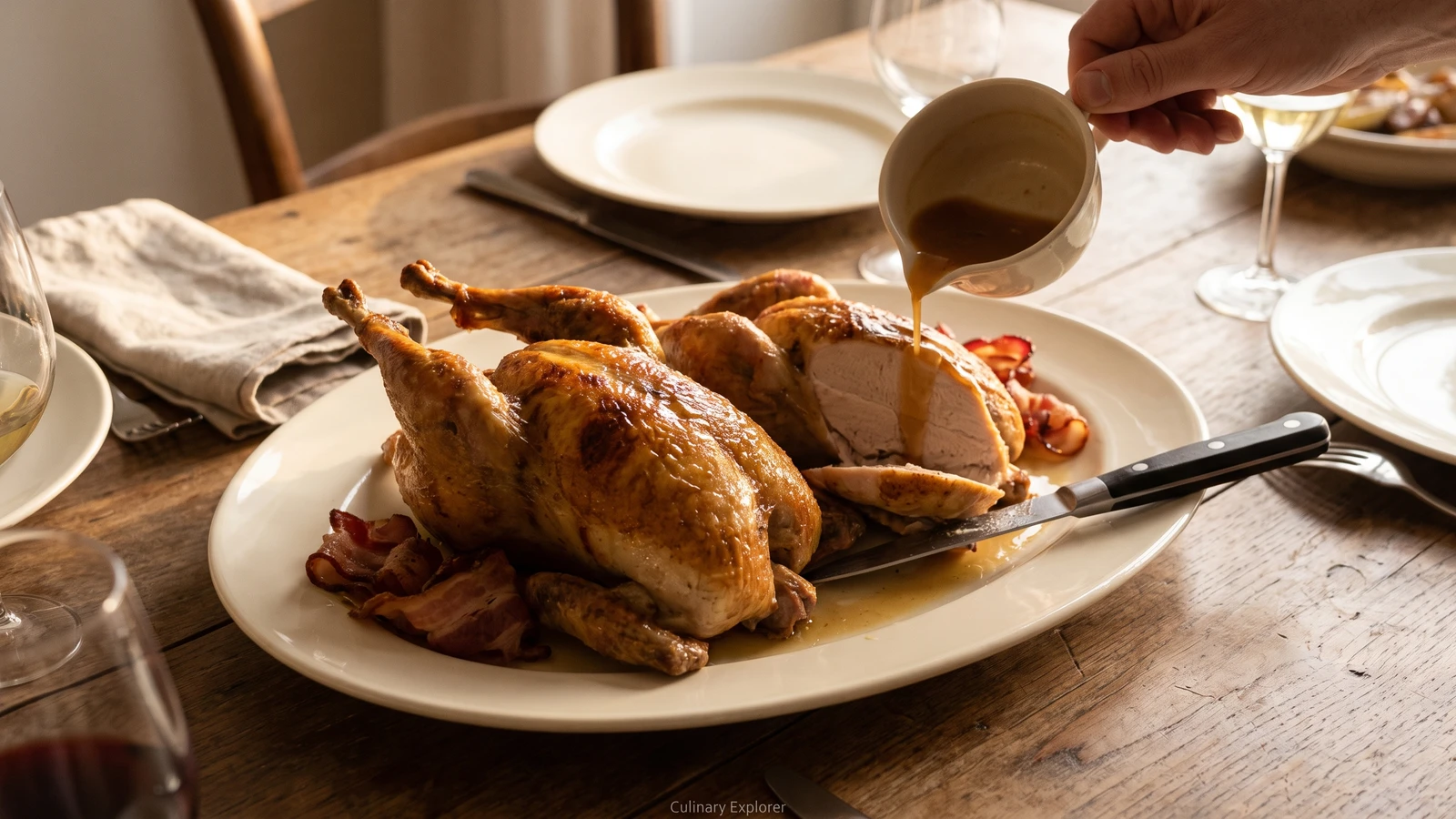
Faisan rôti teaches the decisive judgment of game cookery: choose a young bird for roasting, protect its lean breast with bacon, then carve it beneath a glossy shallot jus.
Faisan rôti (roast pheasant) teaches the first law of game cookery: the bird chooses the method. A young faisan, with grey legs, a flexible lower sternum, and a pointed last large wing feather, can take fierce roasting and stay tender. A round feather tip tells you an older bird wants moist heat instead. Before touching a pan, read the bird.
The old entry is a buying lesson, not a formula. It assumes a whole bird intact enough to inspect and gives no sauce, garnish, or brigade quantities, so the honest completion is a home-scale roast for four, not a false reduction of amounts that never appeared. A grand kitchen might protect the breast with a larding needle, draw on stock never off the fire, hand the jus to a saucier, and color the skin beneath a salamander. Here thin unsmoked bacon protects the breast, the roasting pan makes its own fond, a small saucepan reduces the jus, and a hot oven provides the color. One cook, one stove, one evening.
The obsolete larding needle is scaffolding and can go. Barder, to cover the breast with fat, cannot, because pheasant is remarkably lean. Butter and bacon keep the flesh supple, then come away so the skin can bronze, while the fond, the browned glaze in the pan, becomes a glossy shallot jus. The one step that decides the dish remains the first: choose a young bird for roasting. If the signs say old, change the plan and braise it.
Faisan belongs to the French table de chasse, the hunting table of wooded estates and country households, rather than to one regional larder. Cooks judged the bird before choosing the pan: a young faisan went to the spit or roasting pan, while an older bird was reserved for long, moist cooking, which is why the wing feather and flexible sternum mattered. From the hunting table the bird passed into Parisian dining rooms, where garnishes multiplied but age still governed method.
Quantity
2, each 1½ to 2 pounds (680 to 900 g)
Quantity
2 teaspoons (10 ml / 12 g)
Quantity
1 teaspoon (5 ml / 2 g)
Quantity
8 sprigs
Quantity
2
Quantity
8 thin slices (5 ounces / 140 g)
Quantity
6 tablespoons (90 ml / 85 g)
4 tablespoons softened and 2 tablespoons cold and cubed
Quantity
2 (3 ounces / 85 g)
finely chopped
Quantity
1 cup (240 ml / 240 g)
Quantity
1 cup (240 ml / 240 g), plus up to ¼ cup (60 ml / 60 g) as needed
Quantity
2 teaspoons (10 ml / 10 g)
| Ingredient | Quantity |
|---|---|
| young, oven-ready pheasants | 2, each 1½ to 2 pounds (680 to 900 g) |
| fine sea salt | 2 teaspoons (10 ml / 12 g) |
| freshly ground black pepper | 1 teaspoon (5 ml / 2 g) |
| fresh thyme | 8 sprigs |
| bay leaves | 2 |
| unsmoked streaky bacon or fresh pork back fat | 8 thin slices (5 ounces / 140 g) |
| unsalted butter4 tablespoons softened and 2 tablespoons cold and cubed | 6 tablespoons (90 ml / 85 g) |
| medium shallotsfinely chopped | 2 (3 ounces / 85 g) |
| dry white wine | 1 cup (240 ml / 240 g) |
| water | 1 cup (240 ml / 240 g), plus up to ¼ cup (60 ml / 60 g) as needed |
| fresh lemon juice | 2 teaspoons (10 ml / 10 g) |
Choose the pheasants before preparing them. On an intact young bird, the legs are grey, the lower tip of the sternum yields when gently pressed, and the last large wing feather ends in a point. A round feather tip or rigid sternum means an older bird; save that one for a braise, because bacon and optimism won't make old flesh tender. Remove any pinfeathers, inspect a wild bird for visible shot damage or bone splinters, and pat it completely dry. Don't rinse it.
Heat the oven to 450°F (230°C), with a rack in the lower-middle position. Season each cavity and the outside of each bird with the salt and pepper, then place 4 thyme sprigs and 1 bay leaf inside each cavity. Tuck the wing tips underneath and tie the legs loosely. Rub the birds with the softened butter, then overlap 4 slices of bacon across each breast. Set them breast-side up in a shallow metal roasting pan, leaving space between them.
Roast for 15 minutes, then lower the oven to 400°F (200°C) and baste the birds with the butter and juices in the pan. After another 10 minutes, lift off the bacon and lay it beside the birds to crisp. Continue roasting for 8 to 15 minutes, basting once more, until the skin is deeply bronzed. Watch the pan floor: dark brown is fond and belongs in the sauce, but black is bitter. If it threatens to scorch, add 2 tablespoons of the extra water. If it has already blackened, transfer the unburned juices to a clean saucepan and leave the bitter patches behind.
Insert an instant-read thermometer into the thickest part of each breast without touching bone. Remove the birds when the breasts reach 162°F (72°C) and the thighs are at least 165°F (74°C); the breast should rise to 165°F during a 15-minute rest. If the breasts are ready while the thighs lag behind, remove the legs at their joints and return only the legs to the oven while the breasts rest. Tent everything loosely with foil. If a breast fails to reach 165°F during the rest, return it to a 350°F (180°C) oven in 3-minute intervals until it does.
Pour off the clear fat from the roasting pan, leaving about 1 tablespoon and every sound brown deposit. Set the pan over medium heat, add the shallots, and stir for 2 minutes without letting them color deeply. Add the wine and scrape up the fond, then boil until the wine has reduced by about two-thirds. Add 1 cup of water and all juices released by the resting birds, then reduce until roughly ¾ cup remains and the jus lightly coats a spoon. Strain it into a small saucepan if you want a smooth finish. Remove it from the heat and whisk in the cold butter one cube at a time, followed by enough lemon juice to sharpen the flavor without making it sour. If the jus looks greasy or separates, stop adding butter and whisk in 1 tablespoon of cold water. Ça se rattrape.
Remove the twine and cavity herbs. Take off the legs, then ease each breast away from the breastbone in one piece and slice it thickly across the grain. Spoon a little jus beneath the meat so the bronzed skin stays crisp, and serve the remaining jus at the table with the crisp bacon bards alongside. Never apologize at your own table. À table!
1 serving (about 260g)
Culinary guides, cultural storytelling, and the editorial depth that makes cooking meaningful.
Discover Culinary ExplorerChef Juliette
John Dory has the delicacy of sole and the firmness of turbot. A light flouring, a quick butter sauté, and nut-brown beurre noisette show exactly why looks never mattered.

Chef Juliette
Fresh haddock proves its delicacy in the meunière pan: a fine flour crust, moist pearly flakes, and beurre noisette sharpened with lemon and parsley, ready from one skillet in half an hour.

Chef Juliette
Éperlans à l’Anglaise turns small fish into a lesson in disciplined coating: boned smelts under a close, crisp crumb, pan-fried in clarified butter and finished with bright, half-melted maître d’hôtel butter.

Chef Juliette
Tiny smelts, shallot, mushrooms, white wine, gratin sauce, and fine bread raspings meet a fierce oven, where the fish must turn tender in the same breath the buttered crust bronzes.