Culinary Explorer

A cooking platform built around craft, culture, and the stories behind what we eat.
Discover Culinary Explorer
Pain de Lièvre

Pain de Lièvre

Created by Chef Juliette

Based on No. 1823, Pain de Lièvre, from Le Guide Culinaire (1907) by Auguste Escoffier

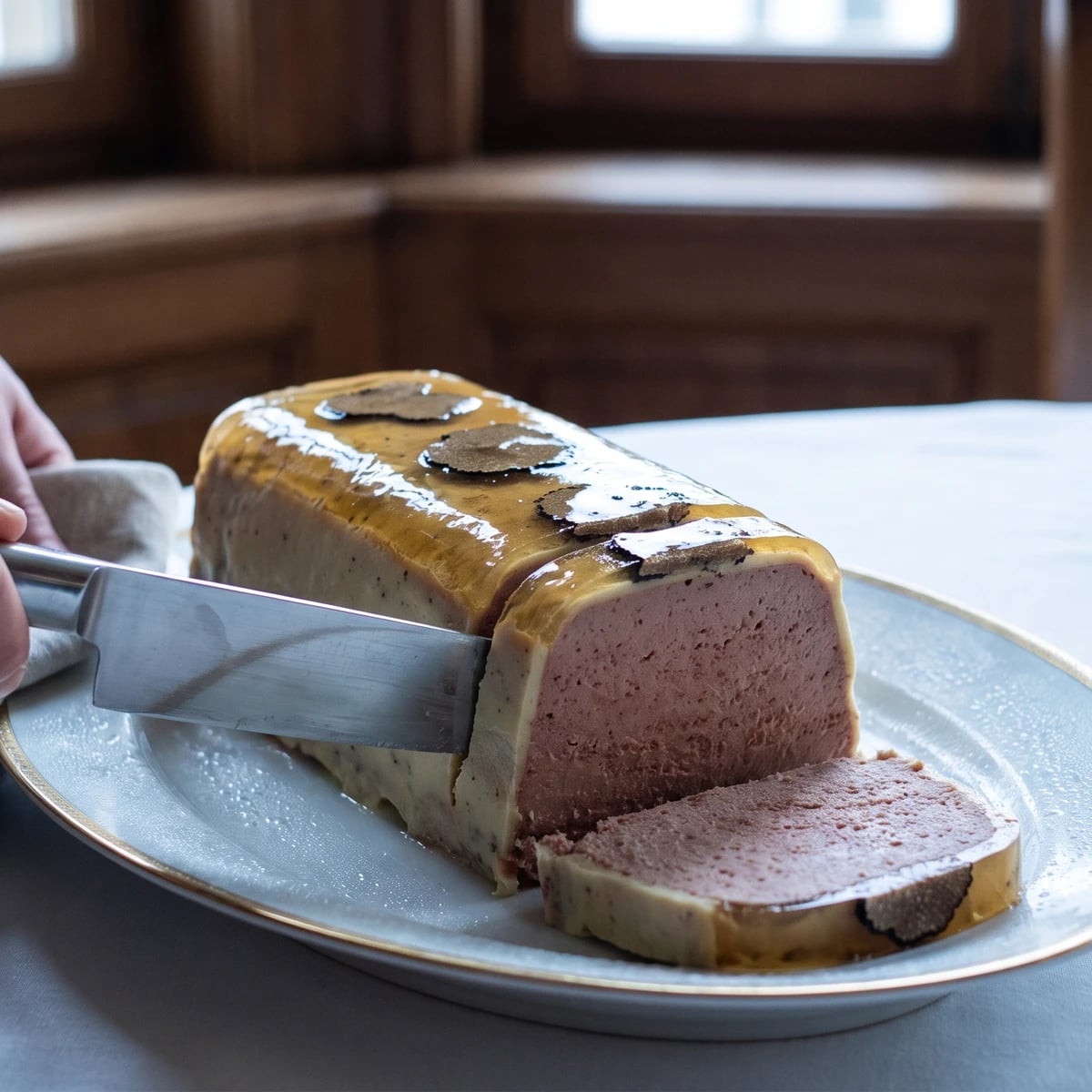
Pain de lièvre turns pounded hare into a close, savoury loaf, then gives it the cold-table discipline of chaud-froid and clear aspic, with truffle visible beneath the jelly.

Main Dishes
French
Make Ahead
Dinner Party
45 min
Active Time
1 hr 30 min cook10 hr total
Yield4 servings

Pain de Lièvre (cold moulded hare loaf) teaches the first law of the cold table: the shape is won before the decoration begins. The forcemeat must bind while cold, cook gently, and chill until absolutely firm. Turn it out while merely cool and it slumps; chill it hard and every slice stands clean beneath its clear jelly.

The classical entry assumed a saucier, poultry cooking liquor and aspic always ready, plus enough hands to pound meat, tend a bain-marie, coat the pain, and build its en belle-vue finish without breaking stride. At home, a food processor replaces the mortar, two loaf moulds replace special presentation moulds, and Poularde en Chaud-froid (No. 1689), prepared separately, supplies the required coating and aspic. One cook, one stove, one evening of work; the refrigerator does the night shift.

The bread or rice cushion, carved ice, and elaborate cold-table supports were service scaffolding, so they go. The fine forcemeat, firm moulding, chaud-froid coating, truffle decoration, and hard jelly set are the dish, so they stay. Test a spoonful of forcemeat before filling the mould, then give the finished pain its full cold rest before turning it out.

Pain de lièvre belongs to the French garde-manger, the cold-larder repertoire carried from game-rich household tables into the formal service of Parisian grand kitchens. Pain refers to the loaf shape rather than bread: hare was finely pounded, bound, moulded, and chilled so a difficult, lean game meat could be carved into composed slices. Serving it en belle-vue placed the decorated pain beneath clear aspic, preserving it while making the truffle and precise shape visible at the cold table.

The technique, the tradition, and the story behind every dish.

Discover Culinary Explorer

Ingredients

boneless hare meat

Quantity

About 4½ cups (1.06 litres / 700 g)

trimmed of sinew and cut into 2.5 cm cubes

pork fatback

Quantity

1 cup (240 ml / 175 g)

cut into 2.5 cm cubes

heavy cream

Quantity

¾ cup (180 ml / 185 g)

divided

fine fresh white breadcrumbs

Quantity

1 cup (240 ml / 60 g)

divided

unsalted butter

Quantity

3 tablespoons (45 ml / 42 g)

divided

shallots

Quantity

½ cup (120 ml / 75 g)

finely chopped

Cognac

Quantity

2 tablespoons (30 ml / 28 g)

large eggs

Quantity

2

fine salt

Quantity

2¼ teaspoons (11 ml / 13 g)

ground white pepper

Quantity

¾ teaspoon (3.75 ml / 1.5 g)

ground allspice

Quantity

¼ teaspoon (1.25 ml / 0.5 g)

small black truffle

Quantity

1 small truffle (about 25 g)

cut into thin slices

chaud-froid sauce

Quantity

1 cup (240 ml / 240 g) from Poularde en Chaud-froid (No. 1689)

prepared separately

clear aspic jelly

Quantity

2 cups (475 ml / 475 g) from Poularde en Chaud-froid (No. 1689)

prepared separately

Equipment Needed

  • Food processor with metal blade
  • 1.5 litre loaf mould or terrine
  • 2 litre straight-sided mould for the en belle-vue finish
  • Deep roasting pan for the bain-marie
  • Instant-read thermometer
  • Small board and 1 pound (450 g) weight

Instructions

  1. 1

    Cool the panade

    Put the hare, fatback, processor bowl, and blade in the freezer for 20 minutes. Meanwhile, warm ½ cup of the cream and stir in ¾ cup of the breadcrumbs; cook over low heat until they form a thick panade, then spread it on a plate to cool completely. Soften the shallots in 1 tablespoon of the butter without colouring, add the Cognac, and cook until nearly dry. Cool this mixture as well. Warm ingredients melt the fat before it can bind, so nothing enters the processor above refrigerator temperature.

  2. 2

    Pound the forcemeat

    Process the hare and fatback in small batches until finely minced, returning each batch to the cold as soon as it is done. Combine everything in the processor with the cold panade, shallots, eggs, salt, white pepper, and allspice. Process in short pulses until the forcemeat looks smooth, sticky, and lightly glossy. Stop if the bowl grows warm and chill it for 15 minutes before continuing; patience keeps the fat inside the loaf instead of leaving it in the mould.

  3. 3

    Test the binding

    Melt 1 teaspoon of the remaining butter in a small pan and cook a tablespoon of forcemeat completely. Let the sample cool before tasting, because cold mutes seasoning. It should hold together without crumbling and feel moist rather than greasy. If it is dry or breaks apart, process in reserved cream 1 tablespoon at a time; if it is slack, add the reserved breadcrumbs a spoonful at a time. If the fat begins to smear, chill the mixture before touching it again. Ça se rattrape.

  4. 4

    Mould and bake

    Heat the oven to 325°F (165°C). Butter a 1.5 litre loaf mould and line its long sides and base with parchment, leaving enough overhang to help lift the pain later. Pack in the forcemeat by firm handfuls, pressing each into the corners so no air pockets remain, then smooth the top. Cover with buttered parchment and foil, set the mould in a deep roasting pan, and add hot water to reach halfway up its sides. Bake until the centre reaches 160°F (71°C), about 60 to 75 minutes. The bain-marie must only murmur at the edges; vigorous boiling tightens the meat and drives out its fat.

  5. 5

    Chill under light weight

    Lift the mould from the bain-marie and let it stand for 20 minutes. Replace the foil with a small board or a second loaf tin and add about 1 pound (450 g) of weight, just enough to close the texture without squeezing out its moisture. Refrigerate for at least 6 hours, preferably overnight. Do not turn it out merely cool. If the loaf flexes when lifted, return it to the mould and chill for another hour; the hard set is what preserves the shape.

  6. 6

    Coat and decorate

    Lift out the cold pain, remove the parchment, and trim any ragged edges. Bring the chaud-froid sauce from Poularde en Chaud-froid (No. 1689) just to a thick pouring consistency over barely warm water, then let it cool until it coats a spoon without running clear. Set the pain on a rack over a tray and cover it with two thin coats, chilling each until firm. Arrange the truffle slices on the broad face chosen for presentation, then brush them with a little of the prepared aspic to hold them in place.

  7. 7

    Set en belle-vue

    Pour a 5 mm layer of clear aspic jelly from Poularde en Chaud-froid (No. 1689) into a clean 2 litre mould that leaves a narrow space around the pain. Chill until tacky but not hard, then lay the decorated face of the pain against this layer so it will appear on top after turning out. Add cool, half-melted aspic around the sides in two additions, allowing the first to set before adding the rest. If the loaf starts to float, hold it in position with two skewers laid across the mould until that first addition firms, then remove them and continue. Chill until hard, at least 2 hours.

  8. 8

    Turn out cold

    Dip only the outside of the mould in warm water for 5 seconds, dry it, cover with a chilled platter, and invert in one confident movement. If it does not release, wrap the mould briefly in a warm towel rather than dipping it repeatedly, which would melt the clear edges. Refrigerate the turned-out pain for 15 minutes, then cut it with a thin knife warmed in hot water and wiped dry between slices. Serve cold, while the aspic is lucid and the loaf stands firm. À table!

Chef Tips

  • Ask a game butcher for boneless hare meat with every trace of shot and damaged flesh removed. Hare is darker, leaner, and more forceful than rabbit. Rabbit will make a good cold pain, but it becomes Pain de Lapin and needs no pretending otherwise.
  • Keep the forcemeat cold from first cut to filled mould. A warm mixture loses its emulsion, and the fat then gathers in a greasy rim instead of remaining finely held through the hare.
  • Choose the inner and outer moulds before beginning. The second should leave roughly 1 cm around the pain for the clear jelly; too wide a gap buries the meat, while no gap leaves the aspic too fragile to turn out.
  • Serve thick slices with cornichons, bitter leaves dressed sharply with mustard, and toasted country bread. A lightly chilled cru Beaujolais has enough fruit for the hare and enough freshness for the cold aspic.

Advance Preparation

  • Prepare Poularde en Chaud-froid (No. 1689) separately before beginning, with its chaud-froid sauce and clear aspic ready for the final coating and moulding.
  • The baked pain can remain weighted in its mould for up to 2 days before coating. Keep it tightly covered and cold.
  • Complete the en belle-vue finish the day before serving. Once turned out, the pain keeps for 3 days under refrigeration, but it should not be frozen because thawed aspic releases water and loses its clarity.

Frequently Asked Questions

Nutrition Information

1 serving (about 475g)

Calories
945 calories
Total Fat
73 g
Saturated Fat
34 g
Trans Fat
1 g
Unsaturated Fat
38 g
Cholesterol
370 mg
Sodium
2150 mg
Total Carbohydrates
17 g
Dietary Fiber
1 g
Sugars
4 g
Protein
54 g

Note: Chef personas and recipes are created with AI assistance. Cook with care: follow safe food-handling practices, check doneness with a thermometer when needed, and adapt for allergies and your kitchen.

Where cooking meets culture.

Culinary guides, cultural storytelling, and the editorial depth that makes cooking meaningful.

Discover Culinary Explorer

More from Poultry (Volaille) - Venison and Ground Game

Browse the full collection