
Chef Juliette
John Dory (St. Pierre)
John Dory has the delicacy of sole and the firmness of turbot. A light flouring, a quick butter sauté, and nut-brown beurre noisette show exactly why looks never mattered.
A cooking platform built around craft, culture, and the stories behind what we eat.
Created by Chef Juliette
Based on No. 1819, Mousses et Mousselines de Lièvre, from Le Guide Culinaire (1907) by Auguste Escoffier
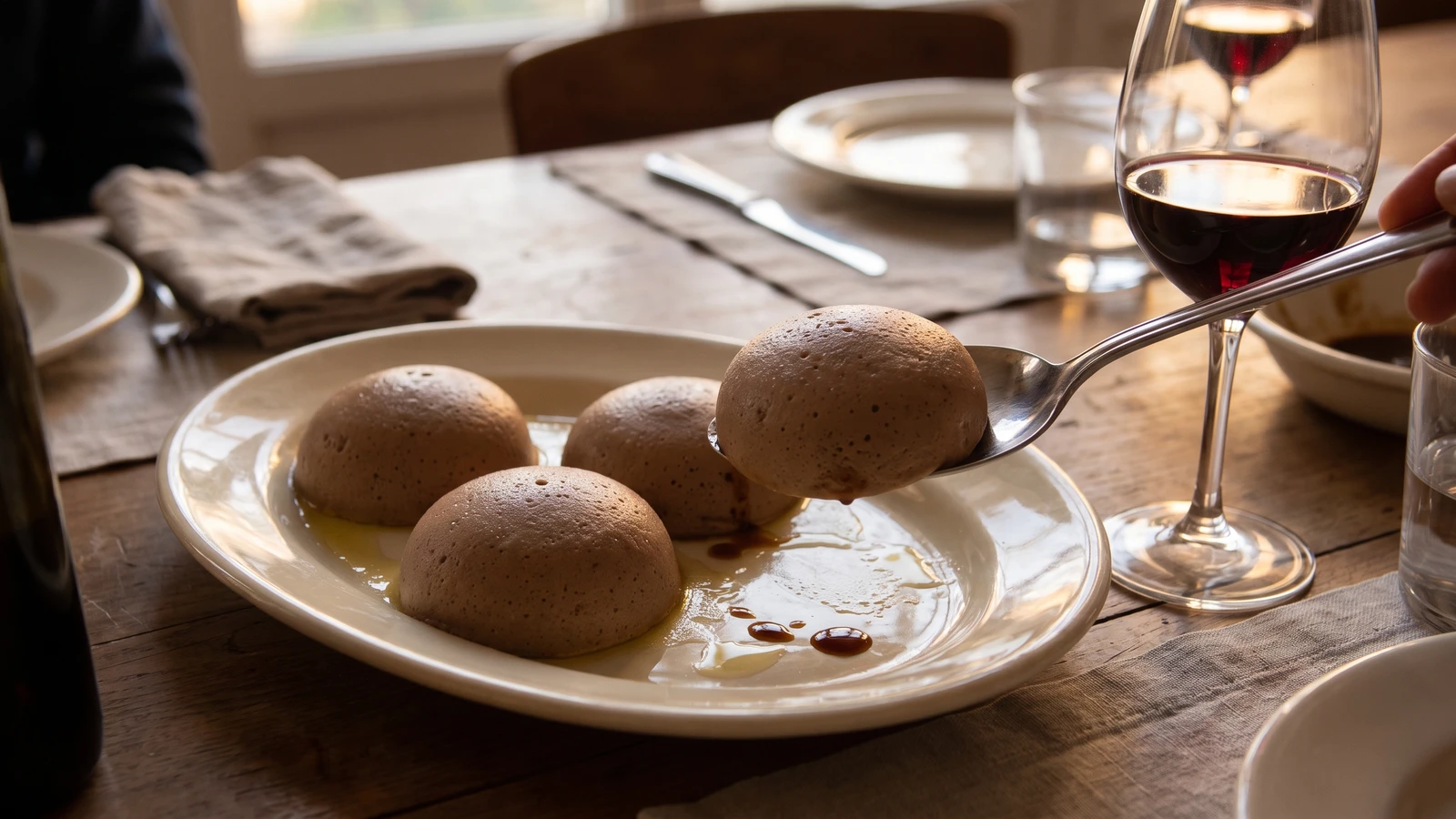
Hare, egg white, and half-whipped cream become a remarkably light game forcemeat, gently cooked as one generous mousse or four individual mousselines in a quiet bain-marie.
Mousses et Mousselines de Lièvre (hare mousse and individual mousselines) teach one of the classical kitchen's most useful transformations: firm, dark game can become delicate without surrendering its character. C'est la même grammaire used for fish and fowl, pounded meat bound with egg white, lightened with cream, then cooked so gently that the mixture sets without tightening.
The professional kitchen assumed a cold stone mortar, a tamis, brigade quantities, and enough hands to pound the hare without letting it warm. At home, a chilled food processor replaces the mortar, a fine sieve replaces the tamis, and four portions replace the great mould. That is scaffolding, so it can change. The fine purée, the half-whipped cream, and the quiet bain-marie are the dish, so they stay. One cook, one stove, one evening.
The cream decides everything. Whip it only until it mounds softly and still moves when the bowl tilts; stiff cream folds badly and leaves the cooked mousse woolly rather than tender. Reserve a little liquid cream before you begin, because if the whisk carries you too far, ça se rattrape: work that reserve into the cream until it becomes supple again.
Mousses et Mousselines de Lièvre belong to Parisian classical game cookery, where the light forcemeat grammar used for fish and fowl was applied to hare and cooked in buttered moulds. The distinction is service, not composition: Mousses fill a large mould for several diners, while Mousselines are moulded in individual portions. The technique carried hare from the hunting table into the formal bourgeois dining room without disguising its dark, mineral character.
Quantity
3 cups (450 g)
completely trimmed of silverskin, sinew, and shot-damaged flesh, cut into 2 cm dice and thoroughly chilled
Quantity
2 (1/4 cup / 60 g)
thoroughly chilled
Quantity
1 1/2 cups (360 ml / 360 g)
thoroughly chilled
Quantity
1 1/2 teaspoons (7.5 ml / 9 g)
Quantity
1/2 teaspoon (2.5 ml / 1 g)
Quantity
1/8 teaspoon (0.6 ml / 0.25 g)
Quantity
2 tablespoons (30 ml / 28 g)
softened, for the moulds
| Ingredient | Quantity |
|---|---|
| boneless hare meatcompletely trimmed of silverskin, sinew, and shot-damaged flesh, cut into 2 cm dice and thoroughly chilled | 3 cups (450 g) |
| large egg whitesthoroughly chilled | 2 (1/4 cup / 60 g) |
| heavy creamthoroughly chilled | 1 1/2 cups (360 ml / 360 g) |
| fine salt | 1 1/2 teaspoons (7.5 ml / 9 g) |
| finely ground white pepper | 1/2 teaspoon (2.5 ml / 1 g) |
| freshly grated nutmeg | 1/8 teaspoon (0.6 ml / 0.25 g) |
| unsalted buttersoftened, for the moulds | 2 tablespoons (30 ml / 28 g) |
Put the processor bowl, blade, a mixing bowl, and the hare in the freezer for 10 to 15 minutes. They should become very cold but the meat must not freeze solid. Heat the oven to 325°F (165°C). Butter four 1-cup (240 ml) ramekins for Mousselines, or one 1-quart (950 ml) mould for a shared Mousse, taking the butter right to the rims. Set the moulds in a deep roasting pan.
Process the cold hare with the salt, white pepper, and nutmeg in short pulses until finely minced. Scrape down the bowl, then add the egg whites a little at a time while pulsing until the meat becomes a smooth, sticky paste. Stop whenever the bowl loses its chill. Warm forcemeat turns greasy and cooks grainy; if that begins, set the bowl over ice for 10 minutes before continuing. Do not press ahead with a warm mixture.
Press the forcemeat through a fine-mesh sieve with a firm flexible scraper, leaving every thread of sinew behind. This replaces the classical tamis, and it is not ceremony: a processor makes the hare small, but the sieve makes it fine. Scrape the purée into the chilled mixing bowl and nest that bowl over ice while you prepare the cream.
Reserve 2 tablespoons (30 ml / 30 g) of the measured cream. Whisk the rest just to demi-fouettée, half-whipped cream: it should form soft folds, hold the faint trace of the whisk, and still slide slowly when the bowl tilts. Never take it to stiff peaks. If it becomes firm or clumpy, don't discard it. Ça se rattrape: whisk in the reserved liquid cream a teaspoon at a time until the cream is smooth and supple again.
Fold one-third of the half-whipped cream into the cold hare purée to loosen it, then fold in the remainder in two additions with broad strokes from the bottom of the bowl. Stop as soon as no white streaks remain. Poach a teaspoonful in barely trembling water for 3 to 4 minutes, then cut and taste it. If it is dense, fold in any unused reserved cream one teaspoon at a time; if it leaks liquid or feels greasy, chill the mixture over ice for 10 minutes and fold it gently back together. Correct the seasoning before filling the moulds.
Spoon the mixture into the buttered moulds without packing it down, filling individual ramekins about three-quarters full or bringing the large mould to within 2 cm of its rim. Smooth the surface with a wet spoon and cover each mould loosely with buttered parchment or foil. The covering prevents a dry skin while leaving the mousse room to rise slightly.
Pour hot water into the roasting pan until it reaches halfway up the moulds, then transfer the pan to the oven. Cook the individual Mousselines for 25 to 30 minutes, or the large Mousse for 40 to 45 minutes. The water should merely quiver. If bubbles begin climbing the moulds, lower the oven and add a little cool water to the pan at once; ça se rattrape before the forcemeat tightens. The mousse is ready when it is evenly set, springs gently at the centre, and reaches 160°F (71°C).
Lift the moulds from the bain-marie and rest them for 7 minutes. Run a thin knife around each edge, place a warmed platter or plate over the mould, and invert decisively. Leave it in place for a few seconds before lifting. If a mousseline clings, cover the upturned mould with a cloth dipped in hot water for 15 seconds, then try again. Spoon any melted butter from the mould around the base and serve at once. À table!
1 serving (about 210g)
Culinary guides, cultural storytelling, and the editorial depth that makes cooking meaningful.
Discover Culinary ExplorerChef Juliette
John Dory has the delicacy of sole and the firmness of turbot. A light flouring, a quick butter sauté, and nut-brown beurre noisette show exactly why looks never mattered.

Chef Juliette
Fresh haddock proves its delicacy in the meunière pan: a fine flour crust, moist pearly flakes, and beurre noisette sharpened with lemon and parsley, ready from one skillet in half an hour.

Chef Juliette
Éperlans à l’Anglaise turns small fish into a lesson in disciplined coating: boned smelts under a close, crisp crumb, pan-fried in clarified butter and finished with bright, half-melted maître d’hôtel butter.

Chef Juliette
Tiny smelts, shallot, mushrooms, white wine, gratin sauce, and fine bread raspings meet a fierce oven, where the fish must turn tender in the same breath the buttered crust bronzes.