
Chef Juliette
Selle de Chevreuil et Cuissot
Selle de Chevreuil et Cuissot teaches the discipline of game: strip every tendon, skip marinade for a young, well-hung joint, roast in butter, and stop before leanness turns to dryness.
A cooking platform built around craft, culture, and the stories behind what we eat.
Created by Chef Juliette
Based on No. 1818, Filets de Levraut à la Vendome, from Le Guide Culinaire (1907) by Auguste Escoffier
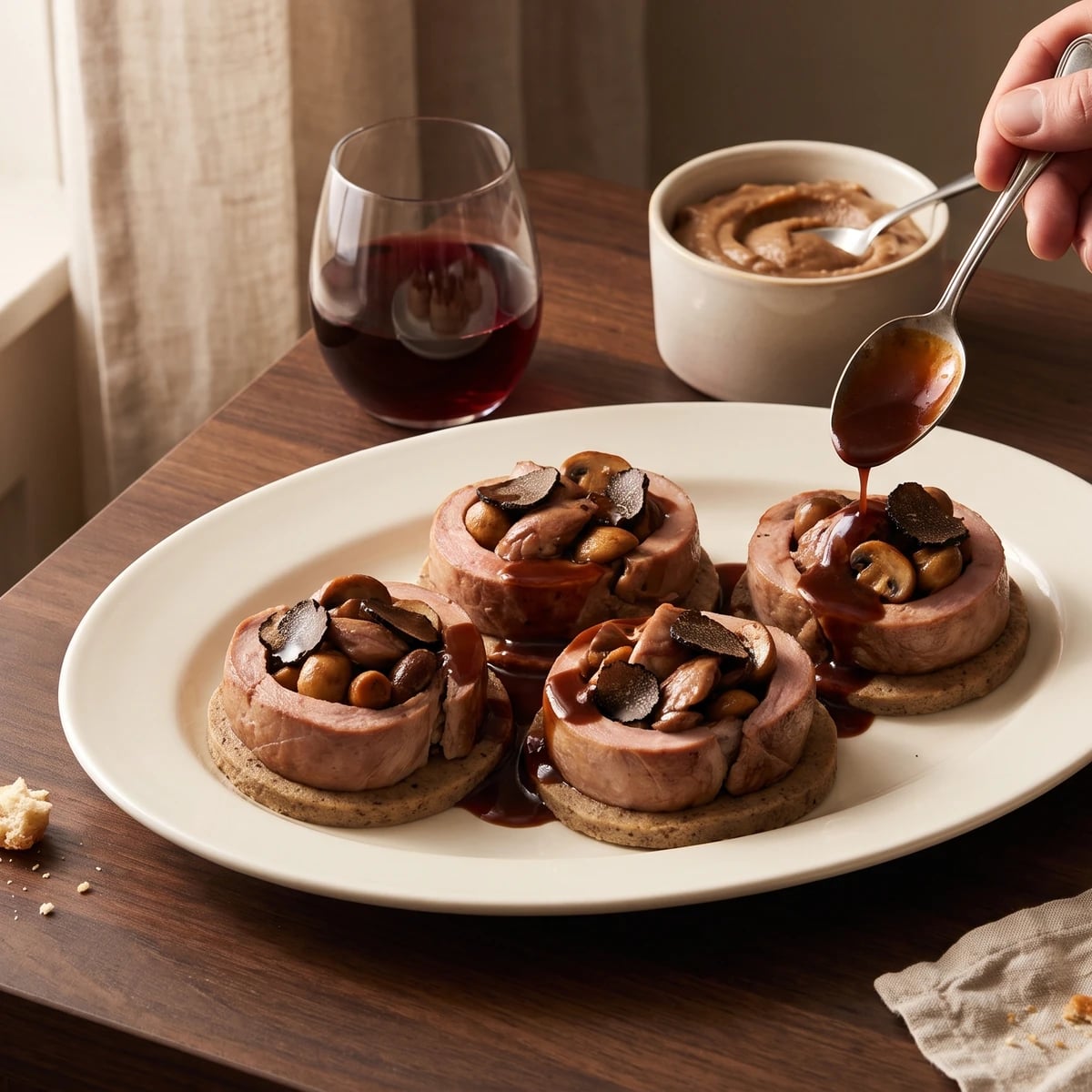
Hare loins are contised with truffle, curved into poached rings, anchored on game forcemeat and filled with tenderloin, mushroom and poivrade, while chestnut purée waits alongside.
Filets de Levraut à la Vendôme (leveret fillet rings with truffle, mushroom, and poivrade) teaches controlled tenderness inside an elaborate assembly. Hare is lean and unforgiving, so know the one true thing before touching a pan: the poaching liquor must barely quiver. Shape the fillets first, poach them gently, and stop while the meat remains supple enough to drink in the sauce.
The original assumed a saucier with poivrade ready, game stock never far from the fire, cold game forcemeat on hand, a row of matching tin moulds, and several cooks running the garnish, poach, and purée together. Four stainless pastry rings replace those moulds at home, vacuum-packed cooked chestnuts remove only the peeling, and the work is sequenced for one cook. For four portions, the book's five ounces of truffle becomes two ounces, while the mushrooms remain equal in weight to the minion fillets, exactly as written. One cook, one stove, one evening.
Running four preparations simultaneously was brigade scaffolding, so that goes. Contise, meaning to make shallow incisions and insert slices of truffle, stays. So do the formed rings, the poached forcemeat bases, the Cognac deglaze, the poivrade, the final butter, and the chestnut purée served apart. These are the dish. Guard the poach above all: bubbling liquid tightens the hare before the sauce can help it.
Filets de Levraut à la Vendôme belongs to the formal game service of the Parisian classical kitchen, not to the bouchon or farmhouse table. Vendôme functions here as a named garnish-title: truffled hare, shaped game forcemeat, poivrade, and chestnut purée signal grand service, but do not establish the dish as a household specialty of the Loire Valley town. The preparation shows game passing from the hunt table into the codified kitchen, where the saddle was portioned, reshaped, and returned with its smaller fillets folded into the garnish.
Quantity
4 (about 1 pound / 455 g total)
silverskin removed
Quantity
4 (about 4 ounces / 115 g total)
cut crosswise into ¼-inch collops
Quantity
½ cup (120 ml / 55 g)
thinly sliced, with 16 small slivers reserved for Contise
Quantity
8 tablespoons (120 ml / 113 g)
divided
Quantity
1¼ teaspoons (6 ml / 7 g)
divided
Quantity
½ teaspoon (2.5 ml / 1 g)
divided
Quantity
4 cups (960 ml / 960 g)
Quantity
2 cups (480 ml / 340 g)
kept very cold
Quantity
1½ cups (360 ml / 115 g)
sliced ¼ inch thick
Quantity
¼ cup (60 ml / 55 g)
Quantity
1¼ cups (300 ml / 300 g)
divided
Quantity
3 cups (720 ml / 400 g)
Quantity
½ cup (120 ml / 120 g)
| Ingredient | Quantity |
|---|---|
| long boneless young hare loin filletssilverskin removed | 4 (about 1 pound / 455 g total) |
| hare minion fillets (tenderloins)cut crosswise into ¼-inch collops | 4 (about 4 ounces / 115 g total) |
| fresh black trufflethinly sliced, with 16 small slivers reserved for Contise | ½ cup (120 ml / 55 g) |
| unsalted butterdivided | 8 tablespoons (120 ml / 113 g) |
| fine saltdivided | 1¼ teaspoons (6 ml / 7 g) |
| freshly ground black pepperdivided | ½ teaspoon (2.5 ml / 1 g) |
| unsalted light game stock, or unsalted brown chicken stock | 4 cups (960 ml / 960 g) |
| prepared raw game forcemeatkept very cold | 2 cups (480 ml / 340 g) |
| small button mushroomssliced ¼ inch thick | 1½ cups (360 ml / 115 g) |
| Cognac or good French brandy | ¼ cup (60 ml / 55 g) |
| prepared poivrade saucedivided | 1¼ cups (300 ml / 300 g) |
| peeled cooked unsweetened chestnuts | 3 cups (720 ml / 400 g) |
| heavy cream | ½ cup (120 ml / 120 g) |
Reserve 1 cup of the stock before any raw hare touches the remainder. Put the chestnuts in a saucepan with ¾ cup of that reserved stock and simmer gently for 15 minutes, until they crush readily beneath a spoon. Purée them while warm with the cream, 2 tablespoons of butter, and ¼ teaspoon of salt. Add the remaining reserved stock a spoonful at a time until the purée falls heavily from the spoon but does not run. Cover it directly with buttered parchment and hold it over barely warm water.
Make four evenly spaced, shallow diagonal incisions across the presentation side of each loin. Slip one reserved truffle sliver into every incision without cutting through the meat. Season the fillets with ½ teaspoon of salt and ¼ teaspoon of pepper. Butter the outside of four 2½-inch stainless pastry rings with 1 tablespoon of butter, wrap one fillet around each with its contised side facing outward, and overlap the ends by ½ inch. Tie each fillet gently around its mould with kitchen string. If one fillet will not quite meet, use a slightly smaller ring rather than stretching the meat; forced thin spots overcook first.
Butter a wide, shallow lidded pan with ½ tablespoon of butter and stand the four moulds upright inside it. Add enough of the remaining stock to reach halfway up the fillets, reserving any excess, and lay a buttered parchment circle directly over them. Bring the liquid slowly to 175°F to 180°F (79°C to 82°C), where it trembles without bubbling, then cover and poach for 8 to 12 minutes. The thickest part should reach about 150°F (66°C) and remain supple. If the liquid begins boiling, lift the pan off the heat, uncover it, and add ¼ cup of cold reserved stock. Ça se rattrape, provided you stop the boil promptly. Rest the rings for 3 minutes, strain and reserve ¾ cup of poaching liquor, then snip the strings and ease away the moulds.
Heat the oven to 300°F (150°C). Reserve 2 tablespoons of the raw game forcemeat for assembly. Butter an 8-inch square metal pan and a sheet of parchment with ½ tablespoon of butter, then spread the remaining forcemeat in an even layer ½ inch thick. Cover it with the parchment, buttered side down, and foil. Set the pan in a larger roasting dish and add hot water to come halfway up its sides. Poach in the oven for 15 to 20 minutes, until just firm and 160°F (71°C) at the centre. Let it settle for 5 minutes before uncovering.
Use one of the pastry rings as a cutter to stamp four forcemeat roundels matching the hare rings. Spread a thin dab of the reserved raw forcemeat on each roundel and set a hare ring firmly over it. Transfer the assemblies to a parchment-lined tray, cover loosely with foil, and warm at 275°F (135°C) for 5 to 7 minutes, just until the raw forcemeat binder has set. Keep them covered in a warm place while the garnish is finished.
Melt 2 tablespoons of butter in a wide sauté pan over medium-high heat. When the foam subsides, add the mushrooms and toss for 1 minute. Add the minion-fillets, the remaining sliced truffle, ¼ teaspoon of salt, and the remaining pepper. Toss quickly for another 60 to 90 seconds, until the collops are coloured at their edges but remain tender. Transfer the entire garnish to a warm bowl, leaving the butter and fond in the pan.
Take the pan away from any open flame and pour in the Cognac. Return it to the heat and scrape the pan thoroughly while the brandy reduces almost dry. Add ½ cup of the reserved poaching liquor and reduce it by half, then add ½ cup of the poivrade sauce. Simmer until the sauce naps the back of a spoon, meaning it leaves an even coating when the spoon is lifted. Remove the pan from the heat and whisk in 2 tablespoons of cold butter, a little at a time. If the sauce turns oily, whisk 1 teaspoon of cold poaching liquor in a clean warm pan, then add the split sauce gradually. Fold the collops, mushrooms, and truffles back into the finished sauce and warm them without boiling.
Warm the remaining ¾ cup of poivrade sauce separately and transfer it to a sauceboat. Reheat the chestnut purée gently, loosening it with a spoonful of cream if necessary, and spoon it into a small timbale or straight-sided serving bowl. Arrange the four hare rings in a circle on a warmed platter, each resting squarely on its forcemeat roundel. Fill the centres generously with the collops, mushrooms, truffles, and their glossy sauce. Serve the extra poivrade and chestnut purée apart, exactly as the dish intends. À table!
1 serving (about 475g)
Culinary guides, cultural storytelling, and the editorial depth that makes cooking meaningful.
Discover Culinary Explorer
Chef Juliette
Selle de Chevreuil et Cuissot teaches the discipline of game: strip every tendon, skip marinade for a young, well-hung joint, roast in butter, and stop before leanness turns to dryness.

Chef Juliette
A three-day marinade perfumes this lean saddle, but the roast lives or dies by its rosy center; the tray fond, cream, meat glaze, and one juniper berry make the sauce.

Chef Juliette
A butter-poêled venison saddle, carved rosy and flanked by unsweetened pears scented with cinnamon and lemon, with clear game jus and redcurrant jelly at the table.

Chef Juliette
Verjuice perfumes rather than pickles this saddle, while a thermometer protects its rosy centre. Poivrade and red-currant jelly meet in strict equality, with semi-candied cherries folded through for the generous game table.