
Chef Juliette
John Dory (St. Pierre)
John Dory has the delicacy of sole and the firmness of turbot. A light flouring, a quick butter sauté, and nut-brown beurre noisette show exactly why looks never mattered.
A cooking platform built around craft, culture, and the stories behind what we eat.
Created by Chef Juliette
Based on No. 1810, Hare and Leveret (Lièvre et Levraut), from Le Guide Culinaire (1907) by Auguste Escoffier
Young hare, browned deeply and braised gently in red wine, teaches the grammar of game cookery: age chooses the method, fond deepens the sauce, and a bare simmer protects the lean meat.
Lièvre et Levraut (hare and leveret) teaches the first law of game cookery: age chooses the method. A young hare can become tender over the course of an evening, its dark, lean flesh mellowed by wine, lardons, and a sauce built from its own browned bones. An old hare asks for another pot entirely, one devoted to soup, forcemeat, or fumet, a concentrated game essence. No amount of optimism changes the animal in front of you.
The old entry is a buying lesson rather than a fixed formula. It assumes the cook sees the hare fur-on, can judge its ear, and has a game stockpot never off the fire. Your honest equivalent is a dressed young hare from a reliable game dealer, jointed by the butcher, with its bones and liver returned to you. Those bones fortify ordinary stock into a small fumet while you prepare the garnish. A separate stock day and a saucier on staff are brigade scaffolding, so they can go. Careful jointing, deep browning, wine reduction, and gentle cooking must stay because they are the dish. One cook, one stove, one evening.
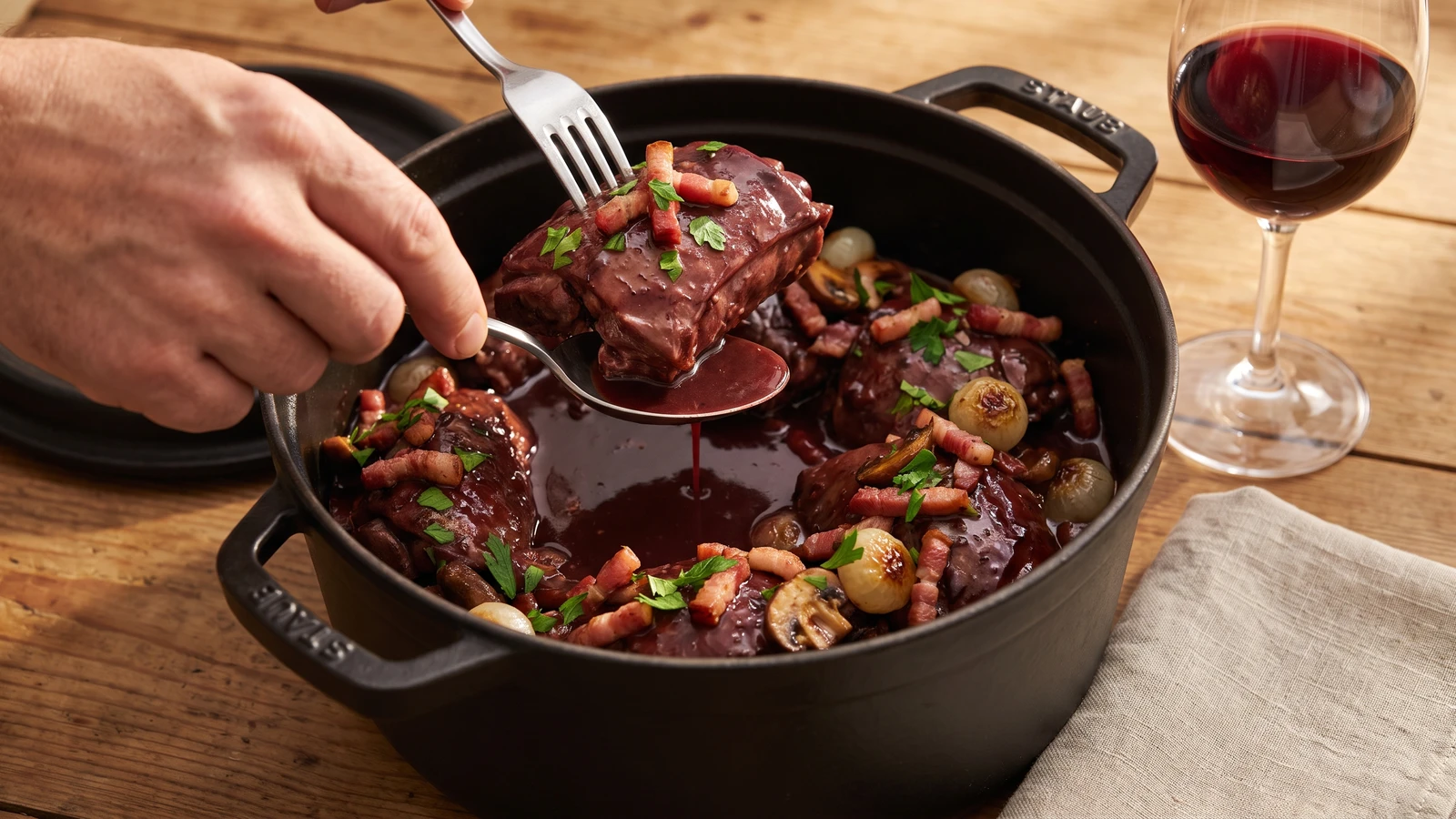
The finished hare should be dark and tender beneath a wine-deep sauce, with pearl onions, mushrooms, and lardons carrying the sweetness, earth, and salt that lean game needs. The bare simmer is the step that matters most: boil the pot and the saddle tightens before the legs surrender.
Lièvre et levraut belongs to the game tables of Burgundy and central France, where cooks have long separated mature hare from young leveret before deciding whether to roast, braise, pound, or extract. Levraut is not a different species but a kitchen judgment about age, and the distinction matters because hare grows powerful in flavor and firm in muscle as it matures. Bourgeoise and grand kitchens reserved younger animals for the table while turning older ones toward soups, forcemeats, and fumet, allowing every part of the hunt to earn its place.
Quantity
1 hare, 5 to 6 lb (2.3 to 2.7 kg)
jointed into forelegs, hind legs, and 4 saddle portions, with bones and heart reserved
Quantity
1 liver, about 2 oz (55 g)
reserved from the animal; use 1 chicken liver if none is supplied
Quantity
2 teaspoons (10 ml / 12 g), plus more to taste
Quantity
1 teaspoon (5 ml / 2 g)
Quantity
1/4 cup (60 ml / 30 g)
divided
Quantity
6 tablespoons (90 ml / 85 g)
divided
Quantity
1 tablespoon (15 ml / 14 g)
Quantity
1 cup (240 ml / 140 g)
cut into batons
Quantity
12
peeled
Quantity
4 cups (950 ml / 285 g)
halved or quartered
Quantity
2 medium
one roughly chopped and one finely diced
Quantity
2 large
one roughly chopped and one finely diced
Quantity
2 cloves
finely chopped
Quantity
1 tablespoon (15 ml / 16 g)
Quantity
2 tablespoons (30 ml / 28 g)
Quantity
2 cups (475 ml / 475 g)
Quantity
2 cups (475 ml / 475 g)
Quantity
1
Quantity
1 tablespoon (15 ml / 20 g)
Quantity
2 teaspoons (10 ml / 10 g)
Quantity
2 tablespoons (30 ml / 8 g)
finely chopped
| Ingredient | Quantity |
|---|---|
| young dressed harejointed into forelegs, hind legs, and 4 saddle portions, with bones and heart reserved | 1 hare, 5 to 6 lb (2.3 to 2.7 kg) |
| hare liverreserved from the animal; use 1 chicken liver if none is supplied | 1 liver, about 2 oz (55 g) |
| fine sea salt | 2 teaspoons (10 ml / 12 g), plus more to taste |
| freshly ground black pepper | 1 teaspoon (5 ml / 2 g) |
| all-purpose flourdivided | 1/4 cup (60 ml / 30 g) |
| cold unsalted butterdivided | 6 tablespoons (90 ml / 85 g) |
| neutral cooking oil | 1 tablespoon (15 ml / 14 g) |
| thick-cut unsmoked bacon or lardonscut into batons | 1 cup (240 ml / 140 g) |
| small pearl onionspeeled | 12 |
| small brown mushroomshalved or quartered | 4 cups (950 ml / 285 g) |
| carrotsone roughly chopped and one finely diced | 2 medium |
| shallotsone roughly chopped and one finely diced | 2 large |
| garlicfinely chopped | 2 cloves |
| tomato paste | 1 tablespoon (15 ml / 16 g) |
| Cognac | 2 tablespoons (30 ml / 28 g) |
| dry red wine | 2 cups (475 ml / 475 g) |
| unsalted chicken or light veal stock | 2 cups (475 ml / 475 g) |
| bouquet garni of parsley stems, thyme, and bay | 1 |
| redcurrant jelly | 1 tablespoon (15 ml / 20 g) |
| red wine vinegar | 2 teaspoons (10 ml / 10 g) |
| flat-leaf parsleyfinely chopped | 2 tablespoons (30 ml / 8 g) |
Buy a young hare weighing 5 to 6 pounds from a reliable game dealer. If it is offered fur-on, the book's test is direct: hold one ear near its tip and pull in opposite directions. An ear that tears readily indicates a leveret; an ear that resists belongs to an older hare, better kept for soup, forcemeat, or fumet than forced through this shorter braise. Ask the butcher to remove the forelegs and hind legs, cut the saddle across the bone into 4 portions, and return the chopped bones, heart, and liver. Pat the meat very dry, then season it with the salt and pepper.
Melt 1 tablespoon of the butter in the cocotte over medium-high heat. Add the chopped bones and heart, then brown them for 8 to 10 minutes until every cut face is deep bronze. Add the roughly chopped carrot and shallot, cook for 3 minutes, then pour in the stock and scrape up the fond, the brown glaze clinging to the pot. Simmer uncovered at the gentlest tremble for 30 minutes, skimming only if a heavy froth gathers. Strain through a fine sieve and press lightly on the solids. You now have the small, concentrated hare fumet that replaces the brigade stockpot.
Wipe the cocotte clean and render the lardons over medium heat until their edges are crisp and bronze. Lift them out with a slotted spoon. Add the pearl onions and mushrooms to the rendered fat, working in batches if necessary, and cook until the onions color in patches and the mushrooms have surrendered their water and browned. Add 1/4 cup of the fumet, cover for 6 to 8 minutes so the onions soften, then uncover and let the liquid cook away. Reserve the garnish with the lardons.
Measure half the flour into a shallow dish and coat the hare lightly, shaking off every excess. Heat the oil with 2 tablespoons of butter in the cocotte until the butter's foam subsides. Brown the hare in uncrowded batches, beginning with the legs and ending with the saddle, until the surfaces are a dark hazelnut color. Move each piece only after it releases easily. If the fond begins turning black, lower the heat and deglaze that patch with a spoonful of wine before continuing; brown gives depth, black gives bitterness. Set the meat aside.
Lower the heat to medium. Add the finely diced carrot and shallot to the cocotte and cook for 5 minutes, then add the garlic and tomato paste and cook until the paste darkens. Stir in the remaining flour and cook for 2 minutes to make a roux, the cooked flour-and-fat base that will give the sauce body. Add the Cognac and let it boil almost dry. Pour in the red wine gradually, scraping up every trace of fond, then reduce it by half. Add the fumet and bouquet garni and bring the sauce only to a bare simmer.
Return the hind legs and forelegs to the sauce, cover, and hold the liquid at the faintest tremble for 50 minutes. Add the saddle portions and continue gently for 30 to 40 minutes, until each portion reaches at least 160°F (71°C) at its thickest point and the leg meat yields when pressed with a fork. Never let the sauce boil. If the saddle is ready while the hind legs still resist, lift the saddle out and cover it loosely, then give the legs another 15 to 25 minutes with a splash of fumet. Ça se rattrape: different muscles are allowed to finish at different times.
Lift the cooked hare to a warm dish and discard the bouquet garni. Simmer the sauce uncovered until it coats the back of a spoon. Meanwhile, melt 1 tablespoon of butter in a small skillet and cook the liver gently until browned outside and at least 160°F (71°C) within. Blend or mash the liver with the redcurrant jelly, vinegar, and a ladleful of sauce, then press the mixture through a fine sieve into the cocotte. Stir over low heat for 2 minutes without boiling. If the sauce looks grainy, strain it once more and whisk in a spoonful of cool fumet. Ça se rattrape.
Remove the cocotte from the heat. Monter au beurre, whisk in the remaining 2 tablespoons of cold butter a little at a time to make a glossy emulsion. If the mounted sauce splits, place 1 tablespoon of cool fumet in a clean warm bowl and whisk the sauce back into it gradually. Taste for salt, pepper, and enough vinegar to keep the wine lively. Return the hare, lardons, pearl onions, and mushrooms, warming them gently without another boil. Scatter with parsley and bring the cocotte straight to the table. À table!
1 serving (about 520g)
Culinary guides, cultural storytelling, and the editorial depth that makes cooking meaningful.
Discover Culinary ExplorerChef Juliette
John Dory has the delicacy of sole and the firmness of turbot. A light flouring, a quick butter sauté, and nut-brown beurre noisette show exactly why looks never mattered.

Chef Juliette
Fresh haddock proves its delicacy in the meunière pan: a fine flour crust, moist pearly flakes, and beurre noisette sharpened with lemon and parsley, ready from one skillet in half an hour.

Chef Juliette
Éperlans à l’Anglaise turns small fish into a lesson in disciplined coating: boned smelts under a close, crisp crumb, pan-fried in clarified butter and finished with bright, half-melted maître d’hôtel butter.

Chef Juliette
Tiny smelts, shallot, mushrooms, white wine, gratin sauce, and fine bread raspings meet a fierce oven, where the fish must turn tender in the same breath the buttered crust bronzes.