
Chef Juliette
John Dory (St. Pierre)
John Dory has the delicacy of sole and the firmness of turbot. A light flouring, a quick butter sauté, and nut-brown beurre noisette show exactly why looks never mattered.
A cooking platform built around craft, culture, and the stories behind what we eat.
Created by Chef Juliette
Based on No. 1809, Boar and Young Boar (Sanglier et Marcassin), from Le Guide Culinaire (1907) by Auguste Escoffier
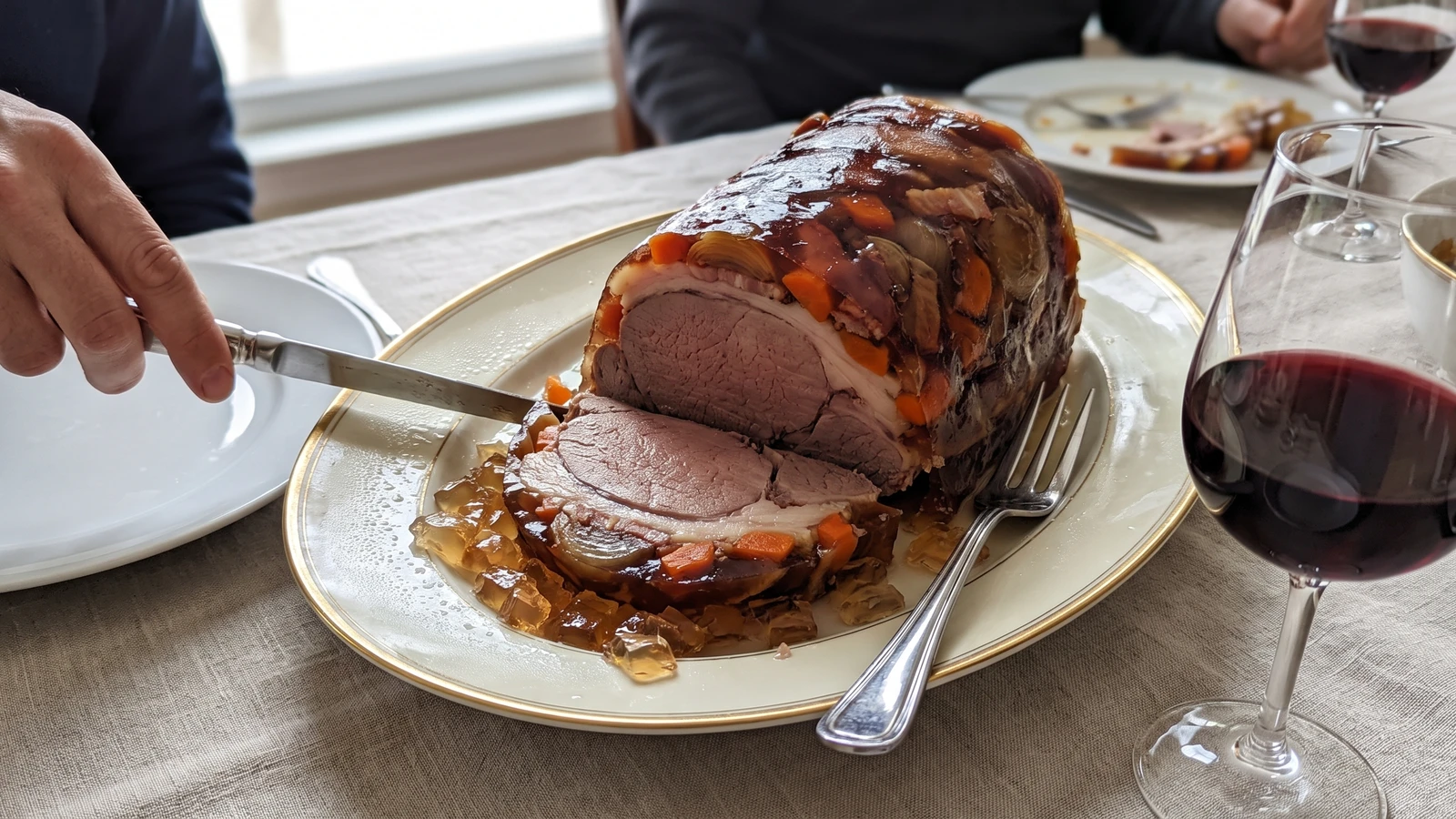
Sanglier et Marcassin teaches restraint: choose a truly young animal, preserve its natural fat, and let the prepared Provençal cold daube set the saddle into clean slices with glossy gravy and aspic.
Sanglier et Marcassin (boar and young boar) teaches one truth before you touch a pan: age decides the dish. For this preparation, choose marcassin under twelve months, with a tender saddle and its own even covering of fat. Leave that fat where nature put it. Larding adds nothing here and distorts the clean flavor of the young animal.
The original entry assumed a hunting larder able to judge whole game, roebuck formulas already in service, a saucier with gravy at hand, a stockpot never off the fire, and a cold pantry for setting a terrine. At home, the honest equivalents are an inspected saddle from a licensed game supplier, a 1½-quart loaf pan or terrine, and the separately prepared Daube à la Provençale Froide (No. 1173), the cold Provençal daube. The brigade quantity becomes one 2½-pound saddle for four. One cook, one stove, one evening of work, then the cold does the waiting.
The brigade scale is scaffolding and can go. The age limit, the natural fat cover, and the linked cold-daube finish are the dish and must stay. Chill the prepared daube until its gravy is completely firm before attempting to turn it out. That full cold set is the step that matters most.
Sanglier et marcassin belong to the cuisine de chasse of France's forested regions, particularly the Ardennes, Alsace, and Burgundy, where age and cut determine preparation more than any single regional sauce. Classical kitchens draw a firm culinary line between mature boar and marcassin: the young animal's tender saddle and natural fat allow it to follow roebuck methods without larding. The cold treatment is Provençal by method, not a claim that wild boar belongs only to Provence; Daube à la Provençale Froide (No. 1173) carries a hot daube into the cold pantry by setting its meat, vegetables, bacon rind, and strained gravy together, then surrounding it with aspic.
Quantity
1 chilled terrine, about 5 cups (1.2 L / 1.5 kg), based on a 2½ lb (1.13 kg) saddle
fully set, with its chopped aspic reserved separately
| Ingredient | Quantity |
|---|---|
| Daube à la Provençale Froide (No. 1173), prepared from the fat-covered saddle of young boar under twelve monthsfully set, with its chopped aspic reserved separately | 1 chilled terrine, about 5 cups (1.2 L / 1.5 kg), based on a 2½ lb (1.13 kg) saddle |
Order a saddle from a young boar confirmed to be under twelve months old. Buy only inspected wild game from a licensed supplier, and ask that any required parasite testing be documented. The meat should smell clean and mild, with firm flesh and an even ivory fat cover, never a heavy, rank aroma.
Have the saddle neatly trimmed without stripping away its natural fat cover. Do not lard it. The marcassin already carries the moisture and richness that larding supplied to leaner game, and piercing the meat only creates channels through which its juices escape.
Prepare the saddle as Daube à la Provençale Froide (No. 1173), following that finished preparation in its own entry rather than rebuilding its carrots, onions, bacon rind, gravy, and aspic here. Scale it to the 2½ lb (1.13 kg) saddle and a 1½-quart (1.4 L) terrine. The meat must reach at least 160°F (71°C) during its hot preparation, then be cooled promptly before chilling.
Keep the finished Daube à la Provençale Froide (No. 1173) refrigerated at or below 40°F (4°C) until its gravy is firm from edge to center. Press the surface lightly through its covering; it should feel close and resilient, not liquid beneath a thin skin. If the center still shifts, give it several more hours in the cold. Patience, not a freezer, preserves the aspic's clear texture.
Set a thoroughly chilled serving dish over the terrine and invert both together. Lift the mold straight upward. If the daube clings, don't pull or shake it apart. Ça se rattrape: wrap the outside of the mold with a towel dipped in warm water for ten seconds, dry it, and try again. Too much warmth melts the gravy, so work in brief intervals.
Surround the turned-out daube with the chopped aspic reserved from its preparation. Cut four generous portions with a long sharp knife, wiping the blade between cuts so the saddle, vegetables, and set gravy remain distinct. Serve immediately while everything is properly cold and firm. À table!
1 serving (about 375g)
Culinary guides, cultural storytelling, and the editorial depth that makes cooking meaningful.
Discover Culinary ExplorerChef Juliette
John Dory has the delicacy of sole and the firmness of turbot. A light flouring, a quick butter sauté, and nut-brown beurre noisette show exactly why looks never mattered.

Chef Juliette
Fresh haddock proves its delicacy in the meunière pan: a fine flour crust, moist pearly flakes, and beurre noisette sharpened with lemon and parsley, ready from one skillet in half an hour.

Chef Juliette
Éperlans à l’Anglaise turns small fish into a lesson in disciplined coating: boned smelts under a close, crisp crumb, pan-fried in clarified butter and finished with bright, half-melted maître d’hôtel butter.

Chef Juliette
Tiny smelts, shallot, mushrooms, white wine, gratin sauce, and fine bread raspings meet a fierce oven, where the fish must turn tender in the same breath the buttered crust bronzes.