
Chef Juliette
John Dory (St. Pierre)
John Dory has the delicacy of sole and the firmness of turbot. A light flouring, a quick butter sauté, and nut-brown beurre noisette show exactly why looks never mattered.
A cooking platform built around craft, culture, and the stories behind what we eat.
Created by Chef Juliette
Based on No. 1806, Noisettes de Chevreuil Villeneuve, from Le Guide Culinaire (1907) by Auguste Escoffier
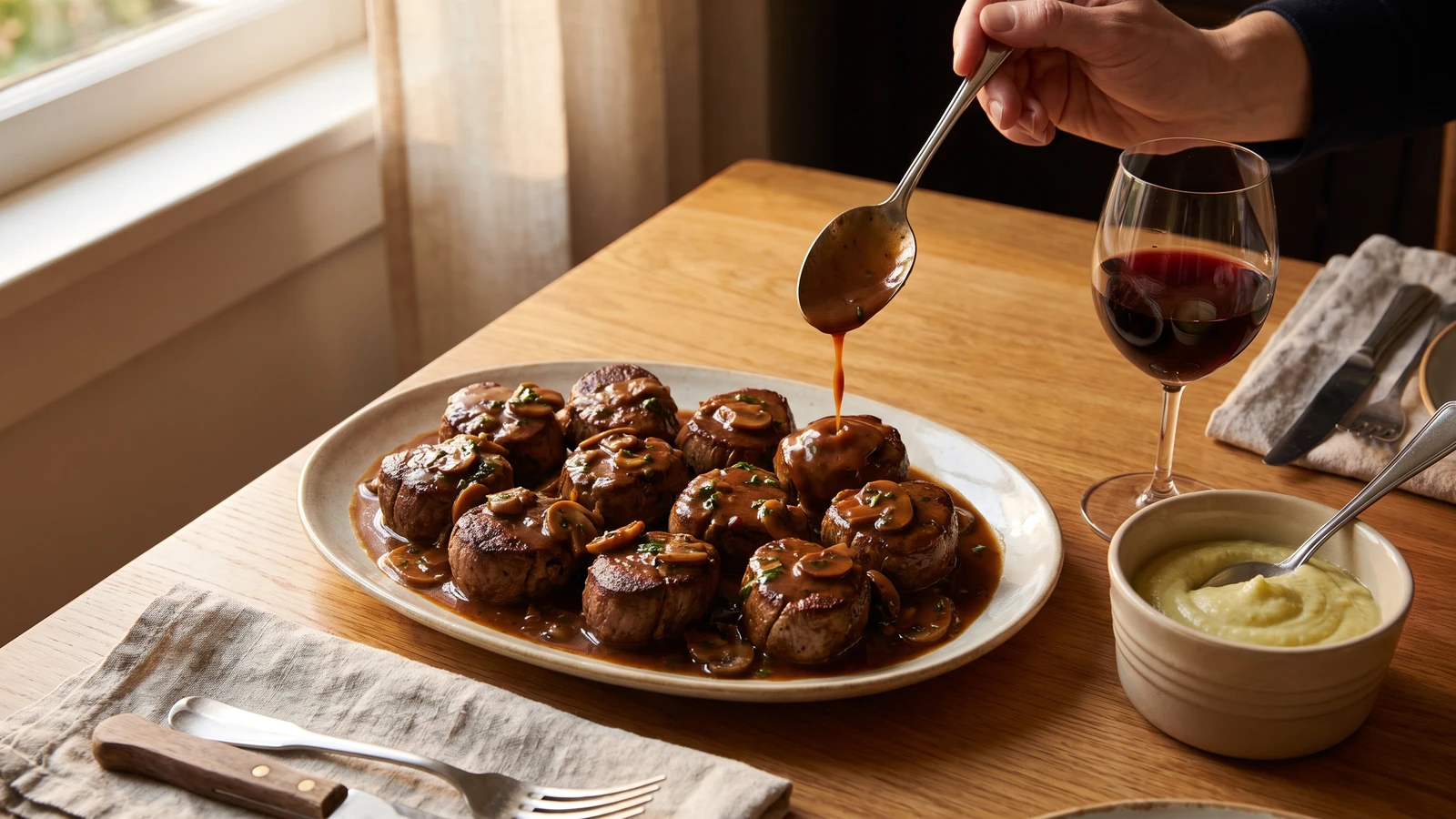
Rich, hand-chopped roebuck noisettes wrapped in caul and browned at the last moment, arranged in a generous crown beneath glossy Chasseur sauce, with smooth celery purée sent separately.
Noisettes de Chevreuil Villeneuve teaches the discipline of a cold farce, the enriched forcemeat that binds lean game without turning greasy. The roebuck is chopped by knife with one-third its weight each of fresh butter and milk-soaked, pressed crumb, then softened with the formula's measure of cream. Warm it before the pan and the butter escapes; keep it cold and the caul bastes twelve tender little rounds beneath a glossy coat of Chasseur sauce.
The original entry assumed a saucier on staff, stock never off the fire for the Chasseur sauce, a vegetable cook with celery purée ready, and enough hands to shape two-ounce portions during service. At home, that choreography is scaffolding: have both finished components ready, hold them separately, then use one board and one heavy skillet for the venison. I have scaled the meat to twelve ounces for four people and kept every ratio, the two-ounce portions, and the caul intact. One cook, one stove, one evening.
Cooking well is not cooking fancy. The knife-chopping, cold butter, pressed crumb, caul, and fast final cooking are the dish, so none of them goes. Keep the farce cold from the first chop through the wrapping; that is the one step that decides whether the noisettes stay succulent and round.
These noisettes belong to the formal French game table, where lean roe deer from the hunt was balanced with butter, cream, and caul before meeting a deeply built sauce. Villeneuve is a named classical treatment, not proof that the dish belongs to one of France's many towns called Villeneuve; its practical home is the grand kitchen and the bourgeois dinner table rather than a single region. The entry also corrects a common assumption about noisette: here it is not an intact loin medallion but a two-ounce hand-chopped round, served with Chasseur sauce and celery purée apart.
Quantity
12 oz (340 g)
completely cleared of tendons and silverskin and thoroughly chilled
Quantity
1/2 cup (120 ml / 113 g)
cut into small cubes
Quantity
about 4 packed cups (960 ml volume / 140 g)
use enough to yield 4 oz (113 g) after soaking and pressing
Quantity
1 cup (240 ml / 245 g)
for soaking the breadcrumbs; excess discarded
Quantity
1/2 cup plus 1 tablespoon plus 1 1/2 teaspoons (142 ml / 142 g)
Quantity
1 1/2 teaspoons (7.5 ml / 8 g)
Quantity
1/2 teaspoon (2.5 ml / 1 g)
Quantity
1 large sheet, about 8 oz (225 g)
soaked in cold water, rinsed, and patted dry
Quantity
1 tablespoon (15 ml / 14 g)
divided
Quantity
1 1/2 cups (360 ml / 360 g)
Quantity
2 cups (480 ml / 500 g)
| Ingredient | Quantity |
|---|---|
| boneless roebuck or venisoncompletely cleared of tendons and silverskin and thoroughly chilled | 12 oz (340 g) |
| cold unsalted buttercut into small cubes | 1/2 cup (120 ml / 113 g) |
| fresh white breadcrumbsuse enough to yield 4 oz (113 g) after soaking and pressing | about 4 packed cups (960 ml volume / 140 g) |
| whole milkfor soaking the breadcrumbs; excess discarded | 1 cup (240 ml / 245 g) |
| cold heavy cream | 1/2 cup plus 1 tablespoon plus 1 1/2 teaspoons (142 ml / 142 g) |
| fine salt | 1 1/2 teaspoons (7.5 ml / 8 g) |
| freshly ground black pepper | 1/2 teaspoon (2.5 ml / 1 g) |
| pig's caul fatsoaked in cold water, rinsed, and patted dry | 1 large sheet, about 8 oz (225 g) |
| clarified butterdivided | 1 tablespoon (15 ml / 14 g) |
| prepared Chasseur sauce | 1 1/2 cups (360 ml / 360 g) |
| prepared celery purée | 2 cups (480 ml / 500 g) |
Open the caul fat gently in a bowl of cold water and leave it for twenty minutes, then rinse and pat it dry without tearing its lacy web. Saturate the fresh breadcrumbs with the milk for five minutes, gather them in a clean cloth, and press firmly until no milk runs freely. Weigh exactly 4 ounces (113 g) of this panade, the milk-soaked bread binder. Chill the panade while you trim every tendon and strip of silverskin from the roebuck; connective tissue caught in a hand-chopped noisette remains stubborn under the teeth.
Cut the chilled roebuck into 1/2-inch (1.25 cm) dice and spread it over a cold, sturdy board. Chop rhythmically with a large sharp knife, scraping and turning the meat often. Once the pieces are lentil-sized, add the cold butter in four additions, chopping each through before adding the next; work in the pressed panade the same way. Scrape everything into a chilled bowl and beat in the cold cream a spoonful at a time, followed by the salt and pepper, until the farce is cohesive and finely textured but not smooth. If the butter begins to shine or smear, stop and chill the mixture for ten minutes. Ça se rattrape. A food processor would warm the fat and erase the knife-cut texture that defines this entry.
Cook a teaspoon of the farce in a trace of clarified butter and taste it. Correct the salt or pepper now, because seasoning cannot be repaired once the caul is wrapped. Weigh twelve portions of 2 ounces (57 g) each and shape them with cold, lightly dampened hands into neat rounds about 2 inches (5 cm) wide and 3/4 inch (2 cm) thick. If the mixture clings to your fingers or slumps, chill it rather than adding extra breadcrumbs; the ratio belongs to the dish.
Spread the caul flat and cut twelve pieces large enough to enclose the rounds once. Set a noisette in the centre of each piece, draw the caul around it without stretching, and trim away heavy overlaps. Place the noisettes seam-side down on a cold tray and chill for fifteen minutes. Caul contracts as it cooks, so wrap snugly, not tightly. If a piece tears, overlap it with a small lacy patch and carry on.
Warm the prepared Chasseur sauce in a small saucepan at a bare simmer, then hold it over the lowest heat. Warm the prepared celery purée separately, stirring until it is smooth and soft enough to hold a gentle mound. Do not boil either component. If the sauce tightens while it waits, whisk in a teaspoon of hot water; if the purée develops a skin, beat it back to smoothness.
Heat a 12-inch (30 cm) heavy skillet over medium-high heat and film it with half the clarified butter. Cook the noisettes in two uncrowded batches, seam-side down first, for about three minutes without moving them. Turn once and cook for another two to three minutes, until the caul has rendered nearly translucent, both faces are deeply browned, and the centre of a test noisette reaches 160°F (71°C). Hold the first batch on a warm rack for no more than five minutes. If the surface darkens before the centre is ready, lift the pan off the heat for thirty seconds, lower the flame, and resume gently. Never press them; the butter belongs inside.
Arrange the twelve noisettes in a close crown on a warmed serving platter. Nappez, coat each one with the hot Chasseur sauce, letting enough pool beneath to meet every serving without drowning the browned caul. Spoon the celery purée into a warmed timbale bowl and send it separately, exactly as the dish intends. Serve at once. À table!
1 serving (about 425g)
Culinary guides, cultural storytelling, and the editorial depth that makes cooking meaningful.
Discover Culinary ExplorerChef Juliette
John Dory has the delicacy of sole and the firmness of turbot. A light flouring, a quick butter sauté, and nut-brown beurre noisette show exactly why looks never mattered.

Chef Juliette
Fresh haddock proves its delicacy in the meunière pan: a fine flour crust, moist pearly flakes, and beurre noisette sharpened with lemon and parsley, ready from one skillet in half an hour.

Chef Juliette
Éperlans à l’Anglaise turns small fish into a lesson in disciplined coating: boned smelts under a close, crisp crumb, pan-fried in clarified butter and finished with bright, half-melted maître d’hôtel butter.

Chef Juliette
Tiny smelts, shallot, mushrooms, white wine, gratin sauce, and fine bread raspings meet a fierce oven, where the fish must turn tender in the same breath the buttered crust bronzes.