Culinary Explorer

A cooking platform built around craft, culture, and the stories behind what we eat.
Discover Culinary Explorer
Côtelettes de Chevreuil Diane

Côtelettes de Chevreuil Diane

Created by Chef Juliette

Based on No. 1802, Côtelettes de Chevreuil Diane, from Le Guide Culinaire (1907) by Auguste Escoffier

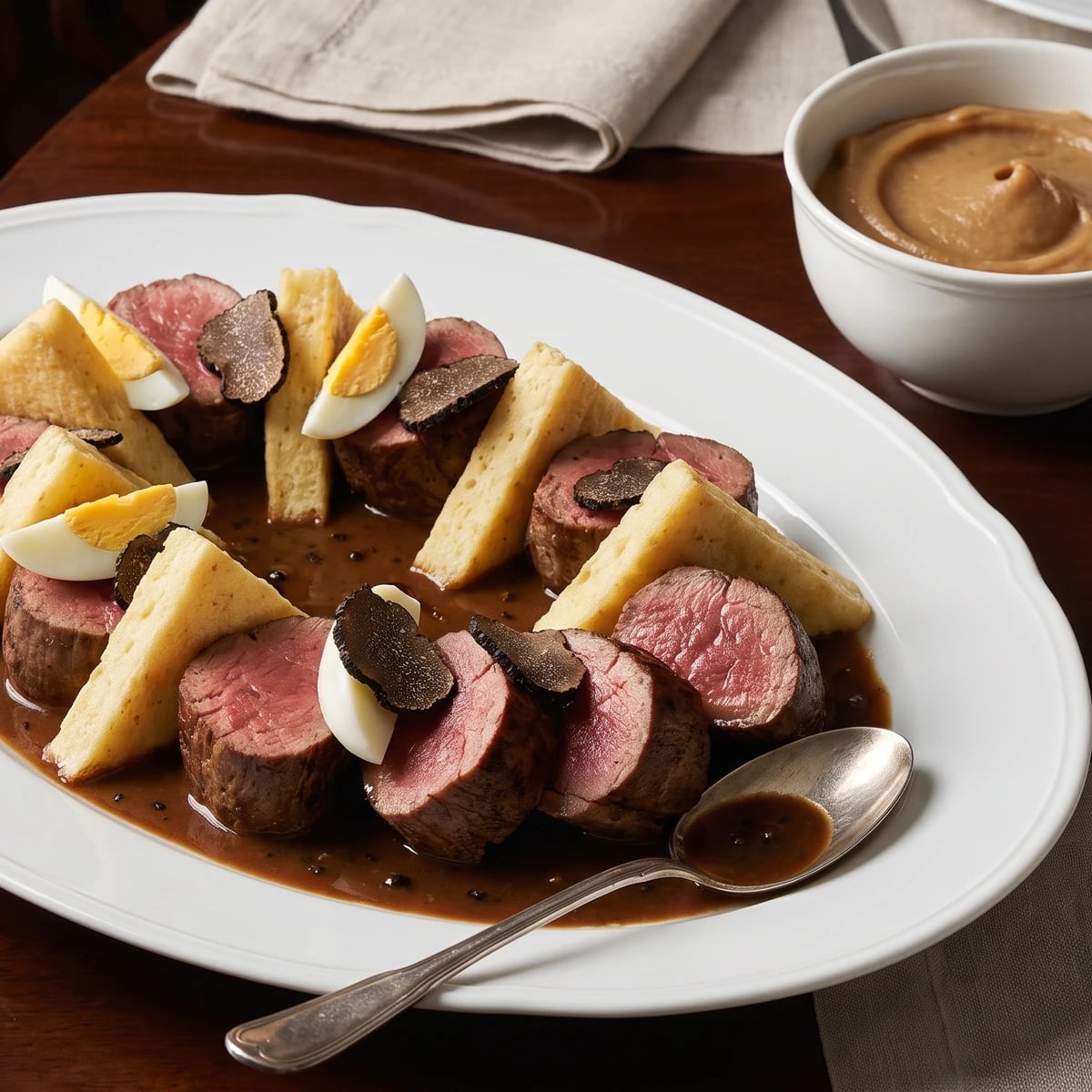
Côtelettes de Chevreuil Diane sets rosy venison between tender triangles of game mousseline, then draws them together with creamy poivrade, black truffle crescents, egg white, and chestnut purée served apart.

Main Dishes
French
Dinner Party
Special Occasion
Celebration
55 min
Active Time
1 hr 10 min cook2 hr 5 min total
Yield4 servings

Côtelettes de Chevreuil Diane (venison cutlets Diane) teaches orchestration. The one true thing to know before touching a pan is that the venison cooks last: the mousseline croûtons, poivrade, chestnut purée, truffle, and egg-white crescents must already be ready, because a rosy cutlet waits for no sauce.

The old entry assumed a saucier beside the range, a game-stock pot never off the fire, brigade trays of mousseline, and a steamer standing ready. A salamander had no work in this particular service, because nothing is gratinéed. At home, a food processor makes the fine forcemeat, a covered shallow pan in a moderate oven supplies the gentle poach, and one skillet builds the poivrade from browned aromatics, a small roux, vinegar, wine, and reduced stock before it cooks the cutlets. Vacuum-packed chestnuts replace the brigade's peeling station. Those are scaffolding changes, made for one cook, one stove, one evening.

What stays is the dish: a sheet of game mousseline one-third inch thick, cut into triangular croûtons equal to the cutlets; poivrade loosened with crème fouettée (softly beaten cream); truffle and hard-boiled white in crescents; chestnut purée served apart. At the table, the crown is bronze, ivory, and truffle-black, with peppered sauce shining around rosy centers. Make every accompaniment first, then sear the chevreuil. That sequence is the step that matters most.

Côtelettes de Chevreuil Diane belongs to the classical Parisian dining-room repertoire, where venison from the hunt was arranged for formal service and Diane, the huntress, signaled game rather than any regional larder. The dish traveled from the game kitchen to the grand table by turning trim into mousseline, so the animal supplied both cutlet and garnish. Its croûtons are not bread at all: the word describes the triangular separators cut from the poached forcemeat sheet.

The technique, the tradition, and the story behind every dish.

Discover Culinary Explorer

Ingredients

venison loin medallions

Quantity

8 (560 g total), about 2½ ounces each

cut 1 inch (2.5 cm) thick

lean venison trim, for the game mousseline

Quantity

9 ounces (250 g)

diced and very cold

large egg whites

Quantity

2 (¼ cup / 60 g)

chilled

heavy cream, for the game mousseline

Quantity

¾ cup (180 ml / 180 g)

ice-cold

fine sea salt

Quantity

3 teaspoons (15 ml / 18 g)

divided

freshly ground black pepper

Quantity

1 teaspoon (5 ml / 2 g)

divided

unsalted butter, for the mousseline tray

Quantity

1 tablespoon (15 ml / 14 g)

softened

salt pork or unsmoked bacon, for the poivrade

Quantity

¼ cup (60 ml / 30 g)

finely diced

unsalted butter, for the poivrade

Quantity

1 tablespoon (15 ml / 14 g)

shallot

Quantity

⅓ cup (80 ml / 50 g)

finely diced

carrot

Quantity

⅓ cup (80 ml / 45 g)

finely diced

all-purpose flour

Quantity

1 tablespoon (15 ml / 8 g)

tomato paste

Quantity

2 teaspoons (10 ml / 10 g)

red wine vinegar

Quantity

¼ cup (60 ml / 60 g)

dry red wine

Quantity

¾ cup (180 ml / 180 g)

unsalted game or good beef stock, for the poivrade and pan fond

Quantity

2 cups (480 ml / 480 g)

divided

black peppercorns

Quantity

2 teaspoons (10 ml / 5 g)

lightly crushed

thyme

Quantity

2 sprigs

bay leaf

Quantity

1

parsley stems

Quantity

4

heavy cream, for the poivrade

Quantity

⅓ cup (80 ml / 80 g)

cold

peeled cooked chestnuts

Quantity

3 cups loosely packed (720 ml / 400 g)

preferably vacuum-packed

unsalted game or good beef stock, for the chestnut purée

Quantity

¾ cup (180 ml / 180 g)

heavy cream, for the chestnut purée

Quantity

½ cup (120 ml / 120 g)

divided

unsalted butter, for the chestnut purée

Quantity

3 tablespoons (45 ml / 42 g)

cubed

clarified butter, for the cutlets

Quantity

3 tablespoons (45 ml / 40 g)

large eggs, for the hard-boiled white crescents

Quantity

2

black truffle

Quantity

1 small (about ¾ ounce / 20 g)

fresh or whole preserved and drained

Equipment Needed

  • 7-cup (1.7-liter) food processor
  • 9 by 13-inch (23 by 33 cm) shallow metal pan and a larger roasting pan
  • 12-inch (30 cm) heavy skillet
  • Fine-mesh sieve
  • Instant-read thermometer
  • Small round cutter or sharp paring knife

Instructions

  1. 1

    Build the poivrade

    Render the salt pork with the tablespoon of butter in a heavy saucepan over medium heat. Add the shallot and carrot, then cook for 8 to 10 minutes, stirring often, until the vegetables are deeply browned rather than merely softened. Stir in the flour for 2 minutes, then the tomato paste for 1 minute. Add the vinegar and reduce it until scarcely a tablespoon remains. Pour in the wine, scraping the pan clean, and reduce by half. Add 1¾ cups (420 ml) of the stock, the thyme, bay, and parsley stems. Simmer gently for 25 minutes, adding the crushed peppercorns for the final 8 minutes so they remain fragrant rather than bitter. Strain through a fine sieve, pressing the vegetables, then reduce to about 1 cup (240 ml), nappant, thick enough to coat the back of a spoon. Season with ½ teaspoon of the salt. If the roux forms lumps, whisk firmly and strain as directed. Ça se rattrape.

  2. 2

    Make chestnut purée

    Combine the chestnuts and their ¾ cup (180 ml) of stock in a covered saucepan. Simmer gently for 15 minutes, until the chestnuts crush easily beneath a spoon. Purée them while hot in the food processor, then return them to the pan with 6 tablespoons (90 ml) of the cream and all the cubed butter. Season with ½ teaspoon salt and ¼ teaspoon black pepper. Beat over low heat until smooth, dense, and spoonable. Hold it covered over the lowest heat, stirring occasionally. If it tightens or turns grainy, beat in the reserved 2 tablespoons (30 ml) cream a little at a time. The purée should mound softly, not stand like mortar.

  3. 3

    Cut the crescents

    Lower the whole eggs into gently simmering water and cook for 10 minutes, then cool and peel them. Separate the whites from the yolks. Slice the whites into thin rounds and use the edge of a small round cutter to cut neat crescents. Slice the truffle equally thin and cut matching crescents. Keep both covered until service so the egg white does not dry and the truffle keeps its perfume.

  4. 4

    Emulsify the mousseline

    Chill the cleaned food-processor bowl and blade before beginning. Process the cold venison trim with 1 teaspoon salt and ¼ teaspoon black pepper until the meat becomes fine and tacky. Add the egg whites and process just until absorbed. Add the ice-cold cream in four small additions, pulsing only until each disappears and the mousseline, a fine cream-bound forcemeat, looks glossy and cohesive. Stop if the bowl or paste begins to feel warm. If the mixture turns oily or grainy before all the cream is incorporated, chill it for 10 minutes, then pulse it smooth before continuing. Ça se rattrape. Poach a teaspoonful in barely simmering water until it reaches 160°F (71°C), then taste it to confirm the seasoning.

    Cold is the discipline here. Warm fat separates from the meat proteins, while cold cream joins them into a tender emulsion.
  5. 5

    Poach the sheet

    Heat the oven to 300°F (150°C). Butter a shallow 9 by 13-inch (23 by 33 cm) metal pan and line its base with parchment. Spread the mousseline in an even layer exactly one-third inch (8 mm) thick, smoothing the surface without compressing it. Cover with parchment and foil, set the pan inside a larger roasting pan, and add hot water to reach halfway up its sides. Bake for 12 to 16 minutes, until the sheet is just firm and reaches 160°F (71°C) at its center without coloring. Rest for 5 minutes, turn it onto a board, and cut 8 triangles equal in scale to the venison cutlets. These are the croûtons of the source entry, made from forcemeat rather than bread. Keep them covered and warm.

  6. 6

    Sear the chevreuil

    Pat the medallions completely dry and season them with the remaining 1 teaspoon salt and ½ teaspoon black pepper. Heat half the clarified butter in a heavy skillet over medium-high heat. Sear the cutlets in two uncrowded batches, adding the remaining butter as needed, until both faces carry a deep Maillard bronze, about 2 minutes per side for 1-inch (2.5 cm) pieces. Lower the heat if the fond darkens faster than the meat. Remove each cutlet at 138 to 140°F (59 to 60°C), then rest for 5 minutes so it reaches 145°F (63°C). If a center remains under after resting, return it to the pan for 30 seconds per side. If the fond has burned black, wipe it away before the next batch; bitter fond has no place in the poivrade.

    Venison loin is lean and carries little protection against excess heat. Use the thermometer early, because the final few degrees arrive quickly.
  7. 7

    Lighten the poivrade

    Pour excess fat from the skillet, leaving the brown fond. Deglaze with the reserved ¼ cup (60 ml) stock, scraping until every savory speck dissolves, then add the poivrade base and simmer until it is once again nappant. Reserve 1 tablespoon of the cold cream, then beat the remainder to soft folds. Take the skillet off the heat and fold in this crème fouettée without boiling the sauce afterward. The poivrade should remain glossy and flow slowly from a spoon. If it looks grainy or begins to separate, keep it off the heat and whisk in the reserved cold cream one teaspoon at a time. Ça se rattrape.

  8. 8

    Build the crown

    Arrange the venison cutlets in a close crown on a warmed oval platter, separating each one with a triangular croûton of game mousseline. Spoon the creamy poivrade over the whole crown, allowing it to pool generously beneath. Lay the truffle and hard-boiled egg-white crescents over the top in an alternating pattern. Bring the chestnut purée separately in a warmed bowl, exactly as the entry directs. Serve immediately. À table!

Chef Tips

  • Chevreuil properly means roe deer. Where roe deer is unavailable, ask for boneless venison loin or saddle from red or fallow deer and have it cut into even medallions; the flavor changes slightly, but the lean structure and quick cooking remain right.
  • A fresh black truffle is splendid when the season offers one, but a whole preserved truffle is the classical pantry's honest answer. Truffle oil cannot be cut into crescents and does not belong in this garnish.
  • Here croûtons describes the triangular separators cut from the game mousseline, not fried bread. Keep their size close to the cutlets so the crown reads as one generous composition rather than a row of unrelated pieces.
  • Serve a mature, restrained red with enough acidity for the cream and chestnuts. Red Burgundy is a natural companion, while an older northern Rhône brings pepper that meets the poivrade without overwhelming the venison.

Advance Preparation

  • The poivrade base can be made up to 2 days ahead, chilled, and reheated gently. Add the crème fouettée only after the cutlets have been cooked and their fond has joined the sauce.
  • The chestnut purée can be prepared 1 day ahead. Reheat it over low heat with a spoonful of cream or stock, beating until its soft texture returns.
  • The mousseline sheet can be poached and cut earlier the same day. Keep the triangles covered in the cold, then warm them gently in a covered pan before assembling the crown.
  • Cut the egg-white and truffle crescents several hours ahead and hold them separately under cover. Sear the venison only when the platter, sauce, mousseline, and purée are ready.

Frequently Asked Questions

Nutrition Information

1 serving (about 480g)

Calories
1115 calories
Total Fat
72 g
Saturated Fat
42 g
Trans Fat
2 g
Unsaturated Fat
27 g
Cholesterol
290 mg
Sodium
2200 mg
Total Carbohydrates
56 g
Dietary Fiber
7 g
Sugars
16 g
Protein
61 g

Note: Chef personas and recipes are created with AI assistance. Cook with care: follow safe food-handling practices, check doneness with a thermometer when needed, and adapt for allergies and your kitchen.

Where cooking meets culture.

Culinary guides, cultural storytelling, and the editorial depth that makes cooking meaningful.

Discover Culinary Explorer

More from Poultry (Volaille) - Venison and Ground Game

Browse the full collection