
Chef Juliette
Selle de Chevreuil et Cuissot
Selle de Chevreuil et Cuissot teaches the discipline of game: strip every tendon, skip marinade for a young, well-hung joint, roast in butter, and stop before leanness turns to dryness.
A cooking platform built around craft, culture, and the stories behind what we eat.
Created by Chef Juliette
Based on No. 1801, Côtelettes de Chevreuil Conti, from Le Guide Culinaire (1907) by Auguste Escoffier
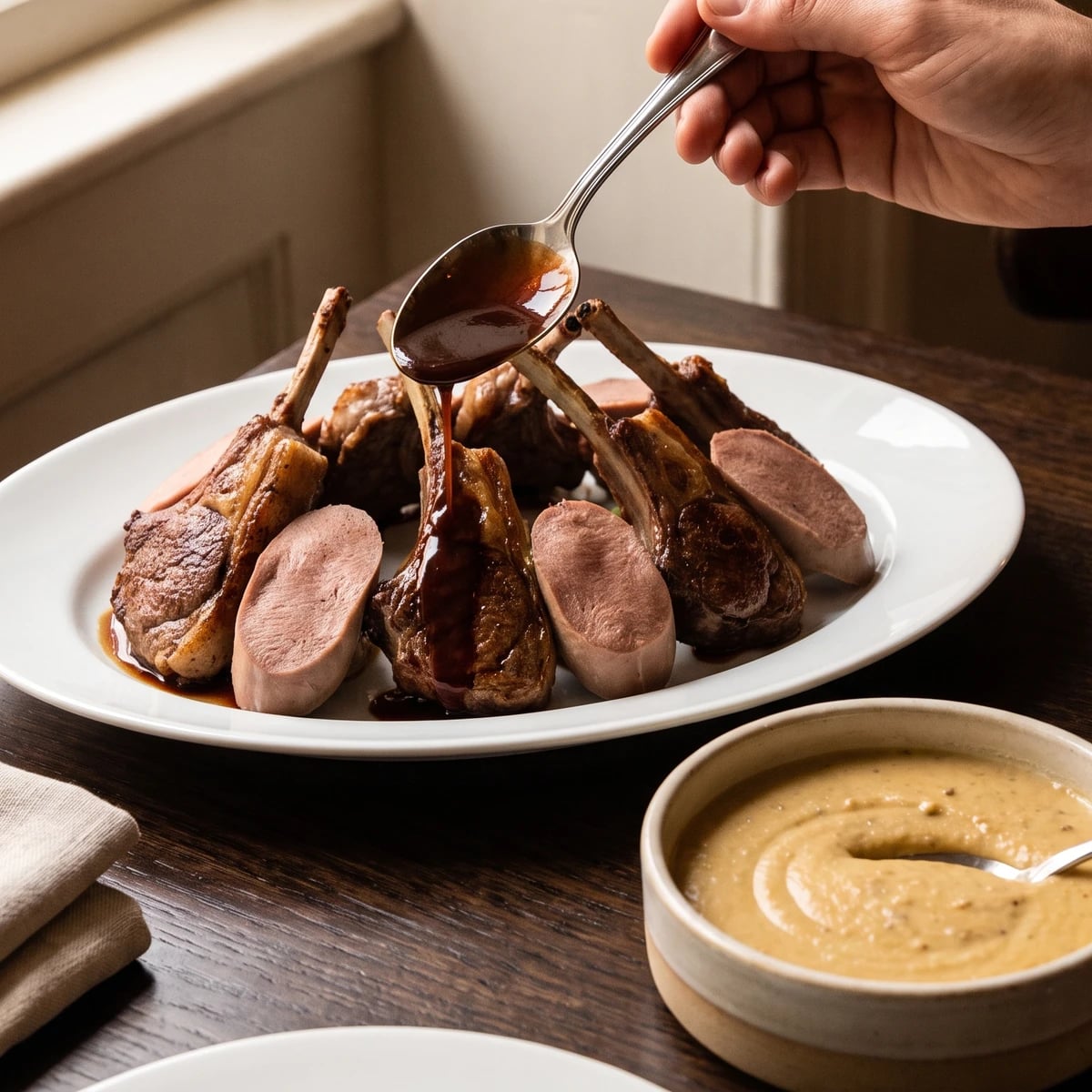
Hot-sautéed venison, just pink at the center, stands in a crown with salted tongue, while white-wine poivrade gleams over the meat and a light buttered lentil purée waits alongside.
Côtelettes de Chevreuil Conti (Conti-style venison cutlets) teaches the discipline of cooking lean game only after everything else is ready. Sauté, quick cooking in a shallow film of fiercely hot fat, gives the cutlets their bronze crust, but venison grants you very little time between properly cooked and dry. The poivrade must be waiting, the tongue shaped, the lentil purée warm, and the platter ready before the meat touches the pan.
The original entry assumed a saucier on staff, Sauce Poivrade already simmering, salted tongue prepared by the charcuterie kitchen, stock never off the fire, and brigade portions arranged on a grand platter. A salamander might have stood nearby, but this dish never asks for gratination, so your broiler stays cold. Here, concentrated brown stock, a small roux, vinegar, and pepper build the poivrade in one saucepan; cooked salted beef tongue replaces several days of curing and simmering; eight cutlets feed four. One cook, one stove, one evening.
Preparing tongue from raw and maintaining a separate pot of brown sauce are brigade scaffolding, so they can go. The smoking-hot sauté, the white wine swilled through the venison fond, the poivrade, and the pairing of salted tongue with buttered lentil purée are the dish itself, and they stay. Have every component ready, then guard the cutlets closely when they meet the pan. That is the step that decides the evening.
Côtelettes de Chevreuil Conti belongs to the Parisian grand-kitchen repertory, where named garnitures allowed a dining room to recognize a complete arrangement before the platter arrived. Conti does not make the dish Italian or identify a French regional larder; here the name marks the formal union of game cutlets, salted tongue, Sauce Poivrade, and buttered lentil purée, a composition that traveled from banquet service to ambitious bourgeois tables.
Quantity
8 (about 2 lb / 900 g total)
trimmed and cut 1 to 1¼ inches thick
Quantity
8 slices (about 10 oz / 280 g total)
cut about ¼ inch thick
Quantity
¾ cup (180 ml / 150 g)
rinsed
Quantity
4½ cups (1.08 L / 1.08 kg)
divided
Quantity
1 small (about 4 oz / 115 g)
halved
Quantity
1 medium (about 3 oz / 85 g)
divided
Quantity
1 stalk (about 1½ oz / 40 g)
finely diced
Quantity
1 small (about 1 oz / 30 g)
finely diced
Quantity
1
Quantity
1
Quantity
8 tablespoons (120 ml / 113 g)
divided
Quantity
1½ tablespoons (22 ml / 12 g)
Quantity
1 tablespoon (15 ml / 17 g)
Quantity
1½ teaspoons (7.5 ml / 5 g)
coarsely crushed
Quantity
⅓ cup (80 ml / 80 g)
Quantity
½ cup (120 ml / 120 g)
Quantity
2 tablespoons (30 ml / 27 g)
Quantity
2 teaspoons (10 ml / 12 g)
divided
Quantity
1 teaspoon (5 ml / 2 g)
| Ingredient | Quantity |
|---|---|
| venison rib cutletstrimmed and cut 1 to 1¼ inches thick | 8 (about 2 lb / 900 g total) |
| cooked salted beef tonguecut about ¼ inch thick | 8 slices (about 10 oz / 280 g total) |
| French green or brown lentilsrinsed | ¾ cup (180 ml / 150 g) |
| low-sodium brown game or beef stockdivided | 4½ cups (1.08 L / 1.08 kg) |
| yellow onionhalved | 1 small (about 4 oz / 115 g) |
| carrotdivided | 1 medium (about 3 oz / 85 g) |
| celeryfinely diced | 1 stalk (about 1½ oz / 40 g) |
| shallotfinely diced | 1 small (about 1 oz / 30 g) |
| bay leaf | 1 |
| bouquet garni | 1 |
| unsalted butterdivided | 8 tablespoons (120 ml / 113 g) |
| plain flour | 1½ tablespoons (22 ml / 12 g) |
| tomato paste | 1 tablespoon (15 ml / 17 g) |
| black peppercornscoarsely crushed | 1½ teaspoons (7.5 ml / 5 g) |
| red wine vinegar | ⅓ cup (80 ml / 80 g) |
| dry white wine | ½ cup (120 ml / 120 g) |
| refined grapeseed or sunflower oil | 2 tablespoons (30 ml / 27 g) |
| fine saltdivided | 2 teaspoons (10 ml / 12 g) |
| freshly ground black pepper | 1 teaspoon (5 ml / 2 g) |
Take the venison from the cold about 25 minutes before cooking. Cut each tongue slice into an oval resembling the eye of a cutlet, using a small cutter or a sharp knife, then cover and leave at cool room temperature. Save the trimmings for another meal. Finely dice half the carrot for the poivrade and leave the other half in a large piece for the lentils. Set a serving platter and a bowl for the purée in a low oven, about 200°F (95°C).
Put the lentils in a saucepan with the onion, the large piece of carrot, bay leaf, 2½ cups of the stock, and ½ teaspoon of the salt. Bring to a gentle simmer and cook uncovered for 25 to 35 minutes, until completely tender but not burst into sludge. Remove the aromatics, reserving any cooking liquor. Pass the lentils through a food mill, or pulse them briefly in a food processor, then beat in 4 tablespoons of butter and enough reserved liquor to make a light purée that falls softly from a spoon. If it becomes dense, add warm stock a tablespoon at a time; if it is loose, stir it over low heat for a minute. Ça se rattrape. Cover closely and keep warm.
Melt 2 tablespoons of butter in a small saucepan over medium heat. Add the diced carrot, celery, and shallot, then cook until deeply golden, about 8 minutes. Stir in the flour and cook until it smells nutty and turns the color of a hazelnut. Add the tomato paste and crushed peppercorns, cooking for another minute. Pour in the vinegar and reduce until only a moist glaze remains, then add 1½ cups of stock and the bouquet garni. Simmer gently for 25 minutes, skimming as needed, until the sauce is nappé, thick enough to coat the back of a spoon. Strain through a fine sieve and press lightly on the vegetables. Hold the poivrade over the gentlest heat. If it tightens, loosen it with a spoonful of stock; if it remains thin, reduce it further.
Dry the venison thoroughly with paper towels, including around the bones. Season immediately before cooking with the remaining salt and the ground pepper. Wet meat cannot sauté properly because its surface must shed water before it can brown. Keep a rack set over a tray beside the stove so the cooked cutlets can drain without sitting in their oil.
Heat a heavy 12-inch skillet over high heat, add the oil, and wait for the first clear wisp from its surface. Sauté the cutlets in two uncrowded batches, about 2 to 3 minutes on the first side and 2 minutes on the second, until richly bronzed. Reduce the heat slightly if the crust races ahead of the center. Lift the cutlets to the rack when an instant-read thermometer reaches about 140°F (60°C), then rest them for at least 3 minutes and confirm they reach 145°F (63°C); if they do not, return them to the pan for 20 to 30 seconds per side. Blot only the beads of excess oil around their edges. If the pan fond turns black rather than mahogany, wipe it away before the next batch and add fresh oil. You lose a little fond, not the dinner.
Pour away the excess frying oil while leaving the brown fond in the skillet. Add the white wine and swill it around the hot pan, scraping up every mahogany speck. Reduce the wine by half, then strain this liquor into the waiting Sauce Poivrade and simmer for 2 minutes. Take the sauce off the heat and whisk in the remaining 2 tablespoons of cold butter, a little at a time, until it gleams. Do not boil after the butter goes in. If the sauce looks greasy, whisk a teaspoon of cold stock in a clean warm pan, then add the sauce back gradually. Ça se rattrape.
Arrange the cutlets upright in a close crown on the warm platter, overlapping them slightly and placing one similarly shaped collop of salted tongue between each pair. Spoon the poivrade over the meat so it coats the cutlets and pools lightly beneath them without burying the tongue. Beat the lentil purée once more, loosening it with warm stock if needed, then send it alongside in its warmed bowl. Serve immediately. À table!
1 serving (about 410g)
Culinary guides, cultural storytelling, and the editorial depth that makes cooking meaningful.
Discover Culinary Explorer
Chef Juliette
Selle de Chevreuil et Cuissot teaches the discipline of game: strip every tendon, skip marinade for a young, well-hung joint, roast in butter, and stop before leanness turns to dryness.

Chef Juliette
A three-day marinade perfumes this lean saddle, but the roast lives or dies by its rosy center; the tray fond, cream, meat glaze, and one juniper berry make the sauce.

Chef Juliette
A butter-poêled venison saddle, carved rosy and flanked by unsweetened pears scented with cinnamon and lemon, with clear game jus and redcurrant jelly at the table.

Chef Juliette
Verjuice perfumes rather than pickles this saddle, while a thermometer protects its rosy centre. Poivrade and red-currant jelly meet in strict equality, with semi-candied cherries folded through for the generous game table.