
Chef Juliette
Selle de Chevreuil et Cuissot
Selle de Chevreuil et Cuissot teaches the discipline of game: strip every tendon, skip marinade for a young, well-hung joint, roast in butter, and stop before leanness turns to dryness.
A cooking platform built around craft, culture, and the stories behind what we eat.
Created by Chef Juliette
Based on No. 1799, Selle de Chevreuil avec Sauces Diverses, from Le Guide Culinaire (1907) by Auguste Escoffier
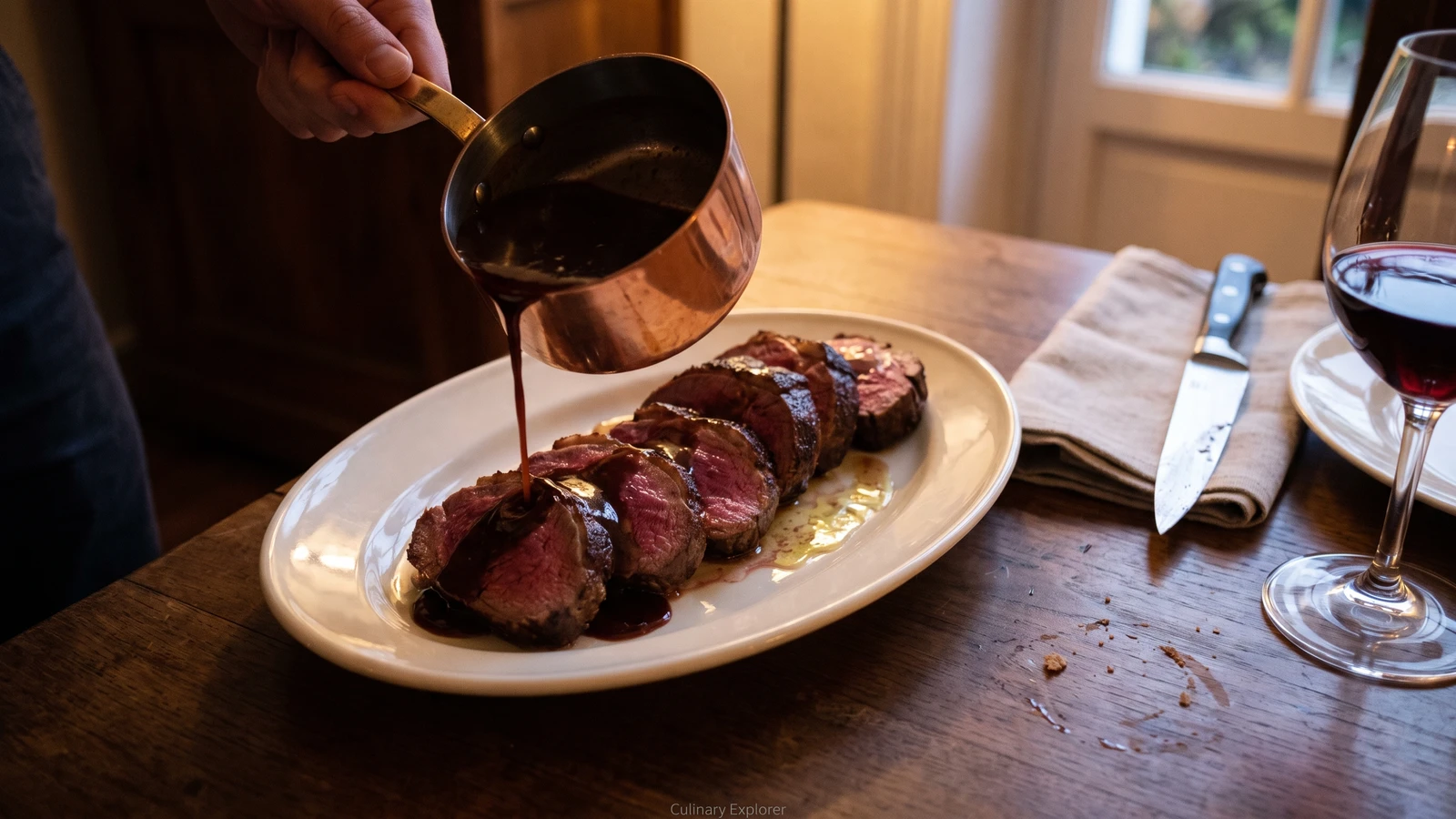
Roebuck saddle roasted rosy and carved thick, with a choice of five classical sauces that prove the accompaniment is not an accessory here: it gives the dish its proper name and final character.
Selle de Chevreuil avec Sauces Diverses (roebuck saddle with a choice of classical sauces) teaches one of the canon's clearest lessons: the sauce names the dish. Poivrade supplies the foundation for venaison, grand-veneur, and moscovite, while Robert follows its own road through onion, white wine, and mustard. C'est la même grammaire: fond, reduction, balance, and a finish chosen to suit the meat.
The original entry was a service instruction for a brigade. It assumed a roast station, a saucier on staff, a stock never off the fire, a larding needle, and a salamander waiting to restore heat before the platter left the kitchen. For four people, one trimmed saddle, a bard of unsmoked pork fat, good unsalted veal demi-glace, an instant-read thermometer, and a platter warmed in the switched-off oven do the same work. The brigade equipment was scaffolding and can go. The reduction and precise roasting are the dish and must stay.
When it reaches the table, the saddle should be deeply browned outside and rosy within, its slices resting beside a sauce glossy enough to hold a clean path through the spoon. Build that sauce before the meat meets the heat. The sauce can wait for the saddle, but this lean roast will not wait for the sauce.
Selle de chevreuil belongs to the French table of the chasse, particularly the wooded game country of Sologne, Burgundy, and Alsace, where roe deer furnished a prized and exceptionally lean roast. Grand kitchens carried the intact saddle, both loins still joined by the backbone, into formal service and named it by its accompaniment, so poivrade, venaison, grand-veneur, moscovite, and Robert describe five finished identities rather than five roasting methods. The entry's economy is the revealing point: the roast remains constant while sauce taxonomy does the naming.
Quantity
1, about 3 to 3½ pounds (1.4 to 1.6 kg)
Quantity
6 ounces (170 g)
thinly sliced
Quantity
2 teaspoons (10 ml / 12 g)
Quantity
1 teaspoon (5 ml / 2 g)
Quantity
8
lightly crushed
Quantity
1 tablespoon (15 ml / 14 g)
Quantity
3 tablespoons (45 ml / 42 g)
Quantity
2
lightly crushed
Quantity
4
Quantity
2 tablespoons (30 ml / 30 g)
Quantity
1½ cups (360 ml / 350 g)
thawed
Quantity
4 ounces (115 g)
Quantity
2 tablespoons (30 ml / 28 g)
Quantity
¾ cup (180 ml / 110 g)
diced
Quantity
½ cup (120 ml / 70 g)
diced
Quantity
⅓ cup (80 ml / 45 g)
diced
Quantity
⅓ cup (80 ml / 80 g)
Quantity
1 cup (240 ml / 240 g)
Quantity
1 cup (240 ml / 240 g)
Quantity
2
Quantity
1
Quantity
4
Quantity
1 teaspoon (5 ml / 3 g)
lightly crushed
Quantity
2 tablespoons (30 ml / 28 g)
diced
Quantity
2 tablespoons (30 ml / 40 g)
Quantity
2 tablespoons (30 ml / 40 g)
Quantity
⅓ cup (80 ml / 80 g)
Quantity
¼ cup (60 ml / 60 g)
Quantity
6
lightly crushed
Quantity
¼ cup (60 ml / 60 g)
Quantity
1 tablespoon (15 ml / 20 g)
Quantity
2 tablespoons (30 ml / 28 g)
Quantity
1 cup (240 ml / 150 g)
thinly sliced
Quantity
½ cup (120 ml / 120 g)
Quantity
2 tablespoons (30 ml / 30 g)
| Ingredient | Quantity |
|---|---|
| whole trimmed roebuck or roe deer saddle, bone-in | 1, about 3 to 3½ pounds (1.4 to 1.6 kg) |
| unsmoked streaky bacon or pork back fatthinly sliced | 6 ounces (170 g) |
| fine sea salt | 2 teaspoons (10 ml / 12 g) |
| freshly ground black pepper | 1 teaspoon (5 ml / 2 g) |
| juniper berrieslightly crushed | 8 |
| neutral oil | 1 tablespoon (15 ml / 14 g) |
| unsalted butter for roasting | 3 tablespoons (45 ml / 42 g) |
| garlic cloveslightly crushed | 2 |
| thyme sprigs | 4 |
| water for deglazing | 2 tablespoons (30 ml / 30 g) |
| unsalted veal demi-glace for the chosen saucethawed | 1½ cups (360 ml / 350 g) |
| poivrade-family roebuck or venison trimmings, or unsalted beef shank scraps (optional) | 4 ounces (115 g) |
| poivrade-family unsalted butter (optional) | 2 tablespoons (30 ml / 28 g) |
| poivrade-family yellow onion (optional)diced | ¾ cup (180 ml / 110 g) |
| poivrade-family carrot (optional)diced | ½ cup (120 ml / 70 g) |
| poivrade-family celery (optional)diced | ⅓ cup (80 ml / 45 g) |
| poivrade-family red wine vinegar (optional) | ⅓ cup (80 ml / 80 g) |
| poivrade-family dry red wine (optional) | 1 cup (240 ml / 240 g) |
| poivrade-family unsalted game or beef stock (optional) | 1 cup (240 ml / 240 g) |
| poivrade-family thyme sprigs (optional) | 2 |
| poivrade-family bay leaf (optional) | 1 |
| poivrade-family parsley stems (optional) | 4 |
| poivrade-family black peppercorns (optional)lightly crushed | 1 teaspoon (5 ml / 3 g) |
| cold unsalted butter for a Poivrade or Venaison finish (optional)diced | 2 tablespoons (30 ml / 28 g) |
| Sauce Venaison redcurrant jelly (optional) | 2 tablespoons (30 ml / 40 g) |
| Sauce Grand-Veneur redcurrant jelly (optional) | 2 tablespoons (30 ml / 40 g) |
| Sauce Grand-Veneur heavy cream (optional) | ⅓ cup (80 ml / 80 g) |
| Sauce Moscovite sweet Malaga wine or medium Madeira (optional) | ¼ cup (60 ml / 60 g) |
| Sauce Moscovite juniper berries (optional)lightly crushed | 6 |
| Sauce Moscovite heavy cream (optional) | ¼ cup (60 ml / 60 g) |
| Sauce Moscovite redcurrant jelly (optional) | 1 tablespoon (15 ml / 20 g) |
| Sauce Robert unsalted butter (optional) | 2 tablespoons (30 ml / 28 g) |
| Sauce Robert yellow onion (optional)thinly sliced | 1 cup (240 ml / 150 g) |
| Sauce Robert dry white wine (optional) | ½ cup (120 ml / 120 g) |
| Sauce Robert Dijon mustard (optional) | 2 tablespoons (30 ml / 30 g) |
Choose one sauce before beginning. Poivrade is peppery, wine-dark, and direct. Venaison softens poivrade with tart redcurrant jelly. Grand-veneur adds both cream and jelly, giving the broadest and most generous sauce. Moscovite carries cream, juniper, and sweet fortified wine. Robert stands apart with onion, white wine, and mustard. Prepare only the ingredients for your chosen path, because the selected accompaniment determines the finished dish's proper title.
For Poivrade, Venaison, Grand-Veneur, or Moscovite, melt the poivrade-family butter in a heavy saucepan and brown the trimmings thoroughly. Add the diced onion, carrot, and celery, then cook until the vegetables take a deep bronze at their edges and a brown fond forms across the pan floor. Pour in the red wine vinegar and scrape well, reducing until only a glaze remains. Add the red wine and reduce by two-thirds, then add the stock, veal demi-glace, thyme, bay leaf, and parsley stems. Hold at a bare simmer for 35 minutes, skimming the surface when needed. Add the crushed peppercorns for the final 10 minutes, then strain through a fine sieve and reduce to about 1½ cups (360 ml), thick enough to nappe, or coat, the back of a spoon. If it remains thin, keep reducing. If it tightens too far, loosen it with a spoonful of stock. Ça se rattrape.
If Robert is your choice, melt its butter over medium-low heat and cook the sliced onion with a small pinch of the measured salt until tender and properly golden, about 12 minutes. Add the white wine and reduce until the pan is nearly dry. Stir in the veal demi-glace and simmer gently for 15 minutes, then strain, pressing lightly on the onion, and return the sauce to a clean saucepan. Do not add the mustard yet. Mustard is the final seasoning and hard boiling robs it of its point.
Heat the oven to 450°F (230°C). Dry the saddle thoroughly, then season it with the remaining salt, ground pepper, and crushed juniper. Lay the unsmoked bacon or back fat over both loins and tie it crosswise with butcher's twine at 1½-inch (4 cm) intervals. Heat the oil in a large ovenproof pan and brown the underside and exposed ends of the saddle for 4 to 5 minutes. Turn it upright, add the roasting butter, garlic, and thyme, and baste well. Roast for 12 minutes, remove the bard and twine, baste again, then lower the oven to 400°F (200°C). Continue roasting until the thickest loin registers 128 to 130°F (53 to 54°C), usually another 10 to 18 minutes. The temperature will continue to rise as the meat rests. This saddle is lean and crosses from rosy to grey quickly, so begin checking early. If it overshoots, remove it at once, rest it properly, then carve a little thinner and serve the sauce beneath the slices. The sauce restores generosity even when it cannot reverse the heat.
Transfer the saddle to a warm platter and rest it loosely covered for 15 minutes. Set the roasting pan over medium heat, pour in the water, and scrape up every dark morsel of fond. Strain this deglazing liquid into the chosen sauce, along with any juices gathered beneath the resting saddle, then skim away excess fat. This small addition joins roast and sauce into one dish; do not discard it.
For Poivrade, warm the sauce gently, take it off the heat, and whisk in the cold butter piece by piece. For Venaison, dissolve the redcurrant jelly in the warm poivrade, then whisk in the cold butter off the heat. For Grand-Veneur, whisk the cream and jelly into the poivrade and simmer only until smooth and lightly thickened. For Moscovite, warm the Malaga with the crushed juniper, cover for 10 minutes, strain it into the poivrade, then add the cream and jelly and reduce gently to a gloss. For Robert, take the hot onion and wine sauce off the heat and whisk in the Dijon mustard. Taste every sauce for salt only after its finish is added. If a cream sauce separates, remove it from the heat, whisk a spoonful of reserved cold cream in a clean pan, then incorporate the broken sauce gradually. Ça se rattrape. Once butter or mustard has gone in, keep the sauce warm without boiling.
Run a long knife down each side of the backbone and lift the two loins away whole. Turn each loin flat and cut it across the grain into generous slices about ½ inch (1.25 cm) thick. Arrange them on the warmed platter with their rosy centres visible, spoon a little sauce beneath them, and send the remainder in a warm saucière. Announce the dish by its sauce: Selle de Chevreuil, Sauce Poivrade; Sauce Venaison; Sauce Grand-Veneur; Sauce Moscovite; or Sauce Robert. Never drown the meat. The sauce should accompany every bite while leaving the saddle unmistakably itself. À table!
1 serving (about 315g)
Culinary guides, cultural storytelling, and the editorial depth that makes cooking meaningful.
Discover Culinary ExplorerChef Juliette
Selle de Chevreuil et Cuissot teaches the discipline of game: strip every tendon, skip marinade for a young, well-hung joint, roast in butter, and stop before leanness turns to dryness.

Chef Juliette
A three-day marinade perfumes this lean saddle, but the roast lives or dies by its rosy center; the tray fond, cream, meat glaze, and one juniper berry make the sauce.

Chef Juliette
A butter-poêled venison saddle, carved rosy and flanked by unsweetened pears scented with cinnamon and lemon, with clear game jus and redcurrant jelly at the table.

Chef Juliette
Verjuice perfumes rather than pickles this saddle, while a thermometer protects its rosy centre. Poivrade and red-currant jelly meet in strict equality, with semi-candied cherries folded through for the generous game table.