
Chef Juliette
John Dory (St. Pierre)
John Dory has the delicacy of sole and the firmness of turbot. A light flouring, a quick butter sauté, and nut-brown beurre noisette show exactly why looks never mattered.
A cooking platform built around craft, culture, and the stories behind what we eat.
Created by Chef Juliette
Based on No. 1797, Selle de Chevreuil à la Beaujeu, from Le Guide Culinaire (1907) by Auguste Escoffier
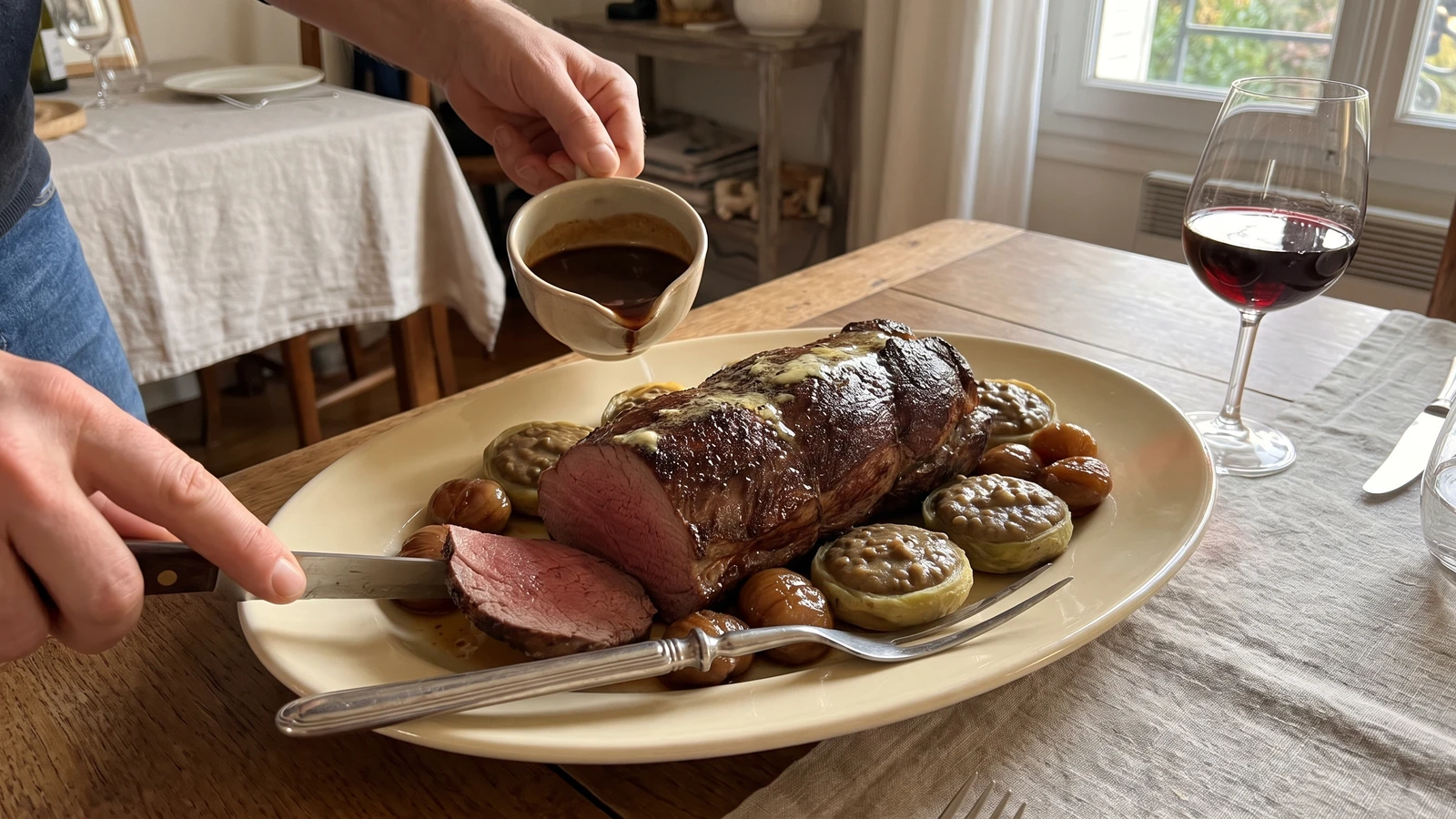
A larded saddle roasted rosy, framed with lentil-filled artichoke bottoms and consommé-glazed chestnuts, with Sauce Chevreuil passed separately: a composed game roast whose garnish carries the plate.
Selle de Chevreuil à la Beaujeu (roast saddle of venison with lentils, artichokes, and glazed chestnuts) teaches the timing of a composed roast. Venison waits badly; lentil purée, chestnuts, and artichokes wait beautifully. Have the garnish nearly finished before the saddle enters the oven, then the meat can rest while everything else receives its final gloss.
The original assumes a saucier on staff, a stockpot never off the fire, a larding needle, and several hands arranging a brigade-sized saddle. The salamander, common scaffolding elsewhere in the grand kitchen, has no work in this plain roast. At home, a butcher-prepared saddle, a narrow knife, firm fatback batons, prepared consommé, and finished Sauce Chevreuil do the same honest work. Prepared artichoke bottoms and peeled cooked chestnuts remove trimming and peeling labor, not technique. The larding, plain roasting, lentil-filled artichokes, consommé glaze, and sauce served apart all remain because they are the dish.
The finished saddle should be deeply bronzed outside and rosy within, surrounded by earthy lentils, tender artichokes, and chestnuts shining with reduced consommé. One cook, one stove, one evening. Before you touch the roasting pan, remember the step that decides everything: finish the garnish first and pull the venison early.
Beaujeu, north-west of Lyon in the Beaujolais hills, gives this classical game presentation its geographical note, but Selle de Chevreuil à la Beaujeu is not a wine braise. Its real home is the formal French game table, where a saddle was roasted whole, surrounded by a precisely composed garnish, and accompanied by Sauce Chevreuil in a separate saucière. The preparation shows how classical titles often identified the garnish and manner of service rather than merely naming a sauce or local bottle.
Quantity
1 small saddle, 3 to 3½ pounds (1.35 to 1.6 kg)
chine bone removed, silver skin trimmed, and tied
Quantity
¾ cup (180 ml / 115 g)
cut into ¼-inch batons
Quantity
6 tablespoons (90 ml / 85 g)
softened and divided
Quantity
2 teaspoons (10 ml / 12 g)
divided
Quantity
1 teaspoon (5 ml / 2 g)
divided
Quantity
⅔ cup (160 ml / 130 g)
rinsed
Quantity
1
finely chopped
Quantity
1
finely chopped
Quantity
1
Quantity
2½ cups (600 ml / 600 g)
divided
Quantity
8, about 14 ounces (400 g) drained weight
Quantity
16, about 1½ cups (360 ml / 240 g)
Quantity
1 cup (240 ml / 240 g)
Quantity
1½ cups (360 ml / 360 g)
warmed
| Ingredient | Quantity |
|---|---|
| bone-in venison saddlechine bone removed, silver skin trimmed, and tied | 1 small saddle, 3 to 3½ pounds (1.35 to 1.6 kg) |
| unsmoked fatback or unsmoked salt porkcut into ¼-inch batons | ¾ cup (180 ml / 115 g) |
| unsalted buttersoftened and divided | 6 tablespoons (90 ml / 85 g) |
| fine sea saltdivided | 2 teaspoons (10 ml / 12 g) |
| freshly ground black pepperdivided | 1 teaspoon (5 ml / 2 g) |
| French green or brown lentilsrinsed | ⅔ cup (160 ml / 130 g) |
| small shallotfinely chopped | 1 |
| small carrotfinely chopped | 1 |
| bay leaf | 1 |
| unsalted brown beef or venison stockdivided | 2½ cups (600 ml / 600 g) |
| prepared artichoke bottoms | 8, about 14 ounces (400 g) drained weight |
| peeled whole cooked chestnuts | 16, about 1½ cups (360 ml / 240 g) |
| prepared beef consommé | 1 cup (240 ml / 240 g) |
| prepared Sauce Chevreuil (venison sauce)warmed | 1½ cups (360 ml / 360 g) |
Chill the fatback batons for 20 minutes, until firm but not frozen solid. With a larding needle, or a narrow boning knife followed by a metal skewer, make 8 to 10 slim channels lengthwise through the thickest parts of the loins. Push one baton into each channel so fat runs through the lean meat rather than merely sitting on top. If the batons soften, buckle, or tear, stop and chill them again for 10 minutes. Ça se rattrape. Keep the larded saddle refrigerated until 30 minutes before roasting.
Melt 1 tablespoon of the butter in a saucepan over medium-low heat. Add the shallot and carrot and cook without browning until softened, about 5 minutes. Add the lentils, bay leaf, 2 cups of the stock, ½ teaspoon of the salt, and ¼ teaspoon of the pepper. Simmer gently until the lentils crush easily between two fingers, 25 to 35 minutes. Remove the bay leaf, drain while reserving the liquid, then purée the lentils with 2 tablespoons of butter and enough cooking liquid to make a smooth, spoon-holding purée. If it becomes loose, return it to low heat and stir until it tightens; if it is stiff, beat in reserved liquid one spoonful at a time.
Arrange the chestnuts in one layer in a wide sauté pan. Add ¾ cup of the consommé and 1 tablespoon of the butter, then bring them to the barest simmer. Cook uncovered for 12 to 18 minutes, rolling the pan gently rather than stirring, until the consommé reduces to a glossy coating around each chestnut. If the pan dries before the glaze forms, add some of the reserved consommé a tablespoon at a time. A broken chestnut still tastes splendid; place it beneath the whole ones when you compose the platter.
Rinse the artichoke bottoms if they came from a jar, then pat them dry. Set them cup-side up in a wide covered pan with ¼ cup of the stock, 1 tablespoon of the butter, and ¼ teaspoon of the salt. Leave the pan ready beside the stove. They will warm while the venison rests, which keeps them tender without letting their edges collapse.
Heat the oven to 450°F (230°C). Set the saddle bone-side down in a heavy roasting pan, rub it with the remaining tablespoon of butter, and season with 1¼ teaspoons of the salt and the remaining pepper. Roast for 12 minutes, then lower the oven to 375°F (190°C). Baste with the fat in the pan and continue roasting until an instant-read thermometer inserted into the center of the loin, clear of bone and fatback, reads 125 to 130°F (52 to 54°C), usually 20 to 30 minutes more. If the surface darkens too quickly, shield it loosely with foil. Pull early: the temperature will rise as the saddle rests. If it proves underdone after resting, return it to the oven in 4-minute bursts; overcooked venison cannot be called back.
Transfer the saddle to a warm board, tent it loosely with foil, and rest it for 15 minutes. Pour off the excess fat from the roasting pan while preserving every browned speck, then set the pan over medium heat. Add the remaining ¼ cup stock and scrape up the fond. Reduce to about 3 tablespoons, strain this roasting essence into the warm Sauce Chevreuil, and hold the sauce at a bare tremble. If it tightens too far, loosen it with a spoonful of consommé; it should nap the back of a spoon, not sit like jam.
While the saddle rests, cover the artichoke pan and warm it over medium-low heat for 6 to 8 minutes. Reheat the lentil purée gently, beating in a spoonful of stock if a skin has formed, then mound about 2 tablespoons into each artichoke bottom. Return the chestnuts to low heat with the last spoonfuls of consommé and roll the pan until their glaze shines again.
Remove the strings and place the whole saddle lengthwise on a warm oval platter. Arrange the lentil-filled artichoke bottoms around it, alternating each with a pair of glazed chestnuts. Bring the Sauce Chevreuil to the table in a separate saucière, exactly as the preparation requires. To carve, run a sharp knife along each side of the backbone, lift away the loins, and slice them across the grain. Give each guest venison, one artichoke bottom, chestnuts, and sauce passed by hand. À table!
1 serving (about 630g)
Culinary guides, cultural storytelling, and the editorial depth that makes cooking meaningful.
Discover Culinary ExplorerChef Juliette
John Dory has the delicacy of sole and the firmness of turbot. A light flouring, a quick butter sauté, and nut-brown beurre noisette show exactly why looks never mattered.

Chef Juliette
Fresh haddock proves its delicacy in the meunière pan: a fine flour crust, moist pearly flakes, and beurre noisette sharpened with lemon and parsley, ready from one skillet in half an hour.

Chef Juliette
Éperlans à l’Anglaise turns small fish into a lesson in disciplined coating: boned smelts under a close, crisp crumb, pan-fried in clarified butter and finished with bright, half-melted maître d’hôtel butter.

Chef Juliette
Tiny smelts, shallot, mushrooms, white wine, gratin sauce, and fine bread raspings meet a fierce oven, where the fish must turn tender in the same breath the buttered crust bronzes.