
Chef Juliette
John Dory (St. Pierre)
John Dory has the delicacy of sole and the firmness of turbot. A light flouring, a quick butter sauté, and nut-brown beurre noisette show exactly why looks never mattered.
A cooking platform built around craft, culture, and the stories behind what we eat.
Created by Chef Juliette
Based on No. 1790, Mousselines de Pigeonneaux à l’Épicurienne, from Le Guide Culinaire (1907) by Auguste Escoffier
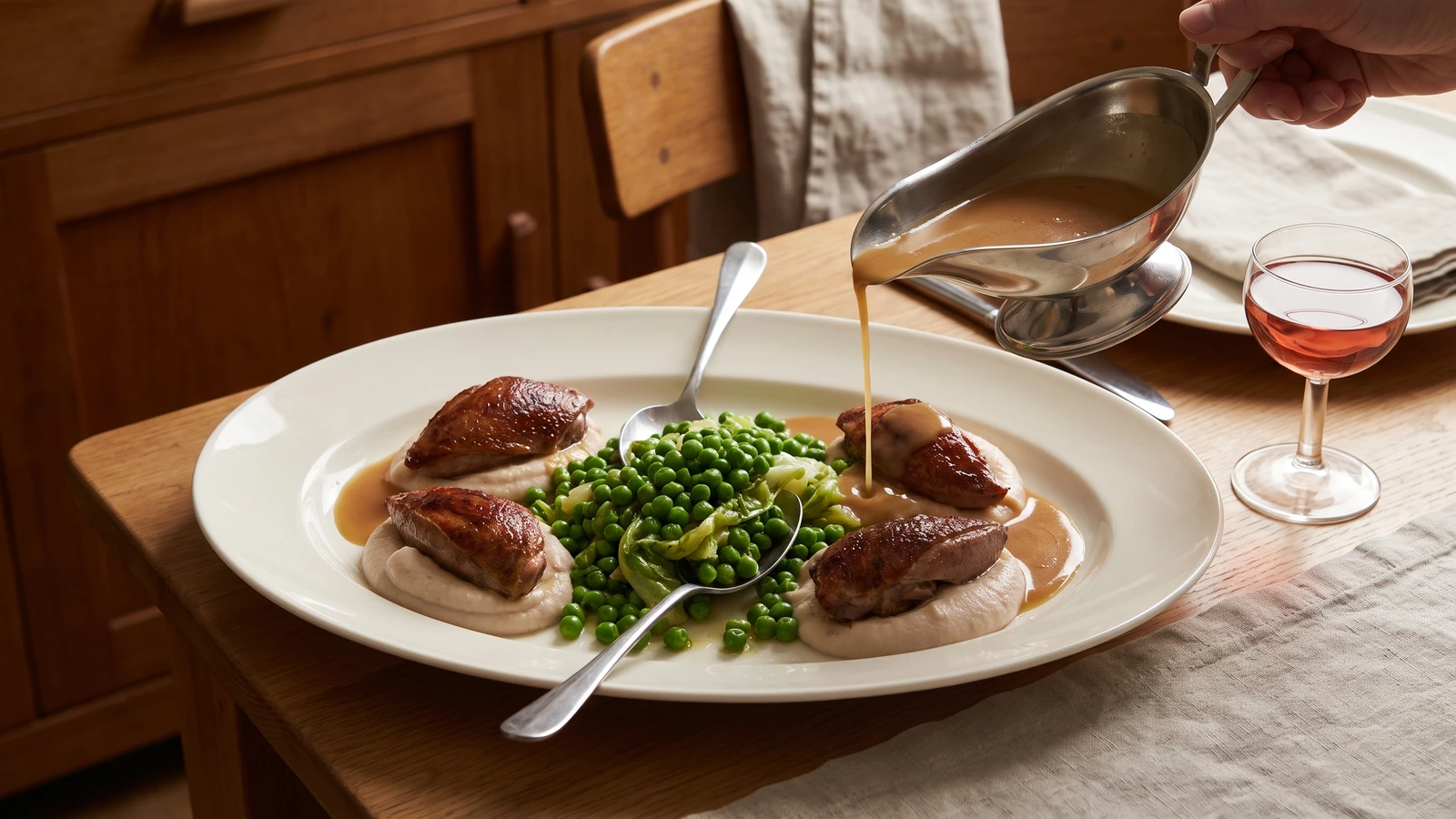
Pigeon mousselines held ice-cold, poached until tender, and crowned with burnished squab breast, gathered around buttered peas and lettuce with a glossy sauce of carcass fumet and velouté.
Mousselines de Pigeonneaux à l’Épicurienne (small poached pigeon mousses with roasted fillets, peas, lettuce, and carcass sauce) teaches one discipline above all: the forcemeat must stay cold from the first cut to the mold. Cold meat binds cream into a fine, tender emulsion. Let it warm and the mixture turns grainy, leaks fat, and loses the texture that makes a mousseline itself.
The original entry assumed a saucier on staff, stock never off the fire, a salamander waiting for last-minute color, trays of little molds, and several hands bringing sauce, garnish, mousselines, and fillets together at once. At home, four squabs supply both the roasted breasts and the meat for four small mousselines; their carcasses make the fumet, a food processor replaces the pounding block, a skillet and hot oven replace the salamander, and four ramekins replace the brigade mold tray. A finished spoonful of velouté, the light stock-and-roux sauce, gives the reduced fumet its body. The separate stations were scaffolding and can go. The cold emulsion, gentle poach, carcass fumet, peas with lettuce, and roasted fillet crown are the dish, and they stay.
The platter arrives pale, bronze, green, and gleaming: tender mousselines around buttery peas, each carrying its own roasted fillet, with the bird returned once more in the sauce. One cook, one stove, one evening. Keep the bowl, blade, pigeon, and cream thoroughly cold before you begin; that is the step that decides everything.
Mousselines de Pigeonneaux à l’Épicurienne belong to the national grand-kitchen repertoire centered in Paris, where one bird could appear as forcemeat, roasted fillet, carcass essence, garnish, and sauce on the same composed platter. The title is not a regional claim; in this preparation, à l’Épicurienne names the generous arrangement of small mousselines, roasted pigeon, peas with lettuce, and fumet given body with velouté. What looks ornamental is brigade organization made visible, translated here without changing the dish’s essential grammar.
Quantity
4 birds (about 14 to 16 ounces / 400 to 450 g each)
giblets removed; breasts separated and carcasses reserved
Quantity
4 tablespoons (1/4 cup / 60 ml / 56 g)
softened and divided
Quantity
1 tablespoon (15 ml / 14 g)
Quantity
1 (about 2 tablespoons / 30 ml / 30 g)
Quantity
3/4 cup (180 ml / 180 g)
thoroughly chilled
Quantity
2 teaspoons (10 ml / 12 g)
divided
Quantity
1/2 teaspoon (2.5 ml / 1 g)
divided
Quantity
1 (about 2 ounces / 55 g)
thinly sliced
Quantity
1 (about 1 1/2 ounces / 40 g)
thinly sliced
Quantity
3 cups (710 ml / 710 g)
divided
Quantity
2 sprigs
Quantity
1
Quantity
1/4 cup (60 ml / 65 g)
warmed
Quantity
2 cups (475 ml / 300 g)
Quantity
1 small head (about 5 ounces / 140 g)
cored and cut into broad ribbons
Quantity
1/2 cup (120 ml / 120 g)
Quantity
1 teaspoon (5 ml / 4 g)
| Ingredient | Quantity |
|---|---|
| whole oven-ready squabsgiblets removed; breasts separated and carcasses reserved | 4 birds (about 14 to 16 ounces / 400 to 450 g each) |
| unsalted buttersoftened and divided | 4 tablespoons (1/4 cup / 60 ml / 56 g) |
| clarified butter | 1 tablespoon (15 ml / 14 g) |
| large egg white | 1 (about 2 tablespoons / 30 ml / 30 g) |
| heavy creamthoroughly chilled | 3/4 cup (180 ml / 180 g) |
| fine sea saltdivided | 2 teaspoons (10 ml / 12 g) |
| ground white pepperdivided | 1/2 teaspoon (2.5 ml / 1 g) |
| small carrotthinly sliced | 1 (about 2 ounces / 55 g) |
| large shallotthinly sliced | 1 (about 1 1/2 ounces / 40 g) |
| unsalted chicken stockdivided | 3 cups (710 ml / 710 g) |
| thyme | 2 sprigs |
| bay leaf | 1 |
| finished veloutéwarmed | 1/4 cup (60 ml / 65 g) |
| fresh shelled peas or frozen peas | 2 cups (475 ml / 300 g) |
| butter lettucecored and cut into broad ribbons | 1 small head (about 5 ounces / 140 g) |
| water | 1/2 cup (120 ml / 120 g) |
| granulated sugar (optional) | 1 teaspoon (5 ml / 4 g) |
Chill the food processor bowl and blade. Remove both breasts from each squab, keeping your knife against the keel so the fillets remain whole. Choose four evenly sized fillets, leave their skin attached, cover them, and refrigerate for roasting. Skin the other four, trim away every visible sinew, and cut the meat into small cubes; you want about 8 ounces (225 g). Spread those cubes on a cold plate and refrigerate. Cut each carcass into several pieces with poultry shears so it will surrender its flavor quickly.
Reserve 1/4 cup (60 ml) of the stock for adjusting the finished sauce. Melt 1 tablespoon of the unsalted butter in a wide saucepan over medium-high heat. Add the carcass pieces and brown them patiently, turning until the bones and attached meat are a deep chestnut and the pan floor carries a firm brown fond. Add the carrot and shallot, cook for 4 minutes, then pour in a splash of the measured stock and scrape up every browned trace. Add the remaining stock, thyme, and bay leaf. Bring to a bare simmer, skim once, and cook uncovered for 40 minutes. Strain firmly through a fine sieve, discard the solids, and reduce the fumet until 3/4 cup (180 ml) remains. Keep it warm.
Set a chilled bowl over ice. Put the cold cubed pigeon meat in the chilled processor with 1 teaspoon of the salt and 1/4 teaspoon of the white pepper. Process in short pulses until the meat becomes smooth and tacky, scraping the bowl as needed. Add the egg white and pulse just until absorbed. With the machine running briefly between additions, incorporate all but 2 tablespoons (30 ml) of the cold cream in four additions. Scrape the forcemeat through a fine sieve into the bowl over ice for the silkiest texture. If the mixture turns grainy or oily, stop. Ça se rattrape: chill it over ice for 10 minutes, put 1 tablespoon of cold cream in the cleaned chilled processor, then pulse the broken mixture into it one spoonful at a time until smooth.
Bring a small saucepan of water to the barest simmer. Poach a teaspoon of mousseline until fully cooked and opaque, about 2 minutes, then taste it. The sample should be tender, cohesive, and fine-grained. If it is firmer than you want, fold the reserved cream into the cold mixture a spoonful at a time. If it weeps fat or crumbles, the emulsion has warmed; rebuild it by the chilling method in the previous step. Butter four 4-ounce (120 ml) molds with 1 tablespoon of the unsalted butter. Divide in the mousseline, tap the molds lightly to release trapped air, smooth the tops, and cover each loosely with buttered parchment or foil.
Heat the oven to 300°F (150°C). Set the molds on a folded kitchen towel in a roasting pan and add hot water to reach halfway up their sides. Poach for 22 to 28 minutes, until the centers reach 165°F (74°C) and feel softly resilient rather than firm. The bain-marie must never boil. If it begins bubbling hard, add a little cool water and lower the oven; gentle heat is the difference between a mousseline and a pigeon-flavored rubber ball. Lift out the molds, rest them for 5 minutes, and keep them covered in a warm place.
Melt 2 tablespoons of the unsalted butter in a wide sauté pan. Add the lettuce, water, 1/2 teaspoon of the salt, 1/8 teaspoon of the white pepper, and the sugar if the peas lack sweetness. Cover and cook gently for 4 minutes, until the lettuce collapses but keeps its green color. If using fresh peas, add them with the lettuce and cook for 8 to 10 minutes in total. If using frozen peas, add them now without thawing and cook for another 3 to 4 minutes. Uncover and reduce any remaining liquid until the peas and lettuce wear a light butter glaze. If the pan is watery, lift out the vegetables and reduce the liquid alone, then return them; do not punish the peas for the sauce’s delay.
Raise the oven to 425°F (220°C). Dry the reserved skin-on fillets and season them with the remaining salt and white pepper. Heat the clarified butter in an ovenproof skillet over medium-high heat. Lay in the fillets skin-side down and leave them undisturbed until deeply bronzed, 3 to 4 minutes. If the skin clings, give it another 30 seconds rather than tearing it; properly browned skin releases from the pan. Turn the fillets, cook for 1 minute, then transfer the skillet to the oven for 3 to 5 minutes. Remove them when the thickest part reaches 160°F (71°C), rest for 5 minutes, and verify that carryover heat has brought them to 165°F (74°C). If not, return them to the oven briefly.
Bring the reduced fumet back to a gentle simmer. Whisk in the warm velouté one tablespoon at a time, using all 1/4 cup (60 ml), and simmer for 3 to 5 minutes until the sauce coats the back of a spoon in a thin, glossy layer. This is the source entry’s few tablespoonfuls of velouté doing their proper work: giving cohesion without hiding the pigeon. If the sauce tightens too far, loosen it with the reserved stock. If it remains thin, reduce it gently. If small lumps appear, strain it; ça se rattrape.
Spoon the peas and lettuce into the middle of a warmed serving platter. Run a thin knife around each mousseline and unmold the four in a ring around the garnish. If one resists, dip the base of its mold in hot water for 5 seconds and try again; never shake it into ruin. Set one roasted pigeon fillet on each mousseline. Spoon enough fumet and velouté sauce over the fillets and around the mousselines to make them gleam, leaving their forms distinct, and bring the remaining sauce separately. À table!
1 serving (about 380g)
Culinary guides, cultural storytelling, and the editorial depth that makes cooking meaningful.
Discover Culinary ExplorerChef Juliette
John Dory has the delicacy of sole and the firmness of turbot. A light flouring, a quick butter sauté, and nut-brown beurre noisette show exactly why looks never mattered.

Chef Juliette
Fresh haddock proves its delicacy in the meunière pan: a fine flour crust, moist pearly flakes, and beurre noisette sharpened with lemon and parsley, ready from one skillet in half an hour.

Chef Juliette
Éperlans à l’Anglaise turns small fish into a lesson in disciplined coating: boned smelts under a close, crisp crumb, pan-fried in clarified butter and finished with bright, half-melted maître d’hôtel butter.

Chef Juliette
Tiny smelts, shallot, mushrooms, white wine, gratin sauce, and fine bread raspings meet a fierce oven, where the fish must turn tender in the same breath the buttered crust bronzes.