
Chef Juliette
John Dory (St. Pierre)
John Dory has the delicacy of sole and the firmness of turbot. A light flouring, a quick butter sauté, and nut-brown beurre noisette show exactly why looks never mattered.
A cooking platform built around craft, culture, and the stories behind what we eat.
Created by Chef Juliette
Based on No. 1786, Suprêmes de Pigeonneaux à la Diplomate, from Le Guide Culinaire (1907) by Auguste Escoffier
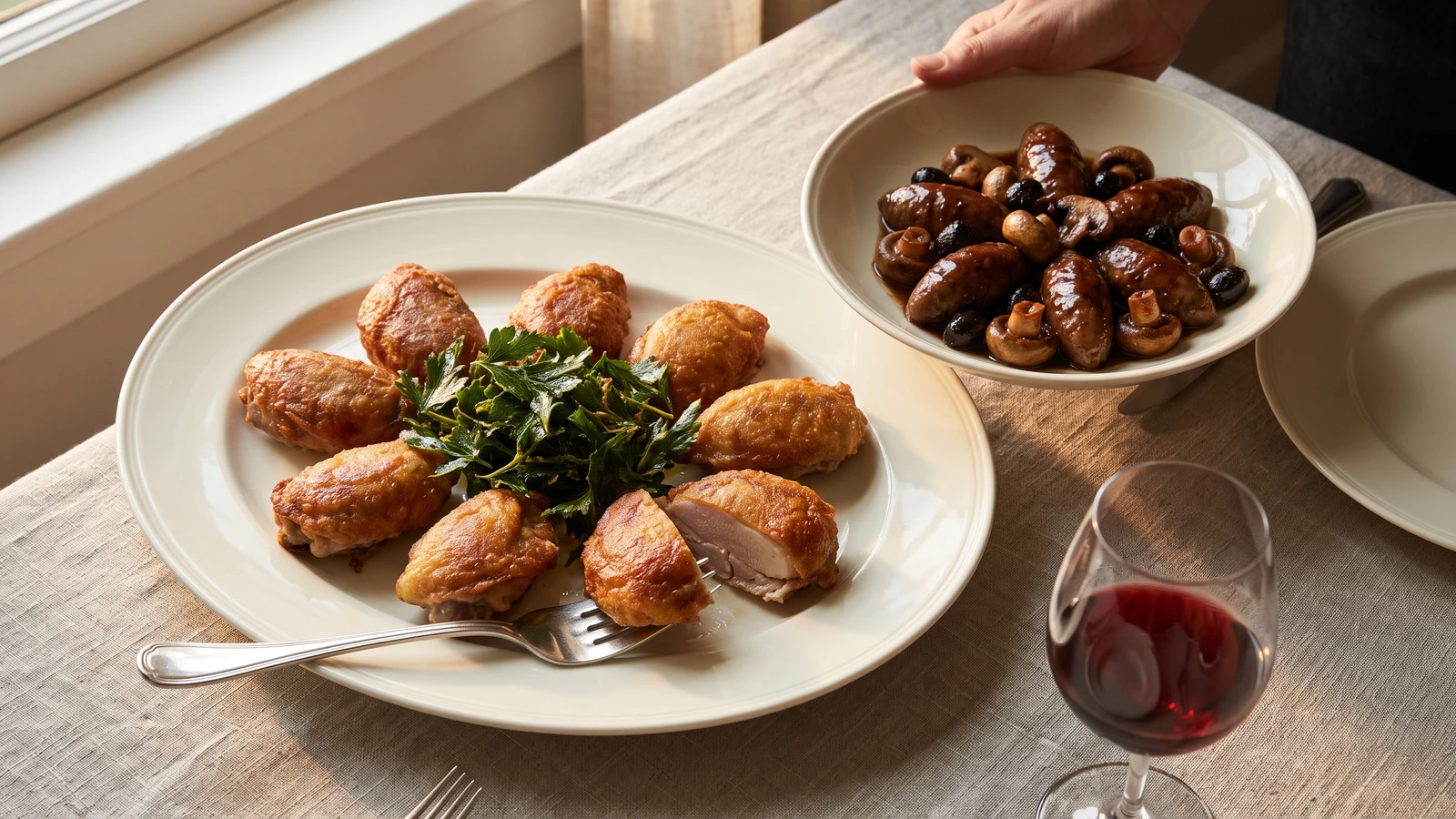
Butter-stiffened squab breasts under a set Villeroy coat, crumbed and fried at the last minute, with pigeon quenelles, mushrooms, black truffles, and a glossy pigeon half-glaze.
Suprêmes de Pigeonneaux à la Diplomate (squab breast fillets Diplomate-style) teaches the architecture of a coated fillet: cook it gently, cool it under light pressure, cloak it in Villeroy, chill until firm, then crumb and fry at the last minute. Villeroy is a thick velouté enriched with cream and yolk, made to set around delicate meat rather than flow beneath it. The one true thing to know before touching a pan is simple: warmth makes that coat slide.
The original kitchen assumed a saucier tending pigeon essence and demi-glace, a commis pounding quenelle forcemeat, and enough birds to make stock without counting the carcasses. Here four whole squabs supply eight suprêmes, leg meat for the quenelles, and bones for a quick pigeon essence; a good finished veal demi-glace supplies the foundation a stockpot once kept ready. A small food processor replaces the mortar, and two weighted trays replace the cold press. One cook, one stove, one evening.
The brigade's separate hands are scaffolding and can go. The two complete chills are the dish and must stay. Cool the butter-stiffened suprêmes fully before coating them, then chill the Villeroy until you can touch it without leaving a mark. Once that coat is firm, the final frying is brief, golden, and wonderfully decisive.
Suprêmes de Pigeonneaux à la Diplomate belongs to the Parisian grand-kitchen repertory, where à la names identified complete garnishes rather than provincial cooking: here Villeroy-coated fillets, pigeon quenelles, mushrooms, truffles, and demi-glace scented with pigeon essence. Villeroy passed naturally from the saucier's bench to the frying pan because its purpose is structural as well as flavorful, setting around a delicate fillet so crumbs can adhere without exposing the meat. Despite its title, Diplomate is not the cooking of one embassy or one region; it is a formal service name, and the generous garnish is part of its identity.
Quantity
4, about 3½ to 4 pounds total (1.6 to 1.8 kg)
breasts removed and skinned; leg meat, wings, skins, and carcasses reserved
Quantity
10 tablespoons (150 ml / 142 g)
divided
Quantity
4 teaspoons (20 ml / 24 g)
divided
Quantity
1 teaspoon (5 ml / 2 g)
divided
Quantity
½ cup (120 ml / 100 g)
chopped
Quantity
5 cups (1.2 L / 1.2 kg)
Quantity
1 cup (240 ml / 250 g)
Quantity
6 cups whole (1.4 L / 340 g)
2 ounces (60 g) finely chopped; remainder quartered
Quantity
⅓ cup (80 ml / 40 g)
Quantity
1 cup (240 ml / 240 g)
thoroughly chilled and divided
Quantity
1
Quantity
1
Quantity
1 large bunch (about 2 packed cups / 480 ml / 55 g)
divided into small sprigs with 2 tablespoons finely chopped
Quantity
1 tablespoon (15 ml / 2 g)
finely chopped
Quantity
1 teaspoon (5 ml / 1 g)
finely chopped
Quantity
6 cups (1.4 L / 1.4 kg)
for poaching
Quantity
3
beaten
Quantity
3 cups (720 ml / 300 g)
Quantity
⅓ cup (80 ml / 55 g)
drained, trimmed into 12 small olive shapes; trimmings reserved
Quantity
6 cups (1.4 L / about 1.3 kg)
for frying
| Ingredient | Quantity |
|---|---|
| farmed squabs (pigeonneaux)breasts removed and skinned; leg meat, wings, skins, and carcasses reserved | 4, about 3½ to 4 pounds total (1.6 to 1.8 kg) |
| unsalted butterdivided | 10 tablespoons (150 ml / 142 g) |
| fine sea saltdivided | 4 teaspoons (20 ml / 24 g) |
| freshly ground white pepperdivided | 1 teaspoon (5 ml / 2 g) |
| shallotschopped | ½ cup (120 ml / 100 g) |
| unsalted brown chicken stock | 5 cups (1.2 L / 1.2 kg) |
| finished veal demi-glace | 1 cup (240 ml / 250 g) |
| small brown or button mushrooms2 ounces (60 g) finely chopped; remainder quartered | 6 cups whole (1.4 L / 340 g) |
| all-purpose flour | ⅓ cup (80 ml / 40 g) |
| heavy creamthoroughly chilled and divided | 1 cup (240 ml / 240 g) |
| large egg yolk | 1 |
| large egg white | 1 |
| flat-leaf parsleydivided into small sprigs with 2 tablespoons finely chopped | 1 large bunch (about 2 packed cups / 480 ml / 55 g) |
| fresh chervilfinely chopped | 1 tablespoon (15 ml / 2 g) |
| fresh tarragonfinely chopped | 1 teaspoon (5 ml / 1 g) |
| waterfor poaching | 6 cups (1.4 L / 1.4 kg) |
| large eggsbeaten | 3 |
| fine dry breadcrumbs | 3 cups (720 ml / 300 g) |
| preserved whole black trufflesdrained, trimmed into 12 small olive shapes; trimmings reserved | ⅓ cup (80 ml / 55 g) |
| refined peanut or grapeseed oilfor frying | 6 cups (1.4 L / about 1.3 kg) |
Keep the breasts and leg meat cold. Chop the wings, carcasses, and skins into manageable pieces. Melt 2 tablespoons of the butter in a wide saucepan and brown the bones and trimmings thoroughly, turning them until every cut surface is deep bronze. Add the shallots and cook for 2 minutes without scorching them. Pour in the chicken stock, scrape up the fond, and hold it at a bare simmer for 40 minutes. Strain firmly, discard the solids, and reduce the liquid to 3 cups (720 ml). This is the home kitchen's pigeon essence, made while the rest of the work moves forward.
Place each skinned breast between sheets of parchment and flatten it gently to an even ⅝ inch (1.5 cm), pressing rather than striking. Season lightly with salt and white pepper. Melt 2 tablespoons of butter in a broad skillet over medium heat. When it foams, raidir the suprêmes, meaning stiffen them gently, for 45 to 60 seconds on each side. Their surfaces should turn opaque without taking much color, and their centers should remain underdone. Arrange them between clean sheets of parchment, cover with a second tray, and add a light 2-pound (1 kg) weight. Refrigerate under pressure for 25 to 30 minutes, until completely cold.
Cook the finely chopped mushrooms in 1 tablespoon of butter over medium heat until their moisture has evaporated, then scrape them into a bowl. Melt 2½ tablespoons more butter in the same pan, stir in the flour, and cook this pale roux for 2 minutes without coloring it. Whisk in 1¼ cups (300 ml) of hot pigeon essence by degrees, smoothing each addition before adding the next. Simmer gently for 5 minutes, stirring, until the sauce is very thick and a spoon drawn through it leaves a clean path. Whisk the yolk with ½ cup (120 ml) of the cream, temper it with a little hot sauce, then return the liaison to the pan. Cook gently until the sauce reaches 165°F (74°C), but do not let it boil. Fold in the chopped mushrooms, chopped parsley, chervil, and tarragon; season with salt and white pepper. If the Villeroy lumps, pass it through a sieve before adding the mushrooms and herbs. If the liaison curdles, take it off the heat and whisk in a spoonful of cold cream. Ça se rattrape.
Let the Villeroy stand for 5 minutes so it remains fluid but is no longer fiercely hot. Blot the chilled suprêmes dry. Using two forks, lower each fillet into the sauce and turn it until every surface carries a coat about ⅛ inch (3 mm) thick. Lift it onto a parchment-lined tray and smooth any bare patch with a spoon. Refrigerate uncovered for at least 45 minutes, until the Villeroy is firm and dry to a light touch. If the coat slides, the fillet or sauce was too warm. Scrape it back into the pan, chill both for 10 minutes, warm the sauce only enough to make it workable, and coat again.
Trim the reserved leg meat of skin, bone, and visible sinew; you should have about 6 to 7 ounces (180 to 200 g). Chill the food processor bowl and blade, then pulse the meat with ½ teaspoon salt and a pinch of white pepper until tacky. Add the egg white and process until smooth. With the machine running in short bursts, add the remaining ½ cup (120 ml) cold cream in three additions, stopping as soon as the mousseline is smooth and glossy. Press it through a fine sieve. Bring the water to 175°F (80°C), season it lightly, and poach a teaspoonful as a test. If it frays or spreads, the mixture is too warm; chill it for 15 minutes and test again. Shape 12 small quenelles between two wet teaspoons and poach them without boiling for 6 to 8 minutes, until firm and 165°F (74°C) at the center. Drain on a cloth-lined tray.
Melt 1½ tablespoons butter in a wide skillet and sauté the quartered mushrooms over medium-high heat until browned at their edges and dry on the surface. Season and set aside. Combine 1¼ cups (300 ml) pigeon essence with the veal demi-glace in a saucepan and reduce gently until the sauce coats the back of a spoon, about 1½ cups (360 ml). Stir in the truffle trimmings, then add the mushrooms, quenelles, and olive-shaped truffles. Warm them at the barest simmer and finish with the remaining 1 tablespoon butter. If the half-glaze becomes too tight, loosen it with pigeon essence one spoonful at a time; if thin, remove the garnish and reduce the sauce further.
Set the beaten eggs and breadcrumbs in separate shallow dishes. Working gently, dip each cold, firm Villeroy-coated suprême in egg, let the excess drain, then roll it in breadcrumbs. Press only enough to secure an even coat. The source calls for egg and crumbs, with no flour between them; the set Villeroy already provides the foundation. Place the crumbed fillets on a rack and refrigerate for 10 minutes while the oil heats. Patch any exposed spot with a dab of egg and fresh crumbs.
Dry the parsley sprigs completely between towels. Heat the oil in a deep, heavy pot to 350°F (175°C), keeping the pot no more than half full. Fry the parsley in small handfuls for 10 to 15 seconds, using a splatter screen and long-handled spider, then drain and season lightly. Fry the suprêmes two or three at a time for 3 to 4 minutes, turning once, until evenly deep gold and 165°F (74°C) at the center. Let the oil return to temperature between batches. If the crust colors before the center is ready, lower the oil to 330°F (165°C) and finish gently. Drain on a rack, never in a pile, and season at once.
Arrange the eight fried suprêmes in a close circle on a warm oval platter and heap the fried parsley in their center. Transfer the quenelles, mushrooms, truffles, and pigeon half-glaze to a separate warmed serving bowl, exactly as the source directs. Keeping the garnish separate preserves the crisp coat and lets each guest spoon sauce beside the pigeon rather than over it. Serve immediately. À table!
1 serving (about 525g)
Culinary guides, cultural storytelling, and the editorial depth that makes cooking meaningful.
Discover Culinary ExplorerChef Juliette
John Dory has the delicacy of sole and the firmness of turbot. A light flouring, a quick butter sauté, and nut-brown beurre noisette show exactly why looks never mattered.

Chef Juliette
Fresh haddock proves its delicacy in the meunière pan: a fine flour crust, moist pearly flakes, and beurre noisette sharpened with lemon and parsley, ready from one skillet in half an hour.

Chef Juliette
Éperlans à l’Anglaise turns small fish into a lesson in disciplined coating: boned smelts under a close, crisp crumb, pan-fried in clarified butter and finished with bright, half-melted maître d’hôtel butter.

Chef Juliette
Tiny smelts, shallot, mushrooms, white wine, gratin sauce, and fine bread raspings meet a fierce oven, where the fish must turn tender in the same breath the buttered crust bronzes.