Culinary Explorer

A cooking platform built around craft, culture, and the stories behind what we eat.
Discover Culinary Explorer
Côtelettes de Pigeonneaux à la Sévigné

Côtelettes de Pigeonneaux à la Sévigné

Created by Chef Juliette

Based on No. 1785, Côtelettes de Pigeonneaux à la Sévigné, from Le Guide Culinaire (1907) by Auguste Escoffier

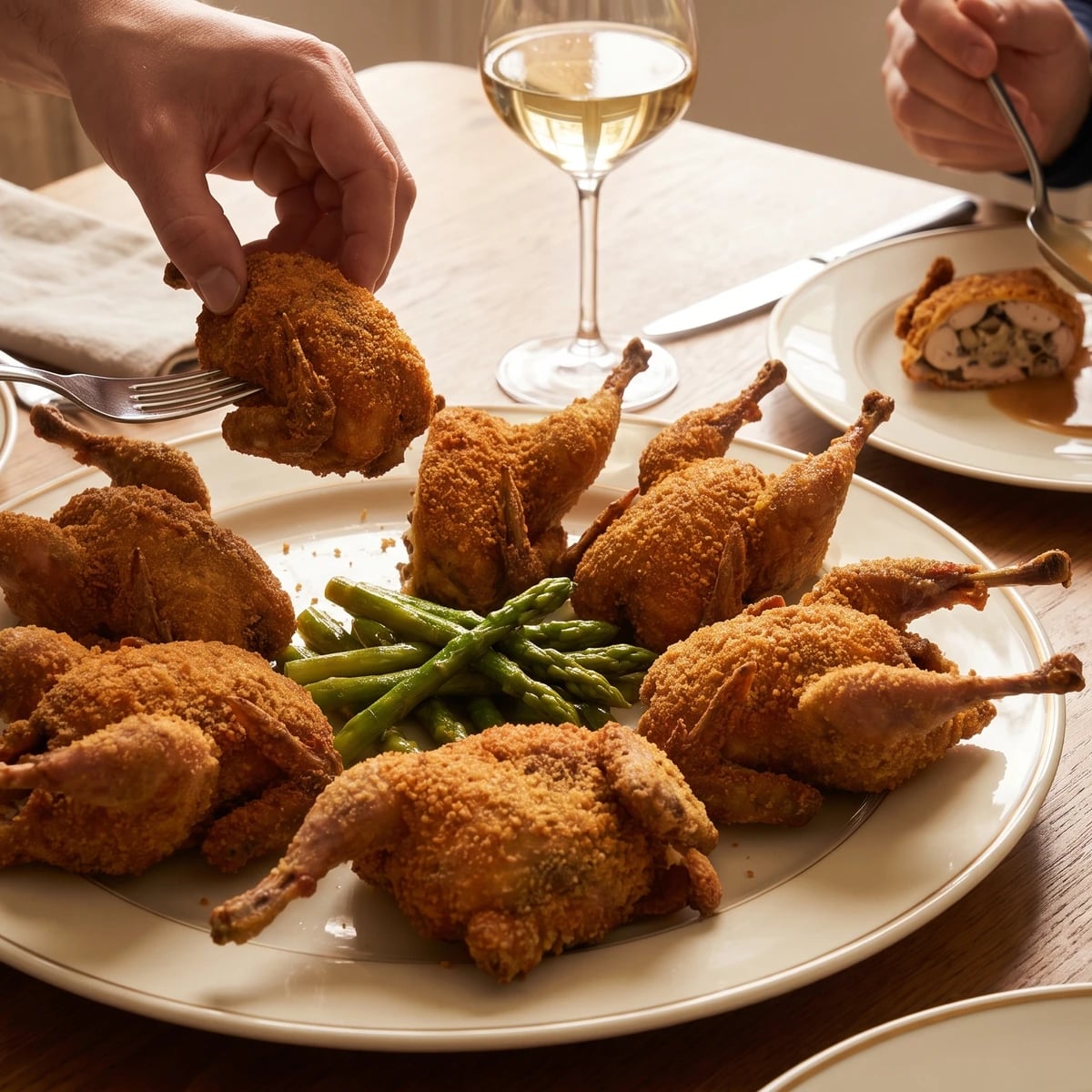
Eight burnished pigeon halves hide domes of truffled chicken and mushroom salpicon beneath a fine crumb, with buttered asparagus at the center and light Madeira sauce passed separately.

Main Dishes
French
Dinner Party
Special Occasion
Date Night
1 hr
Active Time
1 hr 30 min cook3 hr 30 min total
Yield4 servings

Côtelettes de Pigeonneaux à la Sévigné (half-pigeons filled, breaded, and cooked in clarified butter) teaches staged cooking: heat, gentle pressure, cold binding, then heat again. The one true thing is temperature. Each layer must be cold and firm before the next begins, or the salpicon slides, the crumb tears, and the handsome little cutlet loses its shape.

The original entry assumed a saucier on staff, cold Allemande waiting, and stock never off the fire. It did not rely on a salamander, and neither do you; clarified butter makes the final bronze. At home, one chicken breast supplies the white meat, its poaching stock becomes a small Allemande, and reduced veal stock with the pigeon fond gives the light Madeira sauce. The brigade's bank of finished sauces and extra hands are scaffolding and can go. The first sauté, slight pressure, cold salpicon, egg-and-crumb coat, and gentle second cooking are the dish and must stay. One cook, one stove, one evening.

Done properly, the crumb is fine and butter-gold, the pigeon remains succulent beneath it, and the center reveals an ivory salpicon flecked with mushroom and black truffle. Chill the domed halves until the filling feels firm beneath a fingertip before the egg touches them. If a dome shifts, put it back in the cold. Ça se rattrape.

Côtelettes de Pigeonneaux à la Sévigné belongs to the Parisian grand-kitchen repertoire, where fashionable names often marked a composed service rather than a regional recipe. Sévigné invokes the Marquise whose family seat lay near Vitré, yet the dish is not Breton: truffle-bound Allemande, crumbed pigeon, asparagus, and Madeira belong to the national classical pantry assembled in Paris. Its journey runs from formal service to the bourgeois dinner table, where the same filled half-bird can be made in a skillet if the cook respects the cooling and binding.

The technique, the tradition, and the story behind every dish.

Discover Culinary Explorer

Ingredients

oven-ready young pigeons or squab

Quantity

4, about 14 to 16 oz (400 to 450 g) each

split lengthwise into 8 halves, wing tips removed

boneless, skinless chicken breast

Quantity

1 small breast, about 5 oz (140 g)

unsalted chicken stock

Quantity

2 cups (480 ml / 480 g)

unsalted butter for sautéing

Quantity

¼ cup (60 ml / 57 g)

fine sea salt

Quantity

2 tablespoons (30 ml / 36 g)

divided, most reserved for the asparagus water

freshly ground black pepper

Quantity

1 teaspoon (5 ml / 2 g)

button mushrooms

Quantity

1½ cups (360 ml / 150 g)

cut into ¼-inch dice

unsalted butter for the mushrooms

Quantity

2 tablespoons (30 ml / 28 g)

black truffle

Quantity

2 tablespoons (30 ml / 20 g)

finely diced, fresh or preserved

preserved truffle juice (optional)

Quantity

1 tablespoon (15 ml / 15 g)

unsalted butter for the Allemande sauce

Quantity

2 tablespoons (30 ml / 28 g)

all-purpose flour

Quantity

2 tablespoons (30 ml / 16 g)

heavy cream

Quantity

3 tablespoons (45 ml / 45 g)

large egg yolk

Quantity

1

fresh lemon juice

Quantity

2 teaspoons (10 ml / 10 g)

unsalted gelatin-rich veal or beef stock

Quantity

2 cups (480 ml / 480 g)

dry Madeira

Quantity

½ cup (120 ml / 120 g)

divided

large shallot

Quantity

1

finely chopped

unflavored powdered gelatin (optional)

Quantity

1 teaspoon (5 ml / 3 g)

cold unsalted butter for the Madeira sauce

Quantity

1 tablespoon (15 ml / 14 g)

large eggs

Quantity

4

beaten

fine fresh white breadcrumbs

Quantity

3 cups (720 ml / 180 g)

clarified butter

Quantity

1¼ cups (300 ml / 275 g)

for gentle cooking

thick asparagus tips

Quantity

24, about 12 oz (340 g)

trimmed to about 2½ inches long

unsalted butter for the asparagus

Quantity

2 tablespoons (30 ml / 28 g)

Equipment Needed

  • 12-inch (30 cm) heavy sauté pan
  • Two rimmed sheet pans, parchment, and a 2 lb (900 g) weight
  • 2-quart (2 L) saucepan and fine-mesh sieve
  • 12-inch (30 cm) heavy skillet, broad spatula, and wire rack
  • Instant-read thermometer

Instructions

  1. 1

    Poach the chicken

    Put the chicken breast and chicken stock in a small saucepan and bring them slowly to a bare tremble. Poach gently, turning once, until the center reaches 165°F (74°C), about 10 to 12 minutes. Lift the breast onto a plate to cool, then strain and reserve the stock. When the meat is cold, cut it into neat ¼-inch dice; irregular pieces make a lumpy salpicon rather than a smooth dome.

  2. 2

    Sauté and press pigeons

    Pat the pigeon halves completely dry and season them with about one-quarter of the salt and half the pepper. Melt the sautéing butter in a heavy pan over medium-high heat. Sauté means cooking promptly in hot fat: lay in four halves skin-side down and brown them for 5 to 6 minutes, then turn them cut-side down for 4 minutes. Lower the heat and baste with the butter until the thickest meat reaches 165°F (74°C), another 3 to 5 minutes. Repeat with the remaining halves. Lay them cut-side down between two sheets of parchment on a rimmed tray, set a second tray on top, and add a light 2 lb (900 g) weight. Refrigerate the stack within 10 minutes and press until thoroughly cold and evenly flattened, about 40 minutes. The pressure should shape them, not crush them.

  3. 3

    Reduce the Madeira sauce

    Pour away excess butter from the pigeon pan while leaving the bronze fond attached. Add the shallot and ¼ cup (60 ml) of the Madeira, scrape up the fond, and boil until only a syrupy spoonful remains. If the pan residue smells bitter rather than roasted, leave it behind and continue in a clean saucepan; burned butter has no rescue. Add the brown stock. If the stock is thin, first bloom the optional gelatin in 2 tablespoons of cold stock for 5 minutes, then add it. Simmer until reduced to about 1 cup (240 ml), glossy but still flowing, then strain. Set the sauce base aside.

  4. 4

    Make cold Allemande

    Cook the diced mushrooms in their butter over medium-high heat until they release their water, become lightly bronze, and leave the pan dry. Season lightly and spread them on a plate to cool. In a small saucepan, melt the Allemande butter, stir in the flour, and cook for 2 minutes without letting the roux color. Whisk in 1 cup (240 ml) of the reserved chicken-poaching stock a little at a time, then simmer for 6 to 8 minutes until the velouté is thick enough to leave a clear trail across the pan. Whisk the cream and yolk together, temper them with several spoonfuls of hot velouté, then return the liaison to the pan over very low heat. Stir until the Allemande thickens, but do not let it boil. Finish with the lemon juice and a little salt and pepper. If the liaison shows fine grains, pull it from the heat, whisk in a spoonful of cold cream, and strain it at once. Ça se rattrape. Spread the sauce in a shallow bowl set over ice and chill until dense.

  5. 5

    Build the salpicon domes

    Reserve about 3 tablespoons (45 ml) of cold Allemande for adjustments. Fold the diced chicken, cooled mushrooms, truffle, and any preserved truffle juice into about ¾ cup (180 ml) of the remaining sauce. This is the salpicon, a compound of neat dice cohered with sauce, and it must hold together without swimming. Turn the pressed pigeon halves cut-side up and pat away any moisture. Divide the salpicon among them, about 3 tablespoons per half, shaping it into smooth, low domes over the cut surfaces. Refrigerate uncovered for 30 minutes. If a dome slumps, scrape it back into shape with a spoonful of reserved Allemande and chill it longer.

  6. 6

    Egg and crumb

    Put the beaten eggs in one broad dish and the breadcrumbs in another. Supporting each salpicon dome with your fingers, dip the entire pigeon half in egg, let the excess fall away, then place it in the crumbs and heap crumbs gently over every surface. Press only enough to secure a fine, even coat. There is no flour layer here; the source calls for egg and crumbs, and a well-chilled Allemande gives them something firm to grip. Set the crumbed halves on a rack and chill for 15 minutes. If a bare patch appears, dab it with egg and patch it with crumbs rather than recoating the whole bird.

  7. 7

    Blanch the asparagus

    Bring a wide pan of water to a boil and salt it generously with most of the remaining salt. Blanch the asparagus tips until vivid green and just tender when pierced at the base, 2 to 4 minutes depending on thickness. Refresh them briefly in cold water, then drain and dry them very well. Water left on the asparagus would dilute the butter meant to cohere them.

  8. 8

    Cook in clarified butter

    Heat the oven to 275°F (135°C) and set a wire rack over a tray. Pour enough clarified butter into a heavy skillet to make a ¼-inch (6 mm) layer and hold it near 300°F (150°C). Working in batches, lower the pigeons filled-side down into the butter and cook gently for 4 to 5 minutes, until the domes are evenly butter-gold. Turn with a broad spatula, cook the second side for another 4 to 5 minutes, and baste the edges with butter. Transfer them to the rack and let the low oven complete the warming until the center of the salpicon reaches 165°F (74°C). The oven replaces the brigade's warm holding corner, but the clarified butter must make the color. If the crumbs darken before the center is warm, lower the heat and lift the pan from the burner for a minute. Ça se rattrape.

  9. 9

    Finish and serve

    Return the Madeira sauce base to a gentle simmer, add the remaining ¼ cup (60 ml) Madeira, and cook for 2 minutes. Off the heat, whisk in the cold butter. The sauce should nap the back of a spoon lightly; reduce it if watery, or loosen it with reserved chicken stock if it tightens too far. Warm the asparagus in its butter until glossy and season it. Arrange the eight pigeons in a circle on a hot platter, salpicon domes upward and legs radiating outward, then mound the buttered asparagus tips in the center. Pass the light Madeira sauce separately so the crumb stays crisp. À table!

Chef Tips

  • Squab is the market name to ask for. Choose plump young birds with pale, supple skin and have the butcher split them neatly through breastbone and backbone. Cornish hens are larger and milder; they make a pleasant cousin, but not Sévigné.
  • A preserved whole black truffle is an honest classical-pantry answer when fresh truffle is out of season. Drain and dice it, then use its juice in the salpicon. Truffle-flavored oil gives perfume without the earthy substance this filling needs.
  • Clarified butter is essential for the second cooking because its milk solids have been removed. Whole butter would blacken before the cold center warmed. We don't apologize for butter, but we do choose the right butter for the work.
  • Serve the Madeira sauce from a warm sauce boat, never beneath the crumb. A red Burgundy with moderate weight or a Cabernet Franc from the Loire has enough freshness for the butter and enough savor for pigeon and truffle.

Advance Preparation

  • The chicken can be poached, the Allemande chilled, the Madeira sauce base reduced, and the pigeons sautéed and pressed one day ahead. Cool each component promptly, cover, and refrigerate separately.
  • The salpicon may be shaped over the pigeons up to 6 hours before serving. Apply the egg and breadcrumbs no more than 1 hour ahead so the coat remains dry and distinct.
  • Blanch the asparagus up to 2 hours ahead, refresh it, dry it thoroughly, and refrigerate it covered. Warm it in butter only while the pigeons finish.

Frequently Asked Questions

Nutrition Information

1 serving (about 600g)

Calories
1385 calories
Total Fat
106 g
Saturated Fat
48 g
Trans Fat
1 g
Unsaturated Fat
57 g
Cholesterol
550 mg
Sodium
1350 mg
Total Carbohydrates
30 g
Dietary Fiber
4 g
Sugars
6 g
Protein
73 g

Note: Chef personas and recipes are created with AI assistance. Cook with care: follow safe food-handling practices, check doneness with a thermometer when needed, and adapt for allergies and your kitchen.

Where cooking meets culture.

Culinary guides, cultural storytelling, and the editorial depth that makes cooking meaningful.

Discover Culinary Explorer

More from Poultry (Volaille) - Ducks and Ducklings (Canards et Canetons)

Browse the full collection