
Chef Juliette
John Dory (St. Pierre)
John Dory has the delicacy of sole and the firmness of turbot. A light flouring, a quick butter sauté, and nut-brown beurre noisette show exactly why looks never mattered.
A cooking platform built around craft, culture, and the stories behind what we eat.
Created by Chef Juliette
Based on No. 1784, Côtelettes de Pigeonneaux en Papillotes, from Le Guide Culinaire (1907) by Auguste Escoffier
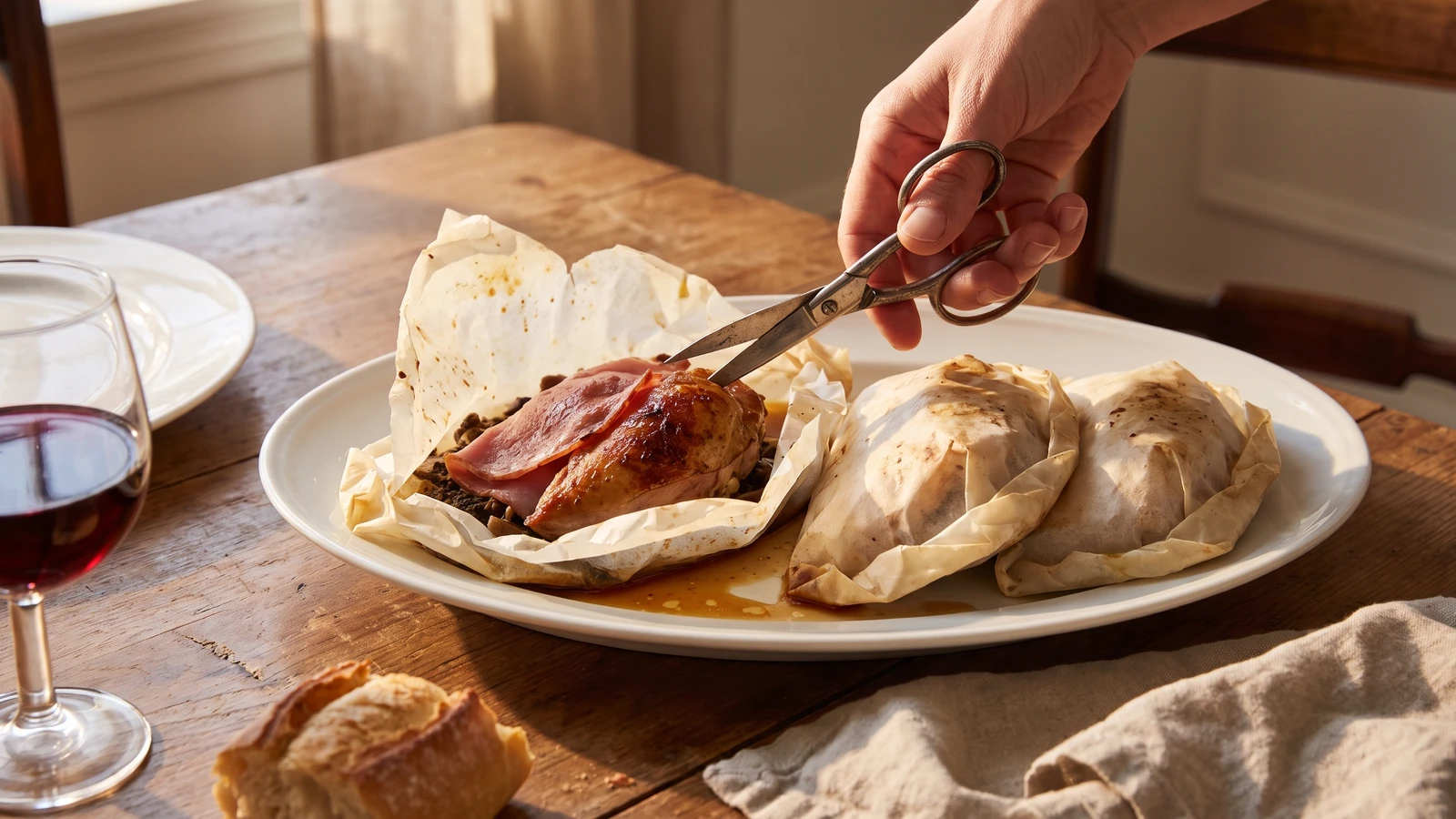
Four paper hearts, each holding butter-stiffened squab, Duxelles, and ham, balloon in the oven. The seal is the lesson, because fragrance and tenderness escape through one careless pleat.
Côtelettes de Pigeonneaux en Papillotes (squab halves baked in paper) teaches the essential truth of cuisson en papillote, cooking inside a sealed paper parcel: the fold is part of the oven. The squab is raidi, gently stiffened in butter without being fully browned, then enclosed with ham, Duxelles, and mushroom. Know this before touching the pan: a loose pleat isn't merely untidy. It lets the parcel's pressure and fragrance escape, and the paper lies flat instead of rising.
The book entry sends the cook to Côte de Veau Papillote (No. 1259) for the garniture and enclosure. It assumed Duxelles sauce waiting from the saucier, strong oiled paper, practiced folding hands, and brigade quantities. A stock never off the fire and a salamander belong to other classical jobs; here the honest home equivalents are finished Duxelles, heavy parchment, a rimmed baking sheet, and four parcels for four diners. The veal cutlet becomes a halved squab, exactly as the entry directs. Perfectly decorative pleats are brigade scaffolding and may go, but the ham-and-Duxelles enclosure and the tight seal are the dish itself.
When it works, each paper heart reaches the table taut and lightly stained with butter, hiding tender squab under mushroom-dark Duxelles and rosy ham. One cook, one stove, one evening. Make every pleat overlap firmly before the parcel enters the oven; that seal decides everything.
Côtelettes de pigeonneaux en papillotes belong to the classical Parisian table, where folded oiled paper enclosed meat, garnish, and sauce and carried the finished preparation directly to the diner. The heart shape was functional as well as handsome: its broad curved edge gave the cook one continuous seam to pleat while leaving room for the parcel to swell. The pigeon preparation traveled directly from the veal construction, changing the cutlet to halved squab while retaining ham and Duxelles, so its identity lies in the enclosure rather than any regional seasoning.
Quantity
2 birds, 1 to 1¼ pounds (450 to 570 g) each
split lengthwise into 4 halves and patted dry
Quantity
4 complete sets from Côte de Veau Papillote (No. 1259)
prepared without the veal cutlets and sized for squab halves
Quantity
5 tablespoons (75 ml / 71 g)
divided
Quantity
¾ teaspoon (3.75 ml / 4.5 g)
Quantity
½ teaspoon (2.5 ml / 1 g)
| Ingredient | Quantity |
|---|---|
| whole young squabssplit lengthwise into 4 halves and patted dry | 2 birds, 1 to 1¼ pounds (450 to 570 g) each |
| garniture and oiled-paper setsprepared without the veal cutlets and sized for squab halves | 4 complete sets from Côte de Veau Papillote (No. 1259) |
| unsalted butterdivided | 5 tablespoons (75 ml / 71 g) |
| fine sea salt | ¾ teaspoon (3.75 ml / 4.5 g) |
| freshly ground black pepper | ½ teaspoon (2.5 ml / 1 g) |
Heat the oven to 425°F (220°C) with a rack in the middle. Prepare four complete garniture-and-oiled-paper sets from Côte de Veau Papillote (No. 1259), omitting its veal cutlets and sizing each heart for one squab half. Heavy parchment is the safe home equivalent of strong kitchen paper. Leave at least 2½ inches (6 cm) of clear paper around the filling area so there is enough edge to pleat without pulling against the bird.
Inspect the split squabs for small bone fragments, especially along the backbone, and remove them with your fingers or tweezers. Pat every surface dry, then season the halves lightly with the salt and pepper. The ham and Duxelles are already seasoned, so restraint here keeps the finished parcel balanced.
Melt half the butter in a wide skillet over medium heat until it foams without browning. Add two squab halves, skin side down, and raidir them for 2 to 3 minutes, just until the skin turns pale gold and the flesh firms; turn and cook the cut side for 1 minute. Repeat with the remaining butter and squab. This isn't a hard sear. The oven must finish the bird inside the paper. If the butter darkens before the flesh firms, lift the pan from the heat, wipe out the spent butter, and continue with fresh butter at a lower temperature.
Let the squab halves settle for 3 minutes, just until they can be handled without scorching your fingers. Place one half into each prepared Côte de Veau Papillote (No. 1259) set in place of its veal cutlet, then complete the referenced ham-and-Duxelles enclosure. Keep the filling compact and centered. A bone pressed against the fold can pierce the parchment as the parcel expands.
Fold each paper heart closed and make narrow, overlapping pleats around the curved edge, pressing every fold firmly before making the next. Finish by twisting the point underneath the parcel. The pleats needn't be ornamental, but they must be continuous. If the paper tears, transfer the entire filling to the spare oiled heart and fold again; a pasted-on patch will open under pressure.
Arrange the parcels without touching on a rimmed baking sheet and bake for 13 to 16 minutes. Each papillote should rise into a taut dome and take a faint butter-gold color around its edges. If one remains flat while the others rise, a pleat is leaking. Pull out the sheet, pinch the open section into two tight overlapping folds with tongs, and return it immediately. Ça se rattrape. Check the largest parcel by slipping an instant-read thermometer through a thick pleat into the thigh without touching bone; the squab is ready at 165°F (74°C). If it falls short, refold that edge and bake for 2 minutes more.
Transfer each inflated papillote directly to a warm dinner plate and serve at once. Let each diner slit the top at the table, keeping hands and faces back from the first opening because the trapped air is fiercely hot. The butter-stained paper, the mushroom-rich aroma, and the revealed squab are the presentation. Nothing needs arranging with tweezers. À table!
1 serving (about 175g)
Culinary guides, cultural storytelling, and the editorial depth that makes cooking meaningful.
Discover Culinary ExplorerChef Juliette
John Dory has the delicacy of sole and the firmness of turbot. A light flouring, a quick butter sauté, and nut-brown beurre noisette show exactly why looks never mattered.

Chef Juliette
Fresh haddock proves its delicacy in the meunière pan: a fine flour crust, moist pearly flakes, and beurre noisette sharpened with lemon and parsley, ready from one skillet in half an hour.

Chef Juliette
Éperlans à l’Anglaise turns small fish into a lesson in disciplined coating: boned smelts under a close, crisp crumb, pan-fried in clarified butter and finished with bright, half-melted maître d’hôtel butter.

Chef Juliette
Tiny smelts, shallot, mushrooms, white wine, gratin sauce, and fine bread raspings meet a fierce oven, where the fish must turn tender in the same breath the buttered crust bronzes.