
Chef Juliette
Caneton Nantais à la Choucroûte
A whole Nantes duckling, browned and gently braised with Rhine wine, carved over choucroute glazed nearly dry with salt pork, then finished beneath a restrained veil of glossy veal sauce.
A cooking platform built around craft, culture, and the stories behind what we eat.
Created by Chef Juliette
Based on No. 1781, Pigeon Pie, from Le Guide Culinaire (1907) by Auguste Escoffier
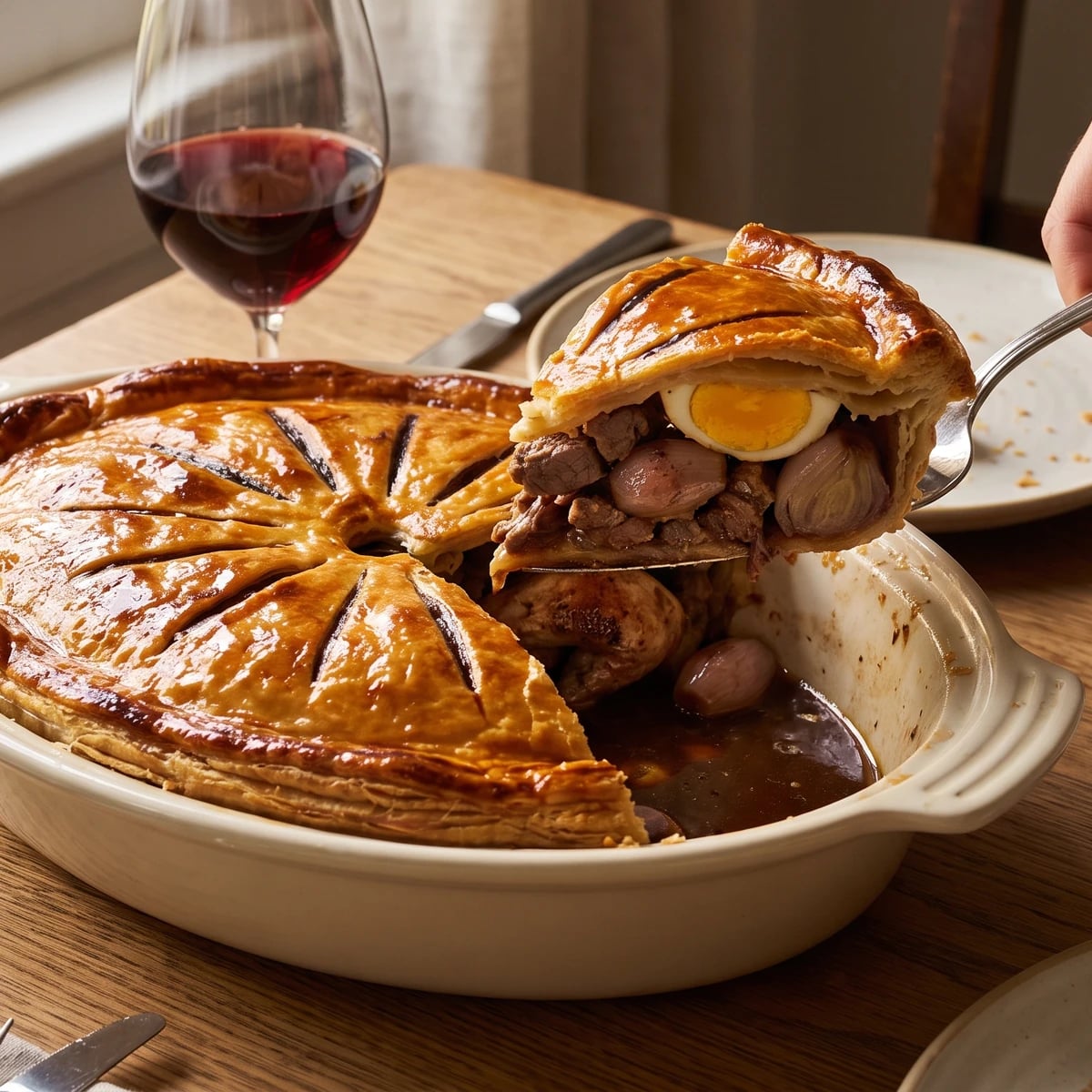
Pâté de pigeons à l’anglaise sets quartered birds over shallot-scented beef collops, tucks in hard-boiled yolk, and seals the whole under gilded puff paste, a lesson in keeping rich gravy beneath a crisp lid.
Pâté de pigeons à l’anglaise (pigeon pie) teaches the architecture of a covered pie. The gravy must rise only halfway around the birds, so the lower meat braises while the upper pieces roast beneath the pastry. Flood the dish and the puff paste softens from below. Starve it of gravy and the pigeon dries. That half-depth measure is the whole balance.
The original entry assumed a saucier on staff, a stockpot never off the fire, a pastry hand nearby, and enough pigeons for a dining room. At home, two birds feed four, gelatin-rich beef stock reduces into the required good gravy, and proper all-butter puff paste saves a morning of lamination. The separate gravy and pastry stations are brigade scaffolding, so they can go. The thin beef lining, shallot, hard-boiled yolk, half-depth gravy, gilding, and central slit are the dish, so they stay. A salamander contributes nothing here; the lid colors in the oven. One cook, one stove, one evening.
The finished pâté comes out deep bronze, its scored lid risen around the vent and its dark gravy bubbling at the slit. Underneath are whole pieces, not forcemeat: pigeon, tender beef collops, sweet shallot, and the curious richness of cooked yolk. Before you touch the pastry, make the collops truly thin and pour the cooled gravy no higher than halfway.
Pâté de pigeons à l’anglaise belongs to the English covered-pie tradition as preserved in French classical manuals, rather than to the larder of a single French region. French kitchens retained its British arrangement of recognizable pigeon pieces, beef collops, cooked yolk, gravy, and a puff-paste lid, even while cataloguing it within the French canon. Here pâté means the enclosing pie preparation, not a smooth forcemeat, a distinction the intact quartered birds make plain.
Quantity
3 cups (720 ml / 720 g), reduced to 1½ cups (360 ml / 360 g)
reduced for the good gravy
Quantity
2 (about 1 lb / 450 g each)
quartered into 8 bone-in pieces
Quantity
12 oz / 340 g
sliced across the grain into thin collops
Quantity
⅓ cup (80 ml / 60 g)
finely chopped
Quantity
1¾ teaspoons (9 ml / 10 g)
divided
Quantity
1 teaspoon (5 ml / 2 g)
divided
Quantity
1
hard-boiled; white removed and yolk halved
Quantity
1 sheet (14 oz / 400 g)
kept cold
Quantity
2 tablespoons (30 ml / 16 g)
for rolling
Quantity
1
beaten
Quantity
1 teaspoon (5 ml / 5 g)
for gilding
| Ingredient | Quantity |
|---|---|
| unsalted gelatin-rich beef stockreduced for the good gravy | 3 cups (720 ml / 720 g), reduced to 1½ cups (360 ml / 360 g) |
| oven-ready pigeons or squabsquartered into 8 bone-in pieces | 2 (about 1 lb / 450 g each) |
| lean beef top round or rumpsliced across the grain into thin collops | 12 oz / 340 g |
| shallotsfinely chopped | ⅓ cup (80 ml / 60 g) |
| fine sea saltdivided | 1¾ teaspoons (9 ml / 10 g) |
| freshly ground black pepperdivided | 1 teaspoon (5 ml / 2 g) |
| large egg for the fillinghard-boiled; white removed and yolk halved | 1 |
| all-butter puff pastekept cold | 1 sheet (14 oz / 400 g) |
| plain flourfor rolling | 2 tablespoons (30 ml / 16 g) |
| large egg for gildingbeaten | 1 |
| cold waterfor gilding | 1 teaspoon (5 ml / 5 g) |
Bring the beef stock to a brisk simmer in a wide saucepan and reduce it to exactly 1½ cups (360 ml / 360 g), about 25 to 35 minutes. This is the good gravy the old kitchen kept ready: concentrated, gelatin-rich, and able to coat a spoon lightly without becoming syrupy. If you reduce it too far, loosen it with a measured spoonful of water; if it still tastes weak, keep simmering. Pour it into a shallow jug and cool it to room temperature so it cannot melt the puff paste during assembly.
Hard-boil the filling egg, cool and peel it, then remove the white and cut the firm yolk into two equal halves. Reserve the white for another meal. Pat the pigeon quarters dry and season them evenly with ¾ teaspoon (4 ml / 4 g) of the salt and half the pepper. Keep the pieces cold while you prepare the beef.
Lay the beef slices between two sheets of baking paper and flatten them with a meat mallet or rolling pin to about 1⁄16 inch (1.5 mm). Thinness matters because the collops must line the dish and become tender in the pigeon juices; thick slices contract into tough pads. Season them with the remaining salt and pepper, then overlap them across the bottom and sides of a 2-quart (2-liter) pie dish. If a collop tears, cover the gap with another thin piece. Ça se rattrape. Sprinkle the shallots evenly over the beef.
Arrange the four quarters from one pigeon on one side of the dish and the second pigeon on the other, fitting the legs into the spaces between the breast pieces. Set one half of the hard-boiled yolk beside each bird. Pour the cooled good gravy down the side until it reaches halfway up the pigeon pieces, usually nearly all of it. If the liquid rises higher, spoon some out now; the exposed upper meat and the space beneath the pastry are what keep the lid crisp.
Heat the oven to 375°F (190°C) with a rimmed baking sheet on the middle rack. Roll the cold puff paste on the lightly floured surface to about ⅛ inch (3 mm), large enough to overhang the dish by 1 inch (2.5 cm). Beat the gilding egg with the cold water, brush a little over the clean rim, and lay the pastry on top without stretching it. Press it firmly to the rim, trim, and crimp. Gild the surface with a thin, even coat of egg wash, streak it with shallow decorative lines, then cut a 1-inch (2.5 cm) slit through the center. Keep egg wash off the cut pastry edges, where it can glue the layers together.
Set the dish on the heated baking sheet and bake for 30 minutes, until the puff paste has risen and taken a strong golden color. Lower the oven to 350°F (180°C) and continue for 1 hour, keeping the full baking time close to 1½ hours. The pâté is ready when the lid is deeply bronzed, gravy bubbles visibly through the slit, and a thermometer angled through the vent into a thick leg piece registers 165°F (74°C). If the pastry bronzes before the center is ready, tent it loosely with foil and continue. Ça se rattrape.
Rest the pâté for 15 to 20 minutes. This lets the gravy settle into the beef lining instead of running across the table at the first cut. Divide the puff lid into four generous panels with a serrated knife, then spoon a mixture of pigeon, beef collops, yolk, and gravy beneath each one. Bring the pie dish itself to the table. Cooking well is not cooking fancy. À table!
1 serving (about 370g)
Culinary guides, cultural storytelling, and the editorial depth that makes cooking meaningful.
Discover Culinary Explorer
Chef Juliette
A whole Nantes duckling, browned and gently braised with Rhine wine, carved over choucroute glazed nearly dry with salt pork, then finished beneath a restrained veil of glossy veal sauce.

Chef Juliette
A butter-poêled Aylesbury duckling, bronzed only after its covered roast, with mint inside and clear veal gravy brightened by lemon. The lesson is simple: poêlé means butter, a lid, and no added liquid.

Chef Juliette
Caneton Molière rebuilds a boned duckling around foie gras, pork, and two truffle rows, then poaches it in carcass stock before a glossy Madeira finish. The lesson is cold filling, even shaping, and gentle heat.

Chef Juliette
Caneton Braisé aux Navets turns one cocotte into a lesson in glazing: burnished duck, pearl onions, and turnips carried to light brown before they finish in a glossy classical sauce.