Culinary Explorer

A cooking platform built around craft, culture, and the stories behind what we eat.
Discover Culinary Explorer
Pigeonneaux à la Bordelais

Pigeonneaux à la Bordelais

Created by Chef Juliette

Based on No. 1776, Pigeonneaux à la Bordelais, from Le Guide Culinaire (1907) by Auguste Escoffier

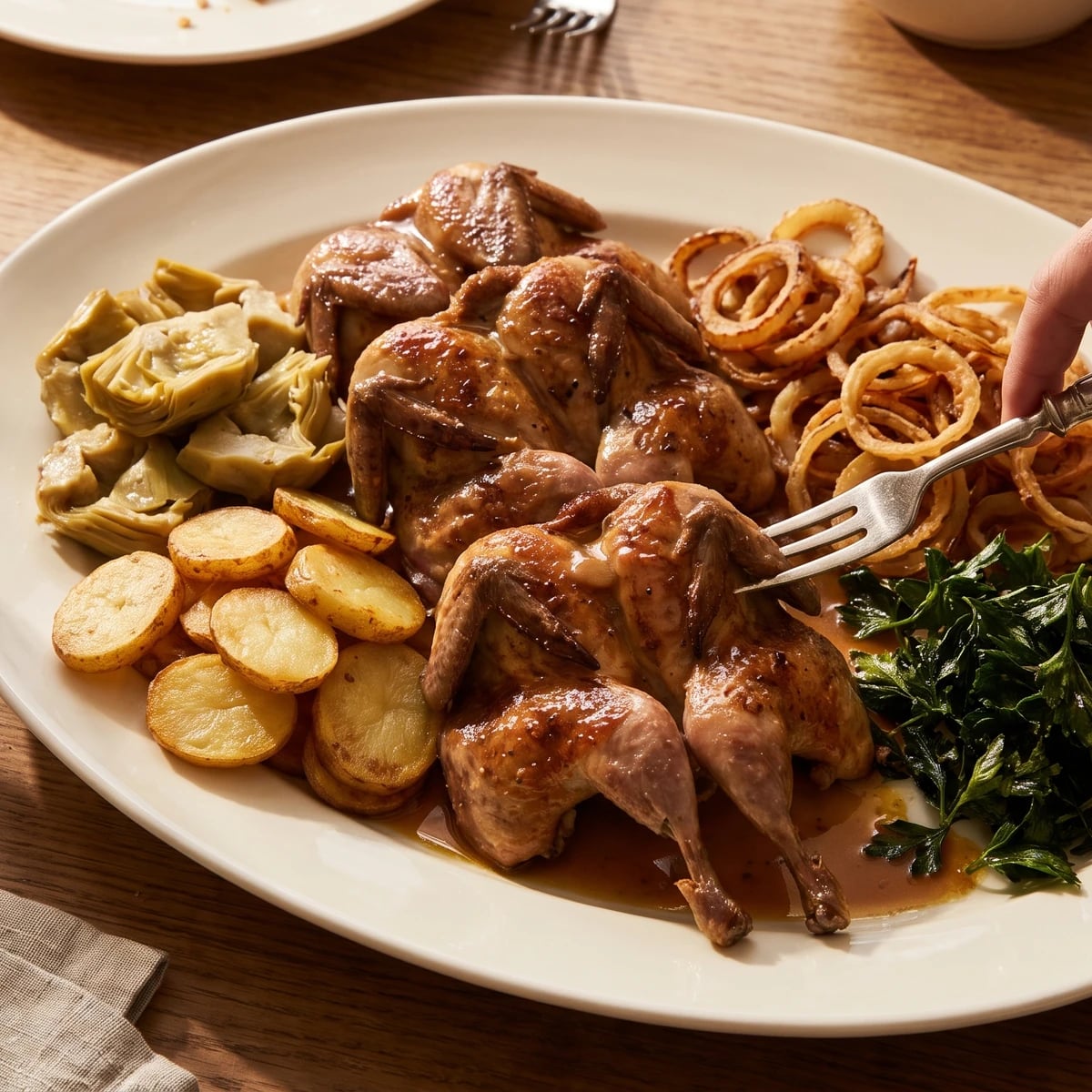
Squab split down the back, flattened, and sautéed in butter, then ringed with Bordeaux's generous garnish of artichoke bottoms, golden potatoes, crisp onion roundels, fried parsley, and pan-brightened chicken gravy.

Main Dishes
French
Dinner Party
Special Occasion
Date Night
45 min
Active Time
35 min cook1 hr 20 min total
Yield4 servings

Pigeonneaux à la Bordelais (squabs with Bordeaux garnish) teaches one uncompromising principle: a small, lean bird must lie evenly against the pan. Flatten it well and the breast bronzes while the joints cook through; leave it arched and one part dries while another remains pale.

The terse original assumed a wide sauté station, another cook tending the garnish, and a saucier with chicken gravy never off the fire. It needed no salamander, and neither do you. Prepare the garnish from Poulet Sauté Bordelaise (No. 1538) first, brown the squabs in batches, then bring all four together for a brief oven finish. That oven finish is the one procedural change, made so a home cook can serve four birds together without crowding the pan. The extra hands were scaffolding. The butter sauté, the ordered garnish, and the pan gravy are the dish, so they stay.

The finished platter should look abundant: bronze birds in the center, distinct little heaps of artichoke, potato, and onion around them, fried parsley between, and enough glossy gravy to catch the fond without drowning anything crisp. One cook, one stove, one evening. The step that decides it comes before the flame: split each bird cleanly down the back, press it level, and dry the skin thoroughly.

In the classical repertory, Pigeonneaux à la Bordelais sits in the Bordeaux-named family of garnished sautés rather than in the family of red-wine sauces. The entry borrows its entire surround from Poulet Sauté Bordelaise (No. 1538), transferring artichoke bottoms, butter-cooked potatoes, fried onion roundels, fried parsley, and chicken gravy from chicken to squab. Here Bordelais identifies the codified garnish and its arrangement, not the marrow-enriched wine sauce often attached to the name.

The technique, the tradition, and the story behind every dish.

Discover Culinary Explorer

Ingredients

whole young squabs

Quantity

4 birds, 12 to 16 ounces (340 to 450 g) each

giblets removed

fine sea salt

Quantity

2 teaspoons (10 ml / 12 g)

freshly ground black pepper

Quantity

1 teaspoon (5 ml / 2 g)

unsalted butter

Quantity

8 tablespoons (120 ml / 113 g)

garnish and chicken gravy from Poulet Sauté Bordelaise

Quantity

1 four-serving batch of Poulet Sauté Bordelaise (No. 1538), including at least ¼ cup (60 ml / 60 g) chicken gravy

garnish and gravy only, prepared and held hot

Equipment Needed

  • Sturdy poultry shears
  • 12-inch (30 cm) heavy ovenproof skillet
  • Small saucepan for clarifying butter
  • Rimmed sheet pan
  • Instant-read thermometer
  • Large warmed oval serving platter

Instructions

  1. 1

    Ready the garnish

    Prepare the garnish and chicken gravy from Poulet Sauté Bordelaise (No. 1538) according to its own entry. Use only its garnish and gravy, because the squabs take the chicken's place in this cross-referenced preparation. Keep the artichokes and potatoes warm, hold the fried onion and parsley dry, and reserve at least ¼ cup (60 ml / 60 g) of the chicken gravy. The squabs cook quickly and wait badly, so every part of the surround must be ready before they meet the butter.

    Warm the serving platter now. A cold platter steals heat from these small birds before the first one reaches the table.
  2. 2

    Open the squabs

    Set each squab breast-side down. With sturdy poultry shears, cut along one side of the backbone so the bird opens like a book, then press firmly over the breast and joints until it lies nearly flat. Trim loose fat and remove any pinfeathers, but leave the bird whole as the entry permits. Pat every surface thoroughly dry. Wet skin cannot brown properly, and browning is the foundation here.

  3. 3

    Season and clarify

    Season the squabs evenly with the salt and pepper, working a little seasoning inside the opened birds. Let them stand for 15 minutes while the oven heats to 425°F (220°C). Melt the butter very gently in a small saucepan, skim away the foam, and pour the clear golden butterfat into a heatproof cup, leaving the milky sediment behind. This is clarified butter, still real butter, prepared so the pan can run hot without scorching its milk solids.

  4. 4

    Sauté in butter

    Heat a large ovenproof skillet over medium-high heat, then add enough clarified butter to coat it generously. Lay in two squabs skin-side down and press them with a broad spatula for the first minute so the breast and legs make firm contact. Cook without shifting them for 4 to 5 minutes, until the skin is deep butter-gold and releases willingly, then turn and cook the inner side for 2 minutes. Transfer them skin-side up to a rimmed sheet pan and repeat with the remaining birds, adding more clarified butter as needed. If the butter turns black or smells acrid, remove the birds, discard the burnt fat, wipe away loose black specks, and begin again with fresh clarified butter. Ça se rattrape. The birds are not lost, but burnt butter must not reach the gravy.

  5. 5

    Finish them together

    Set all four browned squabs in the oven, skin-side up, and cook for 5 to 8 minutes, checking each bird separately. The thickest part of the breast should reach 160°F (71°C) and rise to 165°F (74°C) during a 7-minute rest; the inner thigh should register 165°F (74°C). If a breast is ready while its thigh lags, cover the breast loosely with foil and return that bird to the oven with its legs facing the hotter rear corner. Small birds vary, and the thermometer settles the argument.

  6. 6

    Déglacer the pan

    Pour excess butter from the sauté pan, leaving about 1 tablespoon and every sound brown speck of fond. Déglacer means loosening that fond with liquid: set the pan over medium heat, add the reserved chicken gravy from Poulet Sauté Bordelaise (No. 1538), and scrape firmly with a wooden spoon. Simmer for 1 to 2 minutes, until the gravy runs glossy and lightly coats the spoon. If it becomes too tight, loosen it with another spoonful of hot gravy; if it remains thin, reduce it for another minute. Ça se rattrape in either direction.

  7. 7

    Build the platter

    Arrange the rested squabs down the center of the warm platter, either opened whole or halved through the breastbone for easier serving. Surround them with the garnish from Poulet Sauté Bordelaise (No. 1538), keeping the artichoke bottoms, sliced potatoes, and onion roundels in distinct small heaps, with tufts of fried parsley between. Spoon the pan-brightened chicken gravy over the birds, not over the crisp onion and parsley. Bring the platter directly to the table. À table!

Chef Tips

  • Ask for young squab of roughly equal size, one bird per person. Equal birds cook together; a very large one hidden among smaller birds will leave you choosing between an underdone joint and three dry breasts.
  • Clarified butter is not a substitute for the butter in the source. It is butter with its water and milk solids removed, allowing the birds to take proper colour before the fat burns. Butter, not oil, carries the flavor of this sauté.
  • The garnish from Poulet Sauté Bordelaise (No. 1538) must be ready before the squabs enter the pan. The fried onion and parsley should remain dry and crisp while the artichokes, potatoes, and gravy stay warm.
  • Squab is poultry. For the home table, let the breast reach a safe 165°F (74°C) through cooking and rest, then carve promptly. If the temperature stalls below that point, return the bird to the oven instead of guessing.
  • A supple, Merlot-led red Bordeaux served slightly cool suits the dark, iron-rich meat. Avoid a heavily tannic bottle, since artichoke can make hard tannin taste harsher.
  • Refrigerate leftovers within two hours and eat them within two days. Reheat the squab gently with a spoonful of gravy, keeping any remaining fried garnish separate so it does not soften.

Advance Preparation

  • The garnish from Poulet Sauté Bordelaise (No. 1538) should be completed first and held warm for no more than 20 minutes. Its fried onion and parsley lose their character if left for hours.
  • The squabs can be opened, flattened, and dried up to 8 hours ahead. Refrigerate them uncovered on a rack, then season them 15 minutes before cooking.
  • The butter can be clarified a day ahead and kept covered in the refrigerator. Warm it only until fluid before sautéing.

Frequently Asked Questions

Nutrition Information

1 serving (about 320g)

Calories
845 calories
Total Fat
68 g
Saturated Fat
28 g
Trans Fat
1 g
Unsaturated Fat
39 g
Cholesterol
295 mg
Sodium
1600 mg
Total Carbohydrates
8 g
Dietary Fiber
1 g
Sugars
2 g
Protein
50 g

Note: Chef personas and recipes are created with AI assistance. Cook with care: follow safe food-handling practices, check doneness with a thermometer when needed, and adapt for allergies and your kitchen.

Where cooking meets culture.

Culinary guides, cultural storytelling, and the editorial depth that makes cooking meaningful.

Discover Culinary Explorer

More from Poultry (Volaille) - Ducks and Ducklings (Canards et Canetons)

Browse the full collection