
Chef Juliette
Caneton Nantais à la Choucroûte
A whole Nantes duckling, browned and gently braised with Rhine wine, carved over choucroute glazed nearly dry with salt pork, then finished beneath a restrained veil of glossy veal sauce.
A cooking platform built around craft, culture, and the stories behind what we eat.
Created by Chef Juliette
Based on No. 1775, Pigeons and Squabs (Pigeons et Pigeonneaux), from Le Guide Culinaire (1907) by Auguste Escoffier
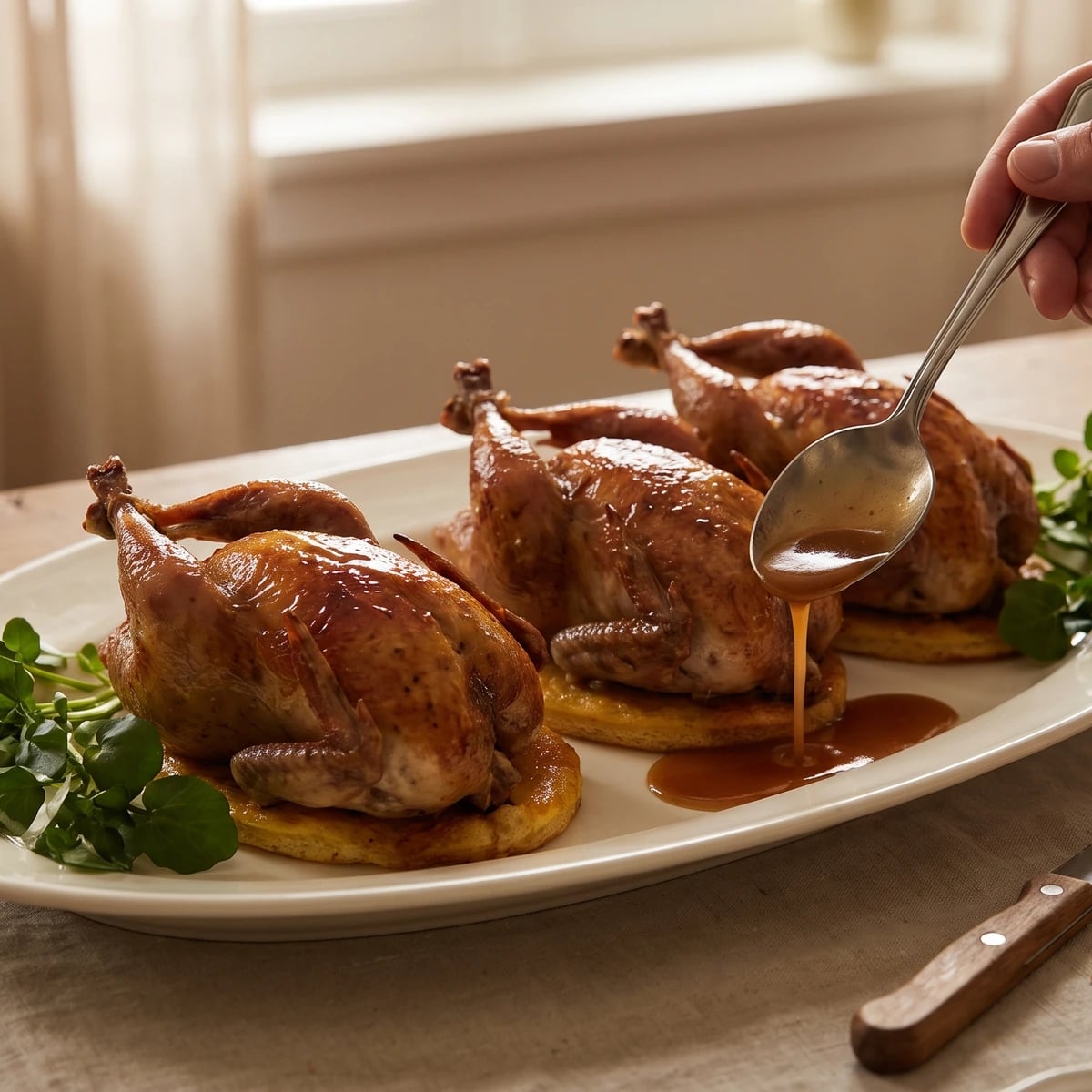
Pigeonneaux rôtis prove that young pigeon deserves the best table: burnished whole birds, buttered canapés, and a bright, glossy pan jus, all governed by fast browning and exact roasting.
Pigeons et Pigeonneaux Rôtis (roasted pigeons and squabs) teach the discipline of the small roast: colour must come quickly, and doneness must be measured, because a bird this compact offers no forgiving middle. Know one thing before touching the pan: this method is for pigeonneau, true squab, not a mature pigeon. An older bird asks for a braise; tenderness is the preparation here.
The source entry gives a judgment on the excellence of young pigeon rather than a composed formula, so this translation uses plain rôtissage and adds no borrowed numbered sauce or named garnish. A grand kitchen could call on a stockpot never off the fire, pass the roasting pan to a saucier, and crisp a waiting bird beneath a salamander. At home, four squabs, a heavy skillet, a shallow roasting pan, good unsalted stock, and a hot oven do the honest work. The oven replaces the salamander, and the birds' own fond, the browned film left in the pan, becomes the foundation of the jus. Separate sauce and holding stations are brigade scaffolding and can go. Hard browning, exact roasting, resting, and the fond stay; those are the dish. One cook, one stove, one evening.
Each bird comes to the table on a buttered canapé that catches its juices, with watercress for peppery freshness and just enough sauce to gleam around the crust. The classical table often sent squab rosier than present home poultry guidance permits, so this version pulls the birds at 160°F (71°C) and verifies 165°F (74°C) after resting. That change is for safety, not style. Begin checking before you think you need to; the thermometer, not the clock, decides the roast.
Roast squab belongs to the Parisian bourgeois table and the wider French classical repertoire, supplied for generations by dovecotes that produced very young, tender birds. The bird traveled from household dovecote to grand kitchen because its dark, delicate flesh carried elaborate garnishes beautifully, though plain rôtissage remained the clearest test of its quality. Pigeonneau marks an age rather than a separate species: a young pigeon suits quick roasting, while a mature pigeon has firmer flesh and generally asks for a braise, a distinction easily lost where pigeon has been undervalued.
Quantity
4, each 1 to 1¼ pounds (450 to 570 g)
fully thawed
Quantity
2 teaspoons (10 ml / 12 g)
divided
Quantity
1 teaspoon (5 ml / 2 g)
divided
Quantity
2 tablespoons (30 ml / 28 g)
Quantity
5 tablespoons (75 ml / 71 g)
divided, with 2 tablespoons kept cold
Quantity
4 sprigs
Quantity
4 cloves
lightly crushed
Quantity
4 slices, about 4 ounces (115 g) total and each ½ inch (1.25 cm) thick
Quantity
⅓ cup (80 ml / 50 g)
finely minced
Quantity
¾ cup (180 ml / 180 g)
Quantity
1 teaspoon (5 ml / 5 g)
Quantity
2 loosely packed cups (475 ml / 60 g)
thick stems removed
| Ingredient | Quantity |
|---|---|
| oven-ready squabs (young pigeons)fully thawed | 4, each 1 to 1¼ pounds (450 to 570 g) |
| fine sea saltdivided | 2 teaspoons (10 ml / 12 g) |
| freshly ground black pepperdivided | 1 teaspoon (5 ml / 2 g) |
| clarified butter | 2 tablespoons (30 ml / 28 g) |
| unsalted butterdivided, with 2 tablespoons kept cold | 5 tablespoons (75 ml / 71 g) |
| fresh thyme | 4 sprigs |
| garliclightly crushed | 4 cloves |
| country bread | 4 slices, about 4 ounces (115 g) total and each ½ inch (1.25 cm) thick |
| shallotfinely minced | ⅓ cup (80 ml / 50 g) |
| unsalted chicken stock | ¾ cup (180 ml / 180 g) |
| red wine vinegar | 1 teaspoon (5 ml / 5 g) |
| watercressthick stems removed | 2 loosely packed cups (475 ml / 60 g) |
Heat the oven to 450°F (230°C). Remove any packets from the cavities, but do not rinse the birds. Pat every surface and cavity thoroughly dry. Season inside and out with most of the salt and pepper, reserving a pinch of each for the jus. Tuck the wing tips underneath and tie the legs together without squeezing the breasts out of shape. Leave the birds for 20 minutes while the oven heats.
Heat a heavy skillet over medium-high heat and add half the clarified butter. Brown two squabs at a time, beginning breast-side down for about 2 minutes, then turning them onto each side and finally the back until the skin is an even deep bronze, about 5 minutes per batch. Add the remaining clarified butter as needed. Transfer the birds breast-side up to a shallow roasting pan with space between them. Divide 1 tablespoon (15 ml / 14 g) of the unsalted butter, the thyme, and the garlic around the birds, then spoon the melting butter over their breasts. If the skillet fond turns black rather than mahogany, move the birds out and wipe away only the burnt fat before continuing. Ça se rattrape, but black specks left behind will make the jus bitter.
Roast the squabs breast-side up for 12 minutes, then baste them with the butter and juices in the pan. Continue roasting and begin checking after another 6 minutes. Insert an instant-read thermometer into the thickest breast and inner thigh without touching bone. Remove each bird as both areas reach 160°F (71°C), usually after 18 to 25 minutes in the oven. If the breasts reach temperature while the thighs lag, shield the breasts loosely with small pieces of foil and continue checking every 3 minutes. Colour is already won; now protect the flesh.
Transfer the squabs to a warm platter and cover them very loosely with foil so the skin stays crisp. Pour all juices from the roasting pan into the skillet and reserve the pan for the canapés. Rest the birds for 10 minutes, then verify that the breast and thigh have reached 165°F (74°C). If either falls short, return that bird to the oven, with its breast shielded, for 3 to 5 minutes and check again. Never apologize at your own table; correct the temperature and carry on.
Lower the oven to 400°F (200°C). Spread 2 tablespoons (30 ml / 28 g) of the softened unsalted butter over both sides of the bread. Lay the slices in the emptied roasting pan and toast for 5 to 7 minutes, turning once, until golden at the edges but still able to absorb the squabs' juices. These canapés are buttered bread bases, not decorative croutons; they belong beneath the birds.
Set the skillet containing the fond and roasting juices over medium heat. Spoon off excess clear fat, leaving about 1 tablespoon in the pan, then add the shallot and cook for 2 minutes without letting it colour. Pour in the stock and scrape every browned morsel from the skillet. Simmer briskly until reduced to about ½ cup (120 ml / 120 g) and glossy enough to coat a spoon lightly. Add the vinegar and the reserved salt and pepper. Take the skillet off the heat and monter au beurre, mount the jus with cold butter, by whisking in the remaining 2 tablespoons (30 ml / 28 g) one small piece at a time. If it separates into greasy droplets, stop adding butter and whisk in 1 teaspoon (5 ml / 5 g) of cold water off the heat until it comes together. Ça se rattrape. Taste once more; the jus should be savoury and bright, never thick like gravy.
Place one toasted canapé on each warm plate and settle a squab on top. Spoon the jus around the bread and only lightly across the bird, leaving most of the burnished skin uncovered. Tuck the watercress alongside, where it can catch a little sauce without collapsing. Bring any remaining jus to the table in a warm jug. À table!
1 serving (about 275g)
Culinary guides, cultural storytelling, and the editorial depth that makes cooking meaningful.
Discover Culinary Explorer
Chef Juliette
A whole Nantes duckling, browned and gently braised with Rhine wine, carved over choucroute glazed nearly dry with salt pork, then finished beneath a restrained veil of glossy veal sauce.

Chef Juliette
A butter-poêled Aylesbury duckling, bronzed only after its covered roast, with mint inside and clear veal gravy brightened by lemon. The lesson is simple: poêlé means butter, a lid, and no added liquid.

Chef Juliette
Caneton Molière rebuilds a boned duckling around foie gras, pork, and two truffle rows, then poaches it in carcass stock before a glossy Madeira finish. The lesson is cold filling, even shaping, and gentle heat.

Chef Juliette
Caneton Braisé aux Navets turns one cocotte into a lesson in glazing: burnished duck, pearl onions, and turnips carried to light brown before they finish in a glossy classical sauce.