
Chef Juliette
Caneton Nantais à la Choucroûte
A whole Nantes duckling, browned and gently braised with Rhine wine, carved over choucroute glazed nearly dry with salt pork, then finished beneath a restrained veil of glossy veal sauce.
A cooking platform built around craft, culture, and the stories behind what we eat.
Created by Chef Juliette
Based on No. 1767, Caneton Glacé aux Cerises, from Le Guide Culinaire (1907) by Auguste Escoffier
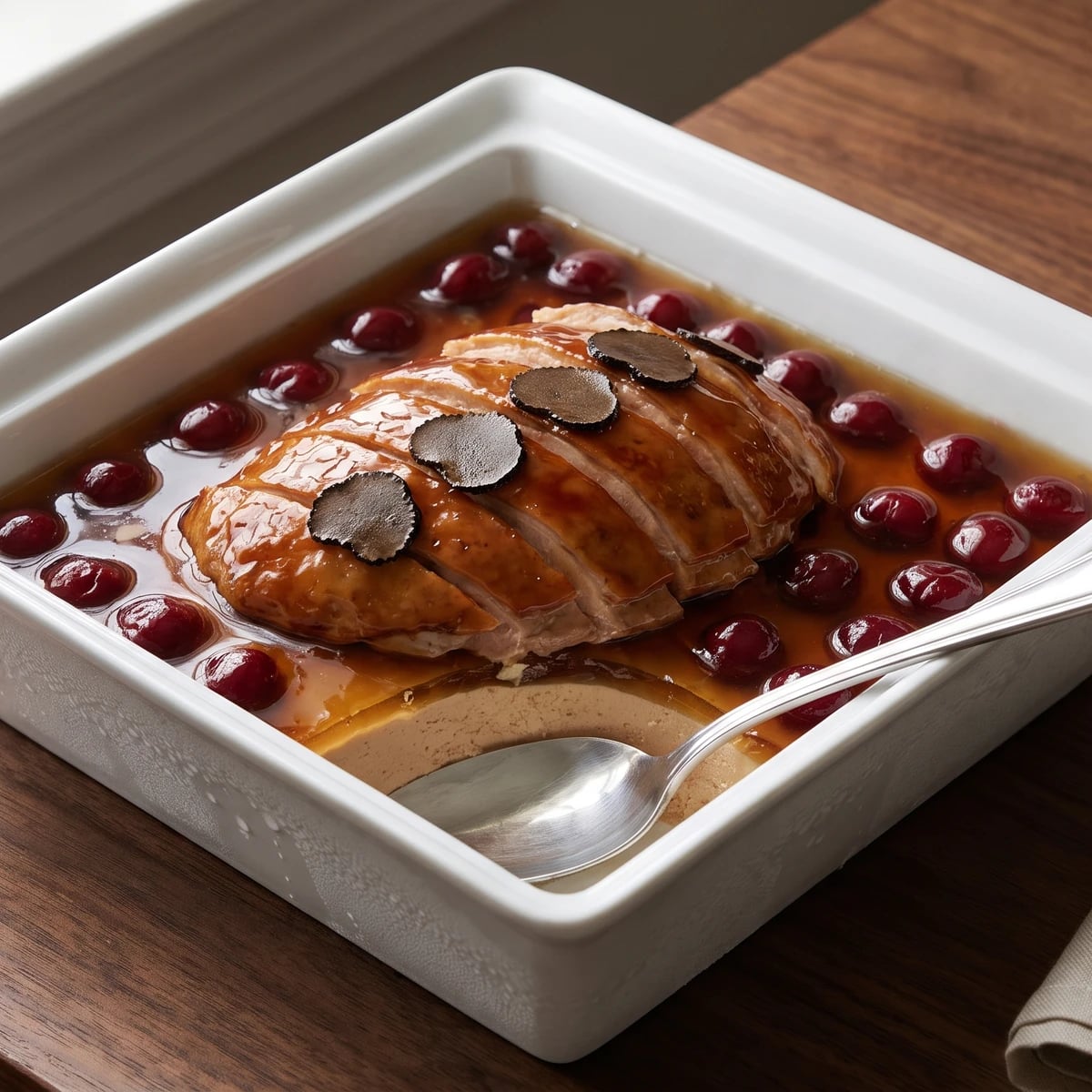
A whole duckling, roasted rosy and rebuilt cold, holds foie gras mousse beneath brown chaud-froid collops, black truffle, and Bordeaux-poached Morello cherries in gleaming duck aspic.
Caneton Glacé aux Cerises (chilled duckling with cherries) teaches the discipline of cuisine froide (cold cookery): temperature is structure. Cold mutes seasoning and exposes a weak set, so every warm component must taste vivid and cool completely before assembly. A lukewarm mousse slumps, warm brown chaud-froid (a savory cold coating sauce) slides from the duck, and warm aspic dissolves the careful work beneath it.
The original formula assumed a saucier on staff, duck essence from stock never off the fire, and a cold larder with room for great presentation dishes. A salamander has no work in this cold construction. At home, unsalted chicken stock is reinforced with the duckling's neck, wing tips, giblets, and roasting fond, measured gelatin supplies the set, and one duckling makes a generous centerpiece for four. The separate sauce station and prolonged aspic clarification are brigade scaffolding and can go. The intact carcass case, foie gras mousse, brown chaud-froid, truffle, Bordeaux-poached Morellos, and duck-scented aspic are the dish, so every one stays. One cook, one stove, one evening. The refrigerator does the night shift.
Finished properly, the duckling rises from clear amber aspic surrounded by wine-dark cherries, its overlapping collops lacquered chestnut and marked with black truffle. Before you touch a pan, clear a level refrigerator shelf and promise not to layer anything until it is thoroughly cold. That pause decides the dish.
Caneton glacé aux cerises belongs to the Parisian cuisine froide, the cold-kitchen repertoire of grand dining rooms, where cooked birds were reconstructed, sauced, glazed with aspic, and presented whole for formal buffets. It traveled to bourgeois celebration tables through caterers and household manuals, with Morello cherries and Bordeaux providing the acidity needed against rich duck and foie gras. Here glacé means chilled and aspic-glazed, not coated in a sweet glaze.
Quantity
1 (4½ to 5 lb / 2 to 2.3 kg)
neck, liver, heart, and gizzard reserved
Quantity
1 tablespoon (15 ml / 18 g), plus more to taste
divided
Quantity
1½ teaspoons (7.5 ml / 3 g)
divided
Quantity
4 tablespoons (60 ml / 56 g)
divided
Quantity
6 cups (1.4 L / 1.4 kg)
Quantity
2 tablespoons (30 ml / 16 g)
Quantity
4 standard packets (3 tablespoons / 45 ml / 28 g)
divided
Quantity
½ cup (120 ml / 120 g)
very cold
Quantity
4 ounces (½ cup / 120 ml / 115 g)
chilled
Quantity
2 cups (480 ml / 400 g)
drained
Quantity
2 cups (480 ml / 475 g)
Quantity
1 small (about 3 tablespoons / 45 ml / 20 g)
sliced paper-thin
| Ingredient | Quantity |
|---|---|
| whole young duckling, giblets includedneck, liver, heart, and gizzard reserved | 1 (4½ to 5 lb / 2 to 2.3 kg) |
| fine sea saltdivided | 1 tablespoon (15 ml / 18 g), plus more to taste |
| freshly ground black pepperdivided | 1½ teaspoons (7.5 ml / 3 g) |
| unsalted butterdivided | 4 tablespoons (60 ml / 56 g) |
| good unsalted chicken stock | 6 cups (1.4 L / 1.4 kg) |
| all-purpose flour | 2 tablespoons (30 ml / 16 g) |
| powdered unflavored gelatindivided | 4 standard packets (3 tablespoons / 45 ml / 28 g) |
| heavy creamvery cold | ½ cup (120 ml / 120 g) |
| fully cooked foie gras terrinechilled | 4 ounces (½ cup / 120 ml / 115 g) |
| pitted Morello cherriesdrained | 2 cups (480 ml / 400 g) |
| dry red Bordeaux wine | 2 cups (480 ml / 475 g) |
| black trufflesliced paper-thin | 1 small (about 3 tablespoons / 45 ml / 20 g) |
Heat the oven to 425°F (220°C). Remove the neck, wing tips, heart, and gizzard for the essence, and keep the liver separate for the mousse. Pat the duckling dry, prick only the fatty skin around the flanks and tail, and season it inside and out with 2 teaspoons of the salt and 1 teaspoon of the pepper. Roast breast-side up for 20 minutes, lower the heat to 350°F (175°C), and continue for 40 to 60 minutes. The breast must reach 155°F (68°C) and remain there for at least 1 minute, while the thickest part of the thigh reaches 165°F (74°C). This is the safe home translation of underdone: rosy and succulent, never raw. If the breast reaches temperature first, shield it loosely with foil and keep the legs facing the hotter back of the oven.
Rest the duckling on a rack for 20 minutes, draining the rendered fat and saving the browned roasting-pan film. Transfer the rack to a shallow tray and refrigerate the bird uncovered until it is cold through and at or below 40°F (4°C), about 3 to 4 hours. Do not leave a whole cooked bird lingering on the counter. The surface must remain intact and dry because it will become the case for the mousse.
While the duckling cools, brown the neck, wing tips, heart, and gizzard in 1 tablespoon of the butter until mahogany at the edges. Pour a little of the chicken stock into the roasting pan, scrape up every trace of fond, and add it to the saucepan with the remaining stock. Hold the liquid at a bare simmer for 45 minutes, then strain it and reduce it gently to 4½ cups (1.05 L / about 1.05 kg). Skim the fat rather than stirring it back in. If the essence boils and turns cloudy, strain it twice through damp cheesecloth; the flavor is still sound. Divide the cold essence into 1½ cups for the chaud-froid, ¼ cup for the mousse, and 2¾ cups for the aspic.
Bring the Bordeaux to a gentle simmer in a nonreactive saucepan and cook it for 5 minutes. Add the Morello cherries and poach them for 2 to 3 minutes, just until they absorb the wine without collapsing. Cool the cherries in the Bordeaux, then refrigerate them in the liquid for at least 2 hours. Keep them submerged until assembly, when they must be drained and blotted dry.
Set the thoroughly chilled duckling breast-side down. Working through the cavity with poultry shears and a short boning knife, cut the ribs away from the backbone and lift out the rib cage and breastbone without piercing the breast skin. Ease each breast fillet whole from beneath that skin, then draw the meat from the thighs and legs through the cavity while leaving the outer skin, wings, and drumstick ends in place as an armature. Slice each breast fillet on a shallow diagonal into eight thin collops, giving you sixteen, and keep them cold between sheets of parchment. Reserve all dark meat and sound trimmings for the mousse. If the case develops a small tear, patch it from inside with a scrap of skin. Ça se rattrape.
Cook the reserved duck liver in 1 tablespoon of the butter over medium heat until just firm and 160°F (71°C) at the center, then cool it completely. Sprinkle 1½ teaspoons (7.5 ml / about 5 g) of the gelatin over 2 tablespoons of the cold mousse essence and let it swell for 5 minutes. Heat the remaining 2 tablespoons of mousse essence, stir in the swollen gelatin until dissolved, and cool it until barely fluid. Process all the reserved duck meat, the liver, foie gras, ½ teaspoon salt, and ¼ teaspoon pepper until very fine. With the machine pulsing, add the gelatin mixture and cold cream gradually. The mousse should be smooth, cold, and able to hold a soft mound. Chill a spoonful for 15 minutes to test it. If it slumps, dissolve the reserved ½ teaspoon of corrective gelatin in 1 tablespoon of warm essence from the aspic portion, blend it into the mousse, and test again.
Line a shallow bowl with plastic wrap and lay the duck case in it breast-side down, with the cavity facing you. Pack in the mousse, pressing out air pockets and shaping it beneath the breast skin into the bird's original convex form. Fold the cavity skin over the filling, invert the duckling breast-side up onto a small flat tray, refine the shape with cool hands, and refrigerate for 1 hour. For the aspic, sprinkle 6 teaspoons (30 ml / about 19 g) gelatin over ½ cup of the cold aspic essence and let it swell for 5 minutes. Heat the remaining essence until hot but not boiling, dissolve the swollen gelatin in it, strain, and cool until fluid and slightly syrupy. Brush two thin coats over the filled carcass, chilling each coat until set, then refrigerate the bird for another 2 hours. Reserve the remaining aspic. If it sets in the bowl, warm it gently only until it flows again.
Sprinkle 1 teaspoon (5 ml / about 3 g) gelatin over 2 tablespoons of the cold chaud-froid essence and leave it for 5 minutes. Melt the remaining 2 tablespoons butter, stir in the flour, and cook the roux over medium-low heat until it reaches a deep hazelnut brown, 6 to 8 minutes. Whisk in the remaining chaud-froid essence gradually, bring it to a quiet simmer, and cook until reduced to about 1 cup and nappant (coating the back of a spoon). Remove it from the heat, stir in the swollen gelatin until dissolved, strain, and season firmly with salt and pepper. Stir over an ice bath until it has the consistency of thick cream. If it becomes solid, warm it very gently; if it remains thin, chill it for another few minutes.
Blot the sixteen cold breast collops completely dry and place them on a rack over a tray. Dip or spoon the brown chaud-froid over each one so the top and sides carry an even chestnut coating, then lay a thin piece of black truffle on every collop while the surface remains tacky. Refrigerate until firm. If the sauce slides away, either the duck or the chaud-froid is too warm. Chill both for 10 minutes, blot the collops again, and recoat them. Ça se rattrape.
Transfer the glazed, mousse-filled carcass to the center of a deep 9-inch (23 cm) square serving dish. Arrange the chaud-froid-coated collops over the convex breast in neat overlapping rows, preserving the truffle decoration. Drain and blot the cold Morello cherries, then arrange them closely around the bird. Warm the reserved aspic only until fluid and cool it until it begins to thicken. Pour a shallow layer around the cherries and chill for 15 minutes to anchor them, then add enough aspic to cover the fruit without flooding the collops. If the cherries float, let the first layer set more firmly before continuing. Refrigerate for at least 4 hours, preferably overnight.
Take the dish from the refrigerator 15 minutes before serving. Dip a broad knife in hot water, dry it, and use it with a serving spoon to lift four collops per person with a portion of the foie gras mousse beneath. Add Bordeaux-poached cherries and a clear spoonful of duck aspic to each plate. Keep the remaining dish cold and do not leave it at room temperature for more than 2 hours. This is generous celebration food, not a timid first course. À table!
1 serving (about 575g)
Culinary guides, cultural storytelling, and the editorial depth that makes cooking meaningful.
Discover Culinary Explorer
Chef Juliette
A whole Nantes duckling, browned and gently braised with Rhine wine, carved over choucroute glazed nearly dry with salt pork, then finished beneath a restrained veil of glossy veal sauce.

Chef Juliette
A butter-poêled Aylesbury duckling, bronzed only after its covered roast, with mint inside and clear veal gravy brightened by lemon. The lesson is simple: poêlé means butter, a lid, and no added liquid.

Chef Juliette
Caneton Molière rebuilds a boned duckling around foie gras, pork, and two truffle rows, then poaches it in carcass stock before a glossy Madeira finish. The lesson is cold filling, even shaping, and gentle heat.

Chef Juliette
Caneton Braisé aux Navets turns one cocotte into a lesson in glazing: burnished duck, pearl onions, and turnips carried to light brown before they finish in a glossy classical sauce.