
Chef Juliette
John Dory (St. Pierre)
John Dory has the delicacy of sole and the firmness of turbot. A light flouring, a quick butter sauté, and nut-brown beurre noisette show exactly why looks never mattered.
A cooking platform built around craft, culture, and the stories behind what we eat.
Created by Chef Juliette
Based on No. 1765, Caneton à la Cuiller, from Le Guide Culinaire (1907) by Auguste Escoffier
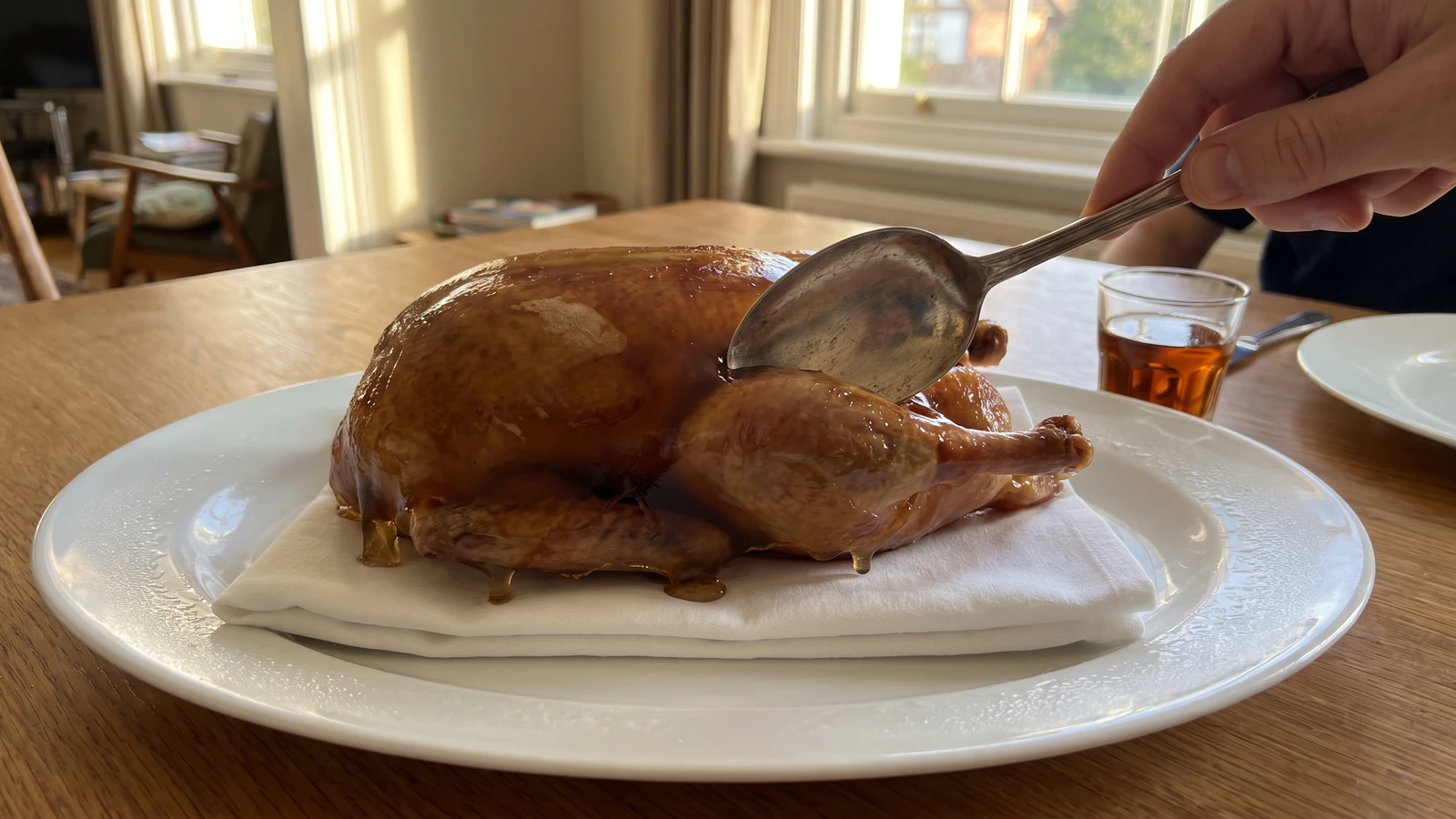
Caneton à la Cuiller is the rare Rouen duckling braised to surrender: Madeira-dark liquor, flesh tender enough for a spoon, and a cold aspic coat that makes tomorrow's table effortless.
Caneton à la Cuiller (spoon-tender duckling) teaches a severe and useful lesson: a bird meant for cold service must pass beyond neat carving tenderness. Before you touch the pan, know the test. The leg joint must turn without resistance, and a spoon pressed into the thigh must enter cleanly. Stop earlier and chilling tightens the meat into something you must saw rather than serve.
The source formula assumed a compact Rouen duckling, a saucier tending the braise, a stockpot never off the fire, clear aspic ready in the cold room, and a napkin fine enough to strain the liquor. At home, good unsalted stock, powdered gelatin, a damp cloth-lined sieve, and a close-fitting ceramic terrine do the same honest work. Clarifying a separate cauldron of aspic is brigade scaffolding and goes. The Madeira braise, complete tenderness, fine straining, fitted vessel, and full cold set are the dish and must stay. One cook, one stove, one evening gives you tomorrow's centerpiece.
When it is right, the duck's bronze skin shows beneath a clear amber coat of aspic (savory jelly), and the Madeira remains warm and nutty even though the dish is cold. Test a spoonful of the finished liquor on a chilled saucer before it covers the bird. That small set is the step that decides the whole dish.
Caneton à la Cuiller belongs to the grand-kitchen repertoire built around the young ducks of Rouen in Normandy, birds prized for a compact frame and deeply flavored flesh. Within that family it is the braised exception: most Rouen duckling preparations depend on quick roasting and rosy meat, while this one cooks the bird completely, perfumes the liquor with Madeira, and carries it cold under aspic to the buffet or formal table. Its name records the intended tenderness, not a decorative flourish, because a spoon should part the flesh once the chilled coating is broken.
Quantity
1 whole, about 4½ pounds (2 kg)
giblets removed
Quantity
2 teaspoons (10 ml / 12 g)
Quantity
½ teaspoon (2.5 ml / 1 g)
Quantity
2 tablespoons (30 ml / 28 g)
Quantity
1 medium, about 1 cup (240 ml / 180 g)
sliced
Quantity
1 large, about 1 cup (240 ml / 150 g)
sliced
Quantity
1 cup (240 ml / 240 g)
Quantity
4 cups (960 ml / 960 g)
divided
Quantity
4 envelopes, about 3 tablespoons plus 1 teaspoon (50 ml / 28 g)
Quantity
½ cup (120 ml / 120 g)
for blooming the gelatin
Quantity
1 teaspoon gelatin (5 ml / 3 g) with 1 tablespoon water (15 ml / 15 g)
reserved for a weak set
Quantity
4 cups (950 ml / 950 g)
for finishing the chilled surface
| Ingredient | Quantity |
|---|---|
| whole young duckling, preferably Rouen-typegiblets removed | 1 whole, about 4½ pounds (2 kg) |
| fine sea salt | 2 teaspoons (10 ml / 12 g) |
| freshly ground black pepper | ½ teaspoon (2.5 ml / 1 g) |
| unsalted butter | 2 tablespoons (30 ml / 28 g) |
| yellow onionsliced | 1 medium, about 1 cup (240 ml / 180 g) |
| carrotsliced | 1 large, about 1 cup (240 ml / 150 g) |
| medium-dry Madeira | 1 cup (240 ml / 240 g) |
| unsalted duck or chicken stockdivided | 4 cups (960 ml / 960 g) |
| unflavored powdered gelatin | 4 envelopes, about 3 tablespoons plus 1 teaspoon (50 ml / 28 g) |
| cool waterfor blooming the gelatin | ½ cup (120 ml / 120 g) |
| unflavored powdered gelatin with cool water (optional)reserved for a weak set | 1 teaspoon gelatin (5 ml / 3 g) with 1 tablespoon water (15 ml / 15 g) |
| boiling waterfor finishing the chilled surface | 4 cups (950 ml / 950 g) |
Choose the holding terrine before cooking. With the duck's wings tucked beneath it and its legs tied close to the body, the vessel should leave no more than 1 inch (2.5 cm) of space around the bird; too broad a dish demands a lake of weak aspic. Trim loose fat from the cavity, pat the skin thoroughly dry, then season the duck inside and out with the salt and pepper. If the neck and gizzard came with it, keep them for the braise, but leave out the liver because it clouds the liquor.
Heat the oven to 325°F (160°C). Melt the butter in a 5 to 6 quart heavy oval cocotte over medium heat. Brown the duck patiently on the breast, back, and both sides, about 12 to 15 minutes in all; use tongs and a wooden spoon together so the skin does not tear. Brown the neck and gizzard alongside it, if using. Lift everything out, pour off the rendered fat into a heatproof bowl, and leave about 2 tablespoons in the pot. Add the onion and carrot and cook until golden at their edges. The fond, the browned glaze on the pot floor, is the foundation of the Madeira liquor.
Pour in the Madeira and scrape the fond loose while the wine bubbles. Reduce it by half, until its raw alcoholic sharpness has gone and the aroma turns rounded and nutty. Return the duck and any browned neck or gizzard to the cocotte. Add about 3 cups (720 ml) of stock, enough to come halfway up the bird while keeping at least ½ cup (120 ml) in reserve. Bring the liquid only to a bare simmer. Press a cartouche (a parchment lid) directly over the duck, cover the cocotte, and transfer it to the oven.
Braise for 2 to 2½ hours, basting every 30 minutes and turning the duck carefully after the first hour. It is ready when the leg rotates freely, a spoon enters the thickest part of the thigh without resistance, and the meat measures about 180 to 185°F (82 to 85°C). This is not a rosy roast; cook it well. The liquor should barely tremble. If it has boiled hard, move the pot out of the oven until calm, lower the heat by 25°F (15°C), and add a little reserved cool stock. The flesh will still soften, and the liquor can be strained clear.
Lift the duck with two wide spatulas and settle it breast-side up in the close-fitting terrine. It will be fragile, so support the breast and legs together. Discard the vegetables, neck, and gizzard. Wet a piece of muslin or clean lint-free cotton, wring it out, and use it to line a fine-mesh sieve. Pass the braising liquor through without pressing the solids; pressure sends their particles through the cloth. Measure the liquor and simmer it uncovered until reduced to 3½ cups (840 ml), or add reserved stock to reach that amount if necessary. Taste carefully for salt, remembering that cold dulls seasoning.
Sprinkle the 4 envelopes of gelatin over the ½ cup (120 ml) cool water and leave it for 10 minutes, until fully swollen. Warm the strained Madeira liquor without boiling, then whisk in the bloomed gelatin until no granules remain. Spoon 1 tablespoon onto a saucer chilled in the freezer and wait 5 minutes. It should set clearly and hold when the saucer tilts, while still yielding to a spoon. If it runs, bloom the optional gelatin in its measured water, dissolve it into the warm liquor, and test again. Ça se rattrape. If the liquor begins setting in the saucepan, warm it gently until fluid. Let the aspic cool to lukewarm, then pour it around and over the duck. Set the terrine in a larger bowl of ice water for about 30 minutes, spooning the thickening liquor over any exposed crown until the whole bird carries a complete coat. Refrigerate uncovered until firmly set, about 1 hour, then cover and chill for at least 8 hours or overnight.
Just before serving, remove the firm surface fat with the edge of a spoon. Fill a heatproof bowl with the boiling water, warm a clean metal spoon in it, dry the spoon, and pass its back lightly over the remaining greasy film, reheating and drying it as needed. This gives the clean finish intended by the source without pouring water directly over a fragile home-set aspic. Warm and dry a thin spatula, loosen the jelly only where it grips the terrine, then slide two broad spatulas beneath the duck and transfer it to a clean folded linen napkin on an oval platter. If a leg loosens, set it back neatly and mask the join with a spoonful of clear aspic from the terrine. Serve cold with a spoon and fork, letting the tenderness explain the name. À table!
1 serving (about 400g)
Culinary guides, cultural storytelling, and the editorial depth that makes cooking meaningful.
Discover Culinary ExplorerChef Juliette
John Dory has the delicacy of sole and the firmness of turbot. A light flouring, a quick butter sauté, and nut-brown beurre noisette show exactly why looks never mattered.

Chef Juliette
Fresh haddock proves its delicacy in the meunière pan: a fine flour crust, moist pearly flakes, and beurre noisette sharpened with lemon and parsley, ready from one skillet in half an hour.

Chef Juliette
Éperlans à l’Anglaise turns small fish into a lesson in disciplined coating: boned smelts under a close, crisp crumb, pan-fried in clarified butter and finished with bright, half-melted maître d’hôtel butter.

Chef Juliette
Tiny smelts, shallot, mushrooms, white wine, gratin sauce, and fine bread raspings meet a fierce oven, where the fish must turn tender in the same breath the buttered crust bronzes.