
Chef Juliette
John Dory (St. Pierre)
John Dory has the delicacy of sole and the firmness of turbot. A light flouring, a quick butter sauté, and nut-brown beurre noisette show exactly why looks never mattered.
A cooking platform built around craft, culture, and the stories behind what we eat.
Created by Chef Juliette
Based on No. 1763, Salmis De Caneton à la Rouennaise, from Le Guide Culinaire (1907) by Auguste Escoffier
Salmis de Caneton à la Rouennaise turns fierce heat and exact carving into a swift service of thirty aiguillettes, pressed red-wine jus, crisped legs, and buttered glaze, pulled at the first curl.
Salmis de Caneton à la Rouennaise (Rouen-style duckling carved into aiguillettes and flash-glazed with pressed red-wine jus) teaches command of heat. The duck meets a fierce oven for eight minutes, four on each side, then every part receives its proper finish. The breast becomes thirty fine lengthwise slices, the legs and wing stumps go under direct heat, and the carcass gives the jus that binds everything together.
The original kitchen assumed a carver, a saucier beside stock that never left the fire, a duck press, and a salamander waiting at full heat. This entry needs no stock, so the separate saucier and stockpot are brigade scaffolding and can go. Kitchen shears, a strong sieve, and a potato masher replace the press; your oven and broiler replace the salamander. The pressed juices receive one full minute at the boil for safety, the only procedural change. The fierce roast, thirty aiguillettes, red wine, shallot, spices, butter, and instantaneous glaze all stay. One cook, one stove, one evening.
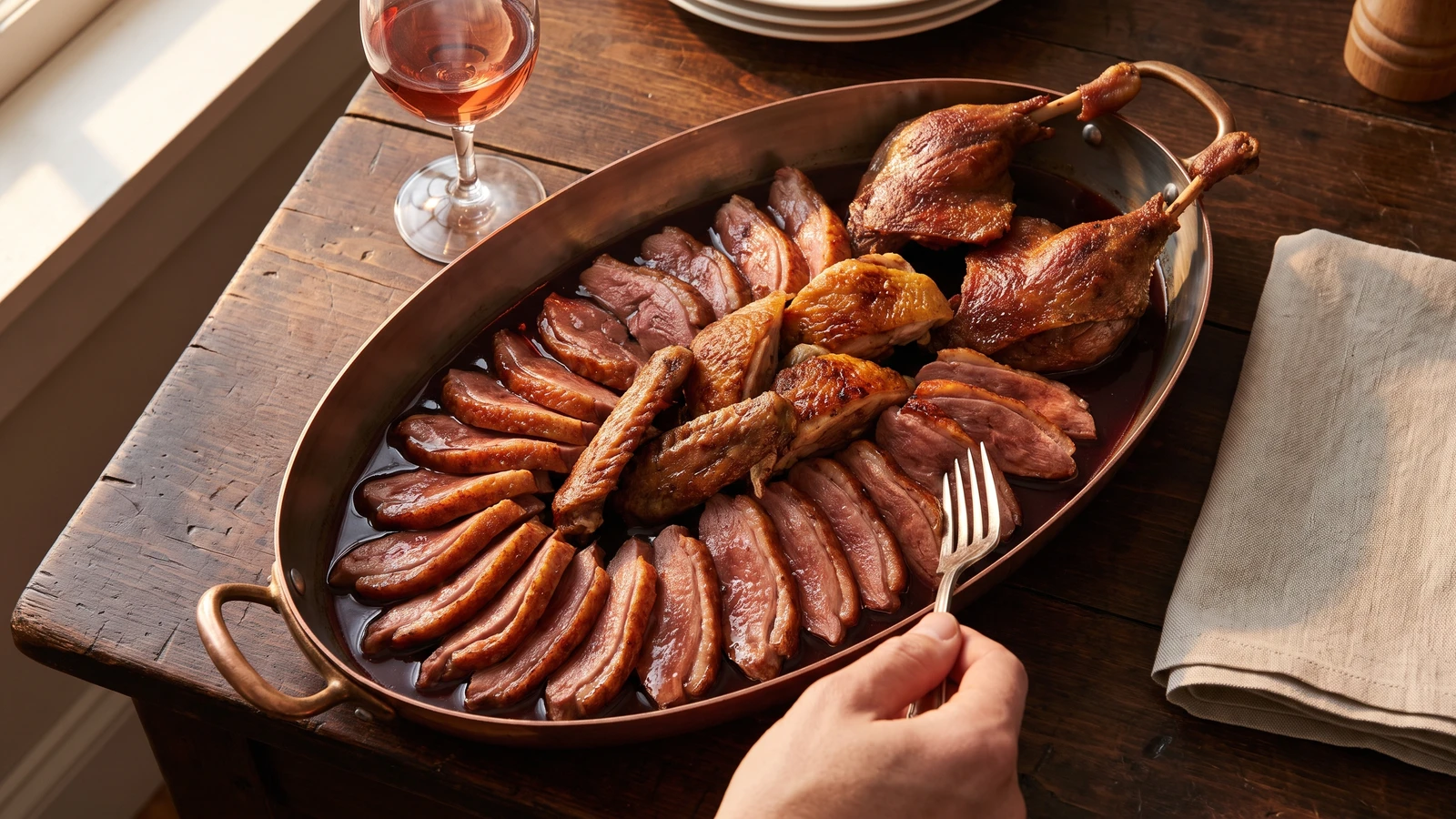
When it lands at the table, the aiguillettes should lie in glossy ranks, the butter and pressed jus caught between them, with crisp legs at either end. The final glaze is the dish. Watch the edges, not the clock, and pull the platter the instant they begin to curl.
Rouennaise duck cookery belongs to Rouen in Normandy, where tender ducklings and carcass pressing became the foundation of a celebrated local repertoire. A salmis ordinarily carries partially roasted game into a sauce made from its own carcass, but this unusually swift version reduces that idea to red wine, pressed juices, shallot, spice, and butter. The book links its lengthwise carving to Aiguillettes de Rouennais à la Bigarrade (No. 1755), yet no orange or sauce Bigarrade enters this dish.
Quantity
1 bird, 4½ to 5 pounds (2 to 2.25 kg); carving reference: Aiguillettes de Rouennais à la Bigarrade (No. 1755)
giblets removed
Quantity
3 tablespoons (45 ml / 42 g)
softened and divided
Quantity
¼ cup (60 ml / 50 g)
very finely chopped
Quantity
2 teaspoons (10 ml / 10 g)
Quantity
1 teaspoon (5 ml / 2.3 g)
Quantity
⅛ teaspoon (0.6 ml / 0.25 g)
Quantity
⅛ teaspoon (0.6 ml / 0.3 g)
Quantity
Scant ½ cup (100 ml / 100 g)
| Ingredient | Quantity |
|---|---|
| young ducklinggiblets removed | 1 bird, 4½ to 5 pounds (2 to 2.25 kg); carving reference: Aiguillettes de Rouennais à la Bigarrade (No. 1755) |
| unsalted buttersoftened and divided | 3 tablespoons (45 ml / 42 g) |
| shallotsvery finely chopped | ¼ cup (60 ml / 50 g) |
| medium-coarse kitchen or kosher salt | 2 teaspoons (10 ml / 10 g) |
| freshly ground black pepper | 1 teaspoon (5 ml / 2.3 g) |
| freshly grated nutmeg | ⅛ teaspoon (0.6 ml / 0.25 g) |
| ground allspice | ⅛ teaspoon (0.6 ml / 0.3 g) |
| dry red wine | Scant ½ cup (100 ml / 100 g) |
Set a rack in the upper third of the oven and heat it to 500°F (260°C), using convection if available. Preheat a heavy shallow roasting pan with it for at least 25 minutes. Cut around the duck's clavicle, the V-shaped wishbone at the neck end, and pull it free; this opens a clean path for carving the breasts. Truss the duck compactly and dry it thoroughly. Lay it on one side in the hot pan for exactly 4 minutes, turn it onto the other side, and roast for 4 minutes more. This first cooking sets the exterior rather than cooking the bird through. Rest it for 5 to 7 minutes, just until it can be handled. If the fierce heat has left soot-black patches, wipe them away with a clean damp cloth while preserving the brown skin beneath. Burnt residue would make the pressed jus bitter.
Mix the salt, pepper, nutmeg, and allspice. Butter a 14-inch (35 cm) flameproof oval metal serving dish with 1 tablespoon (15 ml / 14 g) of the butter. Scatter the chopped shallots over it, then dust them with one-third of the seasoning. Keep the remaining seasoning beside the carving board.
Remove both legs cleanly at the hip joints, followed by the two wing stumps. Lift the breast fillets from the keel in whole pieces and remove their skin, reserving two neat pieces of breast skin for grilling. An aiguillette is a thin lengthwise slice of breast, and the direction of this cut follows Aiguillettes de Rouennais à la Bigarrade (No. 1755). With a very sharp slicing knife, cut each fillet lengthwise into 15 even slices, about 1/16 inch (1.5 to 2 mm) thick. Keep the slices in their original order so they can be laid down neatly.
Cisel the inner flesh of each leg, meaning make several close-set shallow cuts without cutting through the skin. This lets fierce heat reach the joint before the outside burns. Season the legs, wing stumps, and reserved breast skin with half the remaining spice mixture. Set them under a fully heated broiler, about 4 inches (10 cm) from the element, turning the legs once. Remove the breast skin when crisp and the wing stumps when cooked through, usually after 3 to 7 minutes. Continue cooking the legs until their juices run clear and the thickest part reaches 165°F (74°C), about 10 to 14 minutes. If the skin browns before the joint is ready, lower the rack and continue. Hold everything warm.
Arrange the aiguillettes against one another in two close, slightly overlapping ranks over the shallots. Keep them in a single shallow layer so every slice receives the same flash of heat. Sprinkle them evenly with the last of the seasoning, adding no more shallot on top.
Roughly chop the warm carcass with poultry shears. Set the pieces in a sturdy fine-mesh sieve over a small saucepan and press them forcefully with a potato masher or the base of a smaller heavy pan, sprinkling in the red wine a little at a time as you work. Press until the bones have surrendered their juices and the wine has washed them into the saucepan. Bring the collected liquid to a full boil for 1 minute, then reduce briskly to about ⅓ cup (80 ml), skimming off excess duck fat. It should taste concentrated and lightly coat a spoon, not become sticky. If it goes syrupy, ça se rattrape: stir in 1 tablespoon (15 ml / 15 g) of wine and return it briefly to the boil. Strain the hot jus over the aiguillettes.
Dot the aiguillettes with the remaining 2 tablespoons (30 ml / 28 g) of butter. Set the flameproof dish over the lowest stove heat for 20 to 30 seconds, only until the jus stirs beneath the slices, then place it immediately beneath the fully heated broiler. Watch without turning away. Pull the dish as soon as the aiguillettes turn opaque and their fine edges begin to curl, usually within 45 to 75 seconds; the slices are thin enough to cook through at that signal. If one side moves faster, rotate the dish once rather than waiting for the first slices to tighten. Set a grilled leg at each end, place the two wing stumps and crisp breast skin in the middle, and serve at once. À table!
1 serving (about 220g)
Culinary guides, cultural storytelling, and the editorial depth that makes cooking meaningful.
Discover Culinary ExplorerChef Juliette
John Dory has the delicacy of sole and the firmness of turbot. A light flouring, a quick butter sauté, and nut-brown beurre noisette show exactly why looks never mattered.

Chef Juliette
Fresh haddock proves its delicacy in the meunière pan: a fine flour crust, moist pearly flakes, and beurre noisette sharpened with lemon and parsley, ready from one skillet in half an hour.

Chef Juliette
Éperlans à l’Anglaise turns small fish into a lesson in disciplined coating: boned smelts under a close, crisp crumb, pan-fried in clarified butter and finished with bright, half-melted maître d’hôtel butter.

Chef Juliette
Tiny smelts, shallot, mushrooms, white wine, gratin sauce, and fine bread raspings meet a fierce oven, where the fish must turn tender in the same breath the buttered crust bronzes.