
Chef Juliette
John Dory (St. Pierre)
John Dory has the delicacy of sole and the firmness of turbot. A light flouring, a quick butter sauté, and nut-brown beurre noisette show exactly why looks never mattered.
A cooking platform built around craft, culture, and the stories behind what we eat.
Created by Chef Juliette
Based on No. 1759, Caneton Rouennais en Chemise, from Le Guide Culinaire (1907) by Auguste Escoffier
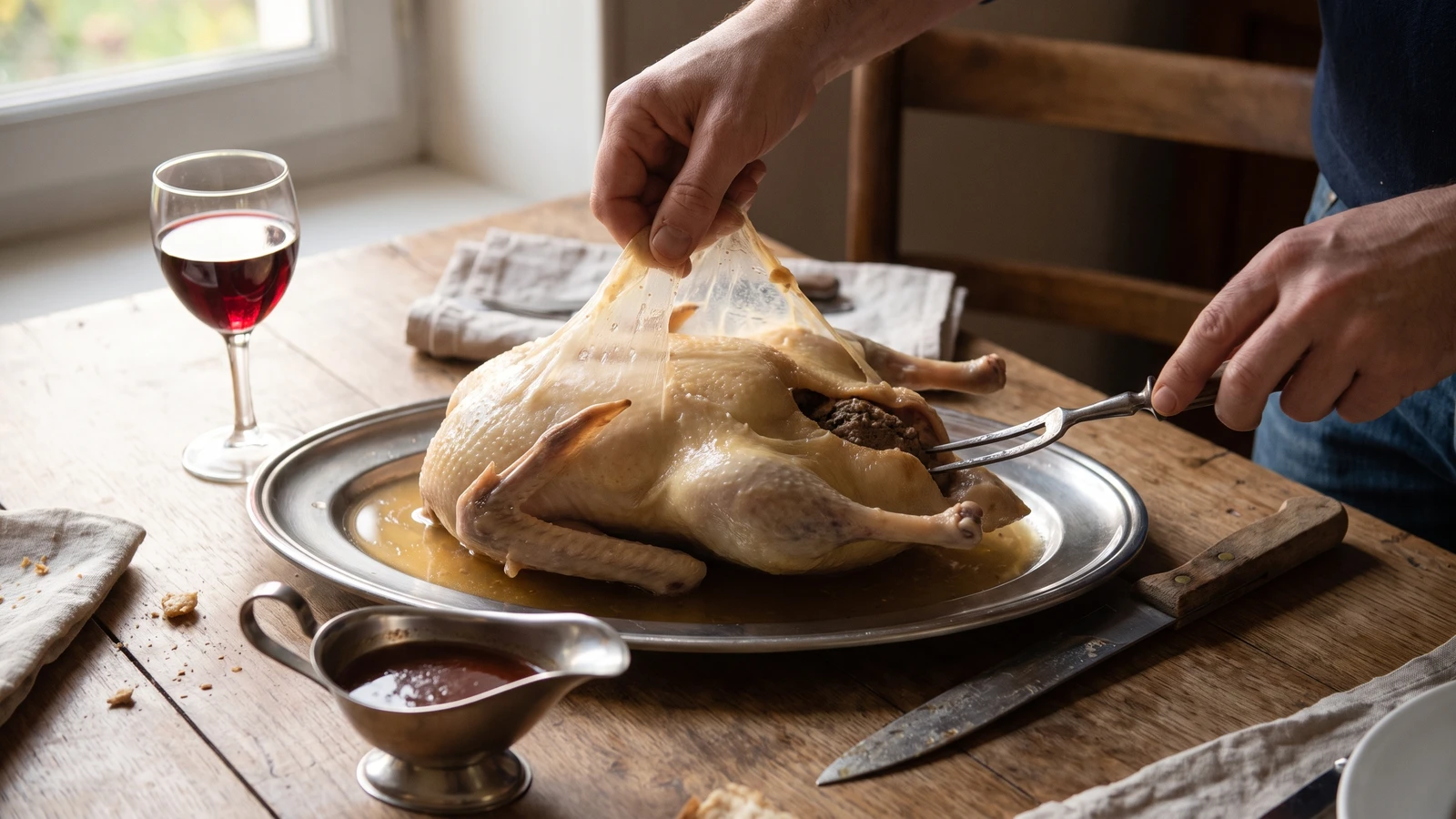
A whole Rouen duckling, liver-stuffed and sealed before a gentle stock poach, arrives taut-skinned and full of its own juices, with Sauce Rouennaise beside it. The shirt does the work, and the seal decides everything.
Caneton Rouennais en Chemise teaches the discipline of enclosure. The liver-stuffed duckling cooks inside a sealed shirt, holding every drop of juice and every breath of aroma close to the bird. The one true thing is simple: if the shirt holds, the duck bastes in its own richness; if it leaks, the dish loses its reason for being.
The original assumed a saucier on staff, a brown stock never off the fire, a brigade-sized stockpot, and a cleaned pig's bladder waiting from the butcher. At home, a narrow pot reduces the stock required, Sauce Rouennaise is prepared as its own component, and a food-safe cook-in bag rated for immersion replaces the bladder. What changes is the membrane, not the intent. A salamander has no place here, because the skin is meant to remain taut and pale, never browned.
The bladder and enormous stockpot were brigade scaffolding. The cool liver forcemeat, compact truss, cloth wrap, tight seal, and gentle forty-five-minute poach are the dish, and they stay. The book's timing becomes the first check rather than a gamble: the centre of a stuffed bird must reach 165°F (74°C). Before the duckling touches the stock, double-tie its shirt and inspect every seam. One cook, one stove, one evening.
Caneton Rouennais belongs to Rouen in Normandy, where local ducklings were prized for their red flesh and traditionally kept unbled so the blood and liver could deepen Sauce Rouennaise. En chemise is a grand-kitchen cousin of cooking en vessie: the stuffed bird is enclosed in a soaked pig's bladder, bound in cloth, and poached so its juices remain with the duck rather than escaping into the cooking liquor. It should not be confused with Rouen's famous pressed duck, which extracts blood and juices from the carved carcass; here, enclosure does the work.
Quantity
1 bird (3½ to 4 lb / 1.6 to 1.8 kg)
neck and giblets removed
Quantity
1 batch Caneton Rouennais (No. 1754), about 1½ cups (360 ml / 370 g)
cool but still pliable
Quantity
3 quarts (2.8 L / 2.8 kg), or enough to cover the wrapped bird
Quantity
1½ cups (360 ml / about 370 g)
prepared and hot
| Ingredient | Quantity |
|---|---|
| small young ducklingneck and giblets removed | 1 bird (3½ to 4 lb / 1.6 to 1.8 kg) |
| prepared liver forcemeat componentcool but still pliable | 1 batch Caneton Rouennais (No. 1754), about 1½ cups (360 ml / 370 g) |
| very strong brown stock | 3 quarts (2.8 L / 2.8 kg), or enough to cover the wrapped bird |
| Sauce Rouennaiseprepared and hot | 1½ cups (360 ml / about 370 g) |
Pat the duckling dry inside and out, remove any loose fat from the cavity, and tuck the wing tips underneath. Fill the cavity with the prepared forcemeat from Caneton Rouennais (No. 1754), keeping it cool and packing it evenly without compressing it into a solid plug. Close the opening with small skewers and twine, then truss the bird compactly, drawing the legs close against the body. A compact truss cooks evenly and slips into its shirt without tearing it.
Slide the duckling neck-first into a large food-safe cook-in bag explicitly rated for simmering, leaving the open end gathered close to the tail as the source directs. Press out the large pockets of air without crushing the bird, draw the bag close, and secure it with two tight cotton-twine ligatures. Fold the loose end back and tie it once more. Inspect the bag from every side, then wrap it snugly in a clean lint-free cotton cloth or muslin square and tie the cloth securely. The cloth protects the shirt and keeps the bird compact; the bag makes the seal.
Bring the very strong brown stock to 185°F (85°C) in a narrow, deep stockpot. Lower in the cloth-wrapped duckling, using the cloth ties as handles, and make certain the bundle is covered. If the stock falls short, move everything to a narrower pot rather than weakening it with water. Return the liquid gradually to 180 to 190°F (82 to 88°C), where the surface barely quivers. Never let it boil.
Begin timing when the stock returns to its gentle poaching range, then cook for about forty-five minutes. Keep the bundle submerged and adjust the heat whenever the surface grows restless. If the stock boils, lift the pot from the burner until it calms, then continue over lower heat; the duck is still sound, but a rolling boil can force liquid past the closure and toughen the outer flesh. At forty-five minutes, lift the bundle onto a rimmed tray and remove the cloth. Keep the bag upright, loosen only its gathered mouth, and insert an instant-read thermometer into the centre of the forcemeat without piercing the bag. It must register 165°F (74°C). If it does not, withdraw the thermometer, expel excess air, retie and rewrap the bird, then return it to the poach in five-minute intervals until it does.
Once the centre reaches temperature, retie the shirt and leave the duckling enclosed for ten minutes so its juices settle into the meat and forcemeat. Meanwhile, warm the Sauce Rouennaise in a small saucepan over gentle heat without allowing it to boil. If the sauce tightens while it waits, loosen it with a spoonful of the strong brown stock and whisk until it flows from the spoon in a glossy ribbon.
Remove the cloth but leave the duckling in its sealed shirt, exactly as the dish requires, and place it on a heated oval platter. Carry it to the table before opening. Slit the bag carefully at the top, directing the opening away from hands and faces, then fold the shirt back to reveal the taut-skinned bird and its captured juices. Carve the duckling, give each serving a spoonful of the liver forcemeat, and serve the Sauce Rouennaise separately. À table!
1 serving (about 395g)
Culinary guides, cultural storytelling, and the editorial depth that makes cooking meaningful.
Discover Culinary ExplorerChef Juliette
John Dory has the delicacy of sole and the firmness of turbot. A light flouring, a quick butter sauté, and nut-brown beurre noisette show exactly why looks never mattered.

Chef Juliette
Fresh haddock proves its delicacy in the meunière pan: a fine flour crust, moist pearly flakes, and beurre noisette sharpened with lemon and parsley, ready from one skillet in half an hour.

Chef Juliette
Éperlans à l’Anglaise turns small fish into a lesson in disciplined coating: boned smelts under a close, crisp crumb, pan-fried in clarified butter and finished with bright, half-melted maître d’hôtel butter.

Chef Juliette
Tiny smelts, shallot, mushrooms, white wine, gratin sauce, and fine bread raspings meet a fierce oven, where the fish must turn tender in the same breath the buttered crust bronzes.