
Chef Juliette
John Dory (St. Pierre)
John Dory has the delicacy of sole and the firmness of turbot. A light flouring, a quick butter sauté, and nut-brown beurre noisette show exactly why looks never mattered.
A cooking platform built around craft, culture, and the stories behind what we eat.
Created by Chef Juliette
Based on No. 1756, Aiguillettes de Rouennais aux Cerises, from Le Guide Culinaire (1907) by Auguste Escoffier
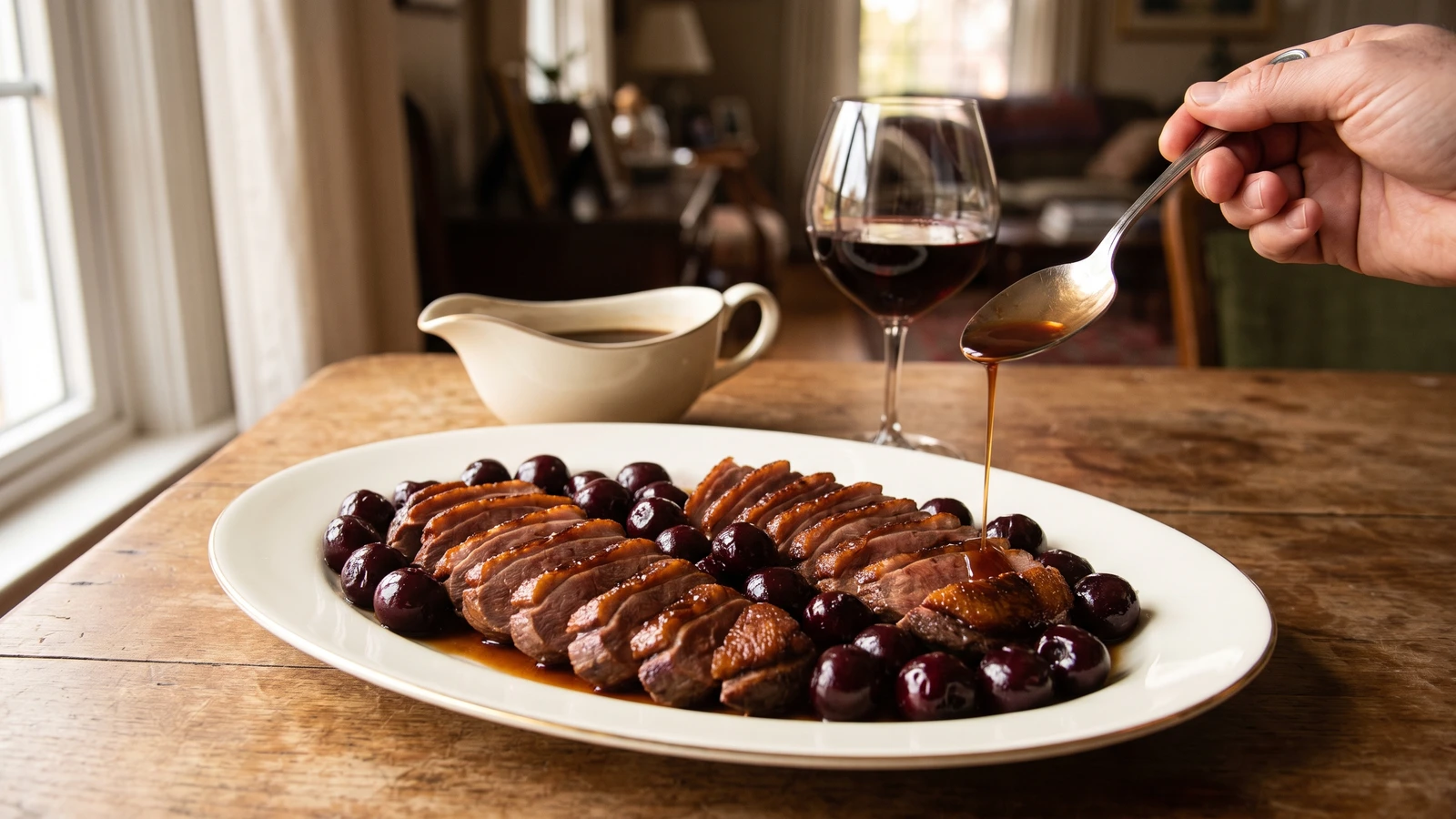
Bronzed Rouen duck breast, sliced into aiguillettes and veiled with clear Madeira pan liquor, with tart Morello cherries warmed only at the finish so every fruit keeps its shape and bite.
Aiguillettes de Rouennais aux Cerises (lengthwise slices of Rouen duckling breast with cherries) teaches clarity in sauce-making. Remove the grease completely, then give the Madeira-rich cooking liquor only enough arrowroot to cling. The one true thing to know before touching the pan is this: arrowroot should make a translucent veil, never a gravy.
The original entry assumes a saucier, veal gravy always ready beside the stove, muslin for a perfectly clear strain, and enough hands to slice the bird while its sauce is finished. At home, Aiguillettes de Rouennais à la Bigarrade (No. 1755) supplies the referenced poêlé method, meaning the duckling is gently pot-roasted in a covered pan, while a shallow spoon and dampened fine-mesh sieve replace the saucier and muslin. That service apparatus is brigade scaffolding. The Madeira in the liquor, complete degreasing, arrowroot finish, and cherries added at the last moment are the dish, and none of them can go. One cook, one stove, one evening.
When it reaches the table, the aiguillettes should wear only a thin gleam of sauce, with the dark Morello cherries still whole and tart around them. Skim every eye of fat before adding the arrowroot. That is the step that decides whether the sauce arrives clear and polished or dull and greasy.
Aiguillettes de Rouennais belong to Rouen in Normandy through the Rouen duck, a substantial bird raised around the Seine valley and prized for its richly flavored flesh. The grand kitchen carried that regional bird into formal service by cutting its just-cooked breasts lengthwise into aiguillettes and pairing them with concentrated cooking liquor, here sharpened by Madeira and sour Morello cherries. This is distinct from Rouen's pressed, blood-bound canard à la rouennaise, and the cherries are a classical sour-fruit counterpoint rather than a claim that they define the Norman larder.
Quantity
1 home-scale preparation Aiguillettes de Rouennais à la Bigarrade (No. 1755), scaled to 1 duckling (about 4 lb / 1.8 kg)
complete through poëling, lengthwise slicing, and the brief reduction of the cooking liquor; stop before the Bigarrade finish
Quantity
2 tablespoons (30 ml / 30 g)
Quantity
1½ cups (8 oz / 225 g)
drained and patted dry
Quantity
2 teaspoons (10 ml / 6 g)
Quantity
2 tablespoons (30 ml / 30 g)
divided between the slurry and any necessary loosening
| Ingredient | Quantity |
|---|---|
| referenced Rouen duckling preparationcomplete through poëling, lengthwise slicing, and the brief reduction of the cooking liquor; stop before the Bigarrade finish | 1 home-scale preparation Aiguillettes de Rouennais à la Bigarrade (No. 1755), scaled to 1 duckling (about 4 lb / 1.8 kg) |
| medium-dry Madeira | 2 tablespoons (30 ml / 30 g) |
| pitted Morello cherriesdrained and patted dry | 1½ cups (8 oz / 225 g) |
| arrowroot | 2 teaspoons (10 ml / 6 g) |
| cold waterdivided between the slurry and any necessary loosening | 2 tablespoons (30 ml / 30 g) |
Follow Aiguillettes de Rouennais à la Bigarrade (No. 1755), scaled to one duckling, through its poëling, lengthwise slicing, and the brief boiling of the reserved cooking liquor with its veal gravy. Add the Madeira to the poëling liquor before the duckling cooks, as this entry directs, then stop before the Bigarrade finish. Use an instant-read thermometer rather than trusting a short clock: the thickest edible portion must reach 165°F (74°C), but take it no further. Arrange the sliced aiguillettes on a lukewarm platter and cover loosely while you finish the sauce.
Pour the reduced cooking liquor into a narrow heatproof jug and let it stand for one minute, then skim away every visible pool and bead of fat with a shallow spoon. Return only the clear liquor to a small clean saucepan. If tiny droplets remain, draw the corner of a clean paper towel lightly across the surface without dipping it into the sauce. Do not whisk the grease back in. A clear sauce begins with patient skimming.
Mix the arrowroot with 1 tablespoon (15 ml / 15 g) of the cold water until perfectly smooth. Bring the degreased liquor to a gentle simmer, then whisk in half the slurry and wait twenty seconds before deciding whether it needs more. Add only enough to make the sauce cling in a thin, translucent film to the back of a spoon. Do not boil it hard once thickened, because arrowroot loses its clean body under prolonged heat. If the sauce becomes too thick, ça se rattrape: whisk in the remaining cold water 1 teaspoon at a time. If it clumps, strain it at once and return it to a clean pan.
Pass the sauce through a dampened fine-mesh sieve into a clean saucepan, lining the sieve with one damp layer of cheesecloth if its mesh is coarse. This is the home equivalent of the book's muslin. Let the sauce pass under its own weight and do not press the solids through, or the clarity you worked for disappears.
Return the strained sauce to the gentlest heat and add the drained Morello cherries at the last possible moment. Roll the pan carefully for 45 to 60 seconds, just until the fruit is warmed and lacquered. Do not stir hard or let the sauce boil. If the skins begin splitting, lift the cherries out immediately and warm the sauce alone. The fruit must remain whole, with its shape and tart bite intact.
Lift the cherries from the sauce and arrange them generously around the aiguillettes. Spoon only a thin coating of the Madeira sauce over the duck, leaving the slices visible, then pour the remaining sauce into a warmed sauceboat and serve it separately, exactly as the entry intends. Bring the platter straight to the table. À table!
1 serving (about 175g)
Culinary guides, cultural storytelling, and the editorial depth that makes cooking meaningful.
Discover Culinary ExplorerChef Juliette
John Dory has the delicacy of sole and the firmness of turbot. A light flouring, a quick butter sauté, and nut-brown beurre noisette show exactly why looks never mattered.

Chef Juliette
Fresh haddock proves its delicacy in the meunière pan: a fine flour crust, moist pearly flakes, and beurre noisette sharpened with lemon and parsley, ready from one skillet in half an hour.

Chef Juliette
Éperlans à l’Anglaise turns small fish into a lesson in disciplined coating: boned smelts under a close, crisp crumb, pan-fried in clarified butter and finished with bright, half-melted maître d’hôtel butter.

Chef Juliette
Tiny smelts, shallot, mushrooms, white wine, gratin sauce, and fine bread raspings meet a fierce oven, where the fish must turn tender in the same breath the buttered crust bronzes.