Culinary Explorer

A cooking platform built around craft, culture, and the stories behind what we eat.
Discover Culinary Explorer
Timbale de Foie Gras Tzarine

Timbale de Foie Gras Tzarine

Created by Chef Juliette

Based on No. 1744, Timbale de Foie Gras Tzarine, from Le Guide Culinaire (1907) by Auguste Escoffier

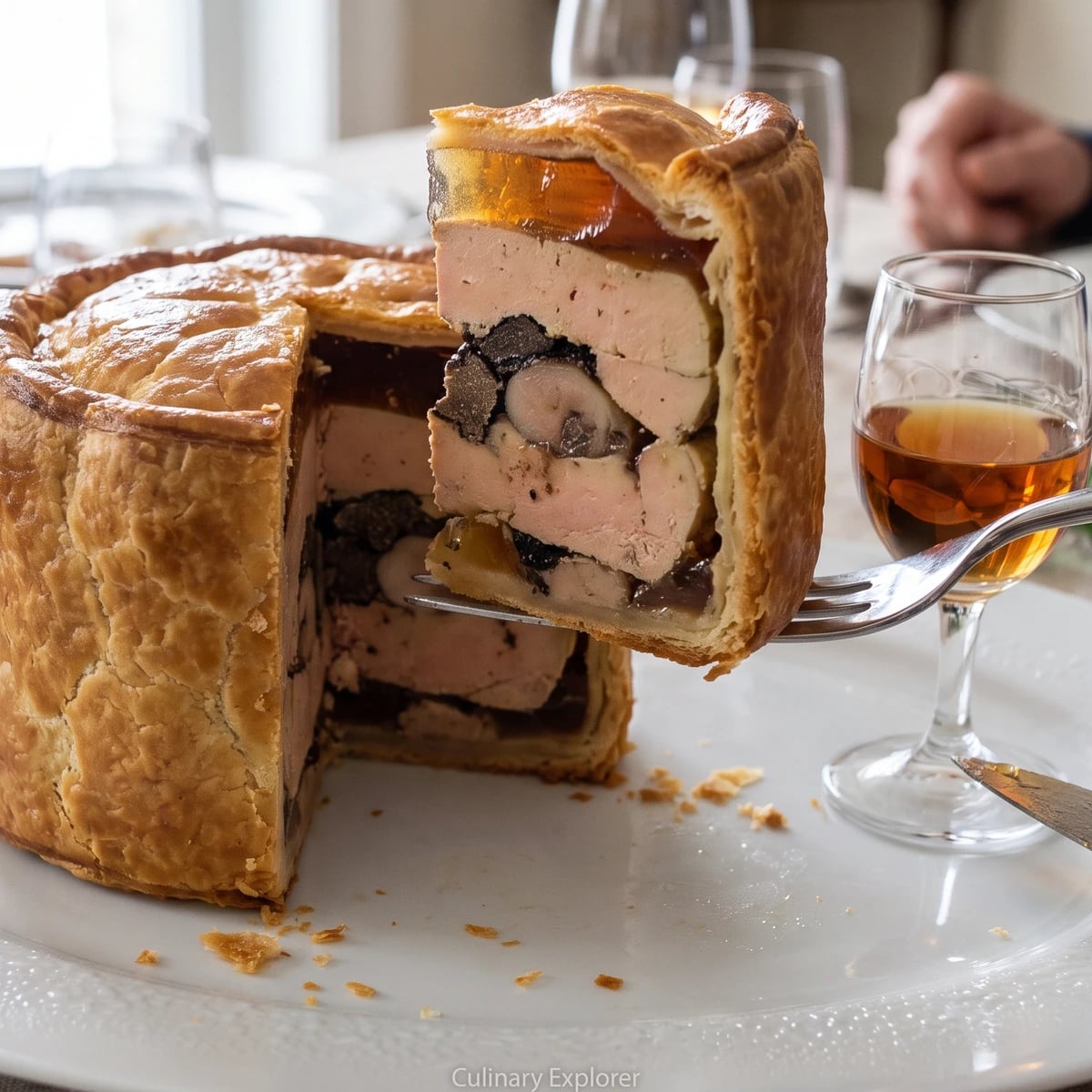
Foie gras at the centre, truffle-filled quails standing around it, and Madeira veal jelly sealing every space: a cold celebration timbale whose triumph depends on a sound pastry seal and a patient two-day rest.

Main Dishes
French
Christmas
Holiday
Celebration
1 hr 30 min
Active Time
1 hr 15 min cook28 hr 45 min total
Yield4 servings

Timbale de Foie Gras Tzarine (a raised foie gras and quail pie) teaches that pastry can be architecture. The one true thing to know before you touch a pan is this: the seal decides the dish. The case must hold the roasting juices first and the Madeira veal jelly afterward, so any weak seam costs both flavor and the clean mosaic you want at the knife.

The original kitchen had a pastry cook to shape the case, a poultry cook to prepare the quails, and a saucier beside a veal stockpot that never went cold. At home, ask the butcher to tunnel-bone four birds, use a deep seamless cake or charlotte mould, and strengthen reduced veal stock with a measured little gelatin, because bought stock rarely sets on its own. Tunnel-boning preserves each quail's whole shape but lets the finished quarter slice without tiny bones; the gelatin restores the stock's intended jelly rather than changing its flavor. One cook, one stove, one evening, then the cold does its work for a day or two.

The brigade labor around the birds and stock was scaffolding, so it can go. The arrangement must stay: whole seasoned foie gras at the centre, truffle-filled quails upright against unsmoked bacon, whole peeled truffles packed into the spaces, and a full moderate bake before the warm jelly goes in. Seal the lid with patience. That is the step that decides everything.

The title Tzarine belongs to the courtly naming language of Parisian grande cuisine, where foie gras, truffles, small game birds, Madeira, and aspic signaled a banquet dish at full strength. The timbale form grew from the French pâté en croûte tradition, with a strong pastry case serving as cooking vessel, presentation, and protection for a rich cold filling. Despite its Russian title, this is not a Russian household pie; its true home is the Paris celebration table, with Tzarine naming luxury rather than geography.

The technique, the tradition, and the story behind every dish.

Discover Culinary Explorer

Ingredients

all-purpose flour

Quantity

4 cups plus 2 tablespoons (980 ml / 500 g)

fine sea salt, for the pastry

Quantity

1½ teaspoons (7.5 ml / 9 g)

cold unsalted butter

Quantity

½ cup plus 1 tablespoon (135 ml / 125 g)

cubed, with 1 teaspoon reserved for the mould

chilled leaf lard

Quantity

½ cup (120 ml / 110 g)

diced

large eggs

Quantity

2

ice water

Quantity

⅓ cup plus 1 tablespoon (95 ml / 95 g)

used as needed

whole fresh duck foie gras

Quantity

1 small liver, about 12 oz (350 g)

deveined with the lobes kept intact

oven-ready quails

Quantity

4, about 4 oz (110 g) each before boning

tunnel-boned and kept whole

fresh black Périgord truffles

Quantity

8 to 12 small truffles, about 7 oz (200 g) total

scrubbed and peeled

unsmoked streaky bacon or larding bacon

Quantity

10 oz (280 g), about 16 very thin slices

fine sea salt, for the foie gras

Quantity

1 teaspoon (5 ml / 6 g)

freshly ground black pepper

Quantity

¾ teaspoon (3.75 ml / 1.5 g)

ground allspice

Quantity

¼ teaspoon (1.25 ml / 0.5 g)

deeply flavored, low-sodium veal stock

Quantity

2 cups (480 ml / 480 g)

medium-dry Madeira

Quantity

⅓ cup (80 ml / 80 g)

unflavored powdered gelatin

Quantity

2½ teaspoons (12.5 ml / 8 g)

Equipment Needed

  • 15 cm (6-inch) diameter, 8 cm (3-inch) deep seamless charlotte, timbale, or fixed-base cake mould
  • Rolling pin
  • Small funnel or bulb baster
  • Instant-read thermometer
  • Fine-mesh sieve
  • Rimmed baking sheet

Instructions

  1. 1

    Make the pâte

    Make the pâte à pâté, the sturdy pastry built to hold a raised pie. Mix the flour with the pastry salt, then rub in the cold butter and lard until the fat is dispersed in small, flat pieces. Add the eggs and enough ice water to form a firm dough. Knead for one minute, only until smooth and cohesive, then flatten, wrap, and chill for at least 1 hour. This pastry is architecture rather than a tender tart shell, so it must bend without cracking. If it crumbles when pressed, work in ice water one teaspoon at a time; if it feels greasy, chill it before continuing.

  2. 2

    Build the Madeira stock

    Reserve ¼ cup (60 ml) of the cold veal stock and sprinkle the gelatin over it. Leave it to bloom for 5 minutes. Simmer the remaining stock with the Madeira until reduced to about 1¼ cups (300 ml), tasting for a deep veal flavor with Madeira behind it rather than in front. Remove from the heat, whisk in the bloomed gelatin, and strain. Keep the stock covered; it may set while the timbale bakes, which is perfectly right, since it will be warmed gently until fluid before pouring.

  3. 3

    Prepare the filling

    Keep the foie gras and quails cold while you work. Cut four stout plugs from one truffle and leave all the remaining peeled truffles whole. Slip one truffle plug into the cavity of each tunnel-boned quail, then tuck the birds back into their natural shape. Season the foie gras evenly with the salt, pepper, and allspice, pressing the seasoning lightly onto every surface without breaking the lobes apart.

  4. 4

    Line the mould

    Heat the oven to 350°F (180°C), or 325°F (165°C) with convection. Butter the timbale mould lightly. Roll three quarters of the chilled pastry about ⅛ inch (4 mm) thick and fit it into the base and straight sides, leaving a ¾ inch (2 cm) overhang. Do not stretch it, since stretched pastry retreats in the oven. Press every crease smooth and inspect the corners for pinholes. If the pastry tears, brush a scrap with water, press it over the hole from inside, and smooth the edges firmly. Ça se rattrape. Line the pastry completely with overlapping bacon, leaving no bare patch.

    A seamless fixed-base mould is the home cook's best insurance. A springform can leak the Madeira stock before the jelly has time to set.
  5. 5

    Pack and seal

    Set the whole seasoned foie gras upright in the centre. Arrange the four quails around it, also upright, with their breasts pressed against the bacon-lined wall. Pack the whole peeled truffles into every space between the birds and foie gras. Cover the filling with a round layer of overlapping bacon. Roll the remaining pastry ⅛ inch (4 mm) thick, dampen the case edge, and lay the lid over it. Fold the overhang inward and crimp the seam hard with your fingers, then press it once more with the back of a fork. Cut a ¾ inch (2 cm) slit in the centre for pressure to escape and for the stock to enter later. Chill the assembled timbale for 15 minutes while the oven finishes heating.

  6. 6

    Bake at moderate heat

    Set the mould on a rimmed baking sheet and bake for 1 hour 15 minutes. The pastry should be a deep butter-gold, firm at the sides, with clear fat just visible at the central slit. If the lid is browning too quickly after 45 minutes, cover it loosely with foil. Check through the slit with an instant-read thermometer angled into the thickest quail; it must reach 165°F (74°C). If it has not, continue in 5-minute intervals. Do not raise the oven temperature, since fierce heat melts the foie gras before the birds are cooked.

  7. 7

    Pour in the jelly

    Warm the Madeira veal stock only until fluid, never to a hard boil. As soon as the timbale leaves the oven, place a small funnel in the slit and pour in the stock ¼ cup (60 ml) at a time, pausing after each addition so it can run into the spaces left by cooking. Continue until the liquid remains visible near the top, wait 10 minutes, then top it up. If the first pour finds a hidden crack and disappears between pastry and mould, stop and chill the timbale for 20 minutes so the fat and gelatin begin sealing the gap, then rewarm the remaining stock and continue slowly. It can be rescued.

    The timbale may not accept every drop. The correct amount is whatever fills the cooked case without forcing liquid through the pastry.
  8. 8

    Cool and mature

    Cool the filled timbale on a rack for 30 minutes. Set the mould in a shallow ice bath for another 30 minutes, keeping the water safely below the rim, then dry the mould and refrigerate it. After 2 hours, inspect the slit; if the jelly level has fallen, top it up with a little gently rewarmed stock. Once fully cold, cover the timbale and leave it undisturbed for at least 24 hours, preferably 48. The jelly must set through the centre, the pastry must absorb its share of the juices, and the truffle must perfume the foie gras. The waiting is the dish.

  9. 9

    Unmould and carve

    Take the timbale from the refrigerator 15 minutes before serving. Wrap the mould briefly in a hot, damp towel, invert it onto a board, then turn it upright onto its serving platter. If it clings, warm the mould for another few seconds rather than pulling at the crust. Cut it into four generous quarters with a long knife dipped in hot water and wiped dry between cuts, giving each serving a section of quail, foie gras, black truffle, bacon, pastry, and amber Madeira jelly. À table!

Chef Tips

  • Ask a good poultry butcher to tunnel-bone the quails while leaving their skin, legs, and shape intact. That preparation once belonged to a brigade's poultry station; handing it to the butcher is an honest division of labor, and it makes the cold timbale far more graceful to carve.
  • Fresh black truffles are the dish, not a decorative flourish. Make this when small winter truffles are available and avoid truffle oil, which supplies perfume without the earthy flesh the original requires. Out of season, choose a pâté en croûte de volaille aux morilles instead and give this timbale its proper moment.
  • Use unsmoked bacon. Smoke overwhelms foie gras and black truffle, while thin larding bacon supplies seasoning, moisture, and a protective layer between filling and pastry.
  • Carton veal stock must be deeply flavored and low in salt, then reduced before the gelatin goes in. Gelatin replaces the natural body of a stockpot kept rich with veal bones; it does not replace the stock itself.
  • Serve the timbale cool rather than painfully cold, with mature Champagne for lift or a small glass of Sauternes beside it. It needs no herb sprig, sauce smear, or ornamental salad. The cut face is the celebration.

Advance Preparation

  • Arrange for the quails to be tunnel-boned up to 1 day before assembly. Keep them covered and very cold.
  • The Madeira veal stock can be reduced and gelled up to 2 days ahead. Refrigerate it, then warm it gently until just fluid when the baked timbale is ready.
  • Bake and fill the timbale 24 to 48 hours before serving. Do not unmould it early; the cold rest sets the jelly, firms the pastry case, and carries the truffle perfume through the filling.
  • Once fully set, the covered timbale keeps for 3 days under refrigeration. Carve only what will be served and return the remainder promptly to the cold.

Frequently Asked Questions

Nutrition Information

1 serving (about 540g)

Calories
1830 calories
Total Fat
130 g
Saturated Fat
52 g
Trans Fat
1 g
Unsaturated Fat
68 g
Cholesterol
580 mg
Sodium
2950 mg
Total Carbohydrates
105 g
Dietary Fiber
5 g
Sugars
2 g
Protein
54 g

Note: Chef personas and recipes are created with AI assistance. Cook with care: follow safe food-handling practices, check doneness with a thermometer when needed, and adapt for allergies and your kitchen.

Where cooking meets culture.

Culinary guides, cultural storytelling, and the editorial depth that makes cooking meaningful.

Discover Culinary Explorer

More from Poultry (Volaille) - Goose (Oie)

Browse the full collection