
Chef Juliette
John Dory (St. Pierre)
John Dory has the delicacy of sole and the firmness of turbot. A light flouring, a quick butter sauté, and nut-brown beurre noisette show exactly why looks never mattered.
A cooking platform built around craft, culture, and the stories behind what we eat.
Created by Chef Juliette
Based on No. 1734, Timbale de Foie Gras Montesquieu, from Le Guide Culinaire (1907) by Auguste Escoffier
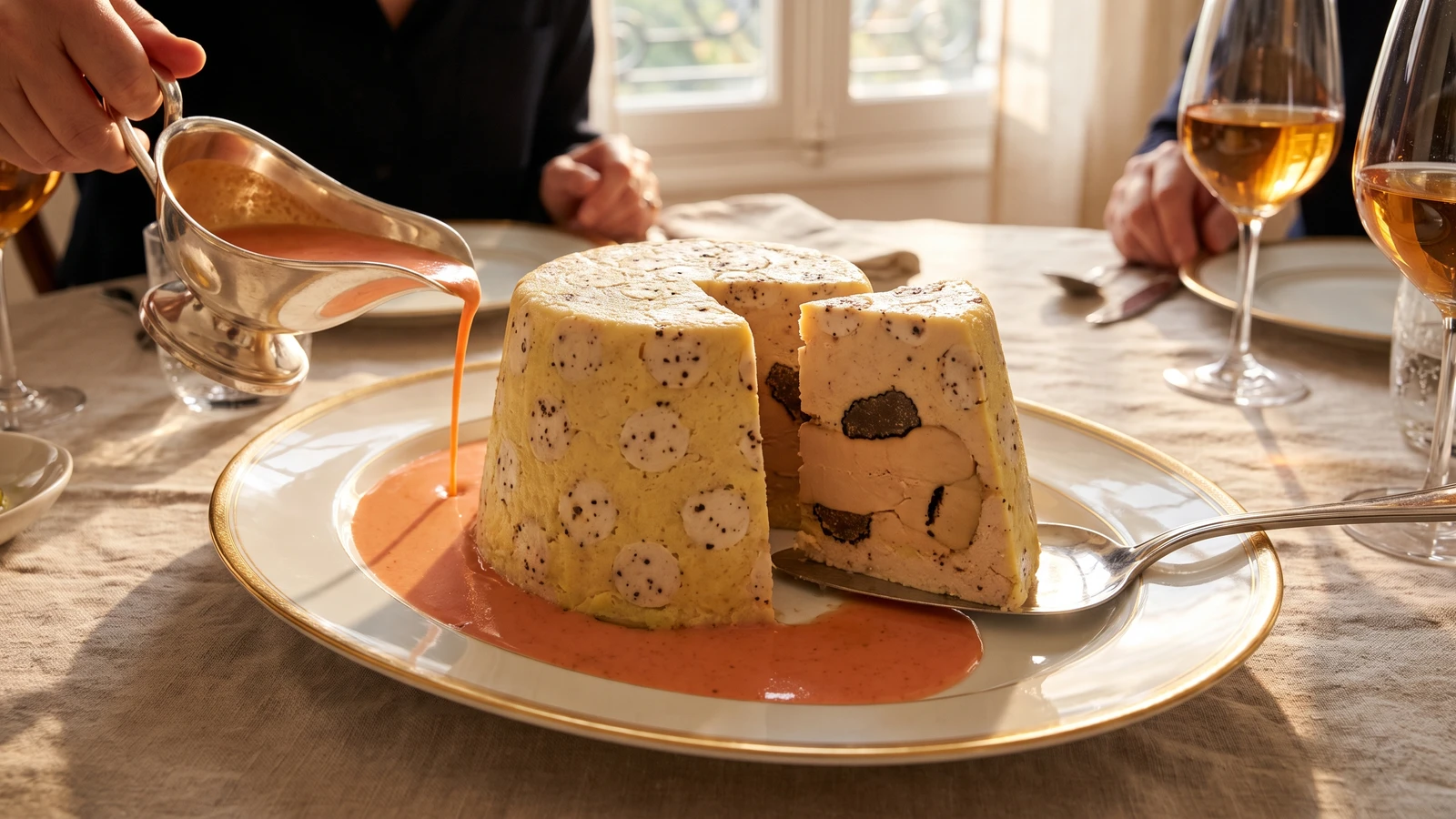
A truffle-tiled charlotte of chicken mousseline and foie-gras parfait, poached below a simmer and turned out whole, with sauce hongroise au paprika pooling pink and glossy around its base.
Timbale de Foie Gras Montesquieu (a truffle-tiled foie gras and chicken mousseline mould) teaches one true thing before you touch a pan: temperature governs everything. The forcemeats must stay cold enough to hold their cream, then the assembled timbale must poach in water that never approaches a boil. Respect those two temperatures and it turns out plump and satin-smooth, its black-truffled roundels forming a handsome pale shell around the rich centre.
The original recipe assumed a garde-manger preparing several forcemeats, a saucier with stock never off the fire, a ready foie-gras parfait, and a proper Charlotte mould. It did not assume a salamander, because this dish is poached under cover, never browned from above. At home, a food processor replaces repeated pounding, one chicken base becomes both the firm lining and the lighter mousseline, good prepared foie-gras parfait replaces another day of work, and a single saucepan builds the sauce hongroise au paprika (Hungarian paprika sauce). What changed is the staffing, not the structure. One cook, one stove, one evening.
The separate production pots and repeated sieving were brigade scaffolding, so they can go. The truffled roundels, the quarter-measure of foie gras in their binding forcemeat, the large dice in the centre, and the covered gentle poach are the dish itself, so they stay. Keep the mixture cold while you build it and the water calm while it cooks. Everything depends on that.
Timbale de Foie Gras Montesquieu belongs to the grand-kitchen repertoire of Paris, where decorative work from the garde-manger met a finished sauce from the saucier in a formal hot entrée. Its title honors Montesquieu of La Brède near Bordeaux, but the preparation is not a Bordeaux regional specialty. The paprika-pink sauce hongroise reflects the canon's naming vocabulary, while the roundel-tiled Charlotte mould displays the ornamental precision expected at a celebration table.
Quantity
About 3¼ cups diced (780 ml / 450 g)
sinew removed and chilled nearly firm
Quantity
2 large (¼ cup / 60 ml / 60 g)
ice-cold
Quantity
1 large (2 tablespoons / 30 ml / 30 g)
lightly beaten
Quantity
1 cup plus 1 tablespoon (255 ml / 255 g)
ice-cold
Quantity
2 teaspoons (10 ml / 12 g)
divided
Quantity
¼ teaspoon (1 ml / 0.5 g)
Quantity
5 tablespoons (75 ml / 70 g)
divided
Quantity
2 small (about ⅓ cup / 80 ml once cut, 60 g)
drained if preserved; 25 g finely chopped and 35 g cut into large dice
Quantity
1½ cups (360 ml / 340 g)
¼ cup (60 ml / 60 g) mashed smooth, remainder chilled and cut into ¾-inch dice
Quantity
1 small (about ¾ cup / 180 ml / 80 g chopped)
finely chopped
Quantity
⅓ cup (80 ml / 80 g)
Quantity
1½ tablespoons (22 ml / 12 g)
Quantity
1½ teaspoons (7.5 ml / 3 g)
not smoked
Quantity
1½ cups (360 ml / 360 g)
Quantity
½ cup (120 ml / 120 g)
| Ingredient | Quantity |
|---|---|
| skinless, boneless chicken breastsinew removed and chilled nearly firm | About 3¼ cups diced (780 ml / 450 g) |
| egg whitesice-cold | 2 large (¼ cup / 60 ml / 60 g) |
| egg white for the truffled sheetlightly beaten | 1 large (2 tablespoons / 30 ml / 30 g) |
| heavy cream for the forcemeatsice-cold | 1 cup plus 1 tablespoon (255 ml / 255 g) |
| fine sea saltdivided | 2 teaspoons (10 ml / 12 g) |
| ground white pepper | ¼ teaspoon (1 ml / 0.5 g) |
| unsalted butterdivided | 5 tablespoons (75 ml / 70 g) |
| whole black trufflesdrained if preserved; 25 g finely chopped and 35 g cut into large dice | 2 small (about ⅓ cup / 80 ml once cut, 60 g) |
| prepared firm foie-gras parfait¼ cup (60 ml / 60 g) mashed smooth, remainder chilled and cut into ¾-inch dice | 1½ cups (360 ml / 340 g) |
| yellow onionfinely chopped | 1 small (about ¾ cup / 180 ml / 80 g chopped) |
| dry white wine | ⅓ cup (80 ml / 80 g) |
| plain flour | 1½ tablespoons (22 ml / 12 g) |
| sweet Hungarian paprikanot smoked | 1½ teaspoons (7.5 ml / 3 g) |
| unsalted chicken stock | 1½ cups (360 ml / 360 g) |
| heavy cream for the sauce | ½ cup (120 ml / 120 g) |
Put the food-processor bowl, blade, a mixing bowl, and a fine sieve in the cold for twenty minutes. Keep the diced chicken, egg whites, and cream thoroughly chilled, with the cream measured as ⅔ cup (150 ml / 150 g) for the firm forcemeat and 7 tablespoons (105 ml / 105 g) for the lighter mousseline. Soften 2 tablespoons of the butter for the parchment and mould, but keep every ingredient entering the emulsion cold. Butter an 8-inch square of parchment, a second sheet to cover it, and a 1-quart metal Charlotte mould.
Pulse the chicken with 1½ teaspoons of the salt and the white pepper until it forms a fine, tacky paste. Add the 2 cold egg whites and process only until absorbed. Remove 110 g of this base to a chilled bowl. With the remaining base in the processor, add the reserved ⅔ cup cold cream in four small additions, pulsing briefly after each; this is the fairly firm chicken forcemeat. Scrape it into the cold bowl, then process the reserved 110 g base with the remaining 7 tablespoons cream to make the softer mousseline chicken forcemeat. Press both once through the chilled sieve and refrigerate separately. If either mixture develops an oily shine or loosens at the edge, stop. Ça se rattrape: set it over ice for ten minutes, then pulse briefly with a spoonful of its measured cold cream until smooth again.
Heat the oven to 300°F (150°C). Spread about 1½ cups (360 ml) of the firm chicken forcemeat evenly over the buttered parchment to a thickness of ⅓ inch (8 mm). Brush it lightly with the beaten egg white, scatter over the 25 g finely chopped truffle, and press the truffle into the surface with the flat of a knife. Cover with the second buttered parchment, buttered side down, and set the sheet in a small metal pan. Place that pan in a roasting pan, pour in water heated to about 175°F (80°C) until it reaches halfway up the sides, cover loosely, and poach for 12 to 15 minutes, until the sheet is just firm and reaches 165°F (74°C). Cool it quickly, then chill until easy to cut.
Peel away the top parchment and stamp the cold sheet into 1-inch (2.5 cm) roundels, cutting closely from one edge to the other. Arrange them over the bottom and sides of the buttered Charlotte mould with their truffled faces pressed against the metal. Keep the circles whole and the gaps narrow, working in tidy rows so the pattern reads clearly when turned out. Chill the lined mould for ten minutes.
Measure the remaining firm chicken forcemeat; the scaled batch should leave about 1 cup (240 ml). Stir in exactly one-quarter of its volume, about ¼ cup (60 ml / 60 g), of the mashed foie-gras parfait. This quarter-measure is the source recipe's binding ratio, and it stays. Spread the enriched forcemeat in a thin, continuous layer over the inside of the tiled mould, pressing it gently between the roundels so they become one shell. Reserve about ⅓ cup (80 ml) to close the top.
Fold the cold ¾-inch dice of foie-gras parfait and the remaining large dice of truffle gently through the mousseline chicken forcemeat. Spoon the mixture into the lined mould in three additions, pressing each one into the sides with a chilled spatula so no air pockets remain. Stop about ½ inch (1.25 cm) below the rim. Spread the reserved foie-enriched firm forcemeat over the filling, joining it firmly to the lining at the edges. Cover with a buttered parchment round, buttered side down, then seal the mould tightly with foil.
Set the mould in a deep roasting pan and pour in water heated to about 175°F (80°C) until it reaches two-thirds of the way up the mould. Cover the roasting pan and poach in the 300°F (150°C) oven for 45 to 60 minutes. The bath must remain between 170°F and 180°F (77°C and 82°C), with no bubbling around the mould, and the centre of the timbale must reach 165°F (74°C). If fat begins gathering at the rim, the heat is climbing too fast. Lift the pan out, replace a cup of hot water with cool water, wait five minutes, and continue at 275°F (135°C). Ça se rattrape before the bath boils.
While the timbale poaches, melt 1 tablespoon of the remaining butter in a saucepan and sweat the onion gently until tender without letting it colour. Add the wine and reduce until only about 2 tablespoons remain. Add another tablespoon of butter, stir in the flour, and cook this roux (butter and flour thickener) for ninety seconds. Take the pan from the heat, stir in the sweet paprika for a few seconds, then whisk in the chicken stock gradually. Simmer gently for fifteen minutes and strain. Return the sauce to the pan, add the cream, and simmer until it nappes the spoon, meaning it leaves an even glossy coat. Season with the remaining salt and whisk in the final cold tablespoon of butter off the heat. If the sauce becomes too thick, loosen it with stock; if it looks greasy, whisk in a tablespoon of cold cream away from the heat.
Rest the cooked timbale in its mould for fifteen minutes. Remove the foil and parchment, run a thin knife only around the upper rim, and place a warm oval platter over the mould. Invert both together, wait ten seconds, then lift the mould straight up. If it holds, wrap the mould briefly in a hot damp towel and try again; don't pry at the roundels. If one loosens, press it back into place and let the sauce meet its edge. Surround the timbale with a generous border of the pink sauce hongroise au paprika and send the remainder to the table in a warm sauceboat. À table!
1 serving (about 435g)
Culinary guides, cultural storytelling, and the editorial depth that makes cooking meaningful.
Discover Culinary ExplorerChef Juliette
John Dory has the delicacy of sole and the firmness of turbot. A light flouring, a quick butter sauté, and nut-brown beurre noisette show exactly why looks never mattered.

Chef Juliette
Fresh haddock proves its delicacy in the meunière pan: a fine flour crust, moist pearly flakes, and beurre noisette sharpened with lemon and parsley, ready from one skillet in half an hour.

Chef Juliette
Éperlans à l’Anglaise turns small fish into a lesson in disciplined coating: boned smelts under a close, crisp crumb, pan-fried in clarified butter and finished with bright, half-melted maître d’hôtel butter.

Chef Juliette
Tiny smelts, shallot, mushrooms, white wine, gratin sauce, and fine bread raspings meet a fierce oven, where the fish must turn tender in the same breath the buttered crust bronzes.