
Chef Juliette
John Dory (St. Pierre)
John Dory has the delicacy of sole and the firmness of turbot. A light flouring, a quick butter sauté, and nut-brown beurre noisette show exactly why looks never mattered.
A cooking platform built around craft, culture, and the stories behind what we eat.
Created by Chef Juliette
Based on No. 1731, Soufflé de Foie Gras, from Le Guide Culinaire (1907) by Auguste Escoffier
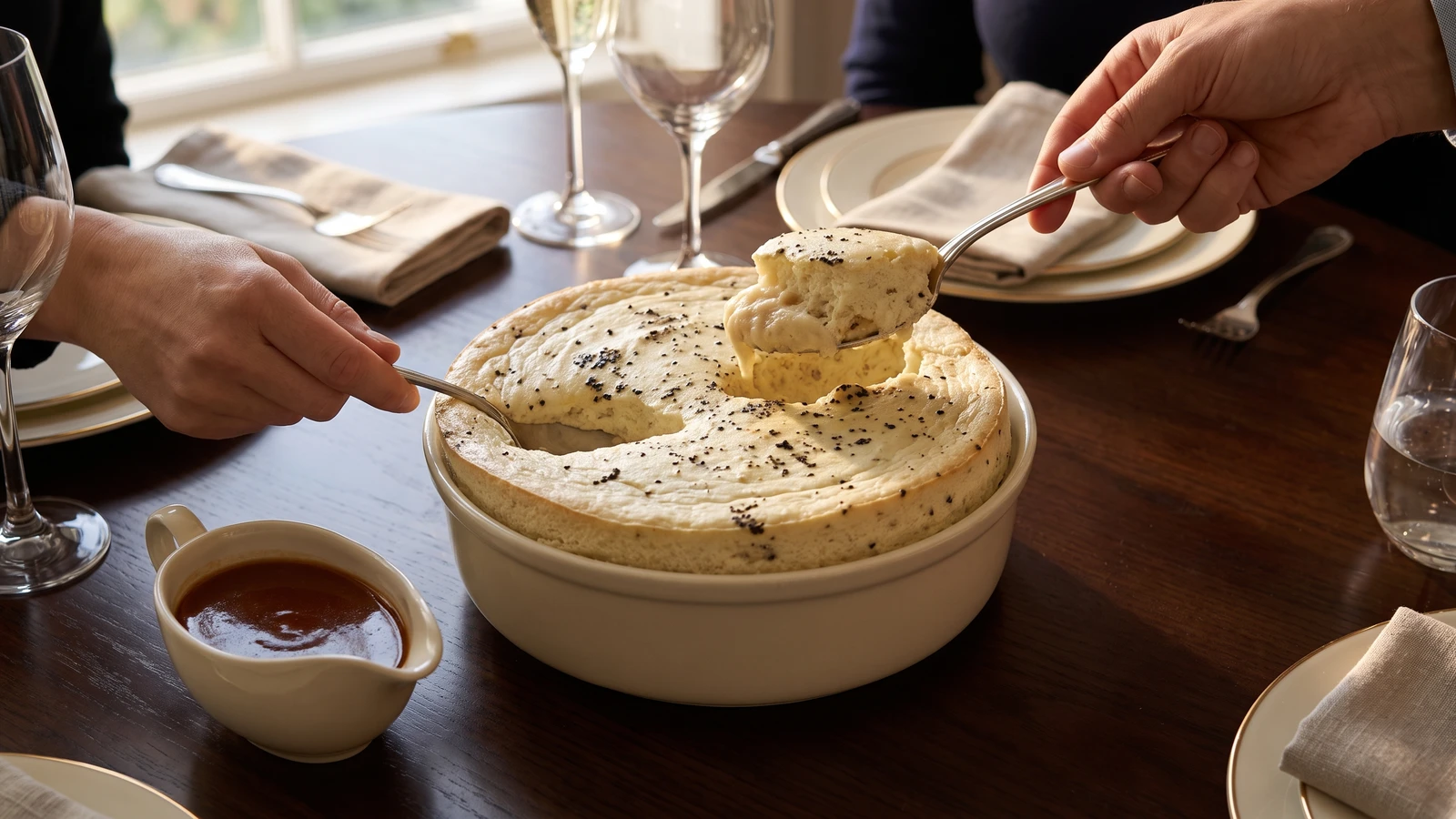
A pale, tender soufflé of sieved foie gras, raw truffle, pounded chicken, and cream, poached under cover until barely risen and served with Madeira sauce, where cold work makes all the difference.
Soufflé de foie gras (poached foie gras soufflé) teaches one true thing: the farce mousseline, a cream-bound forcemeat, must stay cold. Warm foie gras sheds its fat, warm chicken loses its hold on the cream, and the mixture breaks before the egg whites can lift it. Kept icy, it poaches into something pale, delicate, and deeply savory, with black truffle running through every spoonful.
The original kitchen assumed hands for pounding and sieving, an ice station, and a saucier with a stockpot never off the fire behind the Madeira sauce. It had no use for a salamander here, because this soufflé is covered and poached rather than browned. At home, a chilled food processor replaces the hand pounding, but the fine sieve stays because that silkiness is the dish, not brigade scaffolding. Every specified ratio is halved for four servings; the separately served Madeira sauce is set at one cup because the entry gives no quantity for it. One cook, one stove, one evening.
This is not a tall, bronzed soufflé. Expect a low ivory dome, a moist interior flecked with truffle, and a glossy mahogany sauce passed at the table so it never weighs down the rise. Before you touch a pan, chill the blade, bowl, chicken, foie gras, egg whites, and cream. That cold preparation decides everything.
Soufflé de foie gras belongs to Parisian grand cuisine, which brought together foie gras traditions associated with Strasbourg and Périgord, Périgord black truffles, and the classical Madeira sauce repertory. Its name can mislead: this is not the familiar tall, browned oven soufflé, but a covered preparation poached gently in a Bain-Marie, its lightness supplied by stiffened egg whites folded into a sieved forcemeat. The method passed naturally to bourgeois home tables because the water bath needed no specialized oven, while serving the sauce separately protected the soufflé's fragile texture.
Quantity
5⅓ oz (151 g)
veins removed and kept cold
Quantity
1¾ oz (50 g)
scrubbed, finely grated, and kept cold
Quantity
5⅓ oz (151 g)
sinew removed, diced, and kept near-freezing
Quantity
4 large (½ cup / 120 g)
divided: 2 for the chicken farce and 2 for whipping
Quantity
½ cup plus 1 tablespoon plus 2 teaspoons (142 ml / 142 g)
very cold
Quantity
1 teaspoon (5 ml / 6 g)
plus more if needed after testing
Quantity
¼ teaspoon (1.25 ml / 0.6 g)
plus more if needed
Quantity
2 teaspoons (10 ml / 9 g)
softened, for the dish and cover
Quantity
1 cup (240 ml / 250 g)
Quantity
1 teaspoon (5 ml / 5 g)
| Ingredient | Quantity |
|---|---|
| fresh raw foie grasveins removed and kept cold | 5⅓ oz (151 g) |
| fresh black trufflescrubbed, finely grated, and kept cold | 1¾ oz (50 g) |
| boneless, skinless raw chicken breastsinew removed, diced, and kept near-freezing | 5⅓ oz (151 g) |
| large egg whitesdivided: 2 for the chicken farce and 2 for whipping | 4 large (½ cup / 120 g) |
| heavy cream, 36 to 40% fatvery cold | ½ cup plus 1 tablespoon plus 2 teaspoons (142 ml / 142 g) |
| fine sea saltplus more if needed after testing | 1 teaspoon (5 ml / 6 g) |
| finely ground white pepperplus more if needed | ¼ teaspoon (1.25 ml / 0.6 g) |
| unsalted buttersoftened, for the dish and cover | 2 teaspoons (10 ml / 9 g) |
| prepared Madeira sauce | 1 cup (240 ml / 250 g) |
| natural truffle essence | 1 teaspoon (5 ml / 5 g) |
Chill the food processor bowl and blade, mixing bowl, sieve, and flexible scraper for at least 30 minutes. Heat the oven to 325°F (165°C). Butter a 1-quart (1-liter) soufflé dish thoroughly, then butter one side of a sheet of foil large enough to cover it. Nest the cold mixing bowl in a larger bowl half-filled with ice and water. Keep every ingredient refrigerated until the moment it is needed.
Press the cold but pliable foie gras through the fine sieve with the flexible scraper, letting the purée fall directly into the bowl over ice. Work the finely grated raw truffle through the sieve in the same manner, then mix the two purées until evenly mottled. Scrape down the bowl and return it to the ice. Do not leave the foie gras at room temperature to make the sieving easier; soft fat quickly becomes separated fat.
Put the near-freezing chicken into the chilled processor and pulse until finely pounded. Add 2 of the egg whites in three additions, pulsing only until each disappears and scraping the bowl between additions. The paste should be smooth, sticky, and cold. If the processor bowl begins to feel warm, stop and chill the paste for 5 minutes. Press the chicken mixture through the fine sieve, discard any sinew left behind, and mix the sieved chicken into the foie gras and truffle purées.
Season the farce with the salt and white pepper. Keeping the bowl firmly over ice, work in the cold cream a spoonful at a time, waiting until the mixture is smooth and glossy before adding more. Hold back the final tablespoon until the emulsion is stable. If the farce turns grainy or shows beads of fat, stop adding cream and set the bowl deeper into the ice. Ça se rattrape: whisk 2 tablespoons of the troubled mixture with the reserved cold cream until smooth, then beat the remaining farce back into that base one spoonful at a time. Poach a teaspoon of the mixture in barely simmering water until completely cooked, cool it briefly, and taste. Correct the salt and pepper without tasting the raw farce.
In a spotless cold bowl, whisk the remaining 2 egg whites until they hold stiff, glossy peaks. They must stand upright without looking dry or granular. Fold one-third into the farce to loosen it, then fold in the remainder with broad strokes from the bottom of the bowl, turning the bowl as you work. Stop the moment no white streaks remain. Vigorous stirring knocks out the air the original recipe worked so carefully to build.
Spoon the mixture into the buttered soufflé dish and smooth the top without pressing it down. Cover tightly with the foil, buttered side facing the mixture. Set the dish in a deep roasting pan on the pulled-out oven rack, then pour just-boiled water into the pan until it reaches halfway up the dish. Slide the rack in gently and poach for 30 to 35 minutes. The soufflé is ready when the edges are set, the center retains a slight quiver, and an instant-read thermometer reaches at least 165°F (74°C). If it is cooler, re-cover it and continue in 5-minute intervals.
During the final 10 minutes, warm the prepared Madeira sauce over gentle heat until it coats the back of a spoon. Remove it from the heat and stir in the natural truffle essence. Do not boil the sauce after adding the essence, or its perfume will flatten. If the sauce tightens too far, whisk in 1 to 2 teaspoons of hot water until its gloss returns, then pour it into a warmed sauceboat.
Lift the soufflé dish carefully from the Bain-Marie, remove the foil, and let it settle for 2 minutes. Its dome will be modest and pale, not bronzed, and the center should yield softly to a serving spoon. Bring it to the table in its dish and pass the Madeira sauce separately so each serving keeps its lightness. À table!
1 serving (about 210g)
Culinary guides, cultural storytelling, and the editorial depth that makes cooking meaningful.
Discover Culinary ExplorerChef Juliette
John Dory has the delicacy of sole and the firmness of turbot. A light flouring, a quick butter sauté, and nut-brown beurre noisette show exactly why looks never mattered.

Chef Juliette
Fresh haddock proves its delicacy in the meunière pan: a fine flour crust, moist pearly flakes, and beurre noisette sharpened with lemon and parsley, ready from one skillet in half an hour.

Chef Juliette
Éperlans à l’Anglaise turns small fish into a lesson in disciplined coating: boned smelts under a close, crisp crumb, pan-fried in clarified butter and finished with bright, half-melted maître d’hôtel butter.

Chef Juliette
Tiny smelts, shallot, mushrooms, white wine, gratin sauce, and fine bread raspings meet a fierce oven, where the fish must turn tender in the same breath the buttered crust bronzes.