
Chef Juliette
Oison à l’Allemande
A small gosling, its breast boned and filled with buttered apples, braised under a faithful baste, then ringed with ruby-filled apples and served with a glossy roast gravy.
A cooking platform built around craft, culture, and the stories behind what we eat.
Created by Chef Juliette
Based on No. 1729, Escalopes de Foie Gras à la Ravignan, from Le Guide Culinaire (1907) by Auguste Escoffier
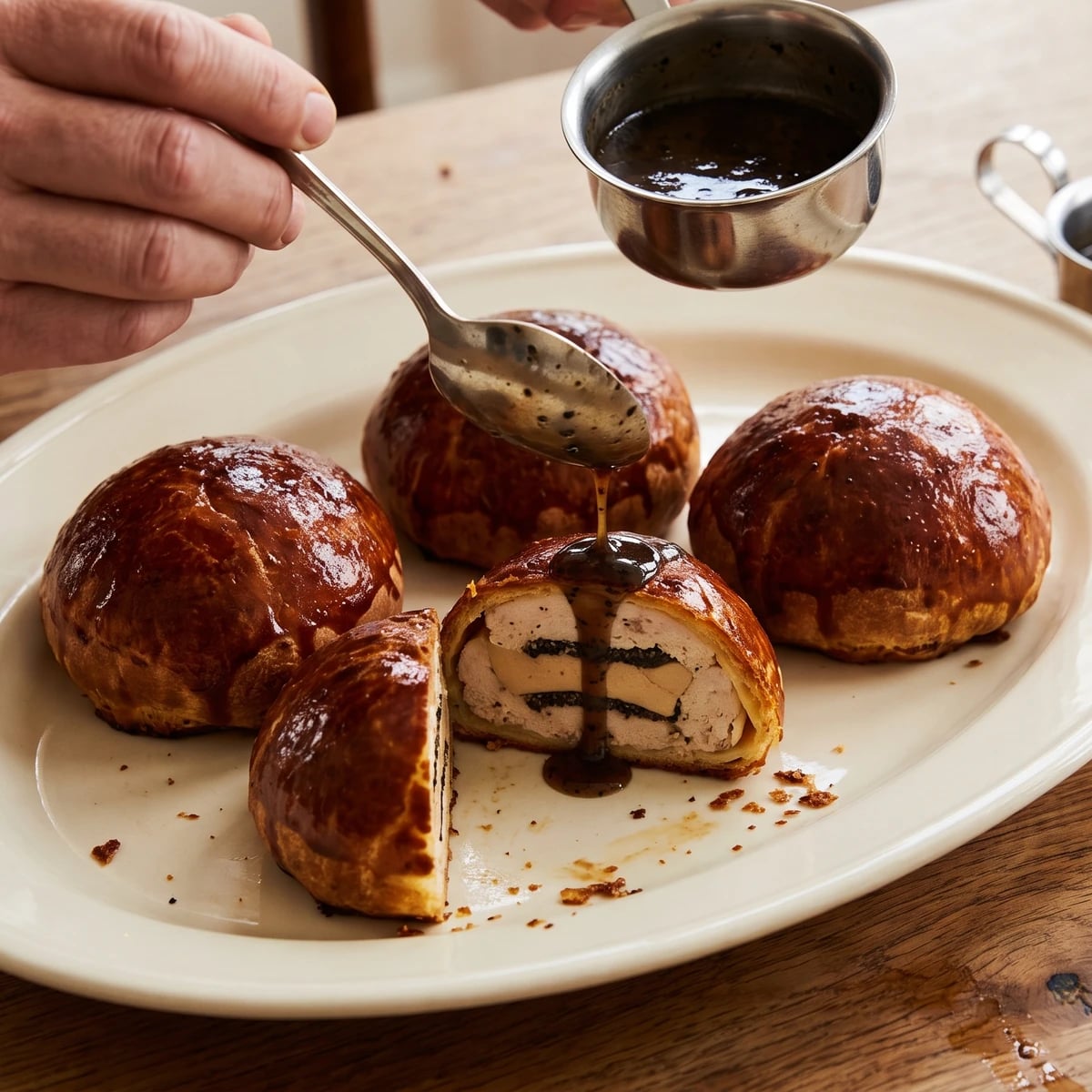
Escalopes de Foie Gras à la Ravignan encloses foie gras and truffle in unsweetened brioche with chicken forcemeat, baked golden and served with Périgueux sauce. The lesson is the seal: escaped fat leaves an empty parcel.
Escalopes de Foie Gras à la Ravignan (foie gras and truffle parcels in brioche) teaches the discipline of enclosure. The one true thing to know before you touch a pan, or rather the baking sheet, is this: the seal is the dish. Press it carelessly and the foie gras renders into the oven; press it cleanly and that fat bathes the truffle and forcemeat inside a bronzed shell.
The old formula assumed unsweetened brioche paste rolled by a pâtissier, chicken forcemeat kept ice-cold by the garde-manger, a saucier with Périgueux sauce ready from stock never off the fire, and a hot service oven. It needed no salamander. Your home equivalent is prepared brioche dough, cold forcemeat and foie gras, a heavy sheet preheated with the oven, and finished sauce warmed gently while the parcels bake. Ten portions become four because this is a home table; the separate hands and holding pots were brigade scaffolding and can go. The truffle-foie-truffle layering, bare margin, dampened seal, gilding, and hot bake stay because they are the dish. One cook, one stove, one evening.
Work cold and resist the urge to heap on more filling. The step that matters most is the seal: preserve the full one-third-inch margin, keep it free of fat and forcemeat, moisten it lightly, then press it firmly with the blunt back of the cutter.
Escalopes de Foie Gras à la Ravignan belongs to the Parisian grand-kitchen canon of named entrées, not to a regional farmhouse repertoire. Despite escalope in the title, the foie gras is not served as a bare pan-seared slice; the preserved formula encloses each thick roundel between truffle and chicken forcemeat inside unsweetened brioche. Sauce Périgueux supplies the black-truffle accent associated with Périgord, but the composed dish itself is Parisian in method.
Quantity
10½ ounces (300 g)
chilled but pliable, prepared without sugar
Quantity
⅓ cup (80 ml / 85 g)
kept very cold
Quantity
3½ ounces (100 g)
chilled and cut into 4 thick roundels
Quantity
1, about ¾ ounce (20 g)
cut into 8 thin round slices
Quantity
1
Quantity
1 tablespoon plus 1 teaspoon (20 ml / 20 g)
divided
Quantity
1 cup (240 ml / about 250 g)
| Ingredient | Quantity |
|---|---|
| unsweetened brioche pastechilled but pliable, prepared without sugar | 10½ ounces (300 g) |
| fine raw chicken forcemeatkept very cold | ⅓ cup (80 ml / 85 g) |
| raw foie graschilled and cut into 4 thick roundels | 3½ ounces (100 g) |
| whole black trufflecut into 8 thin round slices | 1, about ¾ ounce (20 g) |
| large egg | 1 |
| waterdivided | 1 tablespoon plus 1 teaspoon (20 ml / 20 g) |
| finished Périgueux sauce | 1 cup (240 ml / about 250 g) |
Set a heavy baking sheet on the middle rack and heat the oven to 425°F (220°C). Keep the brioche paste, chicken forcemeat, foie gras, and truffle cold until each is needed. Cold filling holds its shape and cold foie gras gives you time to seal the pastry before its surface softens; if either feels greasy, return it to the refrigerator for ten minutes.
Roll the brioche paste between two sheets of parchment to an even one-third inch (8 mm) thick. Cut 8 roundels with a 2½-inch (6.5 cm) cutter, pressing straight down so their edges remain neat. Set 4 roundels on a clean sheet of parchment for the bases and keep the remaining 4 cold for the covers. If the dough springs back or shrinks under the cutter, stop and chill it for ten minutes; ça se rattrape, and rested dough will hold the correct diameter.
Spread about 2 teaspoons of chicken forcemeat over each base, leaving a completely bare one-third-inch (8 mm) margin. Set a truffle slice in the center, then a thick roundel of raw foie gras, followed by a second truffle slice. Coat the stack with another 2 teaspoons of forcemeat, smoothing it into a compact dome without pushing any filling onto the margin. Keep the layers centered. More filling is not generosity here; it is pressure against the seal.
Brush the undersides of the 4 cover roundels very lightly with 2 teaspoons (10 ml / 10 g) of the water, concentrating on their edges. Lay them over the filling and ease the dough down without stretching it thin. Press the edges together with your fingertips, then turn the round cutter over and use its blunt rolled back to press the joined margins firmly all around. If filling has touched the margin, lift the cover, scrape the edge clean, moisten it again, and reseal. If the dough has split, patch it with a thin piece of cold brioche paste and press until seamless. Ça se rattrape. Chill the sealed parcels for ten minutes.
Beat the egg with 1 teaspoon (5 ml / 5 g) of the water. Gild the parcels by brushing their tops and sides with a thin, even coat of beaten egg, taking care not to leave puddles around the bases. The word gild is exact: the egg supplies the deep golden sheen under heat. Return the parcels to the refrigerator for five minutes while the oven and baking sheet finish heating.
Slide the parchment and parcels onto the preheated baking sheet. Bake for 15 minutes without opening the door, until the brioche is deeply golden and firm around the seams. Insert a thin instant-read thermometer through the side of one parcel into the center; because the forcemeat contains raw chicken, it must reach 165°F (74°C). If it has not, bake for 2 minutes more and check again. Should a seam open and release some fat, do not handle the hot pastry or attempt to pinch it closed. Finish cooking it to temperature, lift it carefully with a spatula, and serve that parcel first. The lost richness cannot be put back, but dinner is not ruined.
While the parcels bake, warm the Périgueux sauce over the gentlest heat, stirring until it flows glossily from the spoon. Do not boil it. If it tightens while waiting, remove it from the heat and whisk in the remaining 1 teaspoon (5 ml / 5 g) of water. Rest the baked parcels for 3 minutes, then arrange them in a circle on a warmed platter, as the original service directs. Carry the Périgueux sauce to the table at the same time in a warm sauceboat, keeping it beside the pastry rather than flooding the crisp shells. À table!
1 serving (about 190g)
Culinary guides, cultural storytelling, and the editorial depth that makes cooking meaningful.
Discover Culinary Explorer
Chef Juliette
A small gosling, its breast boned and filled with buttered apples, braised under a faithful baste, then ringed with ruby-filled apples and served with a glossy roast gravy.

Chef Juliette
A sausage-stuffed gosling, browned in butter and poêlé without one drop of cooking liquid, then set over goose-fat choucroute with lean bacon: Alsace’s generous lesson in dry covered roasting.

Chef Juliette
A burnished young goose filled with sage, dry-baked onion, and pressed bread, its rich pan gravy served around the bird and its lightly sweetened apples passed separately.

Chef Juliette
Oison en civet teaches the civet's final discipline: gosling braised in red wine, its sauce strained and bound with blood off the boil until wine-dark, satin-bodied, and ready for a generous table.