
Chef Juliette
Oison à l’Allemande
A small gosling, its breast boned and filled with buttered apples, braised under a faithful baste, then ringed with ruby-filled apples and served with a glossy roast gravy.
A cooking platform built around craft, culture, and the stories behind what we eat.
Created by Chef Juliette
Based on No. 1728, Escalopes de Foie Gras à la Périgueux, from Le Guide Culinaire (1907) by Auguste Escoffier
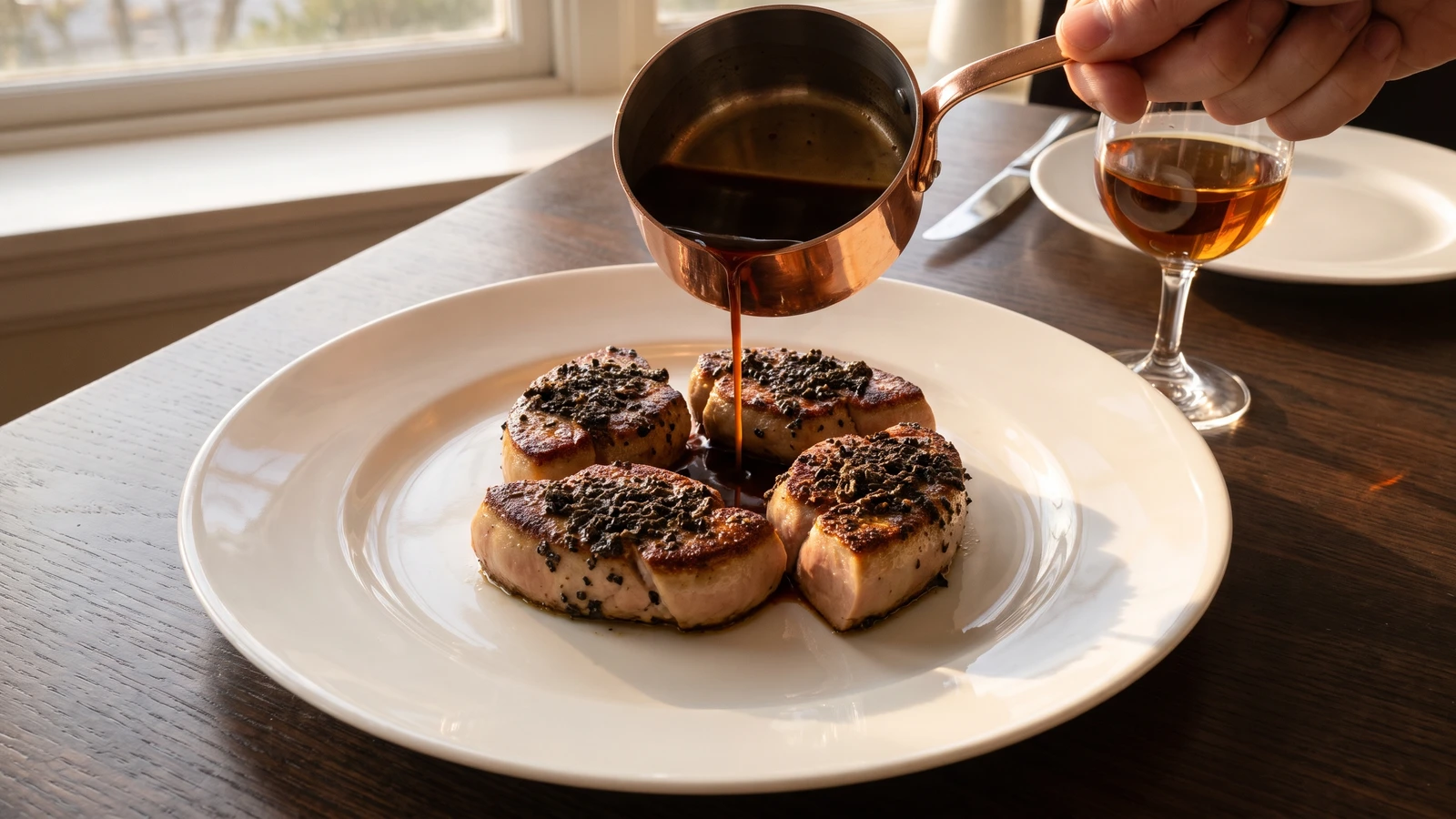
Cold foie gras, a close truffle coat, and a properly hot pan: the lavish sauté that teaches restraint, served in a circle around glossy Madeira sauce scented with Périgord truffle.
Escalopes de Foie Gras à la Périgueux (truffle-crusted foie gras with Madeira sauce) teaches one severe, useful truth: cold liver and hot clarified butter must meet for only a moment. The egg and chopped-truffle coat needs enough heat to set before the foie gras begins surrendering its fat. Hesitate over a lukewarm pan and the escalope melts instead of sautéing. Clarified butter only, because its milk solids are gone and the truffle can darken gently without the pan turning bitter.
The old entry assumed a saucier beside the stove, a veal stockpot never off the fire, and enough hands to coat and sauté brigade portions to order. It needed no salamander, because this dish lives entirely in the sauté pan. At home, use a sound prepared veal demi-glace, reduce it with Madeira, scent it with natural truffle juice, and cook four 2½-ounce escalopes in two small batches. The separate sauce station and service crew are scaffolding, so they go; the egg, chopped truffle, clarified butter, circular arrangement, and sauce in the well are the dish, so they stay. One cook, one stove, one evening.
Have the sauce finished and the platter warm before the foie gras meets the pan. The coated slices must go in refrigerator-cold, and you must leave them untouched until the first crust sets. That brief, decisive sauté is the step that matters.
Escalopes de Foie Gras à la Périgueux belong to the grand table of Périgord, centered on Périgueux in Dordogne, where black truffle and foie gras share the winter larder. The name à la Périgueux points chiefly to the truffle and its Madeira-enriched sauce, not to a claim that foie gras itself began in Périgueux. In this rendering, chopped truffle forms the escalope's crust while truffle essence scents the sauce, a more lavish distribution than the common sauce Périgueux in which the truffle remains in the sauce.
Quantity
4 slices, 2½ ounces (71 g) each and 10 ounces (284 g) total
cut about ¾ inch (2 cm) thick and kept refrigerator-cold
Quantity
½ teaspoon (2.5 ml / 3 g)
Quantity
¼ teaspoon (1.25 ml / 0.6 g)
Quantity
2
beaten until fluid
Quantity
½ cup (120 ml / 60 g)
very finely chopped
Quantity
¼ cup (60 ml / 55 g)
divided
Quantity
½ cup (120 ml / 120 g)
Quantity
¾ cup (180 ml / 180 g)
Quantity
1 tablespoon (15 ml / 15 g)
Quantity
1 tablespoon (15 ml / 14 g)
diced
| Ingredient | Quantity |
|---|---|
| raw duck foie gras escalopescut about ¾ inch (2 cm) thick and kept refrigerator-cold | 4 slices, 2½ ounces (71 g) each and 10 ounces (284 g) total |
| fine sea salt | ½ teaspoon (2.5 ml / 3 g) |
| freshly ground black pepper | ¼ teaspoon (1.25 ml / 0.6 g) |
| large eggsbeaten until fluid | 2 |
| fresh black Périgord trufflevery finely chopped | ½ cup (120 ml / 60 g) |
| clarified butterdivided | ¼ cup (60 ml / 55 g) |
| dry Madeira | ½ cup (120 ml / 120 g) |
| prepared low-salt veal demi-glace | ¾ cup (180 ml / 180 g) |
| natural black truffle juice or truffle essence | 1 tablespoon (15 ml / 15 g) |
| cold unsalted butterdiced | 1 tablespoon (15 ml / 14 g) |
Pour the Madeira into a small heavy saucepan and boil briskly until reduced to ¼ cup (60 ml). Add the veal demi-glace, lower the heat, and simmer until about ¾ cup (180 ml) remains and the sauce naps the back of a spoon, meaning it leaves a clean line when you draw through it with a finger. Stir in the truffle juice or essence, remove the pan from the heat, and whisk in the cold butter a few pieces at a time. Hold the sauce just warm. If it tightens too far, loosen it with a teaspoon of hot water; if it turns greasy after boiling, take it off the heat and whisk in a teaspoon of cold water. Ça se rattrape.
Keep the foie gras cold until the moment you work with it. If cutting from a whole lobe, use a thin knife warmed in hot water and wiped dry between cuts, making four clean escalopes about ¾ inch (2 cm) thick and 2½ ounces (71 g) each. Lay them on a cold tray, blot away surface moisture without pressing, and season both faces with the salt and pepper.
Put the beaten eggs and finely chopped truffle in separate shallow dishes. Dip each escalope into the egg, let the excess fall away, then roll it in the chopped truffle and press very lightly so both faces and the edges are evenly covered. Add no flour or breadcrumbs; the egg and truffle coat specified by the dish must remain itself. Chill the coated escalopes uncovered for 15 minutes. If a bare patch appears, dab it with egg and press on more truffle before sautéing.
Warm a round serving platter and bring the Madeira sauce back to a gentle serving temperature without boiling it. Heat half the clarified butter in a 12-inch (30 cm) heavy skillet over medium-high heat until it runs freely across the pan and a loose crumb of truffle sizzles immediately. Clarified butter only in this pan. Whole butter's milk solids scorch before the truffle coat has time to set.
Lay two refrigerator-cold escalopes in the pan, leaving room around them, and do not move them for 60 to 75 seconds. When the first crust has set, turn each one with a thin metal spatula and sauté the second face for 45 to 60 seconds. The truffle should smell deep and earthy, the coating should be set rather than charred, and the foie gras should yield gently at its center. If rendered fat floods the pan before the crust colors, the pan was too cool: lift out the escalopes, pour off the excess fat, reheat the pan, and return them briefly. Ça se rattrape. Transfer them to the warm platter, wipe away any loose blackened truffle, add the remaining clarified butter, and repeat with the final two.
Arrange the four escalopes in a close circle on the warmed platter and spoon the Madeira sauce flavored with truffle essence into the well at the center. Keep the sauce off the upper crust so the chopped truffle remains distinct. Carry the platter straight to the table; foie gras waits for no one. À table!
1 serving (about 160g)
Culinary guides, cultural storytelling, and the editorial depth that makes cooking meaningful.
Discover Culinary ExplorerChef Juliette
A small gosling, its breast boned and filled with buttered apples, braised under a faithful baste, then ringed with ruby-filled apples and served with a glossy roast gravy.

Chef Juliette
A sausage-stuffed gosling, browned in butter and poêlé without one drop of cooking liquid, then set over goose-fat choucroute with lean bacon: Alsace’s generous lesson in dry covered roasting.

Chef Juliette
A burnished young goose filled with sage, dry-baked onion, and pressed bread, its rich pan gravy served around the bird and its lightly sweetened apples passed separately.

Chef Juliette
Oison en civet teaches the civet's final discipline: gosling braised in red wine, its sauce strained and bound with blood off the boil until wine-dark, satin-bodied, and ready for a generous table.