
Chef Juliette
John Dory (St. Pierre)
John Dory has the delicacy of sole and the firmness of turbot. A light flouring, a quick butter sauté, and nut-brown beurre noisette show exactly why looks never mattered.
A cooking platform built around craft, culture, and the stories behind what we eat.
Created by Chef Juliette
Based on No. 1727, Foie Gras cuit dans une Brioche, from Le Guide Culinaire (1907) by Auguste Escoffier
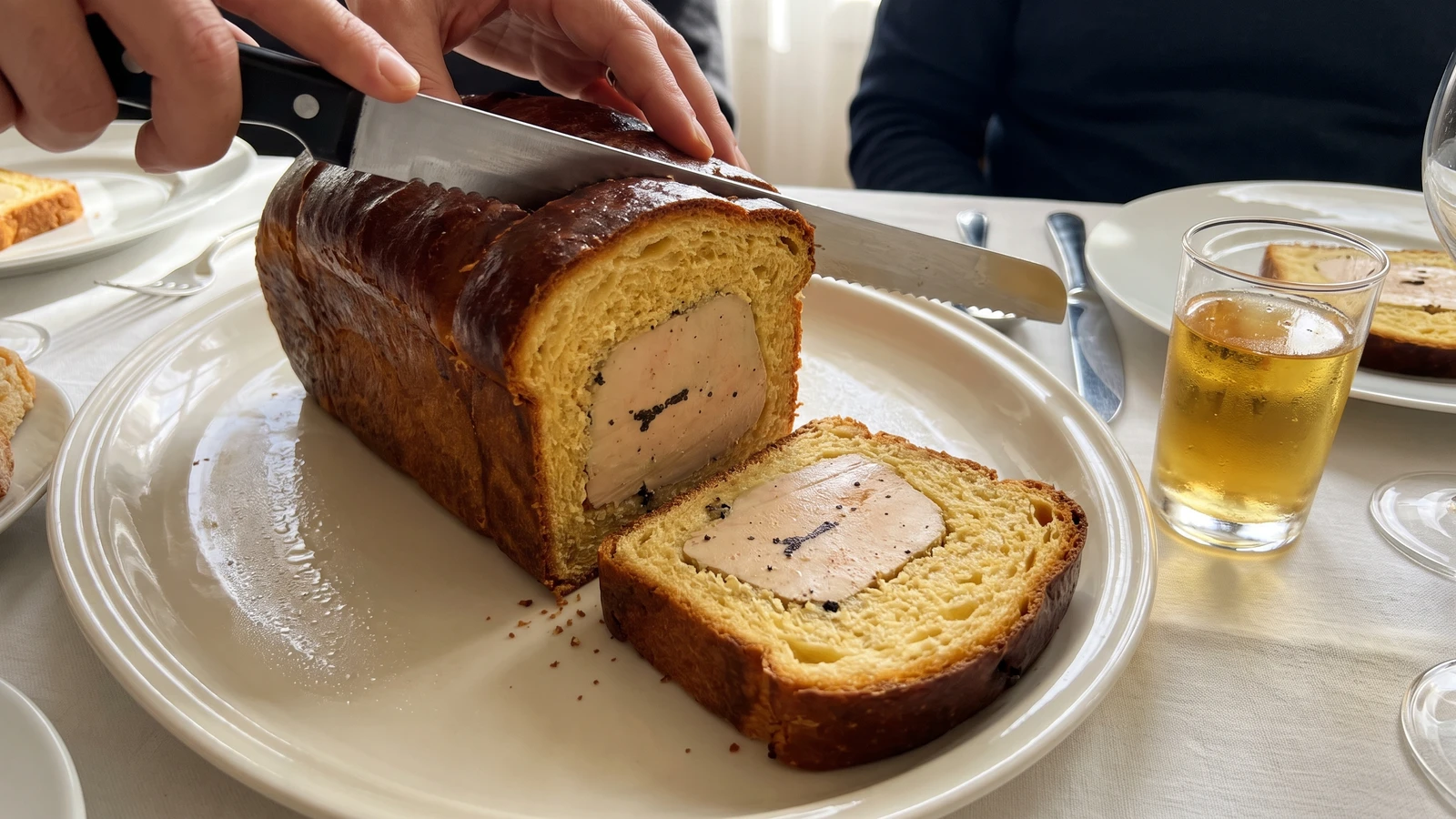
A truffle-studded whole foie gras, gently poached, cooled, and baked upright inside unsweetened brioche, where the dough catches every drop of fat and emerges deeply bronzed, tender, and clean-cut for a celebration table.
Foie Gras cuit dans une Brioche (foie gras cooked inside brioche) teaches one hard, useful truth: temperature is structure. The liver must be completely cold before it meets the dough. Enclose it warm and the butter softens, the foie begins to run, and the loaf loses the clean halo of crumb that makes this dish so remarkable.
The book assumed a timbale mould proportioned to the liver, a proving cupboard held at 86°F, and Ordinary Brioche Paste (No. 2370) ready from the pastry bench. It needed no saucier, perpetual stockpot, or salamander, and neither do you. A 5-cup metal charlotte mould, a doubled parchment collar, a warm enclosed space checked with a thermometer, and your refrigerator do the same work at home. The full brigade batch of dough is scaffolding, so we use only what the smaller mould needs. The first poach, complete cooling, thick brioche lining, short proof, and hot bake are the dish, so every one stays.
Cut cold, the loaf shows a butter-gold crust, tender brioche stained faintly amber where it caught the fat, and a pale, close-grained heart of foie marked with black truffle. One cook, one stove, one evening of measured work, then the cold finishes the set. Before you touch the mould, remember the deciding step: cool the poached liver all the way to its heart.
Foie Gras cuit dans une Brioche belongs to the grand Parisian cold table, although its prized liver came chiefly from Alsace and Périgord and its black truffles from Périgord. Formal kitchens turned those regional luxuries into a moulded centerpiece by first poaching the liver, then baking it within unsweetened brioche. Unlike pâté en croûte, the bread case is not a rigid preserving crust; it is a delicate, absorbent envelope intended to catch the foie's rendered fat and leave a clean cold slice.
Quantity
1 whole liver, about 1¼ lb (560 g)
chilled and preferably deveined
Quantity
1 oz (30 g)
drained if preserved and cut into short batons
Quantity
1½ teaspoons (7.5 ml / 9 g)
Quantity
½ teaspoon (2.5 ml / 1 g)
Quantity
8 slices (7 oz / 200 g)
Quantity
1 lb (454 g) prepared Ordinary Brioche Paste (No. 2370)
cold but pliable
Quantity
2 tablespoons (30 ml / 28 g)
softened, for the mould and paper collar
Quantity
2 tablespoons (30 ml / 16 g)
for rolling
| Ingredient | Quantity |
|---|---|
| whole raw duck or goose foie graschilled and preferably deveined | 1 whole liver, about 1¼ lb (560 g) |
| black truffle, fresh in season or whole preserved in its juicedrained if preserved and cut into short batons | 1 oz (30 g) |
| fine sea salt | 1½ teaspoons (7.5 ml / 9 g) |
| finely ground white pepper | ½ teaspoon (2.5 ml / 1 g) |
| thin unsmoked streaky bacon | 8 slices (7 oz / 200 g) |
| prepared Ordinary Brioche Pastecold but pliable | 1 lb (454 g) prepared Ordinary Brioche Paste (No. 2370) |
| unsalted buttersoftened, for the mould and paper collar | 2 tablespoons (30 ml / 28 g) |
| all-purpose flourfor rolling | 2 tablespoons (30 ml / 16 g) |
Heat the oven to 325°F (165°C). Keep the foie cold as you work. If it has not been deveined, open the lobes only along their natural seams, lift out the large visible veins with the tip of a small knife, and press the liver back into shape. Make narrow channels with a skewer or paring knife and push the truffle batons into them, distributing the truffle through both lobes. Season every surface with the salt and white pepper. If a lobe splits, press the cold pieces firmly together; the soft fat binds them once chilled. Ça se rattrape.
Lay the bacon slices side by side, overlapping them slightly, and set the foie across them. Fold the bacon around the liver until it is completely enclosed, using the remaining slices to cover any gaps. Place it seam-side down in a lidded metal terrine or small loaf pan that holds it snugly, then close with the lid or a tight double layer of foil. The bacon protects the surface during the first cooking; it is wrapping, not a garnish.
Pocher au four, meaning to cook gently in the closed terrine, for exactly 20 minutes. Do not wait for browning. The bacon will turn opaque and release some fat, while the foie becomes set around the edges but remains supple in the middle. This is deliberate because the second baking finishes the cooking. Longer now only renders away the liver you meant to serve.
Leave the terrine covered on a rack for 20 minutes, then refrigerate it for 1½ to 2 hours, until the liver is firm and cold through the centre. Unwrap it gently and discard the bacon, but leave the fine coating of set foie fat on the liver. That fat belongs to the brioche. If the foie feels warm or bends under its own weight, return it to the cold; enclosing it early is the one mistake the dough cannot conceal.
Butter a straight-sided 5-cup (1.2 litre) metal timbale or charlotte mould generously. On a lightly floured surface, divide the prepared Ordinary Brioche Paste (No. 2370), reserving roughly one-third for the lid and a small repair patch. Roll the larger piece about ⅜ inch (8 to 10 mm) thick and ease it into the mould, pressing it against the base and sides without thinning it. Leave enough dough above the rim to meet the lid. If the dough springs back, cover it and rest it for 10 minutes, then continue; fighting it only tears the lining.
Stand the cold foie upright in the lined mould. It should nearly fill the cavity without crushing the dough. Roll the reserved brioche into a lid of the same thickness, dampen the lining's rim very lightly with water, and lay the lid over it. Pinch the two pieces together firmly, trim the excess, and smooth the seam. Cut a 1-inch (2.5 cm) slit through the centre of the lid so pressure and fat can escape without splitting the loaf.
Fold a strong strip of parchment into a double band tall enough to stand about 3 inches (7.5 cm) above the mould. Butter the face that will touch the dough, wrap the collar tightly around the outside, and secure it with kitchen twine. Prove for 30 minutes at about 86°F (30°C), using a switched-off microwave, lidded box, or other enclosed space warmed with a mug of hot water. The dough should soften and swell modestly, not double. If the space rises above 90°F (32°C) or fat beads at the vent, chill the mould for 10 minutes and finish the proof somewhere cooler. Ça se rattrape: you are waking the brioche, not melting the foie.
While the loaf proves, heat the oven to 400°F (200°C) with a rack in the lower-middle position. Set the collared mould on a rimmed baking sheet and bake for 35 to 45 minutes, until the brioche is deeply butter-gold and a thin metal skewer inserted through the centre withdraws clean of raw paste. The skewer may shine with clear fat; it must not carry sticky dough. If the top bronzes before the centre is ready, cover it loosely with foil. If a seam opens and leaks fat, press the saved scrap of cold dough over the split and return the mould to the oven. The collar contains any generous rise.
Rest the loaf in its mould for 25 minutes, remove the collar, and run a thin knife around the rim. Turn it onto a rack while the brioche is still faintly warm. If it resists, wrap the outside of the mould in a hot damp towel for 15 seconds, then try again without pulling. Cool completely, cover loosely, and refrigerate for at least 3 hours. Take it from the cold 20 minutes before serving, present it whole, and carve thick wedges with a serrated knife. The crumb should be tender, the foie clean-cut, and no pool of grease should follow the slice. À table!
1 serving (about 275g)
Culinary guides, cultural storytelling, and the editorial depth that makes cooking meaningful.
Discover Culinary ExplorerChef Juliette
John Dory has the delicacy of sole and the firmness of turbot. A light flouring, a quick butter sauté, and nut-brown beurre noisette show exactly why looks never mattered.

Chef Juliette
Fresh haddock proves its delicacy in the meunière pan: a fine flour crust, moist pearly flakes, and beurre noisette sharpened with lemon and parsley, ready from one skillet in half an hour.

Chef Juliette
Éperlans à l’Anglaise turns small fish into a lesson in disciplined coating: boned smelts under a close, crisp crumb, pan-fried in clarified butter and finished with bright, half-melted maître d’hôtel butter.

Chef Juliette
Tiny smelts, shallot, mushrooms, white wine, gratin sauce, and fine bread raspings meet a fierce oven, where the fish must turn tender in the same breath the buttered crust bronzes.