
Chef Juliette
John Dory (St. Pierre)
John Dory has the delicacy of sole and the firmness of turbot. A light flouring, a quick butter sauté, and nut-brown beurre noisette show exactly why looks never mattered.
A cooking platform built around craft, culture, and the stories behind what we eat.
Created by Chef Juliette
Based on No. 1724, Oison en Civet, from Le Guide Culinaire (1907) by Auguste Escoffier
Oison en civet teaches the civet's final discipline: gosling braised in red wine, its sauce strained and bound with blood off the boil until wine-dark, satin-bodied, and ready for a generous table.
Oison en civet (gosling braised in red wine and bound with its own blood) teaches one uncompromising thing: a liaison au sang, the blood liaison, must warm without boiling. Get that final minute right and the sauce turns dark, glossy, and supple, carrying the wine and the richness of the bird without tasting heavy.
The source assumed a gosling killed for the pot, its blood acidulated at once, and the complete Civet de Lièvre (No. 1821) routine moving through several pans under a saucier's eye. At home, a licensed poultry processor collects the same bird's blood safely, one heavy cocotte replaces the side of the range, and the referenced preparation is scaled for four. The second saucepan is brigade scaffolding, so a warmed serving dish replaces it. The wine marinade, roux, garniture, butter-fried croûtons, and blood liaison stay, because they are the dish. One cook, one stove, one evening.
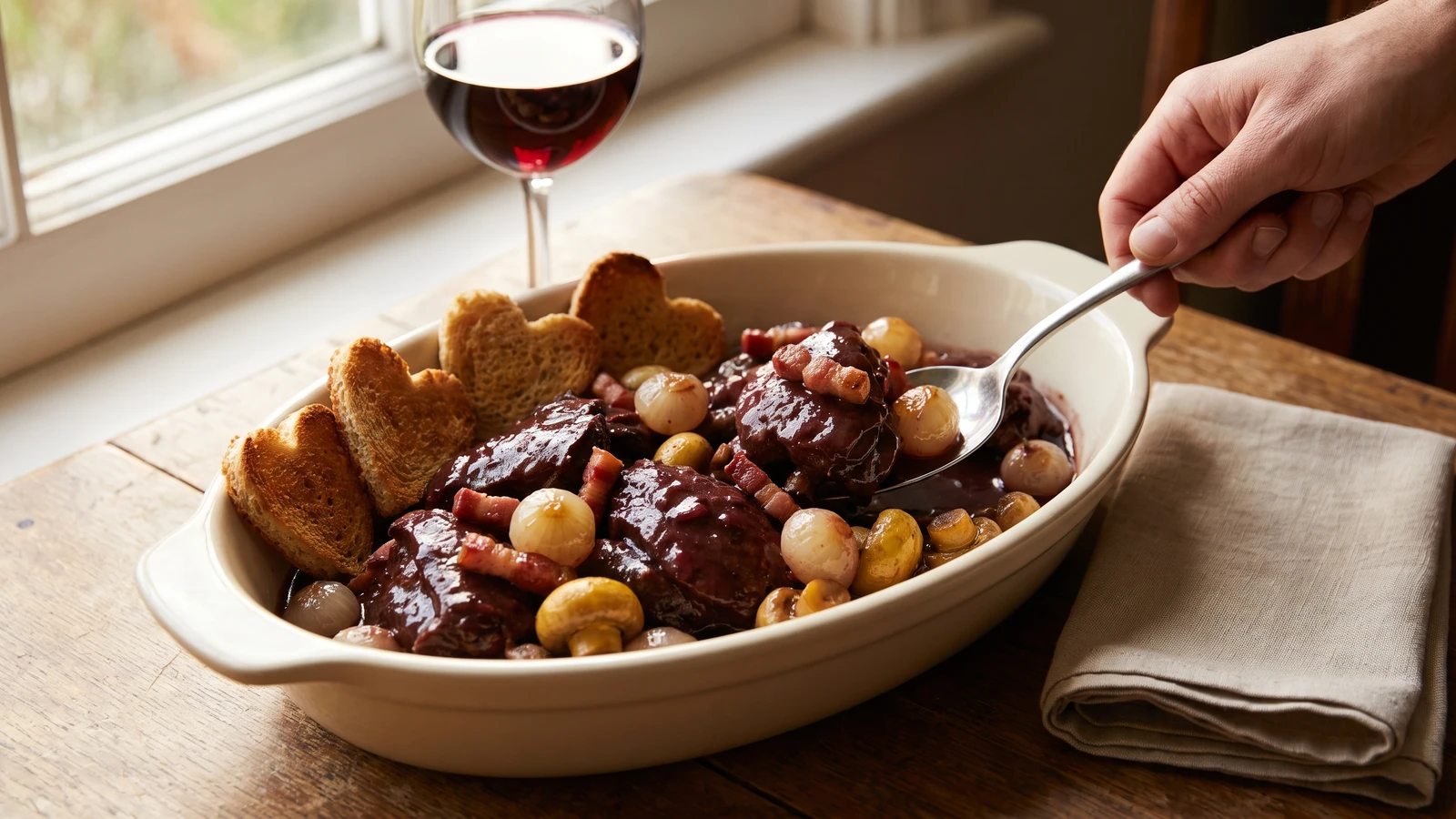
The finished civet should arrive wine-dark and generous, with tender gosling, glazed onions, mushrooms, bacon, and crisp bread hearts catching the sauce. The step that decides everything comes last: temper the blood gradually, watch the thermometer, and deny the sauce a boil.
Oison en civet belongs to the national French classical table rather than one provincial larder: it transfers the wine-dark, blood-bound treatment of hunted hare to rich young goose. Civet traveled from game and household cookery into bourgeois and grand kitchens, where its marinade, roux, garniture, and liaison au sang became a precise service sequence. Despite what the sauce suggests, the name civet is tied to cive, an onion word, not to blood, though the blood liaison distinguishes this formula.
Quantity
1 bird (about 6 lb / 2.7 kg)
butcher-jointed into 8 pieces
Quantity
1 home-scale batch Civet de Lièvre (No. 1821), scaled for 4 servings, with gosling substituted for hare and gosling blood held back for the final liaison
Quantity
½ cup (120 ml / 125 g)
collected by a licensed poultry processor
Quantity
1 tablespoon (15 ml / 15 g)
mixed into the blood immediately at collection
| Ingredient | Quantity |
|---|---|
| young goslingbutcher-jointed into 8 pieces | 1 bird (about 6 lb / 2.7 kg) |
| Civet de Lièvre preparation | 1 home-scale batch Civet de Lièvre (No. 1821), scaled for 4 servings, with gosling substituted for hare and gosling blood held back for the final liaison |
| fresh food-grade blood from the same goslingcollected by a licensed poultry processor | ½ cup (120 ml / 125 g) |
| fresh lemon juicemixed into the blood immediately at collection | 1 tablespoon (15 ml / 15 g) |
Arrange for a licensed poultry processor to collect the gosling's blood directly into the lemon juice and whisk it until uniformly fluid and cold. Bring it home in a sealed chilled container and keep it at 40°F / 4°C or colder. If it contains a few soft clots, pass it through a fine sieve; if it has set solid, acid cannot reverse that coagulation, and it cannot make the liaison. Do not collect or use blood of uncertain origin.
Set the jointed gosling into the marinade specified by Civet de Lièvre (No. 1821), using its proportions and flavorings unchanged. Cover and refrigerate for 3 hours, turning the pieces once so the wine reaches them evenly. Chilling replaces the original kitchen's cool holding area; it changes the logistics, not the marinade.
Drain the gosling and dry every piece thoroughly. Continue with Civet de Lièvre (No. 1821) from the point where its marinated meat is drained through the end of its covered braise, substituting gosling for hare and changing nothing else in order or proportion. When the referenced method tells you to stiffen the meat, use raidir, firming its surface in the roux without chasing a hard roasted crust. Hold the cocotte at the faintest tremble on a low burner, or in a 300°F / 150°C oven, never at a rolling boil.
Begin checking the breast pieces after 50 minutes and the legs after 75 minutes. Every piece must reach at least 165°F / 74°C; the legs are best when closer to 180°F to 190°F / 82°C to 88°C and yielding easily at the joint. Lift finished pieces to a covered warm bowl while the tougher joints continue. If the sauce tightens before the legs soften, lower the heat and cover the cocotte more closely; if the pot floor threatens to catch, loosen it with one spoonful of hot water. Ça se rattrape.
While the gosling finishes, complete the garniture and croûtons prescribed by Civet de Lièvre (No. 1821), keeping the bacon, glazed onions, mushrooms, and butter-fried bread hearts separate until service. Return every cooked gosling piece to the cocotte and let it warm gently in the sauce. Do not add the garniture yet; the source assembles it after the liaison, and that sequence keeps each element distinct.
Five minutes before serving, lower the heat until the sauce no longer bubbles. Reserve ¼ cup of the unbound sauce in a cool bowl. In another bowl, whisk hot sauce into the chilled blood one spoonful at a time, then in a thin stream, until the mixture is fluid and hot. Pour this liaison au sang gradually into the cocotte while stirring constantly. Hold the sauce between 158°F and 162°F / 70°C and 72°C for 2 full minutes, following any stricter guidance from the licensed supplier, and never let it boil. It is ready when it napes the back of a spoon in a smooth, wine-dark film. If grains appear, take the pot off the heat immediately, whisk in the reserved unbound sauce, and pass everything through the fine sieve before warming it gently back into the safe range.
Transfer the gosling pieces one by one to a warmed deep serving dish with the bacon, glazed onions, and mushrooms from Civet de Lièvre (No. 1821). Pass the sauce through a fine sieve directly over them, working gently so no coarse protein reaches the dish. Arrange the heart-shaped croûtons around the rim at the last moment, where they can catch the sauce without surrendering all their crispness. Serve immediately. À table!
1 serving (about 525g)
Culinary guides, cultural storytelling, and the editorial depth that makes cooking meaningful.
Discover Culinary ExplorerChef Juliette
John Dory has the delicacy of sole and the firmness of turbot. A light flouring, a quick butter sauté, and nut-brown beurre noisette show exactly why looks never mattered.

Chef Juliette
Fresh haddock proves its delicacy in the meunière pan: a fine flour crust, moist pearly flakes, and beurre noisette sharpened with lemon and parsley, ready from one skillet in half an hour.

Chef Juliette
Éperlans à l’Anglaise turns small fish into a lesson in disciplined coating: boned smelts under a close, crisp crumb, pan-fried in clarified butter and finished with bright, half-melted maître d’hôtel butter.

Chef Juliette
Tiny smelts, shallot, mushrooms, white wine, gratin sauce, and fine bread raspings meet a fierce oven, where the fish must turn tender in the same breath the buttered crust bronzes.