
Chef Juliette
John Dory (St. Pierre)
John Dory has the delicacy of sole and the firmness of turbot. A light flouring, a quick butter sauté, and nut-brown beurre noisette show exactly why looks never mattered.
A cooking platform built around craft, culture, and the stories behind what we eat.
Created by Chef Juliette
Based on No. 1722b, Oison à l’Allemande, from Le Guide Culinaire (1907) by Auguste Escoffier
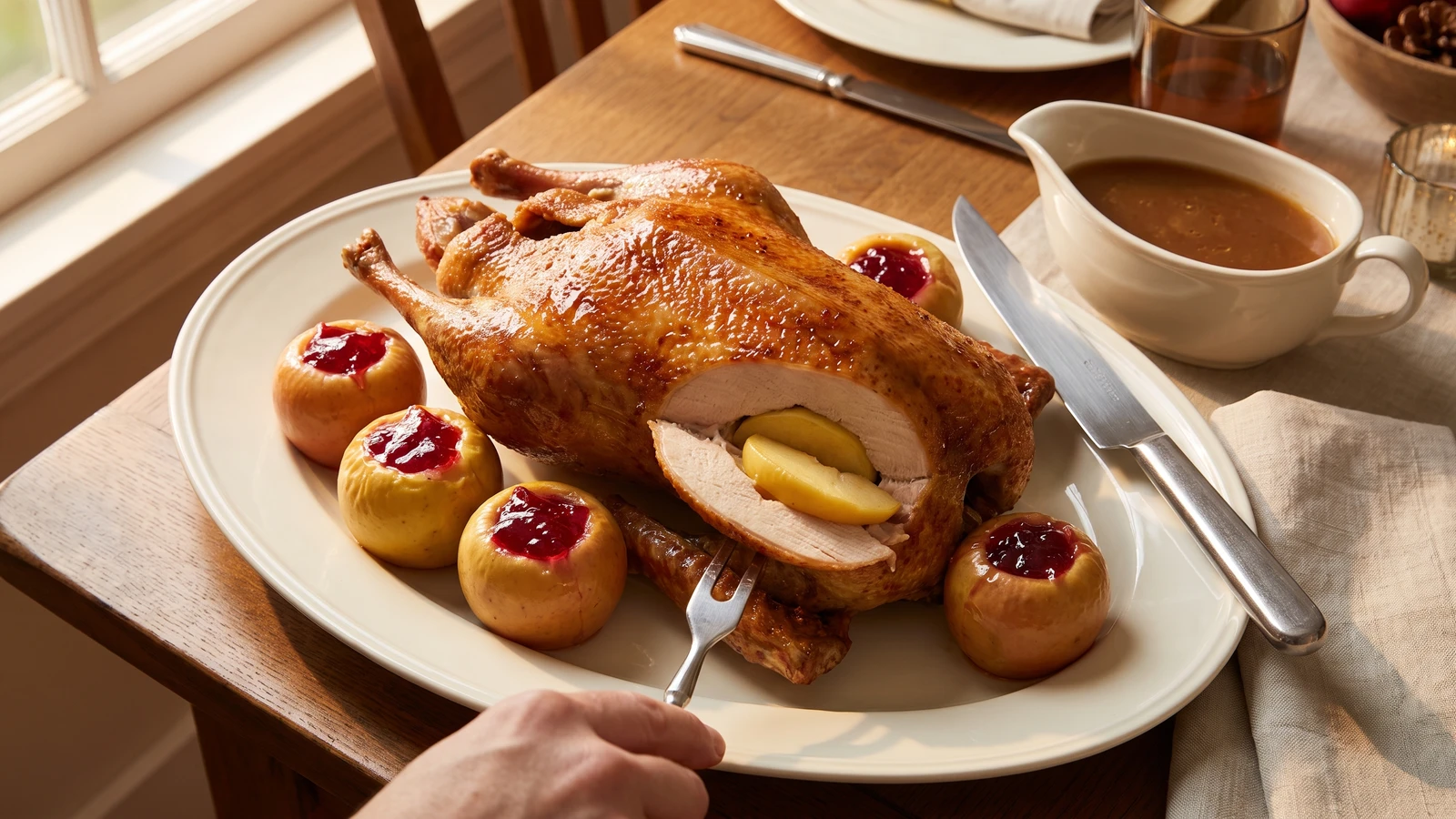
A small gosling, its breast boned and filled with buttered apples, braised under a faithful baste, then ringed with ruby-filled apples and served with a glossy roast gravy.
Oison à l’Allemande (gosling braised with buttered apples and red-currant jelly) teaches one stern, useful thing: basting is part of the cooking, not a final polish. A young bird gives you fat enough to protect the meat, but a lean gosling dries the moment the breast surface is neglected. Keep the heat gentle and return the hot fat on a clock.
The entry assumed a poultry hand to bone the breast without cutting its skin, another cook free to baste, a saucier with good gravy for roasts ready from stock never off the fire, and a tube-cutter for the apples. At home, ask a butcher to remove the breastbone and rib cage, use an apple corer, reduce rich unsalted brown poultry stock in the roasting pan, and let a tight lid plus a timer stand in for spare hands. The last uncovered half-hour gives the bird its bronze without a salamander. One cook, one stove, one evening.
The scale becomes one small gosling for four, but the sequence does not move: buttered apples half-cooked inside, openings closed, a gentle braise under repeated fat, whole buttered apples and currant jelly around the bird, strained gravy on the side. The separate sauce station and specialist cutter are scaffolding; the boning, sewing, and basting are the dish. Before the bird meets the pan, set the basting timer. That is the step that matters most.
Oison à l’Allemande belongs to the Parisian classical service table, where à l’Allemande named a German-style garnish rather than one fixed regional German recipe. The pairing of young goose with apples and red-currant jelly reflects a northern and Germanic taste for rich poultry checked by tart fruit, which French kitchens regularized into a boned, braised bird with strained roast gravy. It is not specifically an Alsatian specialty: Alsace has its own goose traditions, while this title is a French menu designation for the garnish and method.
Quantity
1 bird, 5½ to 6 lb (2.5 to 2.7 kg)
breastbone and rib cage removed from inside, with the breast meat and skin left intact
Quantity
7 apples, about 2¾ lb (1.25 kg)
divide 3 for the stuffing and 4 for the garnish
Quantity
½ cup (120 ml / 113 g)
divided
Quantity
2 teaspoons (10 ml / 12 g)
divided
Quantity
1 teaspoon (5 ml / 2 g)
Quantity
2 cups (480 ml / 480 g)
Quantity
⅓ cup (80 ml / 105 g)
| Ingredient | Quantity |
|---|---|
| small dressed goslingbreastbone and rib cage removed from inside, with the breast meat and skin left intact | 1 bird, 5½ to 6 lb (2.5 to 2.7 kg) |
| firm-tart cooking applesdivide 3 for the stuffing and 4 for the garnish | 7 apples, about 2¾ lb (1.25 kg) |
| unsalted butterdivided | ½ cup (120 ml / 113 g) |
| fine sea saltdivided | 2 teaspoons (10 ml / 12 g) |
| freshly ground pepper | 1 teaspoon (5 ml / 2 g) |
| rich unsalted brown poultry stock | 2 cups (480 ml / 480 g) |
| red-currant jelly | ⅓ cup (80 ml / 105 g) |
Keep the gosling cold while you work. The breastbone, wishbone, and ribs must be removed through the body opening without cutting away the breast meat or opening the breast skin; the boned breast should feel supple, while the back, legs, and wings remain supported by their bones. If doing this yourself, use the tip of a flexible boning knife to scrape the meat from the rib cage in short strokes, always directing the blade toward bone. Lift the cage out in sections rather than pulling against the skin. Stitch a small nick immediately with cotton kitchen twine. Ça se rattrape, but a long tear should be patched and tied before the bird is filled.
Peel and core 3 apples, then cut each into quarters. Melt 3 tablespoons (45 ml / 42 g) of the butter in a wide skillet over medium-low heat. Add the apple quarters and turn them gently for 8 to 10 minutes, until their edges look translucent and butter-gold but their centers remain firm. This half-cooking matters: raw apples would release too much water inside the bird, while fully tender apples would collapse before the gosling is done. Transfer them to a plate and let them cool until barely warm.
Dry the gosling inside and out. Season the interior with 1½ teaspoons of the salt and all the pepper, then arrange the half-cooked apple quarters inside the boned breast cavity without crushing or packing them tightly. Sew the body and neck openings closed with a trussing needle and cotton twine. If you have no trussing needle, cross short metal skewers through the skin and lace the twine around them. Truss the legs close to the body and season the outside with the remaining ½ teaspoon salt. Closing the bird is not brigade scaffolding; it holds the breast around the apples and keeps their juices where they belong.
Heat the oven to 325°F (165°C). Set the gosling breast-side up in a snug covered roasting pan or oval Dutch oven. Melt 2 tablespoons (30 ml / 28 g) of the butter and brush it over the skin, letting the excess run into the pan. Cover tightly and cook for 30 minutes, then baste thoroughly with the butter and rendered goose fat. Continue cooking, basting every 20 minutes. Uncover for the final 30 minutes and baste every 10 minutes so the skin becomes an even deep bronze. Begin checking after 1 hour 45 minutes; the center of the apple filling and the thickest part of the thigh must reach at least 165°F (74°C), usually after 1 hour 45 minutes to 2 hours 15 minutes in total. If the pan is dry at the first basting, melt another tablespoon of butter and use it immediately, taking that spoonful from the garnish allowance. Ça se rattrape. If the skin darkens before the center is hot, cover it loosely and continue at the same gentle heat.
While the gosling cooks, peel the remaining 4 apples and leave them whole. Remove each core cleanly with a ¾-inch (2 cm) apple corer, the honest home equivalent of the book's tube-cutter. Melt the remaining 3 tablespoons (45 ml / 42 g) butter in a lidded sauté pan over low heat. Add the apples, cover, and cook for 25 to 35 minutes, rolling them gently every 5 minutes and spooning butter over their surfaces and into the hollow centers. They are ready when a small knife enters with light resistance and the fruit still stands whole. If they color before becoming tender, lower the heat and keep the pan covered; if the butter turns black, move the apples to a clean pan with a fresh spoonful of butter.
Transfer the cooked gosling to a warmed oval platter and rest it loosely covered for 20 minutes. Arrange the 4 butter-cooked apples around the bird, then spoon the red-currant jelly generously into their hollow centers. Keep any remaining jelly beside the apples rather than stirring it into the gravy; its clear tart sweetness is meant to meet the rich meat at the fork.
While the bird rests, tilt the braising pan and spoon away roughly three-quarters of the rendered grease, leaving the browned fond and a little fat behind. Reserve the removed goose fat for another cooking pot. Set the pan over medium heat, pour in the brown poultry stock, and scrape and swill the pan until every browned deposit has dissolved. Boil steadily for 8 to 12 minutes, reducing the gravy until it tastes concentrated and lightly coats a spoon. Strain it through a fine sieve into a warmed gravy boat. If it looks slick rather than glossy, let it stand for a minute and skim the excess fat; if it is thin, return it to the heat and reduce again. Ça se rattrape.
Remove every thread or skewer before carving. Cut the breast across the grain, taking some of the apple filling with each portion, then divide the legs at their joints. Give each diner both breast and dark meat, one buttered apple with red-currant jelly, and the hot strained gravy passed separately. The fruit should brighten the gosling, not bury it. À table!
1 serving (about 640g)
Culinary guides, cultural storytelling, and the editorial depth that makes cooking meaningful.
Discover Culinary ExplorerChef Juliette
John Dory has the delicacy of sole and the firmness of turbot. A light flouring, a quick butter sauté, and nut-brown beurre noisette show exactly why looks never mattered.

Chef Juliette
Fresh haddock proves its delicacy in the meunière pan: a fine flour crust, moist pearly flakes, and beurre noisette sharpened with lemon and parsley, ready from one skillet in half an hour.

Chef Juliette
Éperlans à l’Anglaise turns small fish into a lesson in disciplined coating: boned smelts under a close, crisp crumb, pan-fried in clarified butter and finished with bright, half-melted maître d’hôtel butter.

Chef Juliette
Tiny smelts, shallot, mushrooms, white wine, gratin sauce, and fine bread raspings meet a fierce oven, where the fish must turn tender in the same breath the buttered crust bronzes.