
Chef Juliette
John Dory (St. Pierre)
John Dory has the delicacy of sole and the firmness of turbot. A light flouring, a quick butter sauté, and nut-brown beurre noisette show exactly why looks never mattered.
A cooking platform built around craft, culture, and the stories behind what we eat.
Created by Chef Juliette
Based on No. 1718, Dindonneau Chipolata, from Le Guide Culinaire (1907) by Auguste Escoffier
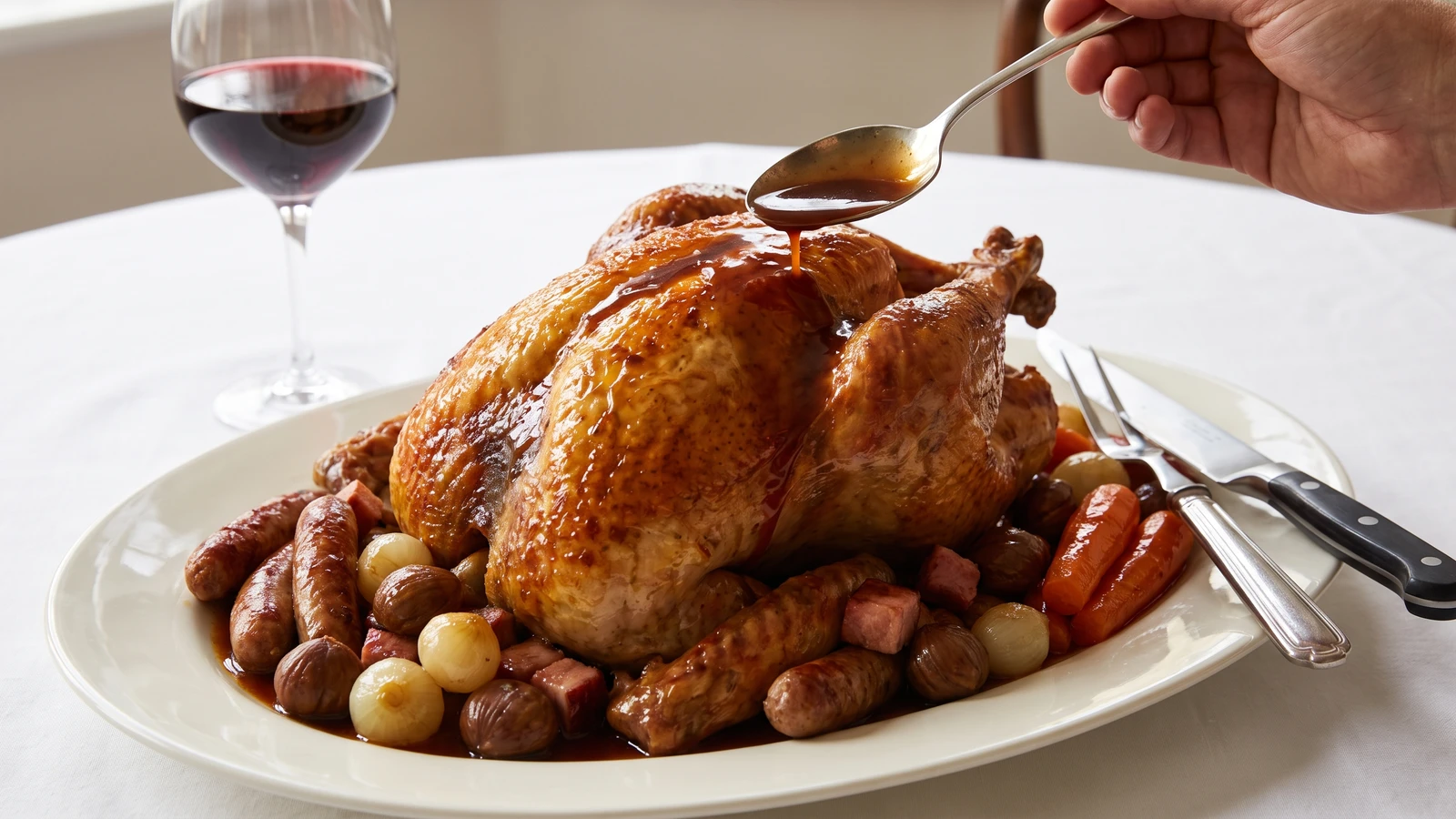
Dindonneau Chipolata makes one abundant platter from a braised turkey crown, small sausages, chestnuts, glazed onions, crisp pork, and turned carrots, all gathered under a tomatéd half-glaze.
Dindonneau Chipolata (young turkey with the classical chipolata garnish) teaches a clean principle: a garniture is a composition, not a handful of extras. Chipolata names the garnish, not the bird. Small sausages, chestnuts, fresh pork dice, glazed onions, and turned carrots are each cooked as they need, then gathered only at the finish under the reduced braising liquor. Put everything into the pot at once and you get one muddled texture; keep the parts distinct and the platter has abundance without heaviness.
The original offered a cut-up bird for lunch and a whole braised bird for dinner. It also assumed a saucier on staff, brown stock never off the fire, brigade hands to turn twenty carrots, and a salamander for the final glaze. For four, this version follows the dinner method with a bone-in turkey crown, halves the garnish quantities, uses prepared unsalted demi-glace made distinctly tomatéd, and turns the home broiler into the salamander. The perfect seven-sided tournée is brigade scaffolding and can go; even tapered carrot ovals serve the same intent. Browning the bird, glazing the vegetables separately, reducing the liquor, and giving the crown its final burnish are the dish, and they stay. One cook, one stove, one evening.
The platter should arrive burnished and generous, with the sausages bronzed, the chestnuts whole, and every onion shining under enough sauce to bind the company without drowning it. The step that decides everything is the final reduction: taste as the sauce narrows, and stop when it coats the back of a spoon with a clear, glossy film.
Dindonneau Chipolata belongs to the Parisian classical repertory of garnitures composées, named combinations through which roasted or braised meats took a distinct identity at the table. Chipolata does not mean merely the small sausage; in this usage it names the full winter garnish of sausages, pork dice, chestnuts, glazed onions, and turned carrots bound with the bird's reduced liquor. The formula traveled readily from grand kitchens to bourgeois holiday tables because its parts could be prepared separately, then arranged around a whole bird for dinner or folded through cut-up turkey for lunch.
Quantity
1 crown, 4 1/2 to 5 pounds (2 to 2.25 kg)
Quantity
2 teaspoons (10 ml / 12 g), plus more as needed
Quantity
1 teaspoon (5 ml / 2 g)
Quantity
6 tablespoons (90 ml / 85 g)
divided
Quantity
3/4 cup (180 ml / 180 g)
Quantity
2 cups (480 ml / about 480 g)
diluted to light sauce consistency
Quantity
2 tablespoons (30 ml / 32 g)
Quantity
2 cups (480 ml / 480 g)
Quantity
10, about 5 ounces (140 g)
peeled
Quantity
10, about 4 1/2 ounces (125 g)
Quantity
2, about 7 ounces (200 g)
peeled and cut into 10 even tapered ovals
Quantity
2 teaspoons (10 ml / 8 g)
divided
Quantity
5, about 8 ounces (225 g) total
Quantity
1/2 cup (2 2/3 ounces / 75 g)
cut into small dice
Quantity
2 teaspoons (10 ml / 5 g)
| Ingredient | Quantity |
|---|---|
| bone-in, skin-on turkey crown | 1 crown, 4 1/2 to 5 pounds (2 to 2.25 kg) |
| fine sea salt | 2 teaspoons (10 ml / 12 g), plus more as needed |
| freshly ground black pepper | 1 teaspoon (5 ml / 2 g) |
| unsalted butterdivided | 6 tablespoons (90 ml / 85 g) |
| dry white wine | 3/4 cup (180 ml / 180 g) |
| prepared unsalted demi-glacediluted to light sauce consistency | 2 cups (480 ml / about 480 g) |
| double-concentrated tomato purée | 2 tablespoons (30 ml / 32 g) |
| unsalted chicken consommé or clear rich poultry stock | 2 cups (480 ml / 480 g) |
| small pearl onionspeeled | 10, about 5 ounces (140 g) |
| peeled cooked chestnuts | 10, about 4 1/2 ounces (125 g) |
| medium carrotspeeled and cut into 10 even tapered ovals | 2, about 7 ounces (200 g) |
| granulated sugardivided | 2 teaspoons (10 ml / 8 g) |
| small fresh chipolata sausages | 5, about 8 ounces (225 g) total |
| fresh pork bellycut into small dice | 1/2 cup (2 2/3 ounces / 75 g) |
| all-purpose flour (optional) | 2 teaspoons (10 ml / 5 g) |
Pat the turkey crown thoroughly dry, then season it all over and beneath the skin where you can reach with the salt and pepper. Tie any loose skin neatly underneath and leave the crown at room temperature for 30 minutes while the oven heats to 325°F (165°C). Dry skin and moderate heat matter here: moisture prevents browning, while fierce heat tightens the breast before the braise can do its work.
Melt 2 tablespoons of the butter in a heavy lidded casserole over medium heat. Brown the turkey crown deeply on every accessible side, turning it with two sturdy spoons or tongs and giving the skin 10 to 12 minutes in all. Lift it out. Pour in the white wine, scrape the fond from the pot floor, and reduce the wine by half. Whisk the tomato purée into the demi-glace until its color and flavor are plainly perceptible, which is what the book means by tomatéd. Pour this half-glaze into the casserole and return the crown bone-side down. The liquid should reach roughly one-third of the way up the bird; add a little consommé if needed, or hold back excess sauce if the vessel is narrow. Cover and braise in the oven for 70 to 95 minutes, basting twice, until the thickest part of the breast reaches 162°F (72°C) without touching bone. If the butter blackens during browning, lift out the bird and wipe away the burnt fat before deglazing. Ça se rattrape at that point; once black bitterness enters the sauce, it stays.
While the turkey braises, place the chestnuts in a small saucepan with 3/4 cup of the consommé. Bring it only to a bare simmer and cook for 12 minutes, turning the chestnuts once, so they drink in the consommé without breaking apart. Lift them out with a slotted spoon and keep them covered. If one splits, keep it for the platter, but stir the rest with a light hand; chestnuts turn to paste when bullied.
Make the vegetables glacer à blanc, glazed without browning. Put the pearl onions in a wide sauté pan with 1 tablespoon of butter, half the sugar, a pinch of salt, and enough consommé to come halfway up their sides. Cover loosely and simmer until nearly tender, then uncover and roll them through the reducing liquid until glossy. Transfer them to a plate. Repeat with the carrots, another tablespoon of butter, the remaining sugar, and more consommé, cooking until a knife enters with slight resistance and the glaze clings. If either glaze catches before the vegetables are tender, add a splash of consommé and roll the pan gently. Ça se rattrape.
Put the diced fresh pork belly in a dry skillet over medium-low heat and let its fat render slowly. Raise the heat once the dice begin to color, then frizzle them until their edges are crisp and curled. Lift them out with a slotted spoon. Brown the chipolata sausages in the rendered fat, turning often so their thin skins color without splitting, about 6 minutes. They need not cook completely yet; the reduced sauce will finish them.
Lift the turkey crown from its casserole, set it on a tray, and cover it loosely for 15 to 20 minutes. Strain the braising liquor into a saucepan, pressing lightly on any collected juices, then skim away excess fat. Boil steadily until reduced to about 1 1/2 cups and thick enough to nappe, coating the back of a spoon in a glossy film. Taste repeatedly as it narrows. If it becomes too intense before it coats, loosen it with unsalted consommé. If the seasoning is right but the sauce remains thin, knead 1 teaspoon each of softened butter and the optional flour into a beurre manié, a soft butter-flour paste. Whisk it into the simmering sauce in tiny pieces and cook for 2 minutes. Stop as soon as the sauce coats; the beurre manié is rescue, not the foundation.
Put the browned chipolatas into the reduced sauce and simmer gently until they reach 160°F (71°C), about 4 to 6 minutes. Add the pork dice, onions, chestnuts, and carrots, then warm everything together for 2 minutes, folding rather than stirring so the garnish stays whole. If the sauce tightens around the chestnuts, loosen it with a spoonful of consommé. Lift the garnish into a warm bowl with a slotted spoon, then whisk 1 tablespoon of cold butter into the sauce off the heat. We don't apologize for butter. It gives the liquor its final sheen and helps it cling to the crown.
Check that the rested turkey has reached 165°F (74°C). If it has not, return it to the covered casserole for 5-minute intervals until it does. Heat the broiler and place the crown on a sturdy tray at least 6 inches from the element. Brush it generously with the finished sauce, broil just until glossy and burnished, then brush and broil once more. This is the home salamander, and it works quickly; if the glaze darkens too fast, lower the tray rather than abandoning it. Set the crown on a long warm platter, arrange the chipolata garnish generously around it, and spoon over enough sauce to make everything gleam. Bring the remaining sauce separately. À table!
1 serving (about 600g)
Culinary guides, cultural storytelling, and the editorial depth that makes cooking meaningful.
Discover Culinary ExplorerChef Juliette
John Dory has the delicacy of sole and the firmness of turbot. A light flouring, a quick butter sauté, and nut-brown beurre noisette show exactly why looks never mattered.

Chef Juliette
Fresh haddock proves its delicacy in the meunière pan: a fine flour crust, moist pearly flakes, and beurre noisette sharpened with lemon and parsley, ready from one skillet in half an hour.

Chef Juliette
Éperlans à l’Anglaise turns small fish into a lesson in disciplined coating: boned smelts under a close, crisp crumb, pan-fried in clarified butter and finished with bright, half-melted maître d’hôtel butter.

Chef Juliette
Tiny smelts, shallot, mushrooms, white wine, gratin sauce, and fine bread raspings meet a fierce oven, where the fish must turn tender in the same breath the buttered crust bronzes.