Culinary Explorer

A cooking platform built around craft, culture, and the stories behind what we eat.
Discover Culinary Explorer
Dindonneau Farci aux Marrons

Dindonneau Farci aux Marrons

Created by Chef Juliette

Based on No. 1716, Dindonneau Farci aux Marrons, from Le Guide Culinaire (1907) by Auguste Escoffier

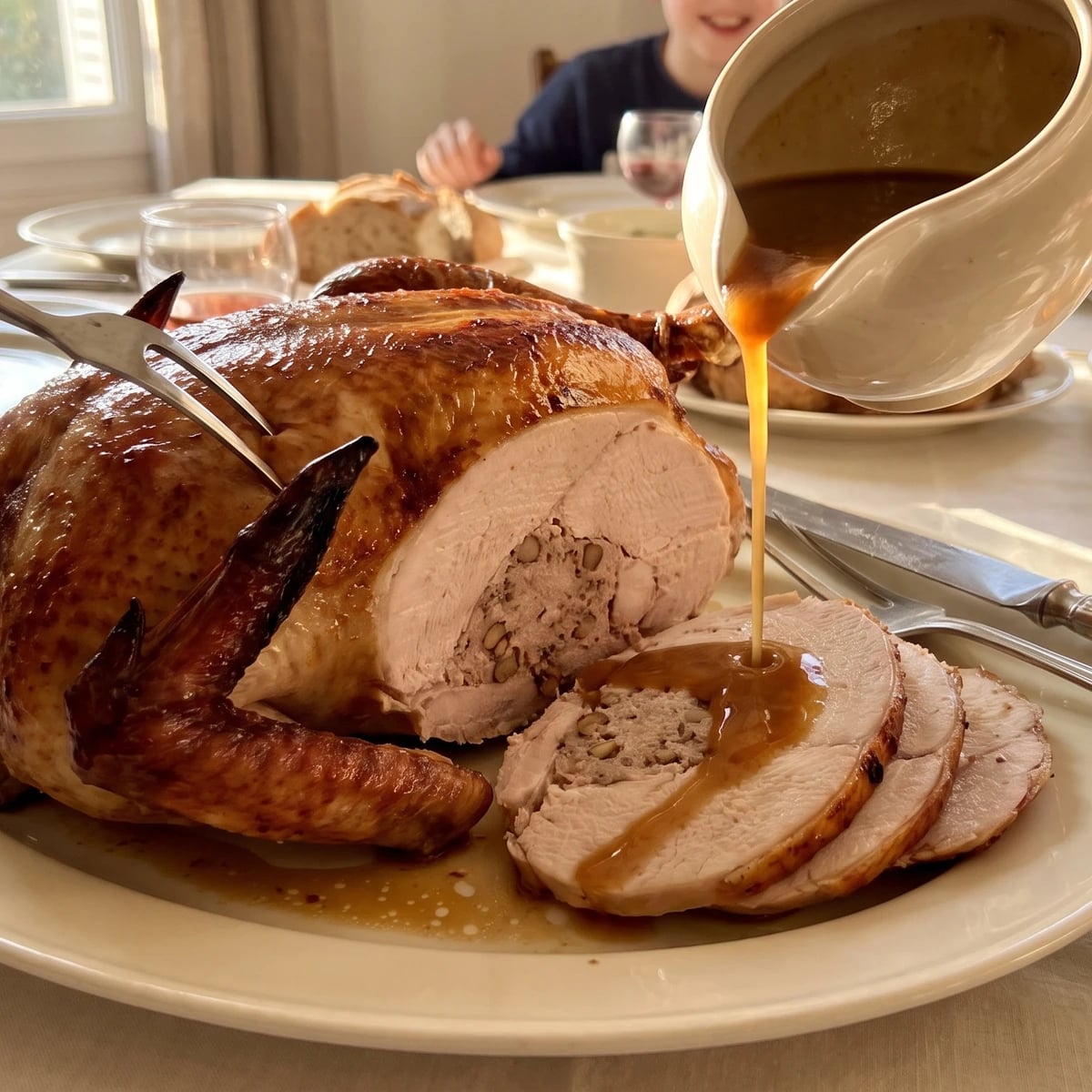
Dindonneau farci aux marrons teaches the holiday roast in one bird: chestnuts tender in consommé, fine pork holding the farce, burnished skin, and natural gravy served apart with its generous fat intact.

Main Dishes
French
Christmas
Thanksgiving
Holiday
1 hr
Active Time
2 hr 30 min cook4 hr total
Yield4 servings

Dindonneau farci aux marrons (young turkey stuffed with chestnuts) teaches the governing truth of a stuffed roast: the farce and the bird must finish together. Chestnuts are brought almost to tenderness in consommé, then folded through very fine pork, so the filling stays succulent without becoming paste and the turkey reaches the table with burnished skin and juicy meat.

The original recipe assumed a vat of smoking fat to loosen chestnut skins, a spit turning under constant basting, consommé never off the fire, and a saucier to finish the gravy. For one cook, one stove, one evening, boiling-water blanching replaces the smoking fat, an oven rack replaces the spit, and strong prepared consommé with the roasting-pan fond makes the gravy. The chestnut and pork farce is reduced to one-third of the book's quantity while preserving its ratio exactly. Passing pork through a tammy was brigade scaffolding; the fine farce, nearly cooked chestnuts, frequent basting, and frankly fatty gravy are the dish, and they stay.

Keep the farce cold and pack it loosely. That is the step that decides the roast: warm, compressed stuffing turns dense and slows the heat before it reaches the center. If the chestnuts begin to crumble, cool them flat and fold only once, gently. Ça se rattrape.

Dindonneau farci aux marrons belongs to the French bourgeois Christmas table rather than to one province: turkey passed from the grand roasting kitchen to the family holiday centerpiece, while chestnuts carried the winter larder into the bird itself. The chestnut and pork farce joins household generosity to classical discipline, with the meat worked fine and the bird basted as it roasts. Its gravy is often misunderstood outside France: it is the natural roasting jus, served apart and left visibly fat, not a flour-thickened brown sauce.

The technique, the tradition, and the story behind every dish.

Discover Culinary Explorer

Ingredients

small young turkey

Quantity

1 bird, 6 to 7 pounds (2.7 to 3.2 kg)

giblets removed and bird patted very dry

fresh chestnuts in their shells

Quantity

12 ounces (340 g)

fatty pork, preferably shoulder

Quantity

10⅔ ounces (302 g)

very finely ground and kept cold

clear consommé

Quantity

3 cups (720 ml / about 720 g)

preferably unsalted and divided

fine sea salt

Quantity

4 teaspoons (20 ml / 24 g)

divided

freshly ground black pepper

Quantity

1½ teaspoons (7.5 ml / 3 g)

divided

Equipment Needed

  • Small sharp paring knife
  • 2-quart heavy saucepan
  • Food processor, if the pork is not already finely ground
  • Sturdy roasting pan with fitted rack
  • Instant-read thermometer with a narrow probe
  • Kitchen twine

Instructions

  1. 1

    Peel the chestnuts

    Cut a shallow cross through the shell on the flat side of every chestnut, taking care not to cut deeply into the flesh. Lower them into boiling water in small batches for 2 minutes, then peel away both the hard shell and the papery inner skin while they are still warm. Boiling water replaces the original bath of smoking fat, which was brigade scaffolding and an unnecessary danger at home. If a skin clings, return that chestnut to the water for 30 seconds rather than gouging away half its flesh.

  2. 2

    Poach in consommé

    Reserve 1 cup of the consommé for roasting and the gravy. Put the peeled chestnuts in the smallest saucepan that holds them comfortably and add the remaining 2 cups. Bring only to a bare simmer and cook for 12 to 18 minutes, until a small knife enters with slight resistance and the chestnuts are nearly tender but still hold their shape. Lift them out and spread them on a tray to cool completely. If they begin to split, stop cooking at once; if several have already softened, cool them without stirring and fold them into the farce last. Ça se rattrape.

  3. 3

    Make the fine farce

    Put the cold, finely ground pork in a chilled bowl. If the grind still looks coarse, pulse it in a food processor in short bursts until it becomes fine and slightly tacky, stopping before the fat warms. This is the honest home equivalent of chopping the pork and rubbing it through a tammy. Mix in 1 teaspoon of the salt and ½ teaspoon of the pepper, then fold in the cooled chestnuts, leaving small ones whole and halving only the largest. Work gently so the chestnuts remain distinct within the pork.

  4. 4

    Stuff and truss

    Heat the oven to 350°F (175°C) with a rack in the lower-middle position. Season the turkey inside and out with the remaining 3 teaspoons salt and 1 teaspoon pepper. Spoon the cold farce loosely into the neck and body cavities, filling them without tamping; compressed stuffing becomes dense and delays heat from reaching its center. Fold over the neck skin, tie the legs together, tuck the wing tips underneath, and place the bird breast-side up on a rack in a sturdy roasting pan. Roast it immediately after stuffing.

  5. 5

    Roast and baste

    Roast undisturbed for 30 minutes, until the skin begins to color and the bird releases enough fat for basting. Spoon the pan fat thoroughly over the breast, thighs, and wing joints, then repeat every 20 to 25 minutes while rotating the pan for even browning. If the fond threatens to scorch, add 2 tablespoons of the reserved consommé around the bird, never over the skin. If the breast reaches a deep bronze before the legs are ready, cover only the breast loosely with foil. If the skin remains pale near the end, raise the oven to 425°F (220°C) for 8 to 10 minutes, watching closely.

  6. 6

    Judge the center

    Begin checking after about 2 hours. Insert an instant-read thermometer into the deepest part of the thigh without touching bone, then into the center of the stuffing through the body cavity. Both must reach 165°F (74°C). If the turkey is ready while the stuffing remains below temperature, remove the farce with a clean spoon, spread it in a shallow baking dish, and return it to the oven until it reaches 165°F (74°C) while the bird rests. The meat needn't suffer for a lagging center; ça se rattrape.

    Color and clear juices are useful clues, but a stuffed bird is judged at its center. A narrow thermometer probe is the calmest cook in the kitchen.
  7. 7

    Rest the bird

    Transfer the turkey to its serving platter and cover it very loosely with foil. Rest for 30 minutes so the juices settle through the meat and the farce firms enough to serve neatly. A tight foil tent softens the carefully browned skin, so give the bird room to breathe.

  8. 8

    Make the fatty gravy

    While the bird rests, set the roasting pan over medium heat, or scrape its contents into a saucepan if the pan is not suitable for the stove. Add the remaining reserved consommé and scrape up every sound brown patch of fond, leaving any black scorch behind. Simmer for 5 to 8 minutes, until the juices taste concentrated but remain fluid, then strain into a warm sauceboat. Do not skim away the clear layer of roasting fat and do not thicken the gravy with flour; the source asks for it frankly fat. If it becomes too salty, loosen it with a spoonful of water and stop the reduction.

  9. 9

    Carve and serve

    Remove the twine and lift the chestnut farce into a warm serving dish. Carve the turkey into generous slices, keeping browned skin with each portion, and bring the gravy separately so everyone can spoon on as much of the rich roasting jus as desired. One bird, one abundant holiday table. À table!

Chef Tips

  • Ask for the smallest whole young turkey your butcher can supply. A bird much larger than 7 pounds needs more farce, longer roasting, and a larger table; this version deliberately reduces the professional quantity for four generous holiday portions.
  • Fresh chestnuts are best here because their firmness survives poaching. Out of season, use 8 ounces (225 g) vacuum-packed whole chestnuts, simmer them in the consommé for only 3 to 4 minutes, and fold them with almost no stirring. The classical pantry solved seasons long before we did.
  • The pork must be plain, fatty, and finely ground. Breakfast sausage brings seasonings the source never asked for, while lean pork produces a dry, crumbly farce. Ask the butcher for shoulder passed twice through the fine plate.
  • Serve a cru Beaujolais or a light red Burgundy. Either has enough freshness for the pork and roasting fat without overpowering the sweet, earthy chestnuts.
  • After the meal, remove any remaining stuffing from the bird and chill it separately within 2 hours. Refrigerated turkey and stuffing keep for up to 3 days and should be reheated to 165°F (74°C).

Advance Preparation

  • The chestnuts can be peeled and poached 1 day ahead. Drain them, cool them completely, and refrigerate them in a shallow airtight container so they keep their shape.
  • The pork farce can be mixed up to 12 hours ahead and kept covered below 40°F (4°C). Fold in the chestnuts only after both are cold.
  • Never stuff the turkey in advance. Fill and truss it immediately before roasting so the cold center does not spend hours warming through.

Frequently Asked Questions

Nutrition Information

1 serving (about 525g)

Calories
1065 calories
Total Fat
53 g
Saturated Fat
17 g
Trans Fat
0 g
Unsaturated Fat
35 g
Cholesterol
360 mg
Sodium
2700 mg
Total Carbohydrates
28 g
Dietary Fiber
5 g
Sugars
7 g
Protein
111 g

Note: Chef personas and recipes are created with AI assistance. Cook with care: follow safe food-handling practices, check doneness with a thermometer when needed, and adapt for allergies and your kitchen.

Where cooking meets culture.

Culinary guides, cultural storytelling, and the editorial depth that makes cooking meaningful.

Discover Culinary Explorer

More from Poultry (Volaille) - Cold Preparations of Fowl

Browse the full collection