
Chef Juliette
Poularde à la Carmélite
Poularde à la Carmélite turns poached chicken, crayfish mousse, truffle, and melting aspic into a cold Parisian centerpiece. The mastery lies in coating while the sauce still flows smoothly.
A cooking platform built around craft, culture, and the stories behind what we eat.
Created by Chef Juliette
Based on No. 1715, Dindonneau (Young Turkey), from Le Guide Culinaire (1907) by Auguste Escoffier
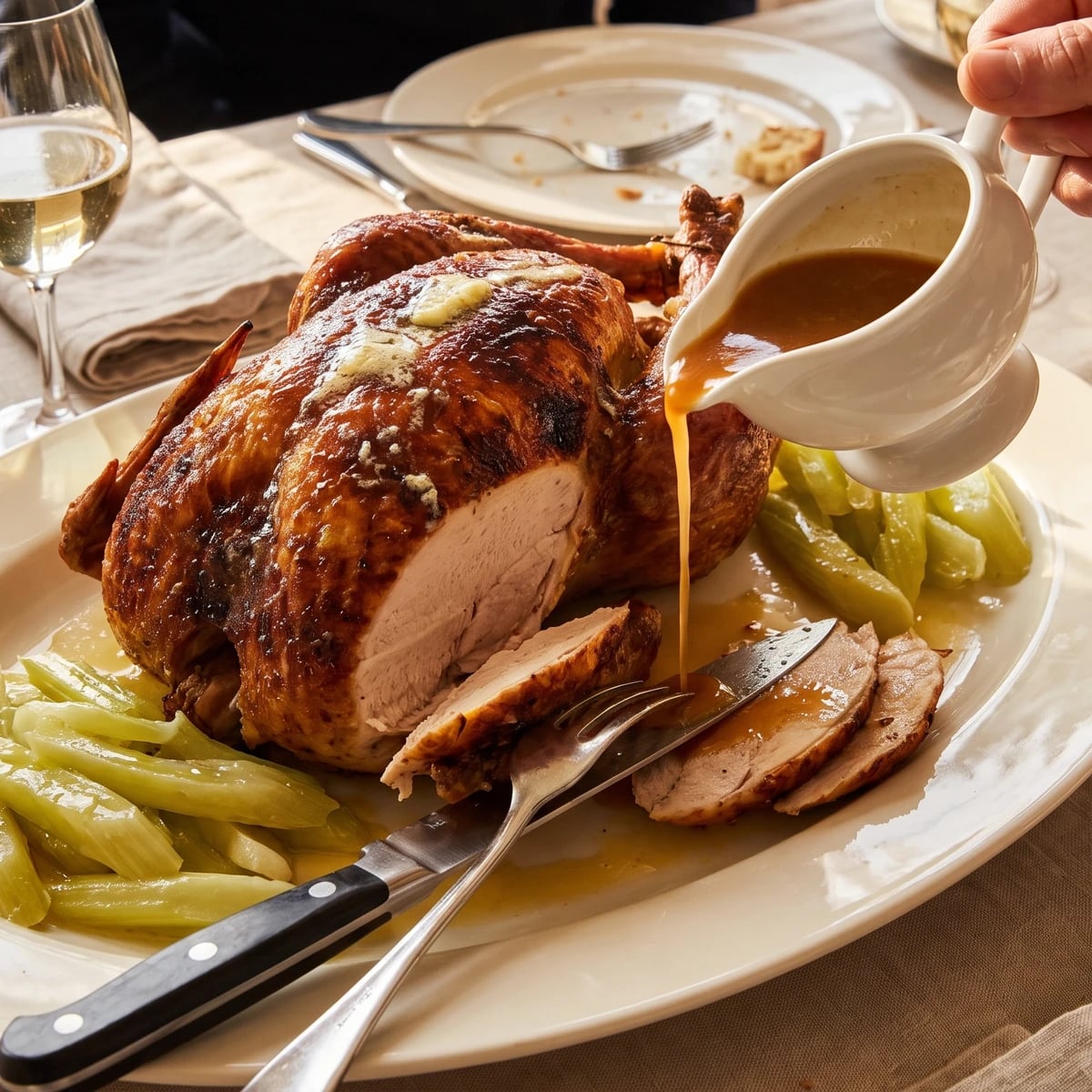
Dindonneau takes the pullet’s grammar into a holiday bird: roast gently, protect the breast, build a glossy jus from the pan fond, then choose one classical garnish and serve generously.
Dindonneau (young turkey) teaches one true thing before you touch the roasting pan: a young turkey behaves more like a large pullet than an old, heavy holiday bird. Its breast is tender and quick to dry while its legs still need time, so the whole technique rests on protecting the breast once it bronzes and judging doneness with a thermometer, not a timetable.
The old entry assumed a saucier nearby, a stockpot never off the fire, and several finished garnishes ready to be called into service. It offered no single fixed preparation, instead sending the bird through the pullet repertoire with Celery à l’Anglaise, à la Financière, à la Godard, or à la Jardinière. The home translation changes only scale and service: one small bird for four, boxed stock fortified with its own neck, a reduced pan jus, and one finished garnish rather than a brigade’s menu of them. One cook, one stove, one evening.
The finished dindonneau should arrive deep bronze, its carved breast moist beneath crisp skin, with a glossy jus carrying every browned trace from the roasting pan. Making all four garnishes is scaffolding for a grand service and can go; roasting the bird evenly and preserving its fond are the dish and must stay. Watch the breast first. That is the step that decides everything.
The dindonneau belongs not to one French province but to the bourgeois holiday table and the formal service of the classical grand kitchen, where a smaller, tender turkey could appear as either a substantial relevé or an entrée. Rather than give the young bird one fixed identity, cooks treated it as a larger pullet and matched it with Celery à l’Anglaise, à la Financière, à la Godard, or à la Jardinière. The entry is therefore a lesson in the canon’s working grammar: the age and tenderness of the bird determine the method, while the chosen garnish determines its place on the menu.
Quantity
1 bird, 6 to 7 lb (2.7 to 3.2 kg)
neck and giblets reserved
Quantity
1 tablespoon plus 1 teaspoon (20 ml / 24 g)
Quantity
1 teaspoon (5 ml / 2 g)
Quantity
8 tablespoons (120 ml / 113 g)
divided, 4 tablespoons softened and 4 tablespoons kept cold
Quantity
1 large (about 1½ cups / 225 g)
cut into wedges
Quantity
2 medium (about 1½ cups / 200 g)
cut into thick pieces
Quantity
2 stalks (about 1 cup / 120 g)
cut into thick pieces
Quantity
3 cups (720 ml / 720 g)
Quantity
1 cup (240 ml / 240 g)
divided
Quantity
1
Quantity
1 finished preparation sufficient for 4 servings; choose one
| Ingredient | Quantity |
|---|---|
| small whole young turkeyneck and giblets reserved | 1 bird, 6 to 7 lb (2.7 to 3.2 kg) |
| fine sea salt | 1 tablespoon plus 1 teaspoon (20 ml / 24 g) |
| freshly ground black pepper | 1 teaspoon (5 ml / 2 g) |
| unsalted butterdivided, 4 tablespoons softened and 4 tablespoons kept cold | 8 tablespoons (120 ml / 113 g) |
| yellow onioncut into wedges | 1 large (about 1½ cups / 225 g) |
| carrotscut into thick pieces | 2 medium (about 1½ cups / 200 g) |
| celerycut into thick pieces | 2 stalks (about 1 cup / 120 g) |
| low-sodium chicken or turkey stock | 3 cups (720 ml / 720 g) |
| dry white winedivided | 1 cup (240 ml / 240 g) |
| bouquet garni | 1 |
| Celery à l’Anglaise, à la Financière, à la Godard, or à la Jardinière | 1 finished preparation sufficient for 4 servings; choose one |
Remove the turkey from its wrapping and take the neck and giblets from the cavities. Reserve the neck, gizzard, and heart; keep the liver cold for another use. Pat the bird thoroughly dry, including inside the cavity, then season it all over and inside with the salt and pepper. Refrigerate it uncovered for 45 minutes while you make the fortified stock. A dry surface browns; a wet one steams.
Melt 1 tablespoon of the butter in a 2-quart saucepan over medium heat. Brown the neck, gizzard, and heart until their surfaces take a deep golden colour, then add half the onion, carrots, and celery. Cook until the vegetables begin to bronze. Pour in 2½ cups of the stock, add the bouquet garni, and hold at the barest simmer for 45 minutes. Strain, discard the solids, and keep the fortified stock warm. This is the honest home equivalent of the stockpot that never left the old stove.
Heat the oven to 425°F (220°C) with a rack in the lower third. Pat the turkey dry once more. Ease your fingers carefully beneath the breast skin and spread 3 tablespoons of softened butter directly over the meat, then rub the remaining 1 tablespoon softened butter over the skin. Fold the wing tips beneath the bird and tie the legs loosely together. Scatter the remaining onion, carrots, and celery in a sturdy roasting pan, set the turkey breast-side up on this aromatic bed, and pour ½ cup of the wine and the reserved ½ cup plain stock around it, never over the skin.
Roast at 425°F (220°C) for 25 minutes, until the skin begins to bronze, then lower the oven to 350°F (175°C). Continue roasting for 65 to 90 minutes, turning the pan once and spooning the pan juices over the legs, not the breast, until the thickest part of the breast reaches 160 to 162°F (71 to 72°C) and the inner thigh reaches 170 to 175°F (77 to 79°C). The breast will colour before the legs finish; once it is deep gold, cover only the breast loosely with foil. If the pan dries or the fond darkens toward mahogany, add a splash of fortified stock at once. Burnt fond cannot be disguised, so intervene while it is brown and useful.
Transfer the turkey to a warm carving board, tipping any juices from its cavity back into the roasting pan. Rest for 30 minutes with the breast loosely shielded by foil, never wrapped tightly or the crisp skin softens. Check that the breast reaches at least 165°F (74°C) during the rest. If it does not, return the bird to the 350°F (175°C) oven for 8 to 10 minutes, then check again. The rest is part of the cooking, not an interval to be hurried.
While the turkey rests, spoon excess fat from the roasting pan, leaving the browned juices behind. Set the pan over medium heat if it is stovetop-safe, or scrape everything into a saucepan. Add the remaining ½ cup wine and scrape up every brown trace of fond. Add the strained fortified stock and boil steadily until reduced to about 1¼ cups, glossy but still fluid enough to pour. Strain into a clean saucepan and taste for seasoning.
Take the jus off the heat. Montez au beurre (finish with cold butter) by whisking in the remaining 3 tablespoons butter, one small piece at a time, until the jus gleams and lightly coats a spoon. Do not boil it after the butter goes in. If the jus separates or looks greasy, stop adding butter and whisk in 1 tablespoon of cold stock until it comes together, then continue slowly. Ça se rattrape.
While the bird rests, warm exactly one finished preparation according to its own entry: Celery à l’Anglaise, à la Financière, à la Godard, or à la Jardinière. Keep that preparation whole and do not combine the four. Remove the legs, separate the thighs and drumsticks, then carve the breast across the grain into generous slices. Arrange the turkey on a warm platter with the chosen preparation, spoon over enough jus to give the meat a gloss, and pass the remainder at the table. Never apologize at your own table. À table!
1 serving (about 630g)
Culinary guides, cultural storytelling, and the editorial depth that makes cooking meaningful.
Discover Culinary Explorer
Chef Juliette
Poularde à la Carmélite turns poached chicken, crayfish mousse, truffle, and melting aspic into a cold Parisian centerpiece. The mastery lies in coating while the sauce still flows smoothly.

Chef Juliette
Poularde au Champagne turns poëling, aspic, and cold service into one lesson in control: truffled foie gras inside a tender pullet, clear Champagne jelly outside, and not one bead of fat to cloud it.

Chef Juliette
Poach the bird gently, cool it in its own liquor, then veil each piece in ivory chaud-froid, black truffle, and clear aspic: a formal cold dish made practical for one home cook.

Chef Juliette
Cold poultry as architecture: tender suprême collops carry a tongue-and-truffle salpicon beneath ivory chaud-froid, then take a bright mosaic of tongue, gherkin, truffle, and egg white before the jelly sets.