
Chef Juliette
John Dory (St. Pierre)
John Dory has the delicacy of sole and the firmness of turbot. A light flouring, a quick butter sauté, and nut-brown beurre noisette show exactly why looks never mattered.
A cooking platform built around craft, culture, and the stories behind what we eat.
Created by Chef Juliette
Based on No. 1706, Aspic de Poulet à la Gauloise, from Le Guide Culinaire (1907) by Auguste Escoffier
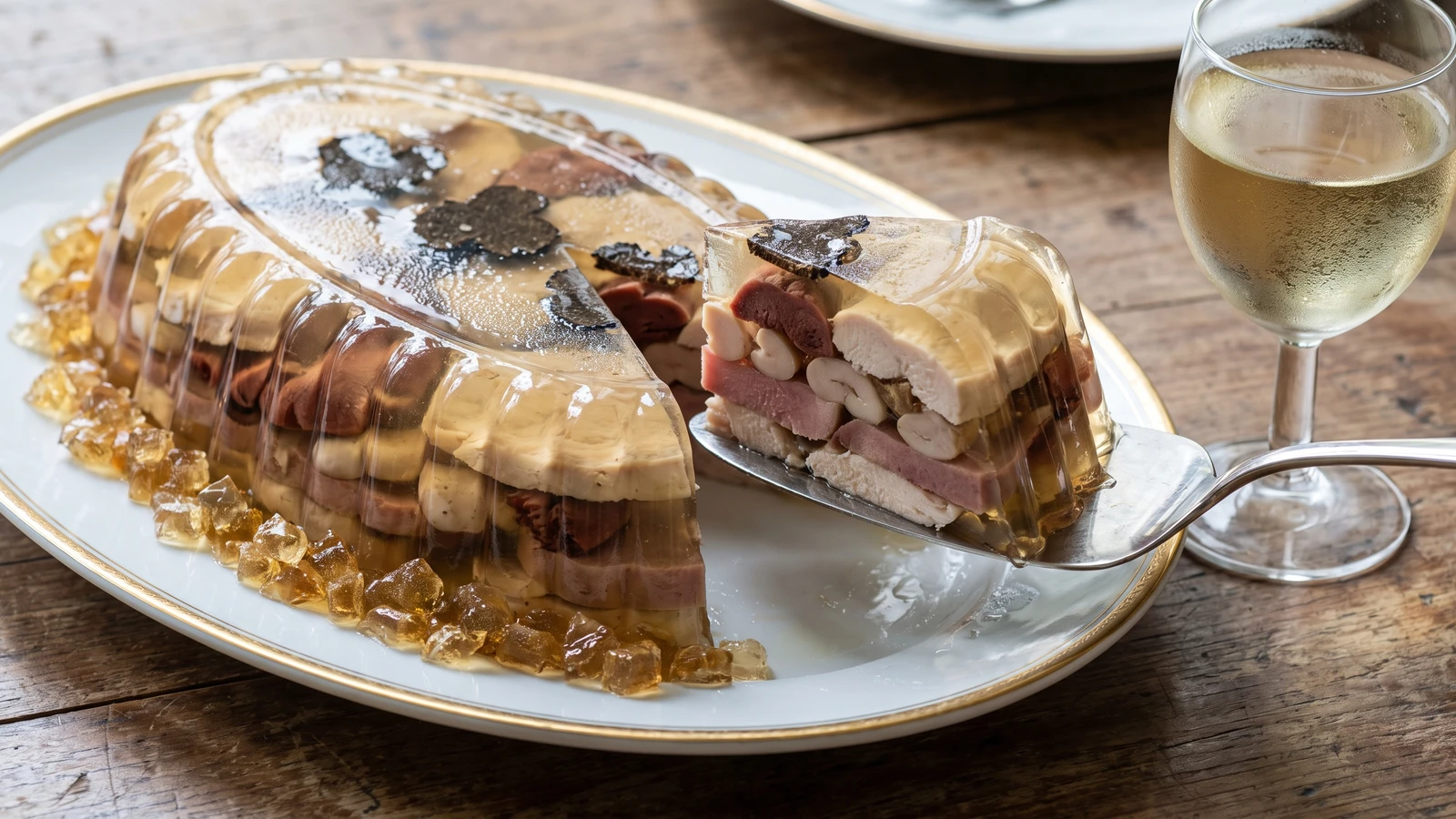
Jewel-clear layers of chicken, truffle, salted tongue, and two colours of chaud-froid reveal the patient rule of aspic: every layer must set before the next one enters the mould.
Aspic de Poulet à la Gauloise (Gaulish-style chicken in savory jelly) teaches patience made visible. Its one true rule is simple: every layer must set before the next touches it. Rush that, and the combs, kidneys, tongue, and chicken drift into a muddle; respect it, and the mould turns out like stained glass.
The original entry assumed a saucier on staff, stock never off the fire, a cold room full of broken ice, and a brigade whose salamander stood ready for other dishes while this one was assembled. At home, the honest equivalents are clear chicken stock strengthened with measured gelatin, two small roux-bound chaud-froid sauces (cooled coating sauces), a tray of ice, a refrigerator, and a 1½-litre mould. No salamander has a job in this cold dish. The brigade portion becomes four generous servings. One cook, one stove, one evening, then a night's chill.
Cleaning raw cocks' combs and cocks' kidneys and clarifying stock all day are upstream brigade scaffolding, so begin with fully cooked specialty offal and good clear stock. Clothing the mould, fixing the truffle decoration, coating the garnishes in brown and white chaud-froid, and waiting between layers are the dish itself; none of that goes. Keep the jelly cool enough not to melt what lies beneath, but fluid enough to pour. That temperature is the step that matters most.
Aspic de Poulet à la Gauloise belongs to the formal cold-buffet repertoire of Parisian grand cuisine, where the garde-manger, the cold kitchen, turned clear poultry jelly and prepared garnishes into a dish that could wait calmly for service. Gauloise is a decorative national title, reinforced by the cockerel garnishes, not evidence of an ancient Gallic recipe; the truffle patterns, two colours of chaud-froid, combs, kidneys, and tongue proclaim the abundance and precision of the grand kitchen. As ornamented moulds and dependable household refrigeration reached bourgeois tables, smaller aspics followed, while the discipline of setting every layer separately remained.
Quantity
6½ cups (1.54 L / 1540 g)
divided
Quantity
¾ cup (180 ml / 180 g)
well reduced
Quantity
3 tablespoons plus 1 teaspoon (50 ml / 32 g)
divided
Quantity
1 teaspoon (5 ml / 3 g)
Quantity
2 large (about 1 lb / 450 g)
Quantity
8 (about 5½ oz / 160 g)
fully cooked, cleaned, rinsed, and patted dry
Quantity
12 (about 4 oz / 120 g)
fully cooked, rinsed, and patted dry
Quantity
6 oz (170 g)
sliced ⅛ inch (3 mm) thick
Quantity
1 small (about 1 oz / 30 g)
drained and thinly sliced
Quantity
2 tablespoons (30 ml / 28 g)
divided
Quantity
2 tablespoons (30 ml / 16 g)
divided
Quantity
¼ cup (60 ml / 60 g)
Quantity
2 teaspoons (10 ml / 12 g)
divided
Quantity
¼ teaspoon (1 ml / 0.5 g)
Quantity
4 cups (960 ml / 900 g)
for setting the layers
Quantity
1 referenced method (No. 916)
for clothing the mould and fixing its decoration
| Ingredient | Quantity |
|---|---|
| clear, lightly seasoned chicken stockdivided | 6½ cups (1.54 L / 1540 g) |
| dark roasted chicken stockwell reduced | ¾ cup (180 ml / 180 g) |
| powdered gelatindivided | 3 tablespoons plus 1 teaspoon (50 ml / 32 g) |
| powdered gelatin for rescue (optional) | 1 teaspoon (5 ml / 3 g) |
| boneless, skinless chicken breast fillets | 2 large (about 1 lb / 450 g) |
| cocks' combsfully cooked, cleaned, rinsed, and patted dry | 8 (about 5½ oz / 160 g) |
| cocks' kidneysfully cooked, rinsed, and patted dry | 12 (about 4 oz / 120 g) |
| cooked salted beef tonguesliced ⅛ inch (3 mm) thick | 6 oz (170 g) |
| preserved black truffledrained and thinly sliced | 1 small (about 1 oz / 30 g) |
| unsalted butterdivided | 2 tablespoons (30 ml / 28 g) |
| plain flourdivided | 2 tablespoons (30 ml / 16 g) |
| heavy cream | ¼ cup (60 ml / 60 g) |
| fine sea saltdivided | 2 teaspoons (10 ml / 12 g) |
| ground white pepper | ¼ teaspoon (1 ml / 0.5 g) |
| icefor setting the layers | 4 cups (960 ml / 900 g) |
| Another Method of Preparing Aspics de Filets de Solesfor clothing the mould and fixing its decoration | 1 referenced method (No. 916) |
Clear a level refrigerator shelf before beginning. Set the ornamented mould in a shallow pan packed with ice, and chill a parchment-lined tray for the coated garnishes. Keep the stock, combs, kidneys, tongue, and truffle cold until each is needed; aspic rewards order, and warm garnishes weaken every layer around them.
Bring 2 cups (475 ml / 475 g) of the clear chicken stock to a bare tremble in a small covered saucepan and season it with about ½ teaspoon of the salt. Add the chicken breasts, cover, and poach without boiling until their thickest part reaches 165°F (74°C), about 14 to 18 minutes. Cool the chicken promptly, then slice it across the grain into neat ⅛-inch (3 mm) collops, thin oval slices about the size of the tongue pieces. Strain and save the poaching stock for another use; the untouched stock will give the aspic greater clarity.
Measure 4 cups (950 ml / 950 g) of the remaining clear stock. Sprinkle 8 teaspoons (40 ml / 26 g) of the gelatin over ¾ cup (180 ml / 180 g) of that cold stock and leave it until fully swollen, about 10 minutes. Heat the remaining stock until hot but not boiling, whisk in the bloomed gelatin, and season until it tastes slightly more assertive than a hot broth; cold quiets salt. Strain through damp muslin or a coffee filter. Pour 1 cup (240 ml / 240 g) into a shallow pan for the croûtons and chill until firm, keeping the rest barely fluid over a bowl of lukewarm water. Test a spoonful in the refrigerator for 5 minutes: it should cut cleanly and stand without sagging. If it remains soft, ça se rattrape. Rewarm the batch, bloom the optional teaspoon of gelatin in a tablespoon of cold stock, dissolve it into the jelly, and test again.
Bloom 1 teaspoon (5 ml / 3 g) gelatin in 1 tablespoon (15 ml / 15 g) of the cold dark stock. Melt 1 tablespoon (15 ml / 14 g) butter in a small saucepan, stir in 1 tablespoon (15 ml / 8 g) flour, and cook the roux slowly until it reaches a deep hazelnut brown without scorching. Whisk in the remaining dark stock a little at a time, then simmer gently until the sauce naps the back of a spoon. Remove it from the heat, dissolve in the bloomed gelatin, strain, and cool over ice until thick but still flowing. Dip each dry cocks' comb to coat it in a thin, even brown layer and set it on the chilled tray. If the sauce slides off, it is too warm; chill it briefly and dip again. If it sets in the pan, warm it over the lowest heat until smooth. Ça se rattrape.
Bloom the remaining 1 teaspoon (5 ml / 3 g) gelatin in 1 tablespoon (15 ml / 15 g) of cold clear stock. Melt the remaining tablespoon of butter, stir in the remaining tablespoon of flour, and cook this roux for 2 minutes without letting it colour. Whisk in the remaining ½ cup (120 ml / 120 g) clear stock, simmer until smooth and lightly thickened, then add the cream and a restrained pinch each of salt and white pepper. Remove the pan from the heat, dissolve in the bloomed gelatin, strain, and cool to the same flowing coating consistency as the brown chaud-froid. Coat the dry cocks' kidneys evenly, place them on the chilled tray, and refrigerate both garnishes until their coatings are firm.
Cut the salted tongue into tidy ovals about 1½ inches (4 cm) long, keeping the slices uniformly thin. Cut the truffle into small diamonds, crescents, or rounds for the bottom and sides of the mould. Lay the chicken collops, tongue ovals, brown-coated combs, white-coated kidneys, and truffle pieces on separate cold plates so the pattern can be built without hesitation.
Use the clothing technique in Another Method of Preparing Aspics de Filets de Soles (No. 916). Pour about ½ cup (120 ml / 120 g) of fluid aspic into the ice-cold mould, rock and turn it until the bottom and sides carry a thin, even coat, then pour the excess back into the bowl. Chill until tacky. Arrange the truffle pattern over the bottom and sides, fixing each piece with a drop of aspic, and chill again until secure. Cover the decoration with a ¼-inch (6 mm) layer of aspic and let it set completely before proceeding. This protective layer keeps the pattern in place when the heavier garnishes arrive.
The order is the architecture: aspic, chicken collops, aspic, brown chaud-froid-coated combs, aspic, white chaud-froid-coated kidneys, aspic, salted tongue ovals, then a final seal of aspic. Arrange each solid layer neatly without pressing it into the jelly beneath, spoon over just enough fluid aspic to cover it, and return the mould to the ice or refrigerator until that layer is firm before adding the next. Keep the unused garnishes cold and the jelly cool but flowing. If a layer floats or tears, stop, chill the mould flat, remove any loose piece, and seal the surface with 2 tablespoons of jelly before continuing. Never pour warm jelly onto a half-set layer; that is how a pattern becomes soup.
Finish with a level ½-inch (1 cm) cap of aspic and refrigerate the filled mould for at least 6 hours, preferably overnight. To turn it out, dip the mould in warm water for 5 seconds, dry the outside, cover it with the serving platter, and invert both together. Hold firmly and give one clean downward shake. If it does not release, return only the mould to the warm water for 2 seconds and try again. Do not pry at the edge. If the outer jelly softens, return the unmoulded aspic to the refrigerator for 10 minutes and it will recover.
Turn the shallow sheet of reserved aspic onto a cold board and cut it into diamonds, triangles, and small crescents. These are the croûtons of the glossary, ornamental pieces of jelly rather than fried bread. Arrange them generously around the unmoulded aspic just before serving. Cut the aspic with a thin knife dipped in warm water and wiped dry between slices, revealing every distinct layer. À table!
1 serving (about 675g)
Culinary guides, cultural storytelling, and the editorial depth that makes cooking meaningful.
Discover Culinary ExplorerChef Juliette
John Dory has the delicacy of sole and the firmness of turbot. A light flouring, a quick butter sauté, and nut-brown beurre noisette show exactly why looks never mattered.

Chef Juliette
Fresh haddock proves its delicacy in the meunière pan: a fine flour crust, moist pearly flakes, and beurre noisette sharpened with lemon and parsley, ready from one skillet in half an hour.

Chef Juliette
Éperlans à l’Anglaise turns small fish into a lesson in disciplined coating: boned smelts under a close, crisp crumb, pan-fried in clarified butter and finished with bright, half-melted maître d’hôtel butter.

Chef Juliette
Tiny smelts, shallot, mushrooms, white wine, gratin sauce, and fine bread raspings meet a fierce oven, where the fish must turn tender in the same breath the buttered crust bronzes.