
Chef Juliette
John Dory (St. Pierre)
John Dory has the delicacy of sole and the firmness of turbot. A light flouring, a quick butter sauté, and nut-brown beurre noisette show exactly why looks never mattered.
A cooking platform built around craft, culture, and the stories behind what we eat.
Created by Chef Juliette
Based on No. 1704, Ailerons de Poulet Lady Wilmer, from Le Guide Culinaire (1907) by Auguste Escoffier
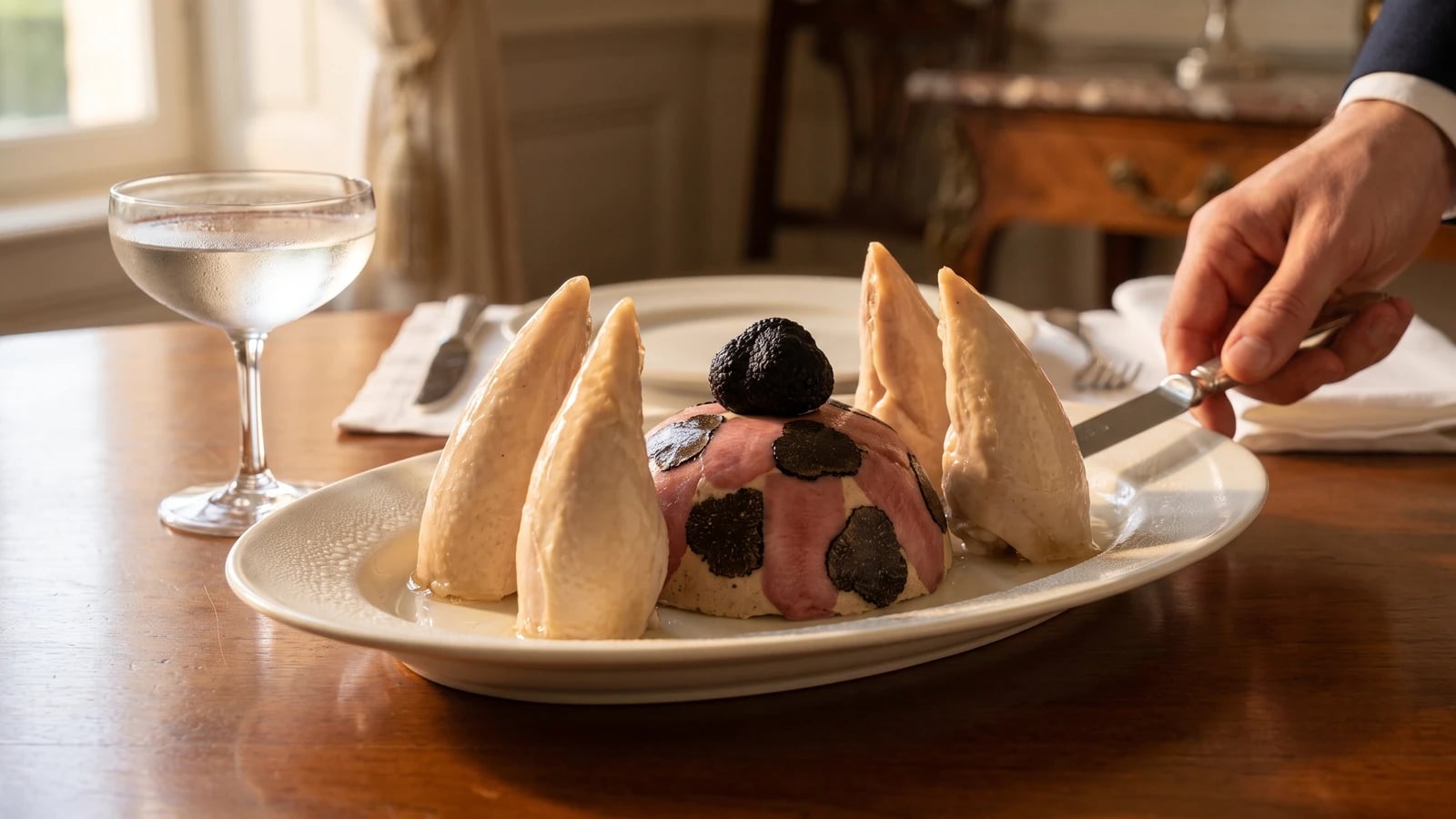
An architectural cold entrée of just-poached wing suprêmes, silken leg mousse, clear aspic, black truffle, and tongue, scaled from three birds to four plates without surrendering its upright crown.
Ailerons de Poulet Lady Wilmer (poached wing-on chicken breast fillets around a dome of leg mousse) teaches the cold side of the classical grammar: cook the breast only until succulent, give the leg a second life as mousse de volaille, a light molded chicken cream, then let gelée, a clear savory jelly, hold the architecture. The one true thing is temperature. Every piece and every spoonful of gelée must be cold enough to set cleanly, but not so cold that it clots before you place it.
The source formula set three whole spring chickens before a brigade, with a garde-manger, the cold-kitchen cook, ready to carve them after poaching, a stockpot never off the fire, clarified jelly at hand, cold-room shelves, and a hatelet, an ornamental skewer, waiting in a drawer. This isn't a saucier's reduction or a salamander's browning job; the garde-manger owns it. Your kitchen gets two small chickens for four servings, a thermometer, reduced unsalted stock strengthened with measured gelatin, a refrigerator, and a plain cocktail pick in place of the hatelet. The birds are jointed before poaching so the suprêmes and legs can leave the liquid at their proper temperatures. That is the one sequence changed, and it protects the source's central instruction that the suprêmes be just cooked.
Egg-white clarification and an elaborate metal hatelet were brigade scaffolding, so they can go. The tender suprêmes, leg mousse, glossy gelée, alternating truffle and tongue, and upright wing points are the dish and must stay. One cook, one stove, one evening, with the refrigerator doing the patient work. Test the gelée on a cold saucer before assembly; if it cannot hold there, it cannot hold a wing, and that test is the step that decides everything.
Ailerons de Poulet Lady Wilmer belongs to the formal cold buffet of Parisian cuisine classique, where poached poultry, molded mousses, aspic, truffle, and cured tongue were arranged as composed entrées rather than served as separate preparations. The English honorific inside a French title reflects how named dishes traveled among cosmopolitan banquet and private-house tables while retaining French garde-manger technique. In this formula, ailerons does not mean a plate of bare wing tips: the architecture depends on trimmed, wing-attached suprêmes set point-up around the mousse.
Quantity
2, 2½ to 3 pounds each (1.1 to 1.35 kg each)
butchered into 4 wing-on suprêmes and 4 leg quarters
Quantity
8 cups (1.9 L / 1.9 kg)
Quantity
2 teaspoons (10 ml / 12 g)
divided
Quantity
½ teaspoon (2.5 ml / 1 g)
Quantity
4 envelopes (3 tablespoons plus 1 teaspoon / 28 g)
use 3 envelopes initially and reserve 1 for correction
Quantity
½ cup (120 ml / 120 g)
Quantity
¾ cup (180 ml / 180 g)
Quantity
½ cup (120 ml / 85 g)
finely chopped
Quantity
2 small truffles (about 2 oz / 55 g total)
drained, with the best one reserved whole and the remainder finely chopped
| Ingredient | Quantity |
|---|---|
| small spring chickensbutchered into 4 wing-on suprêmes and 4 leg quarters | 2, 2½ to 3 pounds each (1.1 to 1.35 kg each) |
| unsalted chicken stock | 8 cups (1.9 L / 1.9 kg) |
| fine sea saltdivided | 2 teaspoons (10 ml / 12 g) |
| finely ground white pepper | ½ teaspoon (2.5 ml / 1 g) |
| unflavored powdered gelatinuse 3 envelopes initially and reserve 1 for correction | 4 envelopes (3 tablespoons plus 1 teaspoon / 28 g) |
| cold water | ½ cup (120 ml / 120 g) |
| cold heavy cream | ¾ cup (180 ml / 180 g) |
| cooked cured ox tongue, preferably langue écarlatefinely chopped | ½ cup (120 ml / 85 g) |
| whole black trufflesdrained, with the best one reserved whole and the remainder finely chopped | 2 small truffles (about 2 oz / 55 g total) |
Ask the butcher to leave the first wing joint attached to each breast, scrape the exposed wing bones clean, and give you four neat suprêmes. Remove the skin for an even ivory surface. Keep one leg quarter from each chicken for the mousse, matching the source's proportion of one leg per bird; wrap and refrigerate the other two legs and the carcasses for another meal. Jointing before poaching is the sole procedural change. It lets each cut stop cooking when it should instead of asking the delicate breast and firm leg to obey one clock.
Pour the stock into a snug 5-quart pot and bring it to 180°F to 185°F (82°C to 85°C), a surface that barely stirs. Add the two leg quarters and poach for 15 minutes, then lower in the four suprêmes. Hold the liquid in the same range, never at a rolling boil, until the thickest part of each breast reaches 160°F to 162°F (71°C to 72°C), about 12 to 18 minutes. Lift each suprême out as it reaches temperature, cover it for 5 minutes, and confirm that it reaches 165°F (74°C); if it does not, return it to the hot liquid briefly. Continue poaching the legs until they reach at least 175°F (79°C) and yield easily at the joint. Arrange everything in one layer on a rack, cool for no more than 20 minutes, then refrigerate uncovered until thoroughly cold.
Strain the poaching liquor through a damp fine cloth into a clean saucepan, bring it to a full boil, and reduce it to 3 cups (720 ml / about 720 g), skimming away fat and froth. Sprinkle 3 envelopes of gelatin over the cold water and leave them for 5 minutes to bloom. Take the reduced liquor off the heat, whisk in the bloomed gelatin until completely dissolved, then season with half the salt and a small pinch of white pepper. Spoon a little onto a chilled saucer and refrigerate it for 5 minutes. It should set into a tender, clear jelly that holds when nudged. If it remains loose, rewarm 1 cup of gelée and dissolve in reserved gelatin, bloomed first with a spoonful of cold water, 1 teaspoon at a time; if it is rubbery, rewarm it and add stock by the tablespoon. Ça se rattrape.
Measure ¾ cup (180 ml / about 180 g) of warm liquid gelée for the mousse and keep it fluid. Set the remaining gelée over a bowl of ice water, stirring until it reaches the consistency of raw egg white. Trim the cold suprêmes into matching shapes, set them on a rack over a tray, and brush each with a thin coat of gelée. Chill for 5 minutes, then repeat twice until the meat gleams beneath a smooth clear skin. If the gelée runs straight off, the meat or jelly is too warm; chill both and try again. If it sets in ridges, stand the bowl briefly in warm water and stir until smooth.
Strip the skin, bones, tendons, and gristle from the cold leg quarters; you should have about 10 ounces (285 g) of cooked meat. Purée it in a food processor with the reserved ¾ cup of liquid gelée, the remaining salt, and the white pepper until smooth, then press the mixture through a fine sieve into a bowl set over ice. Whip the cold cream to soft peaks and fold it into the chicken purée in three additions. Taste a small chilled spoonful and correct the seasoning. If the purée begins setting before the cream is folded in, stand the bowl in lukewarm water and stir just until supple, then return it to the ice before continuing. Rinse a 3-cup dome mold with cold water, shake out the excess, fill it with the mousse, tap gently to release air pockets, and smooth the top. Cover and refrigerate until firmly set, at least 3 hours.
Keep the chopped tongue and chopped truffle in separate chilled bowls so their colors remain distinct. Dry the reserved whole truffle carefully, brush it with a thin coat of half-set gelée, chill for 5 minutes, and repeat once. Chill the serving platter as well. The source asks for alternating truffle and tongue, not a mixed confetti, so resist the urge to combine them.
Dip the outside of the mousse mold into warm water for 5 seconds, dry it, and invert it onto the cold platter. If the dome does not release, wrap the mold briefly in a warm towel and try again; do not shake it. Arrange the four glazed suprêmes at equal intervals around the dome, their cut sides resting against the mousse and their scraped wing points directed upward. Dab half-set gelée between each suprême and the mousse to fix it in place. If a piece slips, brace it with a folded strip of parchment and chill for 10 minutes before continuing. Cover the dome's upper surface and fill the gaps between the suprêmes with alternating panels of chopped truffle and chopped tongue, pressing them lightly into a fresh brush of gelée.
Pierce the glazed whole truffle with a short plain cocktail pick, your home hatelet, and set it upright at the center of the dome. Brush any exposed mousse with one final veil of gelée, remove the parchment supports once the arrangement holds, and refrigerate for at least 45 minutes. Keep the dish properly chilled, then take it out 15 minutes before serving so the mousse loses its refrigerator stiffness. Cut four sections, giving each guest one suprême, a generous wedge of mousse, and both truffle and tongue. À table!
1 serving (about 600g)
Culinary guides, cultural storytelling, and the editorial depth that makes cooking meaningful.
Discover Culinary ExplorerChef Juliette
John Dory has the delicacy of sole and the firmness of turbot. A light flouring, a quick butter sauté, and nut-brown beurre noisette show exactly why looks never mattered.

Chef Juliette
Fresh haddock proves its delicacy in the meunière pan: a fine flour crust, moist pearly flakes, and beurre noisette sharpened with lemon and parsley, ready from one skillet in half an hour.

Chef Juliette
Éperlans à l’Anglaise turns small fish into a lesson in disciplined coating: boned smelts under a close, crisp crumb, pan-fried in clarified butter and finished with bright, half-melted maître d’hôtel butter.

Chef Juliette
Tiny smelts, shallot, mushrooms, white wine, gratin sauce, and fine bread raspings meet a fierce oven, where the fish must turn tender in the same breath the buttered crust bronzes.