
Chef Juliette
John Dory (St. Pierre)
John Dory has the delicacy of sole and the firmness of turbot. A light flouring, a quick butter sauté, and nut-brown beurre noisette show exactly why looks never mattered.
A cooking platform built around craft, culture, and the stories behind what we eat.
Created by Chef Juliette
Based on No. 1703, Ailerons de Poulet à la Carmélite, from Le Guide Culinaire (1907) by Auguste Escoffier
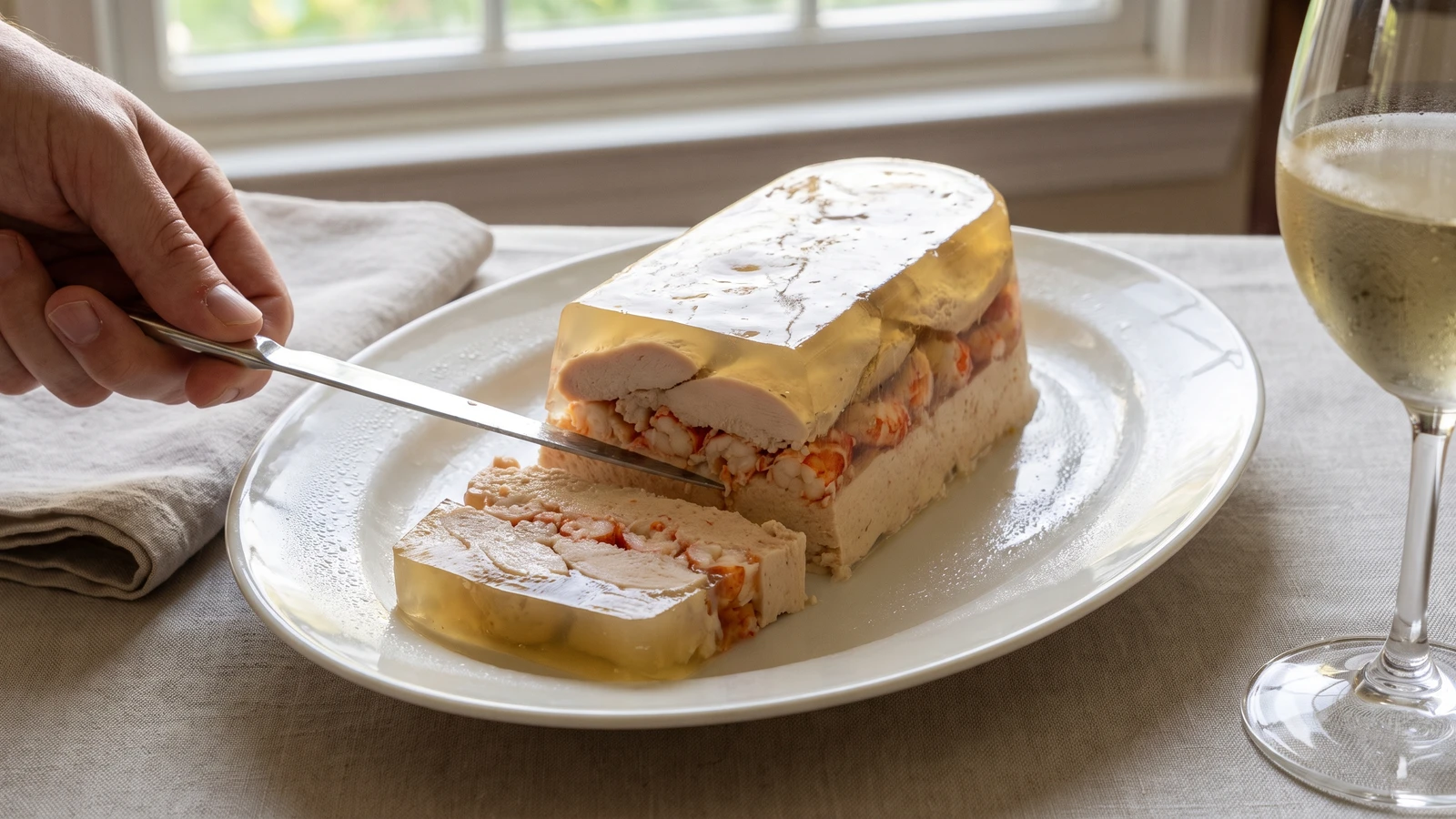
A composed cold timbale of tender chicken suprêmes, delicate crayfish mousse, coral tails, and savory jelly, built by temperature and timing so every layer holds cleanly when unmolded.
Ailerons de Poulet à la Carmélite (chilled wing-bone chicken suprêmes with crayfish mousse) teaches one exact lesson: in cold molded cookery, temperature is structure. The mousse must be firm enough to carry the chicken, and the jelly must be half-set before it is poured. Warm jelly melts the foundation; liquid jelly lets the careful arrangement swim.
The original assumed a whole chicken poached à la Reine, a saucier with succulent chicken jelly ready, a separate crayfish preparation, and a timbale sized for two suprêmes. Your home equivalent is four butcher-prepared airline breasts, good unsalted stock fortified by poaching and reduction, and two one-quart molds. The whole birds became airline breasts because they preserve the attached humerus without leaving one cook with piles of surplus meat; two molds preserve the original opposing pair while feeding four. Elaborate stock clarification and intricate carving are brigade scaffolding and can go. The chilled crayfish mousse, bared bones, opposing suprêmes, row of tails, and savory jelly are the dish, and they stay.
One cook, one stove, one evening. Watch the jelly rather than the clock: it must pour like light syrup, cold enough not to melt the mousse but loose enough to settle around every curve. That moment decides the timbale.
Ailerons de Poulet à la Carmélite belongs to the Parisian grande cuisine repertory of cold entrées, where poultry, crustacean mousse, and aspic were composed in a timbale for the formal table. Carmélite is a classical style name here, not a claim on one French region; the crayfish preparation and molded service place it within the national canon. The easily missed point is anatomical: these ailerons are not chopped chicken wings, but skinned suprêmes presented with the humerus cleared and left attached.
Quantity
4 (about 5 oz / 140 g each; 1¼ lb / 560 g total)
Quantity
6 cups (1.4 L / 1.4 kg)
Quantity
2 (7 oz / 200 g total)
divided and sliced
Quantity
1 (3½ oz / 100 g)
sliced and rinsed
Quantity
1 rib (2 oz / 60 g)
sliced
Quantity
1 (4 oz / 115 g)
quartered
Quantity
1
Quantity
2 teaspoons (10 ml / 12 g)
divided
Quantity
½ teaspoon (2.5 ml / 1 g)
divided
Quantity
32 (about 3 lb / 1.36 kg)
rinsed
Quantity
2 tablespoons (30 ml / 28 g)
Quantity
2 (3 oz / 85 g)
sliced
Quantity
1 tablespoon (15 ml / 16 g)
Quantity
¼ cup (60 ml / 56 g)
Quantity
1 cup (240 ml / 240 g)
Quantity
⅛ teaspoon (0.6 ml / 0.25 g)
Quantity
1½ cups (360 ml / 360 g)
Quantity
1 tablespoon (15 ml / 9 g)
Quantity
3 tablespoons (45 ml / 45 g)
Quantity
1 tablespoon plus ½ teaspoon (17.5 ml / 11 g)
divided
Quantity
⅓ cup plus 1 tablespoon (95 ml / 95 g)
divided
| Ingredient | Quantity |
|---|---|
| small skin-on airline chicken breasts with the first wing bone attached | 4 (about 5 oz / 140 g each; 1¼ lb / 560 g total) |
| unsalted chicken stock | 6 cups (1.4 L / 1.4 kg) |
| medium carrotsdivided and sliced | 2 (7 oz / 200 g total) |
| small leek, white and pale green parts onlysliced and rinsed | 1 (3½ oz / 100 g) |
| celerysliced | 1 rib (2 oz / 60 g) |
| small yellow onionquartered | 1 (4 oz / 115 g) |
| bouquet garni | 1 |
| fine saltdivided | 2 teaspoons (10 ml / 12 g) |
| ground white pepperdivided | ½ teaspoon (2.5 ml / 1 g) |
| medium raw whole crayfish or crawfishrinsed | 32 (about 3 lb / 1.36 kg) |
| unsalted butter | 2 tablespoons (30 ml / 28 g) |
| medium shallotssliced | 2 (3 oz / 85 g) |
| tomato paste | 1 tablespoon (15 ml / 16 g) |
| Cognac | ¼ cup (60 ml / 56 g) |
| dry white wine | 1 cup (240 ml / 240 g) |
| cayenne pepper | ⅛ teaspoon (0.6 ml / 0.25 g) |
| cold heavy cream | 1½ cups (360 ml / 360 g) |
| unflavored powdered gelatin for the crayfish mousse | 1 tablespoon (15 ml / 9 g) |
| cold water for the crayfish mousse | 3 tablespoons (45 ml / 45 g) |
| unflavored powdered gelatin for the chicken jellydivided | 1 tablespoon plus ½ teaspoon (17.5 ml / 11 g) |
| cold water for the chicken jellydivided | ⅓ cup plus 1 tablespoon (95 ml / 95 g) |
Combine the chicken stock, one carrot, the leek, celery, onion, bouquet garni, 1 teaspoon of the salt, and half the white pepper in a wide pot. Bring it to a bare simmer for 15 minutes, then lower in the chicken suprêmes, breast fillets with their first wing bones attached. Hold the liquid between 170°F and 180°F (77°C and 82°C), with only an occasional tremble, until the thickest part of each breast reaches 160°F (71°C), about 18 to 22 minutes. Lift the chicken onto a rack; the temperature will rise as it rests. Boiling tightens the meat, so if the pot becomes lively, pull it off the heat until it settles.
When the chicken is cool enough to handle, remove the skin without tearing the flesh. With a small knife, scrape every shred of meat and tendon from each humerus while leaving the breast and bone joined. This clean white handle is part of the Carmélite presentation. If a suprême tears, ça se rattrape: press it back into shape and place that side against the mousse, where the jelly will hold it. Cover and chill the chicken. Strain the poaching liquid, reserve 1 cup (240 ml / 240 g) for the crayfish essence, and keep the remainder for the jelly.
Melt the butter in a wide sauté pan. Add the remaining carrot and the shallots, cooking gently until softened but not browned. Raise the heat, add the crayfish, and turn them through the butter until their shells color red. Take the pan off the flame before adding the Cognac, then return it to the heat and let the liquor reduce by half. Stir in the tomato paste, add the wine, cover, and cook until the tails are opaque and just firm, about 5 minutes. This aromatic shell-on cooking is what cooked as for bisque means here; the tails take their character before they are peeled.
Lift out the crayfish and let them cool briefly. Shell and devein the tails, reserving the 16 neatest whole tails for the two central rows. Pick the remaining tail and claw meat for the mousse. Return all heads and shells to the pan, crush them firmly with a wooden spoon, and add the reserved cup of chicken poaching liquid. Simmer gently for 20 minutes, then strain through a fine sieve, pressing the shells well. Reduce the liquid to ½ cup (120 ml / 120 g). It should smell deeply of crayfish and lightly coat a spoon, not taste scorched or aggressively salty.
Bloom the mousse gelatin in its 3 tablespoons of cold water for 5 minutes. Purée the picked crayfish meat with the warm reduced essence until smooth, then pass it through a fine sieve. Stir in the bloomed gelatin, the cayenne, and enough salt and white pepper to taste clearly when cold. Set the bowl over ice and stir until the mixture is cool and just beginning to thicken. Whip the cream to soft folds and fold it through in three additions. If the crayfish base sets into strands before the cream goes in, warm the bowl over barely warm water only until fluid. Ça se rattrape.
Rinse two straight-sided 1-quart (950 ml) timbale molds or deep bowls with cold water and shake them dry. Divide the mousse between them, filling each mold halfway, and level the surfaces. Chill for 25 to 30 minutes, until the mousse holds a light fingertip impression without feeling hard. If it becomes fully firm, roughen the surface lightly with a fork before assembly so the jelly can bind the layers.
Reduce the remaining strained poaching liquid to 3½ cups (840 ml / 840 g), skimming away any fat. Reserve ½ cup (120 ml / 120 g) for adjustment. Bloom 1 tablespoon of the jelly gelatin in ⅓ cup of cold water for 5 minutes, then dissolve it in the hot remaining stock without boiling. Taste boldly for salt and white pepper, because chilling mutes both, and strain through a damp cloth or coffee filter. Brush the cold suprêmes with two thin coats of jelly, chilling briefly between coats. Set the rest over ice and stir until it pours like light syrup. If it sets too firmly, whisk in warm reserved stock a spoonful at a time; if a chilled spoonful remains liquid after 5 minutes, bloom the reserved ½ teaspoon gelatin in the remaining tablespoon of water and stir it into the jelly.
Set two glazed suprêmes opposite one another on each mousse foundation, with their cleaned humerus bones pointing toward opposite sides of the mold. Arrange eight trimmed crayfish tails in a straight row between each pair. Spoon the half-set jelly slowly around and over the arrangement until everything is covered. The jelly must be cold and syrupy now. If a breast or tail begins to float, stop after a shallow anchoring layer, chill the mold for 8 minutes, then add the remaining jelly. Nothing is lost, and the geometry stays where you put it.
Refrigerate the timbales for at least 2 hours, until the jelly is fully set through the center. To unmold, dip each mold in warm water for 5 seconds, dry it, cover with a chilled serving plate, and invert decisively. If it resists, repeat for 2 seconds rather than warming it until the edges melt. Cut each timbale cleanly in half with a thin knife dipped in warm water, giving every guest one suprême, crayfish mousse, tails, and jelly. Serve well chilled. À table!
1 serving (about 410g)
Culinary guides, cultural storytelling, and the editorial depth that makes cooking meaningful.
Discover Culinary ExplorerChef Juliette
John Dory has the delicacy of sole and the firmness of turbot. A light flouring, a quick butter sauté, and nut-brown beurre noisette show exactly why looks never mattered.

Chef Juliette
Fresh haddock proves its delicacy in the meunière pan: a fine flour crust, moist pearly flakes, and beurre noisette sharpened with lemon and parsley, ready from one skillet in half an hour.

Chef Juliette
Éperlans à l’Anglaise turns small fish into a lesson in disciplined coating: boned smelts under a close, crisp crumb, pan-fried in clarified butter and finished with bright, half-melted maître d’hôtel butter.

Chef Juliette
Tiny smelts, shallot, mushrooms, white wine, gratin sauce, and fine bread raspings meet a fierce oven, where the fish must turn tender in the same breath the buttered crust bronzes.