
Chef Juliette
Poularde à la Carmélite
Poularde à la Carmélite turns poached chicken, crayfish mousse, truffle, and melting aspic into a cold Parisian centerpiece. The mastery lies in coating while the sauce still flows smoothly.
A cooking platform built around craft, culture, and the stories behind what we eat.
Created by Chef Juliette
Based on No. 1702, Terrine de Poularde en Conserve, from Le Guide Culinaire (1907) by Auguste Escoffier
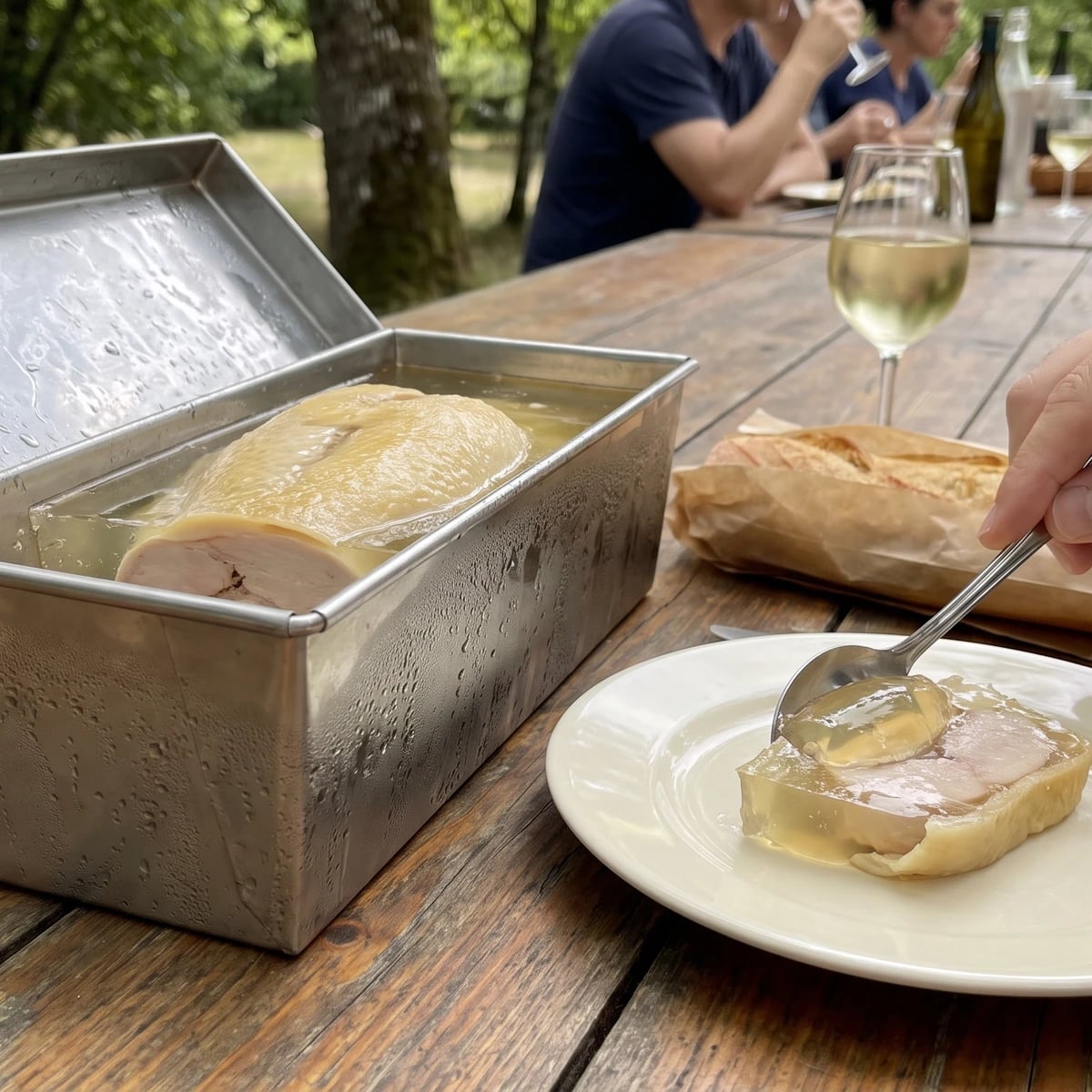
Terrine de Poularde en Conserve keeps every drop of the bird where it belongs: sealed close, cooked gently, then inverted so clear jelly coats the breast and golden fat settles beneath.
Terrine de Poularde en Conserve (sealed poularde terrine) teaches the virtue of containment. A whole poularde cooks in a vessel barely larger than itself, with no added stock to dilute its character; the enclosed juices become clear jelly, and the bird seasons its own keeping liquor. The one true thing is the fit. Too much empty space gives you a little chicken stranded in a puddle rather than a breast closely coated in jelly.
The original entry assumed a soldered metal boîte that could be submerged without leaking, equipment belonging to a professional preserving kitchen rather than an ordinary cupboard. At home, a snug lidded stainless-steel terrine sits in water nearly to its rim, with the lid seam kept above the bath. The soldered seam is scaffolding and can go. The tight enclosure, the full two-hour cooking, and the upside-down cooling are the dish and must stay. One cook, one stove, one evening's work, then a night in the cold.
Because the supplied entry names no stuffing, aromatic, sauce, or separate preparation, this version invents none. Here, preparing the poularde means dressing it for cooking, seasoning it, and trussing it compactly. A poularde, a fattened young hen, gives more skin, fat, and gelatin than a lean roasting bird, but a compact good chicken will answer honestly.
When the marked lid comes off, the breast should sit beneath pale, trembling jelly while the golden fat has gathered at the far base. Before touching the heat, make certain the bird fits tightly and the marked top is unmistakable; that fit and that mark decide the finished terrine.
Terrine de Poularde en Conserve belongs to the Parisian garde-manger and bourgeois cold table, where a prepared poularde could travel from kitchen to buffet or picnic without surrendering its juices. Its boîte was a soldered metal container made just large enough for the bird; cooling it upside down carried the lighter fat toward the eventual base while the gelatin-rich liquor set around the breast. The word conserve describes that sealed method, but a home water bath does not make poultry safe for pantry storage, so this version must remain refrigerated.
Quantity
1 whole (about 4 lb / 1.8 kg)
ready to cook, giblets removed
Quantity
4 teaspoons (20 ml / 22 g)
Quantity
½ teaspoon (2.5 ml / 1 g)
Quantity
4 quarts (3.8 liters / 3.8 kg), plus more as needed
kept boiling for the water bath
| Ingredient | Quantity |
|---|---|
| whole poularde or compact roasting henready to cook, giblets removed | 1 whole (about 4 lb / 1.8 kg) |
| fine sea salt | 4 teaspoons (20 ml / 22 g) |
| ground white pepper | ½ teaspoon (2.5 ml / 1 g) |
| waterkept boiling for the water bath | 4 quarts (3.8 liters / 3.8 kg), plus more as needed |
Check that the cavity is clean, remove any remaining feather stubs, and pat the bird thoroughly dry; do not rinse raw poultry. Season the cavity and skin evenly with the salt and white pepper. Fold the wing tips beneath the shoulders, pull the legs close against the body, and tie them firmly with kitchen twine. The bird must be compact enough to fit the terrine without chopping through its bones or crushing the breast.
Set the trussed poularde into a 2½-quart (2.4-liter) lidded stainless-steel terrine, breast uppermost and facing the lid. It should fit closely on every side while the lid still closes without pressure. Add no water or stock. Clamp or fasten the lid, wrap the upper seam with two tight layers of heavy foil, and tie a small folded foil tag to the lid handle to mark the top. You will need that mark after the terrine has spent the night upside down.
Place a rack or folded kitchen towel in the bottom of a deep stockpot and stand the sealed terrine on it, marked top upward. Pour boiling water around the mold until it reaches about 1 inch (2.5 cm) below the lid seam, then cover the stockpot. The original soldered tin could be covered completely; a home terrine cannot promise the same seal, so this high water bath gives surrounded heat without inviting bath water into the bird. That equipment change protects the original intent rather than changing the cooking.
Bring the surrounding water back to a steady, quiet boil and begin timing. Cook for the full two hours, covered, replenishing with boiling water whenever the level drops. Lift out the terrine, open it carefully away from your face, and check the deepest part of the thigh with an instant-read thermometer; it must reach at least 165°F (74°C). If it has not, reseal the mold and continue in fifteen-minute intervals. The liquor inside should be concentrated and pale gold. If much more than 2 cups of thin liquid has entered, ça se rattrape: lift out the bird, strain the liquid into a saucepan, boil it down to about 1¼ cups (300 ml), then repack the bird in the cleaned mold and pour the reduced liquor around it.
Fasten the lid securely with fresh foil, then turn the terrine upside down on a rimmed tray so the marked top is underneath. As the contents cool, the lighter fat rises toward the unmarked base while the clear poultry liquor settles around the breast and becomes jelly. Leave it inverted for thirty minutes, then set the tray over frozen packs and bank more packs around the mold until it is no longer hot. Refrigerate it, still upside down, for at least eight hours. Do not leave the sealed poultry at room temperature for more than one hour.
Turn the thoroughly chilled terrine so the marked lid is uppermost, remove the foil, and open it. The breast should now face you beneath its clear jelly, with the set fat gathered below the bird. Present it in the opened terrine and carve the breast and leg meat through the jelly, spooning some over every serving. If the jelly cracks as you cut, gather the pieces and lay them over the sliced meat; their flavor has not suffered. Serve well chilled. À table!
1 serving (about 280g)
Culinary guides, cultural storytelling, and the editorial depth that makes cooking meaningful.
Discover Culinary Explorer
Chef Juliette
Poularde à la Carmélite turns poached chicken, crayfish mousse, truffle, and melting aspic into a cold Parisian centerpiece. The mastery lies in coating while the sauce still flows smoothly.

Chef Juliette
Poularde au Champagne turns poëling, aspic, and cold service into one lesson in control: truffled foie gras inside a tender pullet, clear Champagne jelly outside, and not one bead of fat to cloud it.

Chef Juliette
Poach the bird gently, cool it in its own liquor, then veil each piece in ivory chaud-froid, black truffle, and clear aspic: a formal cold dish made practical for one home cook.

Chef Juliette
Cold poultry as architecture: tender suprême collops carry a tongue-and-truffle salpicon beneath ivory chaud-froid, then take a bright mosaic of tongue, gherkin, truffle, and egg white before the jelly sets.