
Chef Juliette
John Dory (St. Pierre)
John Dory has the delicacy of sole and the firmness of turbot. A light flouring, a quick butter sauté, and nut-brown beurre noisette show exactly why looks never mattered.
A cooking platform built around craft, culture, and the stories behind what we eat.
Created by Chef Juliette
Based on No. 1699, Poularde Rose Marie, from Le Guide Culinaire (1907) by Auguste Escoffier
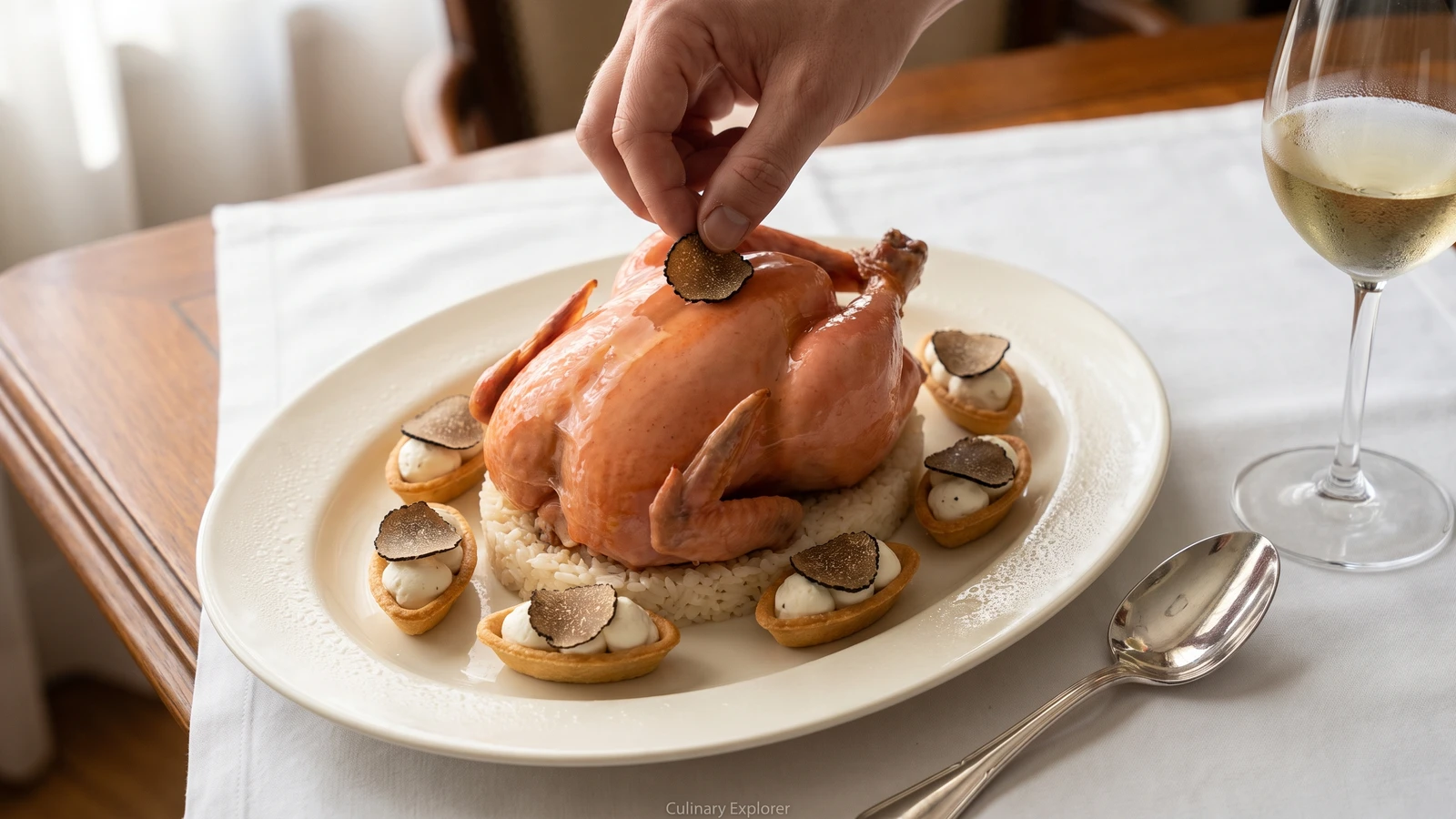
A cold pullet rebuilt in silken ham mousse, coated with tender-pink paprika chaud-froid, glazed in chicken jelly, and ringed by truffled breast collops on little barquettes.
Poularde Rose Marie (cold pullet in rose chaud-froid) teaches the discipline of the cold coating: the bird and its ham mousse must be thoroughly firm before a cool, fluid sauce touches them. Chaud-froid is a velouté-based sauce set with gelatin, and here it must lie in one smooth, tender-pink skin rather than slide, clot, or bury the shape beneath it.
The original kitchen assumed a saucier on staff, chicken stock never off the fire, ranks of little oval moulds, clear jelly ready by the basin, and refrigeration large enough for a banquet platter. The salamander, so useful to other formal dishes, has no work in this cold one. At home, the poularde's reduced poaching liquor becomes both sauce and jelly, a food processor and fine sieve make the mousse, and six prepared Barquettes (No. 314) replace the brigade's drawer of individual moulds. The elaborate freehand ornament can go. The rounded ham-mousse body, white-coated suprêmes, rose chaud-froid, jelly glaze, rice cushion, truffle, and aspic border must stay, because together they are the dish.
Set the mousse until a fingertip leaves no dent. That is the one step that decides everything. If the pink coating begins to slump, scrape it back into the bowl, chill the bird again, and stir the sauce over ice until it thickens slightly. Ça se rattrape.
Poularde Rose Marie belongs to the Parisian repertoire of pièces froides, formal cold dishes built by grand kitchens for decorated buffet service. Its architecture is pure chaud-froid: poached poultry hidden beneath a set sauce and sealed with aspic, while ham mousse and a tender paprika tint distinguish the Rose Marie garnish. It is not a regional farmhouse chicken; the rice cushion and aspic croûtons reveal its true home at the formal cold table.
Quantity
1 (about 4 lb / 1.8 kg)
Quantity
10 cups (2.4 L / 2.4 kg)
Quantity
1 medium (about 1 cup / 150 g)
quartered
Quantity
1 medium (about ¾ cup / 100 g)
thickly sliced
Quantity
1 stalk (about ½ cup / 50 g)
thickly sliced
Quantity
1
Quantity
1 tsp (5 ml / 3 g)
Quantity
2 tsp (10 ml / 12 g)
divided
Quantity
½ cup (120 ml / 100 g)
rinsed
Quantity
1 cup (240 ml / 240 g)
Quantity
1 tbsp plus 1 tsp (20 ml / 12 g)
Quantity
3 tbsp (45 ml / 42 g)
Quantity
3 tbsp (45 ml / 24 g)
Quantity
¾ cup (180 ml / 180 g)
Quantity
2 tsp (10 ml / 6 g)
Quantity
¼ tsp (1 ml / 0.6 g)
Quantity
2¾ cups (660 ml / 400 g)
finely chopped
Quantity
1 cup (240 ml / 240 g)
very cold
Quantity
¾ tsp (4 ml / 2 g)
Quantity
6 fine slices (about 1 oz / 28 g)
drained and blotted dry
| Ingredient | Quantity |
|---|---|
| small poularde or plump young chicken | 1 (about 4 lb / 1.8 kg) |
| unsalted chicken stock | 10 cups (2.4 L / 2.4 kg) |
| yellow onionquartered | 1 medium (about 1 cup / 150 g) |
| carrotthickly sliced | 1 medium (about ¾ cup / 100 g) |
| celerythickly sliced | 1 stalk (about ½ cup / 50 g) |
| bouquet garni of parsley stems, thyme, and bay | 1 |
| black peppercorns | 1 tsp (5 ml / 3 g) |
| fine saltdivided | 2 tsp (10 ml / 12 g) |
| short-grain white ricerinsed | ½ cup (120 ml / 100 g) |
| water | 1 cup (240 ml / 240 g) |
| powdered gelatin for the chicken jelly | 1 tbsp plus 1 tsp (20 ml / 12 g) |
| unsalted butter | 3 tbsp (45 ml / 42 g) |
| all-purpose flour | 3 tbsp (45 ml / 24 g) |
| heavy cream for the chaud-froid | ¾ cup (180 ml / 180 g) |
| powdered gelatin for the chaud-froid | 2 tsp (10 ml / 6 g) |
| ground white pepper | ¼ tsp (1 ml / 0.6 g) |
| mild cooked hamfinely chopped | 2¾ cups (660 ml / 400 g) |
| heavy cream for the ham moussevery cold | 1 cup (240 ml / 240 g) |
| small Barquettesprepared and cooled | 6 Barquettes (No. 314) |
| fine sweet paprika | ¾ tsp (4 ml / 2 g) |
| preserved black truffledrained and blotted dry | 6 fine slices (about 1 oz / 28 g) |
Put the poularde in a narrow stockpot with the chicken stock, onion, carrot, celery, bouquet garni, peppercorns, and 1 teaspoon of the salt. The liquid should cover the bird; add a little water only if the pot demands it. Bring the stock slowly to 180 to 185°F (82 to 85°C), then hold it there without boiling. Poach for 50 to 60 minutes, turning the bird once, until the thickest part of the thigh reaches 165°F (74°C). Hard boiling tightens the breast and clouds the stock, while the quiet poach keeps both useful.
Lift the poularde carefully, drain it, and leave it for 20 minutes before refrigerating it uncovered until cold, about 1½ hours. Strain the poaching liquor through a fine sieve, discard the aromatics, and boil the liquid down to 5 cups (1.2 L / 1.2 kg). This reduction is the home equivalent of the stockpot that never left the brigade stove: one concentrated liquor will carry the chaud-froid and the chicken jelly. Taste before adding salt, because reduction magnifies it.
Combine the rice, water, and ¼ teaspoon of the remaining salt in a small saucepan. Cover and cook gently until the grains are very soft and cling together, about 20 minutes. While warm, press the rice into a low oval cushion at the centre of a large cold platter, no more than 1 inch (2.5 cm) high, then refrigerate it. This rice is literal scaffolding rather than a side dish; keep it low so it supports the poularde without announcing itself.
Measure 2½ cups (600 ml / 600 g) of cold reduced stock. Sprinkle the gelatin for the chicken jelly over ½ cup (120 ml / 120 g) of it and leave it for 5 minutes. Heat the remaining 2 cups just until quivering, remove it from the heat, and stir in the softened gelatin until completely dissolved. Strain again. Pour 1½ cups (360 ml / 360 g) into a shallow tray to make a layer about ⅜ inch (1 cm) deep, and reserve the rest for glazing. Chill both until set. A brigade would clarify this jelly until it resembled glass; careful straining is the honest home equivalent because the glaze is thin and the border small.
Sprinkle the gelatin for the chaud-froid over 2 tablespoons (30 ml / 30 g) taken from 2 cups (480 ml / 480 g) of cold reduced stock. Melt the butter in a saucepan, stir in the flour, and cook this white roux gently for 2 minutes without letting it colour. Whisk in the remaining stock a little at a time, then simmer for 12 minutes, whisking often. Add the ¾ cup of cream and simmer until the sauce nappes the back of a spoon in a smooth ivory coat, about 8 minutes. Remove it from the heat, stir in the softened gelatin and white pepper, then strain. You should have about 2 cups. Measure ½ cup for the mousse and ¾ cup for coating the collops; stir the paprika into the remaining ¾ cup until the shade is a tender rose, never brick-red. Cover the surfaces directly and refrigerate. If the sauce has tiny lumps, don't fight them with the whisk. Strain it while warm, and it is mended.
Process the ham with the reserved ½ cup of chaud-froid until the mixture is as smooth as the machine can make it, scraping the bowl repeatedly. Press it through a fine sieve; this is work, but the smooth surface is the point of the mousse, a light set forcemeat. Whip the cold cream only to soft folds and fold it through the ham mixture without knocking out its body. Taste and add up to ¼ teaspoon of the remaining salt if needed. Spoon a small mound of mousse into each prepared Barquette (No. 314), smoothing the tops into neat ovals, and reserve the rest for the poularde. Chill the filled barquettes immediately.
When the poularde is completely cold, remove its breast skin and lift off the two suprêmes, the breast fillets, keeping them whole. Disjoint the legs and reserve their meat for another meal, but leave the wings attached to the carcass as the source directs. Trim loose skin and small bones so the body sits steadily, then blot it very dry. Pack the reserved ham mousse over the breast cavity and around the trimmed body, rebuilding the poularde's low rounded shape while leaving the wings visible. Smooth the surface with a small offset spatula dipped in cold water. Chill for at least 2 hours, until a fingertip leaves no dent. If the mousse softens and slips while shaping, stop and chill both bowl and bird for 15 minutes before continuing. Warm mousse cannot be persuaded by argument.
Slice each suprême diagonally into three even collops. Set them on a rack over a tray and blot their surfaces dry. Warm the reserved white chaud-froid over barely warm water only until fluid, then cool it to 82 to 86°F (28 to 30°C), when it pours in a thick ribbon. Spoon it over each collop in one complete coat and refrigerate for 20 minutes. If the sauce runs bare at the edges, either the chicken is damp or the coating is too warm. Scrape it back, blot and rechill the collops, cool the sauce until it thickens slightly, and coat again.
Bring the paprika chaud-froid to the same cool, fluid consistency. Set the firm mousse-covered poularde on a rack and pour the sauce steadily along its back, guiding it down the sides with the offset spatula without repeatedly touching the surface. Preserve the rounded body and the outline of the wings; the source allows decoration according to fancy, and a clean rose coat needs no further fuss. Chill until set. If the coating slumps or reveals patches, scrape it back into the bowl, refrigerate the bird for another 20 minutes, and stir the sauce over ice until it gains body. Ça se rattrape.
Melt the reserved glazing jelly over barely warm water, then cool it until fluid but no longer warm against your wrist. Brush a thin coat over the rose poularde, the white collops, and the filled barquettes, and chill for 15 minutes. Lift the poularde onto its rice cushion with two broad spatulas. Arrange the six barquettes evenly around it, place one collop on each, and lay a fine truffle slice on every collop. Cut the jelly in the shallow tray into diamonds or small triangles to make the aspic croûtons, then border the platter with them. If the glaze drags, warm it by a degree or two; if it softens the chaud-froid, stop and chill both before continuing.
Refrigerate the completed platter for at least 1 hour so every layer settles together. Bring it out 15 minutes before serving, cold but not numbing. Give each guest a truffled collop and barquette, then spoon the ham mousse from the poularde around the supporting carcass. The rice cushion may remain on the platter; it has done its work. À table!
1 serving (about 820g)
Culinary guides, cultural storytelling, and the editorial depth that makes cooking meaningful.
Discover Culinary ExplorerChef Juliette
John Dory has the delicacy of sole and the firmness of turbot. A light flouring, a quick butter sauté, and nut-brown beurre noisette show exactly why looks never mattered.

Chef Juliette
Fresh haddock proves its delicacy in the meunière pan: a fine flour crust, moist pearly flakes, and beurre noisette sharpened with lemon and parsley, ready from one skillet in half an hour.

Chef Juliette
Éperlans à l’Anglaise turns small fish into a lesson in disciplined coating: boned smelts under a close, crisp crumb, pan-fried in clarified butter and finished with bright, half-melted maître d’hôtel butter.

Chef Juliette
Tiny smelts, shallot, mushrooms, white wine, gratin sauce, and fine bread raspings meet a fierce oven, where the fish must turn tender in the same breath the buttered crust bronzes.