
Chef Juliette
John Dory (St. Pierre)
John Dory has the delicacy of sole and the firmness of turbot. A light flouring, a quick butter sauté, and nut-brown beurre noisette show exactly why looks never mattered.
A cooking platform built around craft, culture, and the stories behind what we eat.
Created by Chef Juliette
Based on No. 1695, Poulets à l’Écarlate, from Le Guide Culinaire (1907) by Auguste Escoffier
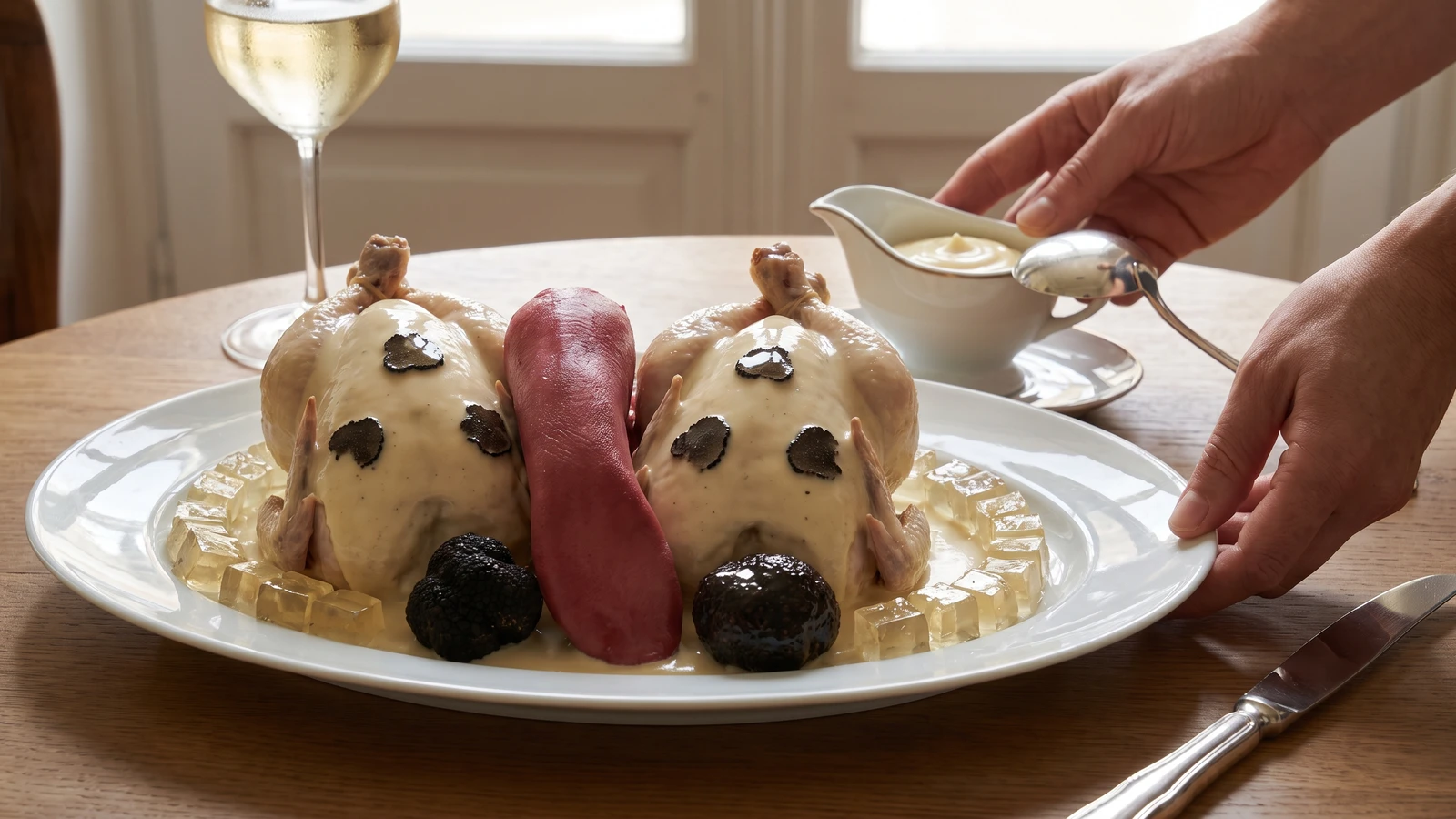
Two chilled stuffed chickens, veiled in white chaud-froid and black truffle, lean around a scarlet salted tongue with glazed truffles and aspic croûtons, while mayonnaise waits apart for carving.
Poulets à l’Écarlate (chickens in scarlet) teaches the discipline of a cold composed dish: temperature is structure. Before you touch a pan, know this one true thing. The stuffed birds must be cold and dry, while the white chaud-froid, the set cold coating, and the aspic must be fluid enough to flow but cool enough to set on contact. Get those temperatures right and the pale chickens, black truffles, clear jelly, and red cured tongue stand as one generous whole.
The book’s entry assumed three fair-sized chickens, a saucier with white chaud-froid ready, a stockpot never off the fire, and larder hands to bone, stuff, glaze, decorate, and assemble. Here three full birds become two small ones, exactly enough for four generous servings; a cold food processor replaces the mortar and tamis, one pot poaches both birds, and the refrigerator does the waiting. Those brigade hands were scaffolding and can go. The smooth stuffing, gentle poach, white coating, truffle decoration, aspic lacquer, upright tongue, whole glazed truffles, jelly croûtons, and mayonnaise served apart are the dish, so every one remains. One cook, one stove, one evening of work.
This is not a dish to rush from poaching pot to platter. Chill the stuffed chickens completely and blot them dry before the first spoonful of chaud-froid touches the skin. That single pause decides whether the coating settles into ivory satin or lands in a puddle beneath the rack.
Poulets à l’Écarlate belongs to the Parisian grand-kitchen cold buffet, where chaud-froid and aspic allowed poached poultry to become a composed centerpiece prepared before service. Its name comes not from a red sauce but from the scarlet cured calf’s tongue standing among the pale chickens, with black truffles supplying the deliberate contrast. The dish traveled through banquet kitchens because it could wait cold without losing its architecture, while the mayonnaise remained separate so the clear aspic glaze stayed pristine.
Quantity
2, 1½ to 1¾ lb (680 to 800 g) each
breast cages removed through the cavity, with skin, legs, and wings intact
Quantity
2, about 12 oz (340 g) total
diced and thoroughly chilled
Quantity
1
Quantity
¾ cup (180 ml / 180 g)
thoroughly chilled
Quantity
1½ teaspoons (7.5 ml / 9 g)
Quantity
¼ teaspoon (1.25 ml / 0.5 g)
Quantity
3 quarts (2.8 L / 2.8 kg)
Quantity
2½ cups (590 ml / 640 g)
chilled
Quantity
1 small, about 1¼ lb (570 g) after trimming
peeled and chilled
Quantity
3, about 3 oz (85 g) total
drained, with 1 thinly sliced and 2 left whole
Quantity
4 cups (950 ml / 950 g)
Quantity
1½ cups (355 ml / 330 g)
chilled
| Ingredient | Quantity |
|---|---|
| small whole chickensbreast cages removed through the cavity, with skin, legs, and wings intact | 2, 1½ to 1¾ lb (680 to 800 g) each |
| boneless, skinless chicken breast halvesdiced and thoroughly chilled | 2, about 12 oz (340 g) total |
| large egg white | 1 |
| heavy creamthoroughly chilled | ¾ cup (180 ml / 180 g) |
| fine sea salt | 1½ teaspoons (7.5 ml / 9 g) |
| ground white pepper | ¼ teaspoon (1.25 ml / 0.5 g) |
| lightly seasoned chicken stock | 3 quarts (2.8 L / 2.8 kg) |
| prepared white chaud-froid saucechilled | 2½ cups (590 ml / 640 g) |
| cooked corned veal tongue, the salted calf’s tongue of the original dishpeeled and chilled | 1 small, about 1¼ lb (570 g) after trimming |
| preserved whole black trufflesdrained, with 1 thinly sliced and 2 left whole | 3, about 3 oz (85 g) total |
| prepared clear aspic jelly | 4 cups (950 ml / 950 g) |
| prepared mayonnaise saucechilled | 1½ cups (355 ml / 330 g) |
Warm the aspic only until it becomes liquid. Pour 3 cups into a 13 by 9 inch (33 by 23 cm) shallow pan, making an even layer about ⅜ inch (1 cm) deep, and refrigerate until firmly set. These will become croûtons of jelly, the small cut aspic shapes used to border the finished dish, not fried bread. Reserve the remaining cup for glazing; if it sets before you need it, loosen it gently over warm water without boiling.
Chill the food processor bowl and blade for 15 minutes. Process the diced chicken breast with the salt, white pepper, and egg white until the paste becomes smooth and tacky. With the blade running, add all but 2 tablespoons of the cold cream in a thin stream, then add the remainder once the mixture looks satiny. This is mousseline de volaille, a fine chicken forcemeat, and the cold processor is the home equivalent of the mortar and tamis once handled by separate hands. If the mixture looks greasy or loose, stop processing and chill it over ice for 10 minutes, then pulse in the held-back cream one spoonful at a time. Poach a teaspoon of mousseline in a little stock until cooked through, taste, and correct the seasoning.
Check the chickens carefully for bone fragments, then blot the cavities dry. Divide the mousseline between them, pressing it into the breast cavities without leaving air pockets, but leaving a little room for the filling to expand. Draw the cavity openings together with small metal skewers and kitchen twine. Shape each bird into a compact, natural oval, tuck the wings close, and wrap it snugly in damp cheesecloth. The cloth replaces the brigade cook’s elaborate sewing and keeps the chickens upright and handsome once cold.
Heat the chicken stock in a deep pot to 176°F (80°C), then lower in the wrapped chickens. Use a small heatproof plate to keep them submerged if they float. Hold the liquid between 172°F and 180°F (78°C and 82°C), with movement below the surface but no rolling bubbles, for 45 to 55 minutes. Turn the birds once and cook until the centre of the stuffing reaches 165°F (74°C). If the stock begins to boil, lift the pot from the burner and add a ladleful of cold stock before returning it to gentler heat; the birds remain tender if you correct the temperature promptly.
Lift the chickens onto a wire rack and let them drain for 15 minutes. Remove the cheesecloth, blot every fold of skin dry, and refrigerate the birds uncovered on the rack until the centres are thoroughly cold, at least 3 hours. Do not coat a tepid or damp bird. Warmth melts the sauce and moisture sends it sliding, while a cold, dry surface catches the coating immediately.
Warm the white chaud-froid gently over a bowl of warm water until it flows like thick cream, then stir it over ice until it falls from the spoon in a broad ribbon. Set the cold chickens on a rack over a clean tray and ladle the sauce over them from crown to tail, letting the excess drain cleanly. Chill for 15 minutes and apply a second thin coat wherever the skin shows through. If the chaud-froid slides off in bare streaks, don’t keep pouring. Ça se rattrape: collect the drips, blot and rechill the bird, cool the sauce until it holds its ribbon, then coat again.
While the final chaud-froid coat is still slightly tacky, arrange the thin truffle pieces neatly over the breasts. Bring the reserved aspic to a cool, syrupy liquid and brush a fine layer over each chicken. Chill until set, then brush on a second layer for an even gloss. Glaze the 2 whole truffles in the same way. If the aspic begins setting in the bowl or brush, warm it briefly over water; forcing thick jelly across the surface will scar the white coating.
Cut the firm sheet of aspic into small, even diamonds or triangles for the croûtons. On a thoroughly chilled oval platter, stand the chickens on their broad tail ends with their breasts facing outward and their shoulders leaning together. Cut the base of the cold tongue flat and stand it between them with its tip pointing upward, then place one glazed whole truffle on either side. A spoonful of softly set aspic beneath each piece acts as an edible anchor; chill the arrangement for 20 minutes if anything shifts. Border the platter with the croûtons and serve the mayonnaise sauce separately in a saucière. At the table, halve each chicken, slice the tongue thinly, and give every plate a little truffle and mayonnaise. À table!
1 serving (about 980g)
Culinary guides, cultural storytelling, and the editorial depth that makes cooking meaningful.
Discover Culinary ExplorerChef Juliette
John Dory has the delicacy of sole and the firmness of turbot. A light flouring, a quick butter sauté, and nut-brown beurre noisette show exactly why looks never mattered.

Chef Juliette
Fresh haddock proves its delicacy in the meunière pan: a fine flour crust, moist pearly flakes, and beurre noisette sharpened with lemon and parsley, ready from one skillet in half an hour.

Chef Juliette
Éperlans à l’Anglaise turns small fish into a lesson in disciplined coating: boned smelts under a close, crisp crumb, pan-fried in clarified butter and finished with bright, half-melted maître d’hôtel butter.

Chef Juliette
Tiny smelts, shallot, mushrooms, white wine, gratin sauce, and fine bread raspings meet a fierce oven, where the fish must turn tender in the same breath the buttered crust bronzes.