Culinary Explorer

A cooking platform built around craft, culture, and the stories behind what we eat.
Discover Culinary Explorer
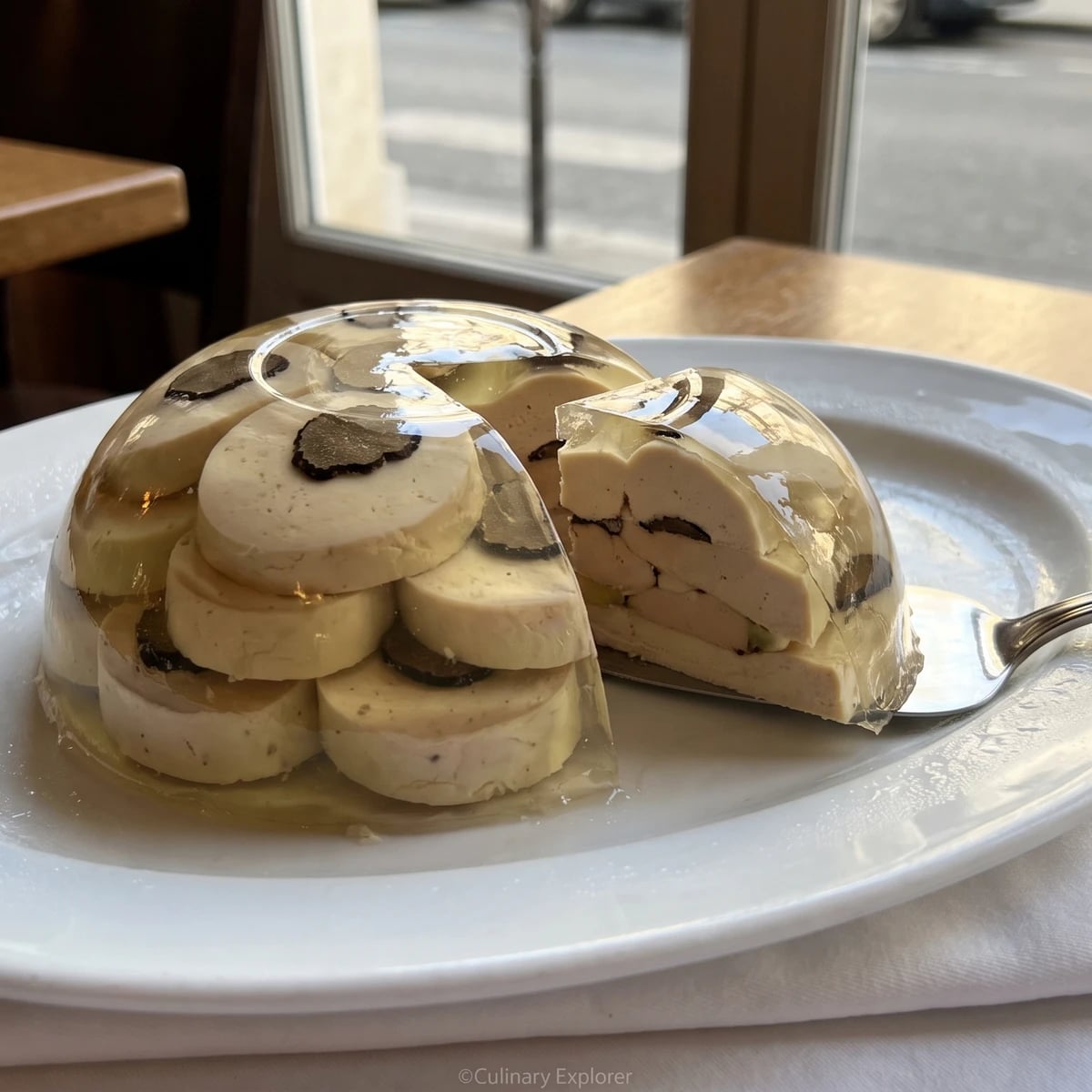
Chaud-froid Felix Faure

Chaud-froid Felix Faure

Created by Chef Juliette

Based on No. 1691, Chaud-froid Felix Faure, from Le Guide Culinaire (1907) by Auguste Escoffier

Pressed chicken, foie gras and truffle become clean medallions under chicken mousse, ivory chaud-froid and clear aspic: a cold centerpiece whose discipline lies in pressure, patience and thin, even coats.

Main Dishes
French
Dinner Party
Special Occasion
1 hr 45 min
Active Time
1 hr 15 min cook10 hr total
Yield4 servings

Chaud-froid Félix Faure (chilled chicken medallions in aspic) teaches the discipline of cold construction: pressure gives the layers their geometry, and every later coat reveals whether that pressure was even. Before you touch a pan, know this one truth. The suprêmes, the boneless breast fillets, must cool in their liquor under a light, level weight, or the foie gras and truffle will wander when you slice.

The original assumed a saucier on staff, chicken stock never off the fire, muslin, an ice room and shelves of small moulds. It had no need of the salamander, since nothing here is browned. The home equivalents are good clear stock, measured gelatin, cheesecloth, one dome mould and an ordinary refrigerator. The full consommé clarification and procession of individual mousse moulds are brigade scaffolding and can go. The butterflied filling, muslin poach, pressure cooling, chicken mousse, white chaud-froid and clear gelée must stay. They are the dish.

Done properly, the dome turns out clear and trembling, with ivory medallions and black truffle visible through the gelée. It is generous, faintly outrageous and entirely achievable: one cook, one stove, one evening of work, with the refrigerator holding the night watch. When the suprêmes leave the oven, level the weight before anything else. That is the step that decides the cut.

Chaud-froid belongs to the formal banquet tables of Paris, where poultry cooked hot was chilled, masked with an opaque sauce and sealed beneath clear gelée so a buffet remained handsome through service. This composition bears the name of French president Félix Faure and displays the grand-kitchen taste for named arrangements of suprêmes, foie gras, truffle, mousse and aspic. It is not a regional farmhouse dish; its pressure-cooling and layered moulding come from the practical demands of Parisian cold service.

The technique, the tradition, and the story behind every dish.

Discover Culinary Explorer

Ingredients

skinless, boneless chicken breast halves with tenderloins attached

Quantity

2 large (about 1½ lb / 680 g)

reserved for the suprêmes

whole chicken legs

Quantity

2 (about 1½ lb / 680 g)

skin removed

clear, low-sodium chicken stock

Quantity

9 cups (2.13 L / 2.13 kg)

divided

raw foie gras

Quantity

7 oz (about ¾ cup / 200 g)

very cold; divided into purée and ⅓-inch (8 mm) rectangles

fresh or preserved whole black truffle

Quantity

1 (about 1½ oz / 45 g)

thinly sliced, with several slices trimmed into rectangles

large egg white

Quantity

1 (2 tablespoons / 30 g)

divided

heavy cream

Quantity

1⅛ cups (270 ml / 270 g)

very cold and divided

unsalted butter

Quantity

4 tablespoons (60 ml / 56 g)

divided

all-purpose flour

Quantity

3 tablespoons (45 ml / 24 g)

unflavored 200-bloom powdered gelatin

Quantity

8 teaspoons (40 ml / 24 g)

divided

fresh lemon juice

Quantity

1 tablespoon (15 ml / 15 g)

fine sea salt

Quantity

2 teaspoons (10 ml / 12 g), plus more as needed

divided

ground white pepper

Quantity

¾ teaspoon (4 ml / 2 g)

divided

Another Method of Preparing Aspics de Filets de Soles

Quantity

1 procedural application (No. 916)

used to clothe and fill the dome mould

Equipment Needed

  • Food processor with chilled bowl and blade
  • Fine-mesh sieve
  • Instant-read thermometer
  • Small roasting dish
  • Muslin or doubled cheesecloth
  • Kitchen string
  • Flat board and two 1-pound weights
  • Small offset spatula
  • Wire cooling rack
  • 2-quart (1.9 L) dome mould or round bowl
  • Large bowl for an ice-water bath

Instructions

  1. 1

    Prepare the suprêmes

    Chill the food-processor bowl and blade for 15 minutes. Pull the tenderloin from each breast and reserve it for the forcemeat. Lay a breast flat and cut horizontally through its thick side, stopping ½ inch (1 cm) before the opposite edge so the two halves remain hinged. Open it like a book and flatten it gently between sheets of parchment to an even ½-inch (1.25 cm) thickness. Repeat with the second breast, then season both lightly with salt and white pepper.

    Do not pound the breasts thin. You are evening their thickness, not making escalopes; torn meat cannot contain the foie gras layers cleanly.
  2. 2

    Build the foie layers

    Make a farce mousseline, the cold chicken forcemeat used to bind the filling. Process the reserved tenderloins with half the egg white, ¼ teaspoon salt and a pinch of white pepper until smooth. With the blade moving, add 2 tablespoons (30 ml / 30 g) cream and stop as soon as the paste turns glossy. If it becomes warm or oily, chill it for 10 minutes before proceeding. Purée 4¼ oz (120 g) of the cold foie gras separately, then fold in just enough farce mousseline to make a thick, spreadable paste. Spread a thin layer over one half of each opened suprême. Add the remaining 2¾ oz (80 g) foie gras in ⅓-inch (8 mm) rectangles, cover with more purée, lay on several truffle slices, then seal them beneath a final thin coat of purée. Brush the bare margins with the remaining egg white and close each suprême. If a hinge splits, patch it with a scrape of forcemeat. Ça se rattrape; the muslin will hold the repair.

  3. 3

    Poach without boiling

    Heat the oven to 325°F (160°C). Place the chicken legs in a narrow covered saucepan with 4 cups (950 ml / 950 g) stock and hold them at the barest simmer until the thickest part reaches 165°F (74°C), about 35 minutes. Lift them out and reserve the stock. Butter two damp pieces of muslin or doubled cheesecloth with 1 tablespoon (15 ml / 14 g) butter, wrap each filled suprême snugly and tie the ends with kitchen string. Set them in a small roasting dish and pour the hot leg-poaching stock around them to reach halfway up their sides. Cover with parchment and foil, then poach in the oven until the centre of the foie gras filling reaches 165°F (74°C), about 22 to 30 minutes. The liquor should barely tremble. If it bubbles hard, lower the oven immediately; boiling squeezes out the filling and tightens the breast.

  4. 4

    Press while cooling

    Keep the suprêmes wrapped and transfer them to a shallow loaf pan or snug container. Strain enough cooking liquor around them to reach halfway up their sides. Cover with a small flat board or a second pan and add an even 2-pound (900 g) weight. Set the container in an ice-water bath for 30 minutes, then refrigerate it, still weighted, until the centre is below 40°F (4°C), about 2 hours and always within 4 hours of leaving the oven. Light pressure closes the layers; excessive pressure squeezes them out. Bone the poached legs, measure 10½ oz (300 g) meat and chill it promptly for the mousse.

    Two identical unopened 1-pound cans make a better weight than one heavy object. Set them side by side so the pressure remains level from end to end.
  5. 5

    Make jelly and sauce

    For the gelée, measure 3 cups (710 ml / 710 g) untouched stock. Sprinkle 14 g gelatin over ¼ cup (60 ml / 60 g) of it and leave for 5 minutes. Warm the remaining stock without boiling, dissolve in the bloomed gelatin, season lightly and strain through a damp fine cloth. Keep it fluid until assembly. For the white chaud-froid, bloom 6 g gelatin in 3 tablespoons (45 ml / 45 g) of the remaining 2 cups (475 ml / 475 g) stock. Melt 3 tablespoons (45 ml / 42 g) butter, stir in the flour and cook this white roux gently for 2 minutes without colouring it. Whisk in the remaining stock gradually and simmer for 10 to 12 minutes, until the sauce naps the back of a spoon. Add ½ cup (120 ml / 120 g) cream and the lemon juice, season with salt and white pepper, then remove from the heat and dissolve in the bloomed gelatin. Strain. Reserve ¾ cup (180 ml / about 180 g) for the chicken mousse and keep the remainder for coating.

  6. 6

    Make the chicken mousse

    Bloom the remaining 4 g gelatin in 2 tablespoons (30 ml / 30 g) of the cream for 5 minutes, then warm it gently over barely hot water until clear. Purée the chilled leg meat with the reserved ¾ cup (180 ml / about 180 g) chaud-froid and the melted gelatin until very smooth, then press the mixture through a fine sieve. Whip the remaining 6 tablespoons (90 ml / 90 g) cream to soft peaks and fold it through the chicken purée. Taste it cold and correct the seasoning. The mousse must hold a soft mound. If it slumps, set the bowl over ice and fold slowly until it gains body; if it sets too firmly, soften a small portion over warm water and fold it back through.

  7. 7

    Cut and envelop

    Unwrap the thoroughly chilled suprêmes and trim their ends. With a very sharp knife, cut each crosswise into 10 to 12 medallions, wiping the blade between cuts. The foie gras and truffle should read as distinct, level bands. If the filling shifts or the cut feathers, stop and chill the suprême for another 20 minutes. Spread a thin bed of chicken mousse on a parchment-lined tray, set the medallions upon it and cover their tops and edges with enough mousse to envelop them completely. Smooth each into an even round with a small offset spatula, then chill until firm, about 40 minutes.

  8. 8

    Coat with chaud-froid

    Cool the remaining white chaud-froid over ice, stirring, until it resembles thick pouring cream, about 80°F (27°C). Set the mousse-covered medallions on a rack over a tray and spoon the sauce over each in one thin, opaque coat. Add a second light coat only where the mousse shows through. Place one fine truffle slice on every medallion while the surface remains tacky, then chill for 20 minutes. If the sauce sets in the bowl, warm it briefly over tepid water; if it runs off the medallions, cool it for 5 minutes and try again. Ça se rattrape.

  9. 9

    Clothe the dome mould

    Set a cold 2-quart (1.9 L) dome mould or round bowl over ice. Following Another Method of Preparing Aspics de Filets de Soles (No. 916), pour in about ¼ cup (60 ml / 60 g) fluid gelée and rotate the mould until its interior wears a thin, even coat. This is clothing the mould. Chill just until set, arrange reserved truffle slices against the base and sides, and secure each with a few drops of gelée before adding a thin covering layer.

    The gelée should be cool and lightly syrupy. Warm jelly melts the chaud-froid coating; jelly already set into lumps traps cloudy seams.
  10. 10

    Set the aspic

    Arrange the medallions upright and close together against the mould's sides. Spoon in just enough gelée to secure the first tier and chill until set. Repeat with further tiers, working inward and filling the centre with the remaining medallions. Add gelée between every layer so no dry pockets remain, then cover the top completely. If you see an air bubble against the mould, free it with a slender skewer before the jelly sets. If the gelée firms in its jug, return the jug briefly to tepid water. Chill the completed aspic for at least 3 hours, preferably overnight.

  11. 11

    Unmould and serve

    Dip the mould in warm, never hot, water for 5 to 8 seconds. Dry it, place a chilled platter over the top and invert both together. If the dome does not release, repeat the brief dip rather than pulling at the gelée. Set the turned-out aspic on a folded white serviette, as the dish asks, and keep it cold until the moment of service. Cut with a thin knife dipped in warm water and wiped dry between portions. À table!

Chef Tips

  • Raw duck foie gras is the honest home choice when goose foie gras is unavailable. A smooth bloc can supply the purée, but it cannot form the raw ⅓-inch rectangles that give Félix Faure its distinct centre.
  • A preserved whole black truffle is better than a tired fresh one. Drain it well and slice it thinly; the classical pantry solved seasonality without pretending a poor ingredient was a good one.
  • Choose a clear refrigerated chicken stock with a clean, concentrated flavour. The measured gelatin supplies the necessary structure, but it cannot repair a stock that tastes only of salt.
  • Keep every mousse component cold. Warm chicken, foie gras or cream sheds fat instead of binding, and the finished coating turns greasy rather than close and smooth.
  • Serve with Blanc de Blancs Champagne or a firm, mineral white Burgundy. The wine needs enough acidity to meet the foie gras without trampling the truffle.

Advance Preparation

  • The suprêmes and chicken legs can be poached a day ahead. Keep the suprêmes wrapped, weighted and refrigerated in their cooking liquor; bone and chill the leg meat separately.
  • The chaud-froid sauce and gelée can be made a day ahead and refrigerated in separate covered containers. Rewarm each gently over tepid water until fluid, never boiling.
  • The completed aspic is best assembled the evening before service and left to set overnight. Keep it moulded and covered, then unmould no more than 30 minutes before it reaches the table.
  • Refrigerate leftovers promptly and eat them within 2 days. Do not freeze the aspic; freezing breaks the gelée and makes the mousse weep.

Frequently Asked Questions

Nutrition Information

1 serving (about 650g)

Calories
945 calories
Total Fat
66 g
Saturated Fat
32 g
Trans Fat
1 g
Unsaturated Fat
33 g
Cholesterol
410 mg
Sodium
1650 mg
Total Carbohydrates
10 g
Dietary Fiber
1 g
Sugars
2 g
Protein
76 g

Note: Chef personas and recipes are created with AI assistance. Cook with care: follow safe food-handling practices, check doneness with a thermometer when needed, and adapt for allergies and your kitchen.

Where cooking meets culture.

Culinary guides, cultural storytelling, and the editorial depth that makes cooking meaningful.

Discover Culinary Explorer

More from Poultry (Volaille) - Cold Preparations of Fowl

Browse the full collection