
Chef Juliette
John Dory (St. Pierre)
John Dory has the delicacy of sole and the firmness of turbot. A light flouring, a quick butter sauté, and nut-brown beurre noisette show exactly why looks never mattered.
A cooking platform built around craft, culture, and the stories behind what we eat.
Created by Chef Juliette
Based on No. 1690, Poularde en Chaud-froid à l’Écossaise, from Le Guide Culinaire (1907) by Auguste Escoffier
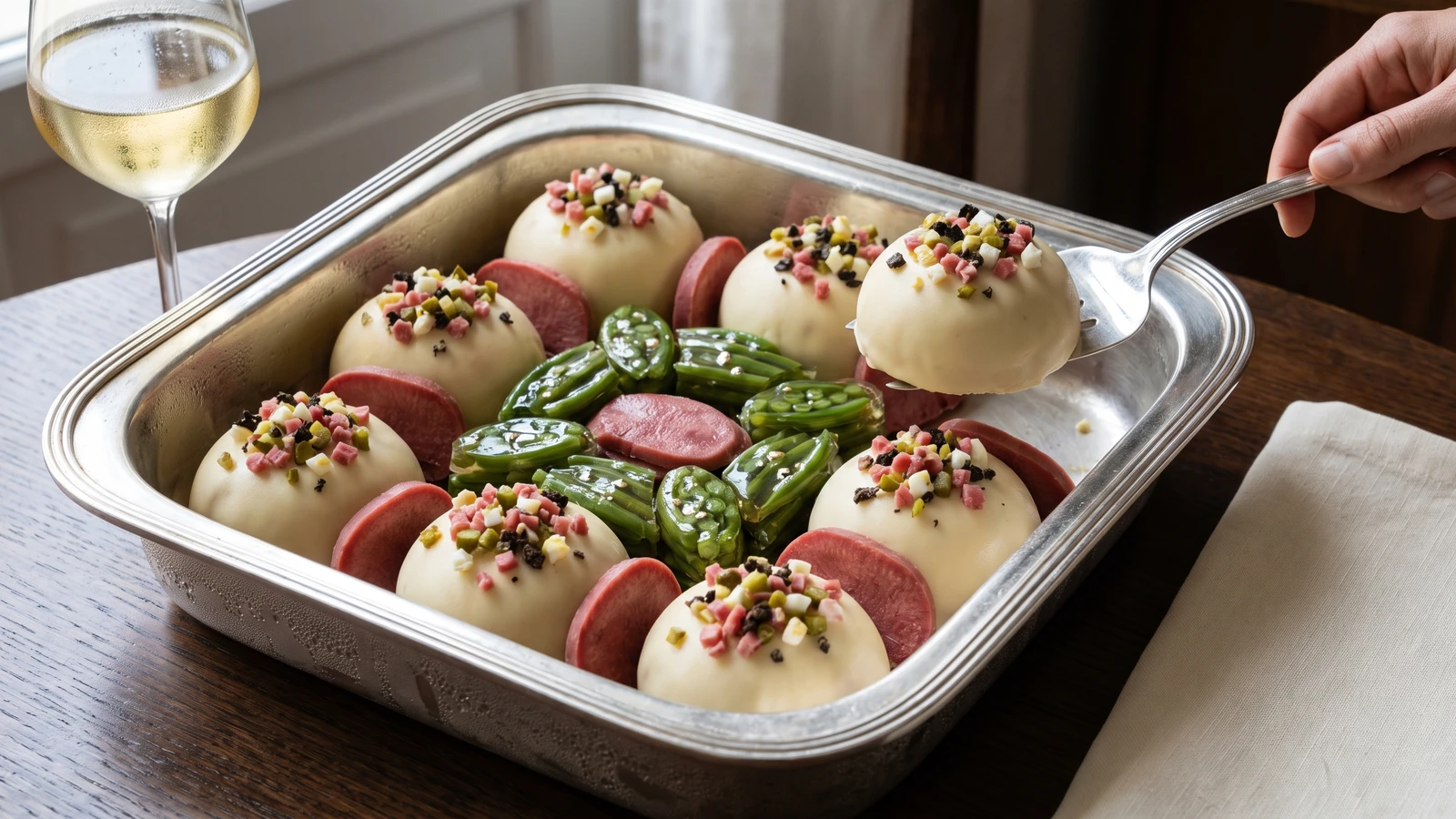
Cold poultry as architecture: tender suprême collops carry a tongue-and-truffle salpicon beneath ivory chaud-froid, then take a bright mosaic of tongue, gherkin, truffle, and egg white before the jelly sets.
Poularde en Chaud-froid à l’Écossaise (cold poached chicken with a set white glaze and mosaic garnish) teaches that temperature is an ingredient. Each suprême, the breast fillet, must be thoroughly cold, while the chaud-froid remains just fluid enough to veil it. Warm chicken makes the coating slide; overchilled sauce sets in ridges. Meet between the two and every collop takes an ivory coat as smooth as porcelain.
The original assumed several pullets, a saucier on staff, chicken jelly from a stockpot never off the fire, silver serving dishes, and enough hands to decorate every piece before its coating set. A salamander served neighboring hot preparations, but has no work here; refrigeration, not top heat, finishes chaud-froid. For four, one poularde and measured gelatin give the poaching liquor the body a brigade found in its permanent stockpot, while a deep rimmed porcelain dish replaces silver without changing the food. The quantity of carcass meat is reduced to what eight collops can carry, but its equal proportion with salted tongue and truffle remains exact. Those are the brigade scaffolds. The salpicon, the fine dice bound with jelly, its domed shape, white coating, colored shower, tongue slices, and bean aspic are the dish, so they stay.
Have every chopped garnish cold and ready before you begin coating. Once the chaud-froid touches a collop, you have a brief tacky moment in which the mosaic must cling. That timing decides the finish. One cook, one stove, one evening.
Poularde en chaud-froid à l’Écossaise belongs to the Parisian grand-kitchen repertory of service froid, in which poached poultry was portioned, masked in a sauce that set cold, and composed for the buffet table. À l’Écossaise is a French catalogue title for this exact garnish of salted tongue, truffle, gherkin, egg white, and French beans in aspic, not a claim that the preparation came from a Scottish household. Its path to the bourgeois celebration table was practical as well as splendid: every element could be finished ahead, then carried in cold with its pattern intact.
Quantity
1 whole (4 to 4½ pounds / 1.8 to 2 kg)
giblets removed
Quantity
3 quarts (2.8 liters / 2.8 kg), or enough to cover by 1 inch
Quantity
1 medium (6 ounces / 170 g)
quartered
Quantity
1 medium (3½ ounces / 100 g)
cut into chunks
Quantity
1 small (3½ ounces / 100 g)
rinsed and cut into chunks
Quantity
1 rib (1½ ounces / 45 g)
cut into chunks
Quantity
1
Quantity
1 teaspoon (5 ml / 3 g)
Quantity
1½ tablespoons (22 ml / 27 g), plus more as needed
Quantity
3 packets (2 tablespoons plus ¾ teaspoon / 21 g)
Quantity
½ cup (120 ml / 120 g)
Quantity
3 tablespoons (45 ml / 42 g)
Quantity
¼ cup (60 ml / 32 g)
Quantity
1 cup (240 ml / 238 g)
Quantity
¼ teaspoon (1 ml / 0.5 g)
Quantity
1 piece (12 ounces / 340 g)
well chilled
Quantity
about 1 cup diced (240 ml / 150 g)
drained and well chilled
Quantity
⅓ cup chopped (80 ml / 40 g)
drained and dried
Quantity
2
hard-boiled, whites separated
Quantity
about 45 (8 ounces / 225 g)
trimmed
| Ingredient | Quantity |
|---|---|
| poularde or plump young roasting hengiblets removed | 1 whole (4 to 4½ pounds / 1.8 to 2 kg) |
| cold water | 3 quarts (2.8 liters / 2.8 kg), or enough to cover by 1 inch |
| yellow onionquartered | 1 medium (6 ounces / 170 g) |
| carrotcut into chunks | 1 medium (3½ ounces / 100 g) |
| leek, white and pale green partsrinsed and cut into chunks | 1 small (3½ ounces / 100 g) |
| celerycut into chunks | 1 rib (1½ ounces / 45 g) |
| bouquet garni of parsley stems, thyme, and bay leaf | 1 |
| black peppercorns | 1 teaspoon (5 ml / 3 g) |
| fine sea salt | 1½ tablespoons (22 ml / 27 g), plus more as needed |
| 225-bloom unflavored powdered gelatin | 3 packets (2 tablespoons plus ¾ teaspoon / 21 g) |
| cold water for blooming gelatin | ½ cup (120 ml / 120 g) |
| unsalted butter | 3 tablespoons (45 ml / 42 g) |
| all-purpose flour | ¼ cup (60 ml / 32 g) |
| heavy cream | 1 cup (240 ml / 238 g) |
| ground white pepper | ¼ teaspoon (1 ml / 0.5 g) |
| cooked salted beef tongue with a deep pink-red centerwell chilled | 1 piece (12 ounces / 340 g) |
| preserved black trufflesdrained and well chilled | about 1 cup diced (240 ml / 150 g) |
| cornichonsdrained and dried | ⅓ cup chopped (80 ml / 40 g) |
| large eggshard-boiled, whites separated | 2 |
| slender French beans or haricots vertstrimmed | about 45 (8 ounces / 225 g) |
Set the poularde breast-side up in a pot that holds it closely. Add the cold water, onion, carrot, leek, celery, bouquet garni, peppercorns, and salt. Bring the liquid slowly to its first tremble, skimming away the grey foam as it rises, then hold it between 180 and 185°F (82 and 85°C). Never let it boil; rough heat tightens the breast and clouds the liquor needed for the clear jelly. Poach for 50 to 65 minutes, until both the deepest part of the breast and the thickest part of the thigh register at least 165°F (74°C). Lift the bird onto a rack over a tray, let it drain for 10 minutes, then refrigerate it uncovered until completely cold, no longer than 2 hours before chilling.
Strain the poaching liquor through a fine sieve lined with a damp clean cloth, then skim away the visible fat. Boil the clear liquor steadily until reduced to 6 cups (1.4 liters). Taste before reducing farther: it should be deeply chicken-flavored but not aggressively salty. If it has become too salty, loosen it with unsalted water; measured gelatin supplies the set, so there is no prize for concentrating the salt. Reserve 1¼ cups (300 ml) of the ungelatinized liquor for the white chaud-froid sauce. Sprinkle the gelatin over the ½ cup (120 ml) cold water and leave it for 5 minutes, then whisk the softened gelatin into the remaining hot liquor until completely dissolved. Pour the chicken jelly into shallow containers, cool them over ice, and refrigerate. This reduced chicken jelly becomes both binder and aspic.
Hard-boil the eggs for 10 minutes, cool them in cold water, peel them, and separate the whites; the yolks are not used here. From the central part of the salted tongue, cut 8 thin oval slices for the serving dish. Dice 3½ ounces (100 g) of the remaining tongue into precise ⅛-inch (3 mm) cubes for the salpicon, then finely chop another 1¾ ounces (50 g) for the colored shower. Dice 3½ ounces (100 g) of the truffle to the same ⅛-inch size for the salpicon and finely chop the remaining 1¾ ounces (50 g). Finely chop the cornichons and egg whites. Keep the oval tongue slices, the two salpicon ingredients, and the four chopped shower ingredients separate and cold.
Remove and discard the poularde skin. Run a slim knife down each side of the breastbone and along the ribs to raise the two suprêmes whole. Cut each suprême crosswise into 4 even collops, making 8 pieces in all. Pick the remaining carcass clean of meat, rejecting skin, bone, and gristle, then dice exactly 3½ ounces (100 g) as finely as the tongue and truffle. The remaining poultry meat belongs to another supper; reducing its quantity is what keeps this brigade presentation proportionate for four.
Melt ⅓ cup (80 ml) of the chicken jelly over gentle heat, then cool it until fluid but slightly syrupy. Combine the 3½ ounces (100 g) diced poultry, 3½ ounces (100 g) diced salted tongue, and 3½ ounces (100 g) diced truffle. Fold in just enough jelly to coat and cohere the dice without leaving a puddle. Divide the salpicon among the 8 collops and shape each portion into a smooth, generous dome. If the dice slide apart, the jelly is too warm; chill the bowl for 5 minutes and fold again. If it sets before shaping, stand the bowl briefly in tepid water and stir. Ça se rattrape. Chill the domed collops for 20 minutes.
Melt the butter in a saucepan over gentle heat. Stir in the flour and cook this white roux for 2 minutes without letting it color. Gradually whisk in the reserved 1¼ cups (300 ml) poaching liquor, then simmer gently for 8 minutes, stirring until the raw flour taste is gone. Add the cream and simmer for another 5 to 7 minutes, until the sauce falls from the spoon in a broad ribbon. Remove it from the heat and whisk in 1 cup (240 ml) melted chicken jelly, then season with white pepper and only as much salt as it needs. Strain the sauce and stir it over an ice bath until cool, thick, and still pourable. If it runs from a chilled spoon without coating, cool it longer. If it sets in the bowl, warm it over tepid water and whisk until smooth. Ça se rattrape.
Set the chilled collops on a wire rack over a rimmed tray. Combine the finely chopped tongue, truffle, cornichons, and egg whites, then fold in 2 tablespoons (30 ml) barely liquid chicken jelly so the pieces glisten and cling together. Work one collop at a time: spoon the white chaud-froid generously over its dome and sides, then immediately shower it with the chopped mixture while the coating remains tacky. Catch and reuse clean sauce from the tray for any bare patches. If a coating sets before its garnish adheres, brush it with the thinnest film of liquid jelly and sprinkle again. Chill the finished collops for 30 minutes without covering them.
Blanch the French beans in well-salted boiling water until tender but still vivid, 3 to 4 minutes, then cool them promptly in ice water and dry them thoroughly. Cut them on a long diagonal into ¾-inch (2 cm) lozenges. Melt ½ cup (120 ml) chicken jelly and cool it until syrupy, then fold it through the beans until they cohere as a salad rather than float in aspic. If jelly pools beneath them, chill the bowl for 5 minutes and fold once more.
Arrange the 8 coated collops in a deep square serving dish, alternating each one with an oval slice of salted tongue. Mound the bound French-bean salad in the center, keeping its lozenge shapes visible. Chill the completed dish for at least 2 hours, uncovered until its surface has set and then lightly covered so nothing marks the chaud-froid. Bring it to the table properly cold, with each ivory dome intact and the clear jelly holding its colored mosaic. À table!
1 serving (about 700g)
Culinary guides, cultural storytelling, and the editorial depth that makes cooking meaningful.
Discover Culinary ExplorerChef Juliette
John Dory has the delicacy of sole and the firmness of turbot. A light flouring, a quick butter sauté, and nut-brown beurre noisette show exactly why looks never mattered.

Chef Juliette
Fresh haddock proves its delicacy in the meunière pan: a fine flour crust, moist pearly flakes, and beurre noisette sharpened with lemon and parsley, ready from one skillet in half an hour.

Chef Juliette
Éperlans à l’Anglaise turns small fish into a lesson in disciplined coating: boned smelts under a close, crisp crumb, pan-fried in clarified butter and finished with bright, half-melted maître d’hôtel butter.

Chef Juliette
Tiny smelts, shallot, mushrooms, white wine, gratin sauce, and fine bread raspings meet a fierce oven, where the fish must turn tender in the same breath the buttered crust bronzes.