
Chef Juliette
John Dory (St. Pierre)
John Dory has the delicacy of sole and the firmness of turbot. A light flouring, a quick butter sauté, and nut-brown beurre noisette show exactly why looks never mattered.
A cooking platform built around craft, culture, and the stories behind what we eat.
Created by Chef Juliette
Based on No. 1685, Soufflé de Volaille with Cooked Meat, from Le Guide Culinaire (1907) by Auguste Escoffier
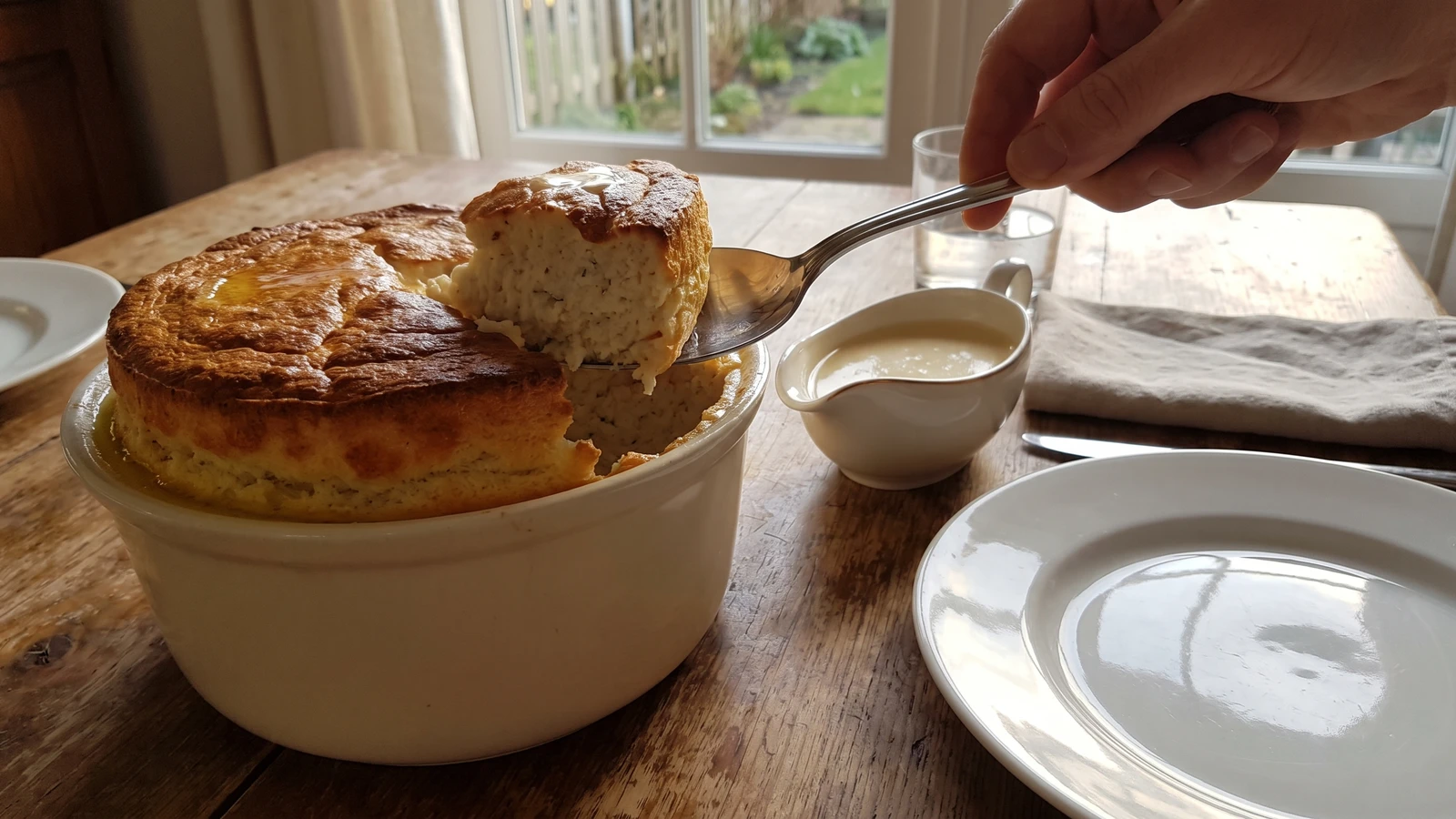
Cooked chicken becomes a feather-light savoury soufflé through fine pounding, a true tamis, gentle warming, and six stiff whites, with glossy Suprême sauce waiting beside the risen dish.
Soufflé de Volaille (cooked-chicken soufflé) teaches a severe little truth: the whites can lift only what the base has made smooth. Before touching a pan, know this one thing. The chicken and cold reduced Béchamel must become a fine, concentrated paste, warm but never boiled, or six perfect whites will have nothing even to carry.
The book's kitchen assumed cooked breast waiting from service, a mortar and tamis, a saucier with reduced Béchamel and Suprême sauce ready, and chicken stock never off the fire. Your food processor and fine sieve do the pounding and passing; one straight-sided porcelain dish replaces the metal timbale, while the finished Suprême sauce warms gently beside it. A salamander has no work here, since moderate oven heat must set the centre as the soufflé rises. The formula already gives four generous main-course servings, so its full one-pound chicken ratio stays intact rather than mangling five yolks and six whites into fractions. One cook, one stove, one evening.
Staffed sauce work is scaffolding and can go; the pounding, the tamis, the gentle warming, the five yolks, and the six stiff whites are the dish and must stay. Fold with a broad, light hand and bake at once. The moment that decides it comes before folding: the base must be smooth, supple, and only warm when the yolks enter.
Soufflé de volaille belongs to the classical Parisian table, where cooks treated soufflé as a whole family of preparations rather than a sweet alone. Poultry, fish, meat, and game could all be pounded, passed through a tamis, and lightened with egg whites, turning cooked meat into a refined hot entrée. Suprême sauce became the natural poultry accompaniment because its chicken foundation and cream reinforce the meat without weighing down the airy interior.
Quantity
1 pound (454 g)
completely cold and finely chopped
Quantity
6 tablespoons (90 ml / about 95 g)
Quantity
1½ ounces (3 tablespoons / 45 ml / 43 g)
cubed
Quantity
5
Quantity
6
separated cleanly and free of yolk
Quantity
1 tablespoon (15 ml / 14 g)
for the dish
Quantity
1¼ cups (300 ml / about 315 g)
for serving
| Ingredient | Quantity |
|---|---|
| cooked skinless chicken breast meatcompletely cold and finely chopped | 1 pound (454 g) |
| cold reduced Béchamel sauce | 6 tablespoons (90 ml / about 95 g) |
| unsalted buttercubed | 1½ ounces (3 tablespoons / 45 ml / 43 g) |
| large egg yolks | 5 |
| large egg whitesseparated cleanly and free of yolk | 6 |
| softened unsalted butterfor the dish | 1 tablespoon (15 ml / 14 g) |
| finished Suprême saucefor serving | 1¼ cups (300 ml / about 315 g) |
Set a rack in the lower third of the oven and heat it to 350°F (180°C). Butter the bottom and sides of a 2-quart (1.9-litre) straight-sided soufflé dish, making upward strokes around the wall, then chill the dish while you prepare the mixture. Butter alone belongs here, with no flour or cheese coating added to the source formula.
Put the cold cooked chicken in a food processor and work it until finely pounded, stopping often to scrape the bowl. Add the cold reduced Béchamel a spoonful at a time and continue processing until the preparation becomes a dense, even paste. Press it firmly through a tamis, a fine drum sieve, or the finest sturdy sieve you own, using a flexible scraper. Scrape every bit from the underside. The processor replaces the mortar, but it does not replace the tamis; passing removes fibres the blade leaves behind and gives the finished soufflé its fine crumb.
Transfer the passed mixture to a heavy saucepan and warm it over the lowest heat, stirring and scraping constantly, until it is hot throughout but never bubbling, about 140°F (60°C). Take the pan off the heat and beat in the cubed butter until completely absorbed. Let the base stand for 2 minutes, then beat in the yolks one at a time. If the pan catches or the mixture begins to bubble, lift it off immediately, move the unscorched portion to a clean bowl, and pass it through the sieve again. If the yolks form a few visible flecks, the same warm sieve rescue will remove them. Ça se rattrape.
Put the egg whites in a spotlessly clean, dry bowl. Whisk slowly until foamy, then increase the speed and beat until the whites hold stiff, glossy peaks. Stop while they still look smooth and moist. Dry, granular whites resist folding and break into little clumps, taking their air with them.
Stir one-quarter of the whites firmly into the warm chicken base to loosen it. Add half the remaining whites and fold with a broad spatula, cutting down through the centre, sweeping across the bottom, and turning the mixture over itself. Repeat with the final whites just until no large white streaks remain. Scrape the mixture into the prepared dish without banging it, smooth the top lightly, and run a clean thumb around the inside rim to free the edge. Put it in the oven at once.
Bake without opening the oven for the first 25 minutes. Continue for 10 to 15 minutes more, until the soufflé stands well above the rim, its crown is deep butter-gold, and the centre gives a small, resilient tremble rather than a liquid slosh. A thin skewer inserted near the centre should emerge moist but without raw paste, and the centre should reach at least 160°F (71°C). If the crown colours too quickly after the first 25 minutes, lay a loose sheet of foil over it and finish baking.
During the final 10 minutes, warm the finished Suprême sauce gently according to its own formula, keeping it short of the boil. Bring the soufflé straight to the table in its dish. Open it with a serving spoon, lift generous portions onto warmed plates, and spoon the Suprême sauce alongside or just beneath each serving, never over the whole crown. A soufflé waits for nobody. À table!
1 serving (about 275g)
Culinary guides, cultural storytelling, and the editorial depth that makes cooking meaningful.
Discover Culinary ExplorerChef Juliette
John Dory has the delicacy of sole and the firmness of turbot. A light flouring, a quick butter sauté, and nut-brown beurre noisette show exactly why looks never mattered.

Chef Juliette
Fresh haddock proves its delicacy in the meunière pan: a fine flour crust, moist pearly flakes, and beurre noisette sharpened with lemon and parsley, ready from one skillet in half an hour.

Chef Juliette
Éperlans à l’Anglaise turns small fish into a lesson in disciplined coating: boned smelts under a close, crisp crumb, pan-fried in clarified butter and finished with bright, half-melted maître d’hôtel butter.

Chef Juliette
Tiny smelts, shallot, mushrooms, white wine, gratin sauce, and fine bread raspings meet a fierce oven, where the fish must turn tender in the same breath the buttered crust bronzes.