Culinary Explorer

A cooking platform built around craft, culture, and the stories behind what we eat.
Discover Culinary Explorer
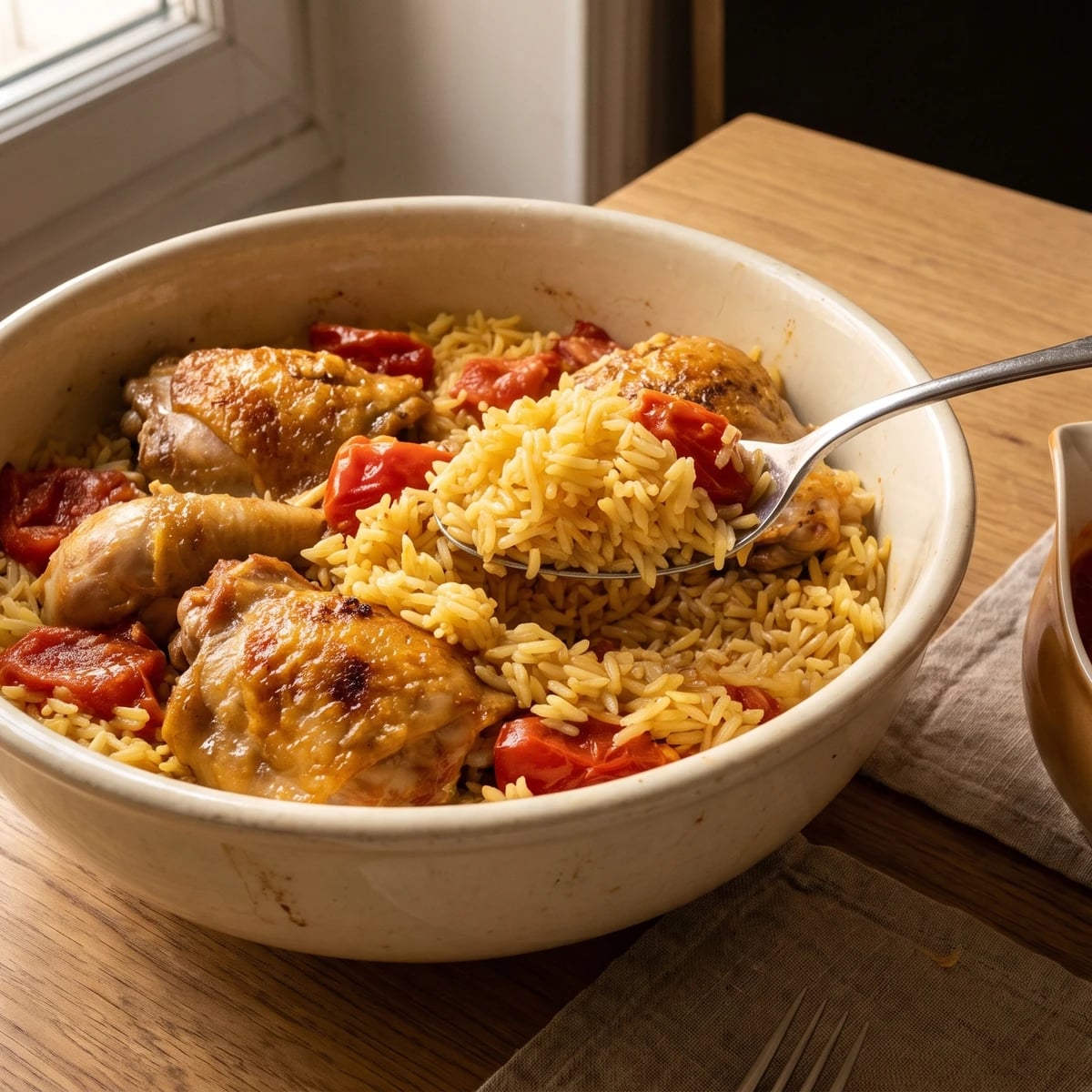
Pilaw de Volaille à la Parisienne

Pilaw de Volaille à la Parisienne

Created by Chef Juliette

Based on No. 1681, Pilaw de Volaille à la Parisienne, from Le Guide Culinaire (1907) by Auguste Escoffier

Chicken and rice share one buttered pan, taking on tomato, bay, white broth, and the browned fond before a final forkful of veal stock leaves every grain separate and deeply savory.

Main Dishes
French
Weeknight
One Pot
Comfort Food
25 min
Active Time
45 min cook1 hr 10 min total
Yield4 servings

Pilaw de Volaille à la Parisienne (Parisian chicken pilaff) teaches the discipline of absorption: the broth must be sufficient to cook the rice and no more, because the promised finish is dry, separate grains carrying chicken, tomato, bay, and butter. The one true thing to know before touching the pan is this: cover the rice with broth, not the chicken.

The original entry assumed a fowl cut for fricassée, white broth and veal stock never off the fire, a saucier with tomato sauce already made, and enough pans to brown the bird and rice separately. At home, one small chicken, good chicken stock, prepared veal stock or diluted veal demi-glace, and one wide ovenproof pan do the work. The source proportion stays intact, 3½ ounces of rice to the bird. Browning the rice in the chicken pan merely removes brigade scaffolding; butter, tomato concass, bay, the very hot oven, the veal-stock finish, and the separate sauceboat all remain because they are the dish. One cook, one stove, one evening.

After twenty-five minutes, the chicken should be burnished, the broth gone, and the rice loose under your fork rather than swollen into porridge. The deciding moment is the liquid line before the pan enters the oven: let the broth rise just above the rice between the chicken pieces, then stop pouring.

Pilaw de Volaille à la Parisienne belongs to the cosmopolitan Parisian branch of the classical canon, where the Persian and Ottoman pilaf method entered French kitchens while keeping its defining dry, separate rice. The title does not describe a rustic Paris household dish; à la Parisienne signals an urban composed preparation, here joining poultry and tomato with the French foundations of white broth and veal stock. The sauceboat is deliberate: tomato sauce is served alongside rather than stirred through, preserving the pilaff's dry texture.

The technique, the tradition, and the story behind every dish.

Discover Culinary Explorer

Ingredients

small chicken

Quantity

1 chicken (3 to 3½ pounds / 1.4 to 1.6 kg)

cut into 8 pieces as for a fricassée

fine salt

Quantity

1½ teaspoons (7.5 ml / 9 g)

freshly ground black pepper

Quantity

½ teaspoon (2.5 ml / 1 g)

unsalted butter

Quantity

4 tablespoons (60 ml / 57 g)

divided

long-grain white rice

Quantity

½ cup (120 ml / 100 g)

small yellow onion

Quantity

1 onion (about ½ cup / 80 g)

finely chopped

bay leaf

Quantity

1 leaf

ripe tomatoes

Quantity

2 medium tomatoes (about 1 cup / 250 g)

peeled, seeded, and concassed

low-sodium white chicken broth

Quantity

1¼ cups (300 ml / 300 g)

heated and divided

full-flavored veal stock or diluted veal demi-glace

Quantity

⅓ cup (80 ml / 80 g)

warmed

prepared tomato sauce

Quantity

1 cup (240 ml / 240 g)

warmed and served separately

Equipment Needed

  • 12-inch (30 cm) ovenproof sauté pan or shallow 4-quart (3.8-liter) cocotte
  • Instant-read thermometer
  • Heatproof serving fork
  • Warmed deep serving bowl or timbale
  • Small sauceboat

Instructions

  1. 1

    Prepare the concass

    Set a rack in the center of the oven and heat it to 450°F (230°C). Score a shallow cross in the base of each tomato, cover them with boiling water for 30 seconds, then slip off the skins. Halve them, remove the seeds, and chop the flesh roughly. This is the tomato concass, the book's word for the rough chop. Warm the chicken broth, veal stock, and prepared tomato sauce separately. Pat the chicken dry, then season it on every side with the salt and pepper.

  2. 2

    Brown the chicken

    Melt 2 tablespoons (30 ml / 28 g) of the butter in a wide ovenproof sauté pan over medium-high heat. When the foam subsides, brown the chicken in two batches, skin-side first, until the surface is a firm butter-gold and the pan floor holds a brown fond, about 7 to 9 minutes per batch. The pieces need not cook through. Keep the heat lively but controlled; if the butter turns black, lower the heat and wipe out only the burnt fat, preserving any sound brown fond. Set the chicken aside.

  3. 3

    Brown the rice

    Lower the heat to medium and add the remaining 2 tablespoons (30 ml / 28 g) butter. Stir in the onion and rice, coating every grain in the butter and fond. Cook for 4 to 5 minutes, stirring steadily, until the onion softens and the rice turns opaque with a few pale golden edges. Browning the rice is not decoration; it helps the grains remain separate. If the rice begins catching before it colors evenly, lower the heat rather than adding liquid. Stir in the tomato concass and bay leaf for 1 minute.

  4. 4

    Set the liquid line

    Return the chicken to the pan, skin-side up, nestling the pieces into the rice without burying them. Pour about 1 cup (240 ml / 240 g) of the hot white chicken broth around the chicken, adding only enough of the remainder to stand just above the rice between the pieces. The chicken should remain mostly exposed. Bring the liquid to a strong simmer, then transfer the uncovered pan immediately to the very hot oven. Cook for exactly 25 minutes without stirring; moving the rice now releases starch and spoils the dry, separate finish.

  5. 5

    Test and rescue

    After 25 minutes, the chicken should register at least 165°F (74°C) at the thickest part without touching bone, and the rice should be tender with no free broth underneath. If the rice is tender but liquid remains, move the chicken to a plate and set the pan over medium heat for 2 to 4 minutes, lifting the rice once with a fork. If the pan is dry but the grains remain firm, sprinkle over 2 to 4 tablespoons (30 to 60 ml / 30 to 60 g) of the reserved hot broth, cover loosely with foil, and return it to the oven for 5 minutes. Ça se rattrape. Remove any cooked breast pieces while darker joints finish, rather than drying the whole bird for one stubborn thigh.

  6. 6

    Fork in veal stock

    Move the chicken briefly to a warm plate and discard the bay leaf. Sprinkle the warm veal stock evenly over the rice, then lift and separate the grains gently with a fork so the stock disappears through the pilaff without crushing it. This final stock is an enrichment, not another bath. If it pools at the bottom, hold the pan over low heat for 1 to 2 minutes while lifting the rice once more.

  7. 7

    Dish and serve

    Spoon the rice carefully into a warmed deep serving bowl, the honest home equivalent of the service timbale, and arrange the chicken over it with the browned skin exposed. Bring the warm tomato sauce in a sauceboat so each diner can add it without surrendering the pilaff's dry texture. Serve immediately. À table!

Chef Tips

  • Use a wide pan, not a narrow pot. The shallow layer allows the rice to cook evenly and lets the surplus broth leave during its twenty-five minutes in the hot oven.
  • Long-grain rice gives the dry separation this pilaff promises. If you rinse it, spread it on a clean towel until completely dry before browning; wet rice spits in butter and turns translucent without taking color.
  • When fresh tomatoes are pale and woolly, use two drained whole canned plum tomatoes, about 1 cup (240 ml / 240 g). They are already peeled; seed and concass them, then proceed exactly as written.
  • The veal-stock finish needs body without aggressive salt. A good prepared veal stock works beautifully, as does a modest spoonful of veal demi-glace diluted to ⅓ cup (80 ml / 80 g) with hot water.
  • Pour a dry Loire white or a light, supple red. The wine needs enough freshness for the tomato sauce and no heavy oak to flatten the buttered rice.

Advance Preparation

  • The chicken may be cut up and the tomato concass prepared earlier in the day. Keep both covered and cold, then dry the chicken again before seasoning and browning.
  • The chicken broth, veal stock, and prepared tomato sauce may be measured in advance. Warm them before use so cold liquid does not halt the cooking.
  • Do not bake the pilaff ahead. Rice held in broth continues swelling and loses the dry separation that defines the dish. Leftovers should be cooled promptly, chilled for up to 3 days, and reheated covered with a spoonful of broth.

Frequently Asked Questions

Nutrition Information

1 serving (about 410g)

Calories
670 calories
Total Fat
36 g
Saturated Fat
14 g
Trans Fat
1 g
Unsaturated Fat
19 g
Cholesterol
190 mg
Sodium
1450 mg
Total Carbohydrates
30 g
Dietary Fiber
3 g
Sugars
5 g
Protein
55 g

Note: Chef personas and recipes are created with AI assistance. Cook with care: follow safe food-handling practices, check doneness with a thermometer when needed, and adapt for allergies and your kitchen.

Where cooking meets culture.

Culinary guides, cultural storytelling, and the editorial depth that makes cooking meaningful.

Discover Culinary Explorer

More from Poultry (Volaille) - Various Preparations of Fowl

Browse the full collection