
Chef Juliette
John Dory (St. Pierre)
John Dory has the delicacy of sole and the firmness of turbot. A light flouring, a quick butter sauté, and nut-brown beurre noisette show exactly why looks never mattered.
A cooking platform built around craft, culture, and the stories behind what we eat.
Created by Chef Juliette
Based on No. 1675, Mousselines de Volaille à la Sicilienne, from Le Guide Culinaire (1907) by Auguste Escoffier
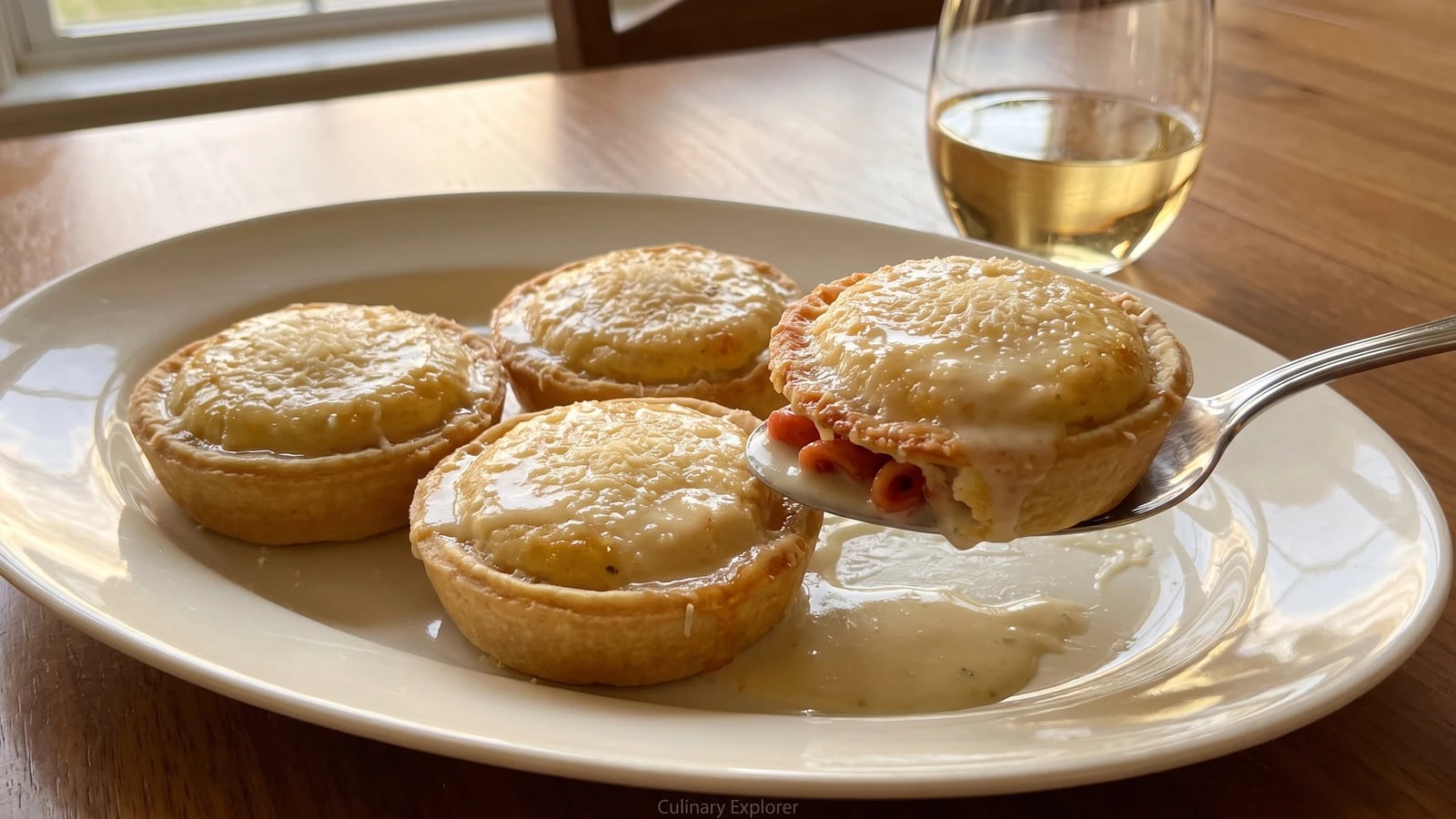
Cold is the architecture of these silken chicken mousselines, set over tomato-dressed macaroni in crisp oval tartlets, cloaked with sauce suprême, and flashed beneath fierce heat until Parmesan turns pale gold.
Mousselines de Volaille à la Sicilienne (individual silken chicken mousses over tomato-dressed macaroni tartlets) teach one true thing: temperature is structure. Keep the chicken, egg whites, cream, bowl, and blade cold, and the forcemeat becomes smooth, light, and stable. Let it warm and the emulsion loosens before it ever reaches the mould.
The brigade formula assumes a saucier on staff, stock never off the fire, a pastry station shaping oval tartlets, a mortar and tamis for the mousseline, and a salamander waiting to glaze the finished plates. At home, good unsalted poultry stock builds one compact sauce suprême, an all-butter pastry sheet replaces the pastry station, a food processor and fine sieve replace the long pounding, and the broiler supplies fierce heat from above. Those are scaffolding changes. The cold mousseline, macaroni à la Napolitaine, sauce suprême, Parmesan, and quick glaze are the dish and must stay. One cook, one stove, one evening.
The finished tartlets should arrive crisp beneath the macaroni, with the mousselines tender enough to yield under a spoon and the ivory sauce shining under pale-gold Parmesan. Chill the chicken, cream, bowl, and blade thoroughly before you begin; that cold is the step that matters most.
Mousselines de Volaille à la Sicilienne belong to the Parisian grand-cuisine repertory, where individually moulded forcemeats were paired with named garnishes and assembled just before service. The title is French service shorthand rather than a faithful map of a Sicilian household dish: its explicit Italian notes are macaroni à la Napolitaine and Parmesan, while the mousseline and sauce suprême are French technique. The composition passed naturally to formal bourgeois tables because its tartlets, sauce base, and forcemeat could be prepared separately, then joined under fierce top heat.
Quantity
1 package, about 14 ounces (400 g)
thawed in the refrigerator but kept cold
Quantity
10½ ounces (300 g)
trimmed, diced, and thoroughly chilled
Quantity
2 (about ¼ cup / 60 g)
cold
Quantity
1¾ cups (420 ml / 420 g)
divided and very cold
Quantity
6 tablespoons (90 ml / 85 g)
divided; keep 2 tablespoons cold
Quantity
2 cups (475 ml / 475 g)
Quantity
¼ cup (60 ml / 30 g)
Quantity
1 tablespoon (15 ml / 15 g)
Quantity
¾ cup (180 ml / 90 g)
Quantity
1 cup (240 ml / 240 g)
Quantity
1 tablespoon (15 ml / 16 g)
Quantity
⅔ cup (160 ml / 60 g)
finely grated and divided
Quantity
2 teaspoons (10 ml / 12 g), plus 1 tablespoon (15 ml / 18 g) for the pasta water
divided
Quantity
¼ teaspoon (1.25 ml / 0.6 g)
Quantity
⅛ teaspoon (0.6 ml / 0.25 g)
Quantity
2 tablespoons (30 ml / 30 g)
for joining the pastry
| Ingredient | Quantity |
|---|---|
| all-butter puff pastrythawed in the refrigerator but kept cold | 1 package, about 14 ounces (400 g) |
| boneless, skinless chicken breasttrimmed, diced, and thoroughly chilled | 10½ ounces (300 g) |
| large egg whitescold | 2 (about ¼ cup / 60 g) |
| heavy cream, at least 35 percent fatdivided and very cold | 1¾ cups (420 ml / 420 g) |
| unsalted butterdivided; keep 2 tablespoons cold | 6 tablespoons (90 ml / 85 g) |
| unsalted or low-sodium chicken stock | 2 cups (475 ml / 475 g) |
| all-purpose flour | ¼ cup (60 ml / 30 g) |
| fresh lemon juice | 1 tablespoon (15 ml / 15 g) |
| dry small elbow macaroni or ditalini | ¾ cup (180 ml / 90 g) |
| canned tomato passata | 1 cup (240 ml / 240 g) |
| tomato paste | 1 tablespoon (15 ml / 16 g) |
| Parmesanfinely grated and divided | ⅔ cup (160 ml / 60 g) |
| fine sea saltdivided | 2 teaspoons (10 ml / 12 g), plus 1 tablespoon (15 ml / 18 g) for the pasta water |
| ground white pepper | ¼ teaspoon (1.25 ml / 0.6 g) |
| freshly grated nutmeg | ⅛ teaspoon (0.6 ml / 0.25 g) |
| cold waterfor joining the pastry | 2 tablespoons (30 ml / 30 g) |
Put the food-processor bowl, metal blade, fine sieve, and a clean mixing bowl in the cold for at least 20 minutes. Heat the oven to 400°F (200°C) with a rack in the middle. Use 1 tablespoon of the butter to coat four 5-ounce (150 ml) ramekins or individual oval moulds, then chill them. Reserve 1 tablespoon of the cream for brushing the pastry, 1 cup for the mousseline, and the remaining cream for the sauce.
Roll the cold pastry to a rectangle about ⅛ inch (3 mm) thick. Using a paper template and a sharp knife, cut eight ovals about 5 by 3½ inches (13 by 9 cm). Leave four whole for the bases; cut a smaller oval from each remaining piece to make four rims about ½ inch (1.5 cm) wide. Dock the centres of the bases with a fork, brush the outer edges lightly with the cold water, and settle a rim onto each. Brush the rims with the reserved cream and chill for 10 minutes. Bake on a parchment-lined sheet for 16 to 20 minutes, until deeply golden. If the centres rise, press them down gently with the back of a spoon while hot. Cool on a rack and lower the oven to 325°F (160°C).
Warm the chicken stock in a small saucepan. In a second saucepan, melt 2 tablespoons of the butter over medium-low heat, stir in the flour, and cook this roux for 2 minutes without allowing it to brown. Whisk in the warm stock by small additions at first, smoothing each one before adding the next. Bring to a bare simmer and cook for 20 minutes, whisking along the bottom occasionally, until reduced by roughly one quarter. Strain the velouté, a pale roux-thickened stock sauce, into a clean saucepan and cover its surface directly with parchment. If small flour lumps formed, the sieve removes them cleanly; there is no reason to begin again.
Put the chilled chicken in the cold processor with 1 teaspoon of the fine salt, the white pepper, and nutmeg. Pulse until the meat becomes a smooth, sticky paste, stopping once to scrape the bowl. Add the egg whites in two additions, processing only until absorbed. With the motor running, pour in the reserved 1 cup of cold cream in a thin, steady stream. Stop as soon as the mixture is smooth and glossy. Press it through the chilled fine sieve into the bowl set over ice, leaving any sinew behind. Poach a teaspoon in barely simmering water for 2 minutes and taste it. If the mixture looks greasy or slumps instead of holding a soft mound, it has warmed. Ça se rattrape: chill it over ice for 10 minutes, then pulse briefly with 1 tablespoon of cold cream taken from the sauce allowance.
Divide the mousseline evenly among the cold buttered moulds, about 5 ounces (145 g) in each, and smooth the tops without packing them hard. Cover each surface with a small piece of parchment. Set the moulds in a roasting pan and add hot water to come halfway up their sides. Bake in this bain-marie for 22 to 28 minutes, until the mousselines are just firm, spring lightly at the centre, and register 165°F (74°C). The water should barely tremble. If the mousselines begin to dome or crack, add a splash of cool water to the bath and lower the oven to 300°F (150°C). Rest them in their moulds for 3 minutes.
While the mousselines poach, bring a saucepan of water to a boil with the tablespoon of pasta salt. Cook the macaroni until just tender, drain it well, and do not rinse. In the emptied pan, simmer the passata, tomato paste, and ½ teaspoon of the fine salt for 8 to 10 minutes, until thick enough that a spoon drawn through leaves a clear trail. Stir in 1 tablespoon of the butter, half the Parmesan, and the macaroni. If the mixture is loose, reduce it for another minute before it meets the pastry; wet macaroni turns a crisp tartlet to paste.
Return the velouté to a gentle simmer and add the remaining cream. Reduce for 6 to 10 minutes, whisking often, until the sauce reaches nappe, coating the back of a spoon in an even ivory layer. Take it off the heat and whisk in the lemon juice, the remaining 2 tablespoons of cold butter, and up to the final ½ teaspoon of fine salt as needed. Keep it warm over a pan of hot water, never over direct heat. If it tightens, loosen it with a spoonful of stock or water. If the butter makes it look oily, whisk 1 tablespoon of cold cream in a clean pan, then add the sauce gradually until smooth.
Return the tartlets to the 325°F (160°C) oven for 3 to 4 minutes to restore their crispness, then arrange them on a broiler-safe tray. Spoon the macaroni à la Napolitaine into each tartlet, keeping it just below the pastry rim. Run a thin knife around each mousseline, invert it onto the centre of a filled tartlet, and lift away the mould. Coat each mousseline generously with sauce suprême, allowing a little to pool over the macaroni but keeping the pastry rim visible.
Heat the broiler to its highest setting and position the tray about 4 inches (10 cm) below it. Dust the coated mousselines evenly with the remaining Parmesan and glaze for 45 to 90 seconds, watching without interruption, until the cheese takes pale-gold freckles and the sauce bubbles at the edges. A salamander's work is measured in seconds; lingering under the heat only overcooks the mousseline. Rotate the tray if the colour comes unevenly, then transfer the tartlets to a warm platter and serve at once. À table!
1 serving (about 480g)
Culinary guides, cultural storytelling, and the editorial depth that makes cooking meaningful.
Discover Culinary ExplorerChef Juliette
John Dory has the delicacy of sole and the firmness of turbot. A light flouring, a quick butter sauté, and nut-brown beurre noisette show exactly why looks never mattered.

Chef Juliette
Fresh haddock proves its delicacy in the meunière pan: a fine flour crust, moist pearly flakes, and beurre noisette sharpened with lemon and parsley, ready from one skillet in half an hour.

Chef Juliette
Éperlans à l’Anglaise turns small fish into a lesson in disciplined coating: boned smelts under a close, crisp crumb, pan-fried in clarified butter and finished with bright, half-melted maître d’hôtel butter.

Chef Juliette
Tiny smelts, shallot, mushrooms, white wine, gratin sauce, and fine bread raspings meet a fierce oven, where the fish must turn tender in the same breath the buttered crust bronzes.