
Chef Juliette
Abatis aux Navets
Glazed turnips, pearl onions, and tender poultry giblets settle into a pale, glossy sauce, with crisp-edged salt pork lending depth: a thrifty braise whose whole success rests on cooking the flour first.
A cooking platform built around craft, culture, and the stories behind what we eat.
Created by Chef Juliette
Based on No. 1674, Mousselines de Volaille à la Patti, from Le Guide Culinaire (1907) by Auguste Escoffier
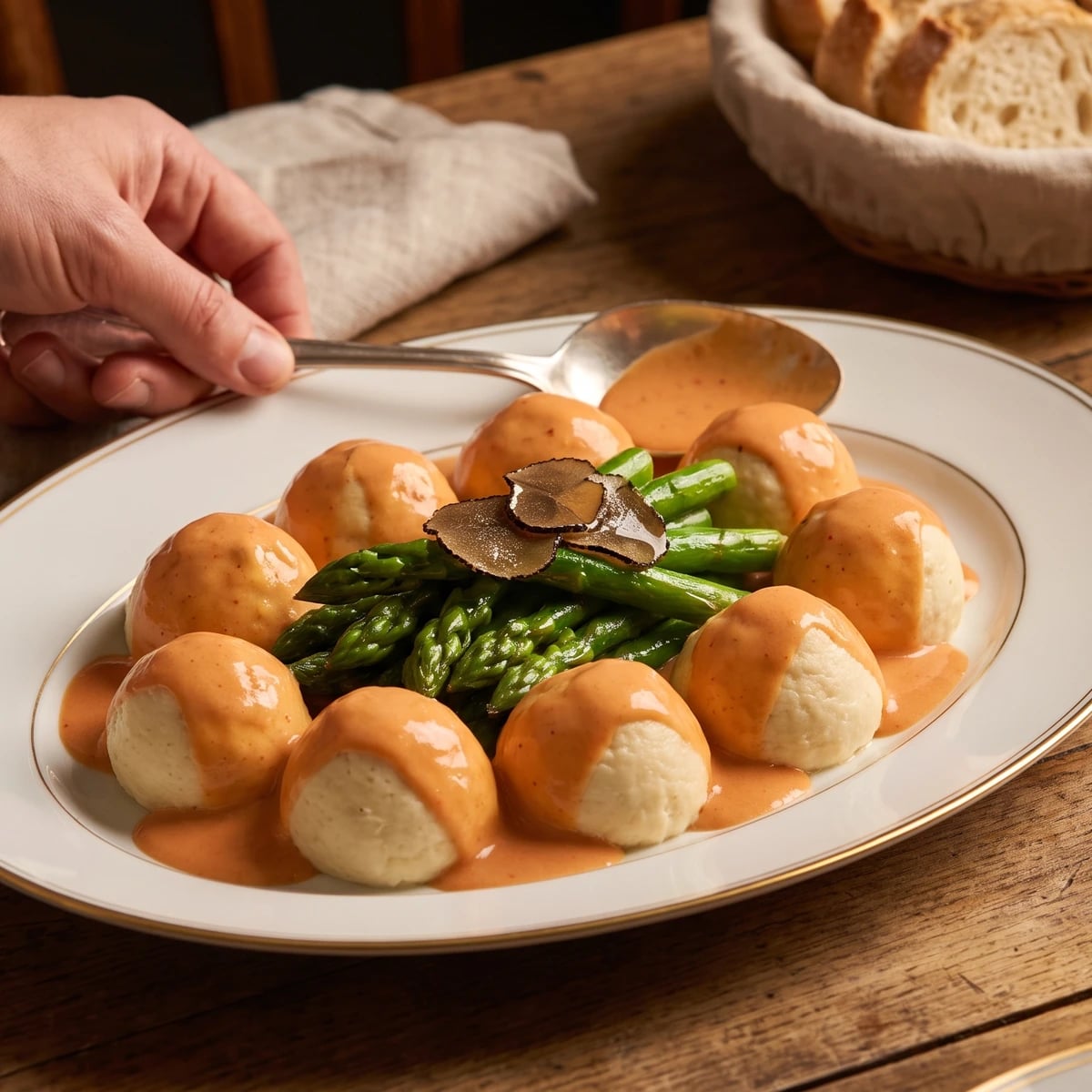
Silken chicken mousselines, gently poached and veiled with crayfish-butter sauce suprême, circle buttered asparagus and glossy black truffle in a celebration dish scaled faithfully for four.
Mousselines de Volaille à la Patti (chicken mousselines with crayfish suprême, asparagus, and truffle) teach the discipline of a cold farce mousseline, a silken poultry forcemeat held together by its own emulsion. The one true thing to know before touching a pan is this: chicken, egg whites, cream, bowl, and blade must remain cold. Keep them cold and the mousselines poach tender and fine; let them warm and the mixture loosens, turns grainy, and loses the lightness that justifies all this ceremony.
The book's terse formula says to proceed as for Mousselines Alexandra, then change the finish to sauce suprême enriched with crayfish butter, with butter-bound asparagus tips and glazed truffle in the center. That direction assumed chilled mortars, a tamis, a poaching cook, a saucier on staff, and chicken stock never off the fire. A food processor, a sturdy fine sieve, and one saucepan used in sequence are the honest home equivalents. A salamander has no work here because the dish is sauced, not gratinéed. One cook, one stove, one evening.
What changed is the staff count, equipment, and brigade yield, not the dish's intent. Separate holding pans and prolonged hand-pounding are scaffolding and can go. The cold emulsion, fine sieving, gentle poach, roux-built sauce suprême, real crayfish butter, asparagus cohered with butter, and glazed truffle are the dish, so every one stays. Chill the chicken and processor before you begin; that is the step that decides whether all this richness feels light.
Mousselines de volaille belong to Parisian grand cuisine, where delicate poultry farces were shaped, poached, sauced, and named for celebrated guests rather than tied to a regional household larder. The dedication à la Patti honors the soprano Adelina Patti, joining sauce suprême with crayfish butter, asparagus tips, and black truffle in the cosmopolitan language of the grand table. Its distinction from Alexandra lies chiefly in the sauce and central garnish, a reminder that classical recipe names often described a precise assembly rather than an entirely different preparation.
Quantity
8 whole (about 8 oz / 225 g)
shells separated and coarsely crushed; tail meat reserved for another dish
Quantity
6 tablespoons (90 ml / 85 g)
softened
Quantity
2 large breasts (12 oz / 340 g)
trimmed, diced, and thoroughly chilled
Quantity
2 large (¼ cup / 60 ml / 60 g)
thoroughly chilled
Quantity
1 cup (240 ml / 240 g)
thoroughly chilled
Quantity
1½ teaspoons (7.5 ml / 9 g)
divided
Quantity
½ teaspoon (2.5 ml / 1 g)
divided
Quantity
1 small pinch
Quantity
2¼ cups (540 ml / 540 g)
divided
Quantity
2 tablespoons plus 1 teaspoon (35 ml / 32 g)
Quantity
¼ cup (60 ml / 32 g)
Quantity
¾ cup (180 ml / 180 g)
divided
Quantity
2 teaspoons (10 ml / 10 g)
Quantity
24 tips (about 10 oz / 280 g)
trimmed to 3 inches / 7.5 cm
Quantity
2 tablespoons (30 ml / 28 g)
Quantity
1 small (1 oz / 28 g)
thinly sliced
Quantity
1 tablespoon (15 ml / 14 g)
Quantity
4 quarts (3.8 L / 3.8 kg)
divided, for blanching and poaching
Quantity
2 tablespoons (30 ml / 36 g)
divided, for the cooking water
| Ingredient | Quantity |
|---|---|
| cooked whole shell-on crayfishshells separated and coarsely crushed; tail meat reserved for another dish | 8 whole (about 8 oz / 225 g) |
| unsalted butter for crayfish buttersoftened | 6 tablespoons (90 ml / 85 g) |
| boneless, skinless chicken breaststrimmed, diced, and thoroughly chilled | 2 large breasts (12 oz / 340 g) |
| large egg whitesthoroughly chilled | 2 large (¼ cup / 60 ml / 60 g) |
| heavy cream for the mousselinethoroughly chilled | 1 cup (240 ml / 240 g) |
| fine sea saltdivided | 1½ teaspoons (7.5 ml / 9 g) |
| ground white pepperdivided | ½ teaspoon (2.5 ml / 1 g) |
| freshly grated nutmeg | 1 small pinch |
| unsalted chicken stockdivided | 2¼ cups (540 ml / 540 g) |
| unsalted butter for the roux | 2 tablespoons plus 1 teaspoon (35 ml / 32 g) |
| all-purpose flour | ¼ cup (60 ml / 32 g) |
| heavy cream for the sauce suprêmedivided | ¾ cup (180 ml / 180 g) |
| fresh lemon juice | 2 teaspoons (10 ml / 10 g) |
| slender asparagus tipstrimmed to 3 inches / 7.5 cm | 24 tips (about 10 oz / 280 g) |
| unsalted butter for the asparagus | 2 tablespoons (30 ml / 28 g) |
| black truffle or whole preserved trufflethinly sliced | 1 small (1 oz / 28 g) |
| unsalted butter for glazing the truffle | 1 tablespoon (15 ml / 14 g) |
| waterdivided, for blanching and poaching | 4 quarts (3.8 L / 3.8 kg) |
| coarse saltdivided, for the cooking water | 2 tablespoons (30 ml / 36 g) |
Remove the crayfish tail meat and refrigerate it promptly for another dish. Pulse the shells until coarsely broken, then combine them with the softened butter in a small saucepan. Warm over the lowest heat for 15 minutes, stirring often; the butter should turn deep coral and smell distinctly of crayfish, but the shells must never fry or brown. Strain through a fine sieve, pressing firmly to recover the colored butter. Measure about 3 tablespoons (45 ml / 43 g) for the sauce and keep it cool. Wash the processor bowl and blade thoroughly, dry them, then chill both before making the farce.
Melt the roux butter in a saucepan, stir in the flour, and cook for 2 minutes without allowing it to color. This pale roux, butter and flour cooked together, gives sauce suprême its body. Reserve ¼ cup (60 ml / 60 g) of the chicken stock for the truffle, then whisk the remaining stock into the roux a little at a time. Bring to a gentle simmer and cook for 20 minutes, whisking and skimming as needed. Add all but 2 tablespoons of the sauce cream and simmer until the sauce coats the back of a spoon, about 8 minutes. Strain, press parchment directly against its surface, and hold it warm. Keep the remaining cold cream for the final adjustment or rescue.
Set a mixing bowl over ice. Put the chilled chicken, 1¼ teaspoons of the fine salt, half the white pepper, and the nutmeg into the cold processor bowl. Pulse until finely minced, add the cold egg whites, then process only until the mixture becomes smooth, sticky, and satin-like. Scrape it immediately into a sturdy fine sieve and press it through with a flexible scraper, leaving sinew behind. Return the sieved farce to the bowl over ice. Beat in three-quarters of the cold mousseline cream in four additions, making certain each addition disappears before the next goes in. Cover and chill for 20 minutes.
Bring half the water to a boil with half the coarse salt. Blanch the asparagus tips until tender at the base but still bright and distinct, 2 to 4 minutes depending on thickness. Drain them very well, then roll them over gentle heat with the asparagus butter until every tip gleams and the butter clings rather than puddles. For the truffle, reduce the reserved ¼ cup of chicken stock in a small pan to 2 tablespoons. Whisk in the truffle butter, add the slices, and turn them gently in the glaze for 30 seconds. Remove from the heat before their perfume is cooked away.
Heat a small cupful of the remaining poaching water until it barely quivers. Drop in a teaspoon of farce and poach it for 2 minutes, then taste. It should be tender, juicy, and sufficiently seasoned. If it is rubbery, beat in the remaining mousseline cream one tablespoon at a time and test again; if it softens or breaks apart, chill the farce for 10 minutes before retesting. Adjust with the remaining fine salt and white pepper. Following the Mousselines Alexandra method, use two tablespoons dipped in cold water to shape 8 smooth, plump ovals. Set them on a dampened tray and keep them cold.
Heat the remaining water with the remaining coarse salt in a wide pan to 175 to 180°F (79 to 82°C). The surface should tremble without bubbling. Slide in 4 mousselines, cover loosely, and poach for 8 to 10 minutes, turning them carefully halfway through, until they feel resilient and reach 165°F (74°C) at the center. Lift them out with a slotted spoon, drain on a clean towel, and repeat with the rest. If one develops ragged edges or starts to split, pull the pan off the heat immediately and let the water settle before continuing. Ça se rattrape: the mousseline remains tender, and its sauce will cover the small scar. Hold the cooked mousselines covered for no longer than 15 minutes.
Bring the sauce suprême back just below a simmer, then remove it from the heat. Whisk in the lemon juice followed by the measured crayfish butter, a small piece at a time, until the sauce becomes glossy and coral-ivory. This is monter au beurre, mounting the sauce with butter, and it must happen off the heat. Taste for salt and white pepper. If the sauce is too thick, loosen it with a spoonful of hot water; if it turns oily or splits, whisk the reserved cold cream in a clean bowl and add the broken sauce to it gradually. Ça se rattrape. Never boil the sauce after the crayfish butter goes in.
Warm a broad oval serving platter. Heap the butter-bound asparagus tips in the center and arrange the 8 mousselines around them in a close ring. Spoon the crayfish sauce suprême generously over each mousseline, letting a little collect around their bases, then lay the glazed truffle slices over the asparagus exactly as the source directs. Serve the remaining sauce in a warm boat and bring the platter to the table at once. Cooking well is not cooking fancy, but it does require serving this while the sauce still gleams. À table!
1 serving (about 420g)
Culinary guides, cultural storytelling, and the editorial depth that makes cooking meaningful.
Discover Culinary Explorer
Chef Juliette
Glazed turnips, pearl onions, and tender poultry giblets settle into a pale, glossy sauce, with crisp-edged salt pork lending depth: a thrifty braise whose whole success rests on cooking the flour first.

Chef Juliette
Pâté d’abatis turns modest poultry giblets into a generous supper: browned in butter, bound with a light consommé sauce, cooled completely, then sealed beneath puff pastry that rises crisp and gilded.

Chef Juliette
Four boned chicken legs become compact ballotines, packed with good sausage meat, sewn into their own skin, browned deeply, and braised until the filling stays juicy and the pan sauce gleams.

Chef Juliette
Boudins de Volaille à la Richelieu turn a cold chicken mousseline around truffled salpicon, then poach, crumb, and bronze it in clarified butter, with glossy Périgueux sauce served separately.